Total Complaints
80 filings
Volvo Ex90 · model year
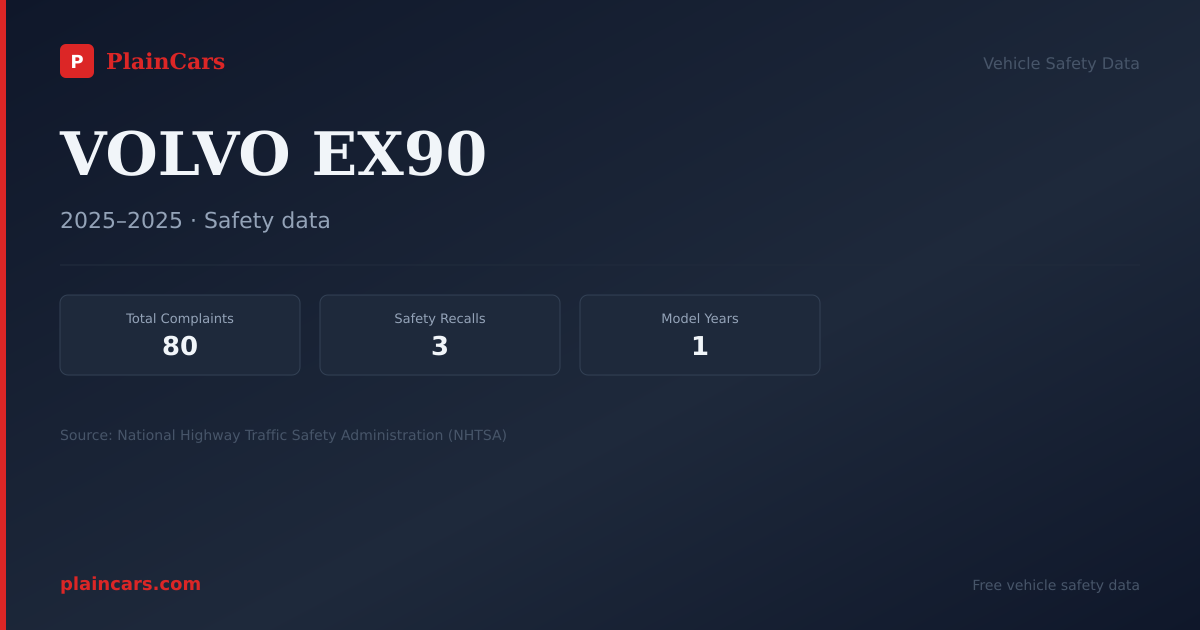
80 NHTSA complaints, and 3 recall campaigns listed for this cohort. A VIN lookup is required to determine whether a specific vehicle has an unrepaired recall.
NHTSA overall rating
Not crash-tested
New Car Assessment Program
The 2025VolvoEx90 carries 80 consumer safety complaints in NHTSA's Office of Defects Investigation database for this specific model-year cohort. Within that volume, owners reported 0 crashes, 0 fires, 3 injuries, and 0 fatalities. For crash performance, NHTSA's New Car Assessment Program gave this cohort an overall Not Rated/5 rating, with Not Rated/5 front crash, Not Rated/5 side crash, and Not Rated/5 rollover scores derived from standardized barrier and dynamic tests.
The most frequently selected component label in reports for the 2025 Ex90 is electrical system with 19 filings, followed by unknown or other (8) and fuel/propulsion system (8). Complaint categories reflect owner reports and intake categorization; they do not establish a defect pattern or cause. This cohort has 3 NHTSA recall campaigns listed below. Enter a VIN in NHTSA's official recall lookup to determine whether a specific vehicle has an unrepaired recall.
NHTSA currently has 28 investigation files overlapping the 2025 Ex90. Owners comparing this cohort against neighboring years should read the complaint-by-year trend as report volume, not a causal diagnosis. Use the related-complaint feed and the official recall lookup when researching a specific vehicle.
PlainCars' own composite of NHTSA NCAP crash-test ratings and rollover-risk assessment, each dimension normalized against the federal scale or the full national model-year corpus. Not an official NHTSA figure, and not a substitute for a specific vehicle's VIN-level recall check.
Total Complaints
80 filings
Crashes Reported
0 reports
Source
NHTSA ODI
Federal complaints database
At or below the fleet median complaint volume.
| Component | Count |
|---|---|
| ELECTRICAL SYSTEM | 19 |
| UNKNOWN OR OTHER | 8 |
| FUEL/PROPULSION SYSTEM | 8 |
| POWER TRAIN | 7 |
| VEHICLE SPEED CONTROL | 6 |
| SERVICE BRAKES | 6 |
| LANE DEPARTURE: WARNING | 4 |
| LANE DEPARTURE: ASSIST | 4 |
| FORWARD COLLISION AVOIDANCE: ADAPTIVE CRUISE CONTROL | 4 |
| FORWARD COLLISION AVOIDANCE: AUTOMATIC EMERGENCY BRAKING | 3 |
| SEAT BELTS | 2 |
| EXTERIOR LIGHTING | 2 |
| ENGINE | 1 |
| AIR BAGS | 1 |
| STEERING | 1 |
STRUCTURE:BODY:HATCHBACK/LIFTGATE:SUPPORT DEVICE/STRUT
Volvo Car USA, LLC (Volvo) is recalling certain 2025 EX90 vehicles. A spindle nut may detach from the Power Operated Tailgate (POT) drive units, causing the tailgate to suddenly drop.
SEATS:CRITICAL FASTENERS
Volvo Car USA, LLC (Volvo Car) is recalling certain 2025 EX90 vehicles. The bolts for the second-row free-standing seat may not be tightened properly.
EXTERIOR LIGHTING:HEADLIGHTS:CONCEALMENT DEVICES
Volvo Car USA, LLC (Volvo) is recalling certain 2025 EX90 vehicles. Due to a software error in the low power controller (LPC), the headlight shutters may close over the high and low beams while driving.
My Volvo EX90 has recurring software reliability problems affecting safety-related detection systems and hands-free operation features. These failures involve inconsistent or incorrect detection of vehicles and pedestrians and unpredictable loss of hands-free phone functionality. These issues create increased distraction and reduce confidence in driver-assistance safety features.
My Volvo EX90 has recurring software reliability problems affecting safety-related detection systems and hands-free operation features. These failures involve inconsistent or incorrect detection of vehicles and pedestrians and unpredictable loss of hands-free phone functionality. These issues create increased distraction and reduce confidence in driver-assistance safety features.
The onboard charger (GHCA) has now failed to charge on any Level 2 (the most common kind) charger. The first time it failed was on December 15, 2025 and was replaced under warranty and released back to me on December 31, 2025. Then on February 4, 2026, it failed to charge on a Level 2 charger and was confirmed to have a second onboard charger failure. (Both failures confirmed by Volvo technicians.) Not being able to charge presents safety issues of being stranded and leaving the car completely in-operational. In addition to the GHCA failure, the dash that sits on top of the steering wheel has gone black/dark twice in the last 2 weeks. while driving, with no known reason. That dash houses the speedometer, the battery percentage indicator, my gear shifting indicators as well as other ancillary items such as a map and speed limit signs.
Our 2025 Volvo EX90 was delivered with the seat track covers missing for the second row captain's chairs. It took a few weeks for the dealer to order them and install them. Looking at other active listings it appears most of the 6-seat Volvo EX90s being offered for sale is missing the seat track covers. I believe this is a saftey issue as without the cover the seat tracks and wiring is exposed and likely increases the risk of injury to 2nd row passengers (feet getting caught in seat tracks or debris getting into seat tracks preventing them from working properly, etc). I have reported this to my local Volvo dealership and Volvo Customer Support. I believe they should issue a recall to ensure the seat track covers are installed before delivery and that all already-sold EX90 missing the seat track covers gets them installed.
The GHCA failed while AC charging at home, and the vehicle made loud banging noises. AC charging is no longer possible, and a replacement part is still backordered with no ETA over three months later. A corporate case has been filed with Volvo and they are effectively unresponsive, only emailing me once a few weeks after the case was created, saying that they would promptly reply to any of my responses, but have not replied for almost a month after my immediate response.
GHCA Failure that resulted in inability to charge the car.
Ongoing Software Issues From shortly after delivery through now, the vehicle experiences frequent and recurring warning messages and system failures, including but not limited to: Suspension system warnings Driver assistance and self-driving feature failures One-pedal driving malfunctions Parking camera and sensor errors Other system warnings that appear to be software-related While the vehicle was often still technically drivable, these issues regularly caused the car to operate at reduced functionality, with key safety and convenience features disabled. Although software updates have reduced the frequency of these issues, they still occur intermittently and often require a vehicle reset or time to resolve. Because of these persistent and unpredictable warnings, my family and I have avoided taking this vehicle on long trips out of concern that the car may become unsafe or inoperable while traveling. The vehicle was brought in for service in December 2024 in an at
Ongoing Software Issues From shortly after delivery through now, the vehicle experiences frequent and recurring warning messages and system failures, including but not limited to: Suspension system warnings Driver assistance and self-driving feature failures One-pedal driving malfunctions Parking camera and sensor errors Other system warnings that appear to be software-related While the vehicle was often still technically drivable, these issues regularly caused the car to operate at reduced functionality, with key safety and convenience features disabled. Although software updates have reduced the frequency of these issues, they still occur intermittently and often require a vehicle reset or time to resolve. Because of these persistent and unpredictable warnings, my family and I have avoided taking this vehicle on long trips out of concern that the car may become unsafe or inoperable while traveling. The vehicle was brought in for service in December 2024 in an at
Ongoing Software Issues From shortly after delivery through now, the vehicle experiences frequent and recurring warning messages and system failures, including but not limited to: Suspension system warnings Driver assistance and self-driving feature failures One-pedal driving malfunctions Parking camera and sensor errors Other system warnings that appear to be software-related While the vehicle was often still technically drivable, these issues regularly caused the car to operate at reduced functionality, with key safety and convenience features disabled. Although software updates have reduced the frequency of these issues, they still occur intermittently and often require a vehicle reset or time to resolve. Because of these persistent and unpredictable warnings, my family and I have avoided taking this vehicle on long trips out of concern that the car may become unsafe or inoperable while traveling. The vehicle was brought in for service in December 2024 in an at
The Grid to High Voltage Converter A (GHCA) is a critical, often failing, component in 2025+ Volvo EX90 and Polestar 3 electric vehicles that converts AC grid power to high-voltage DC for the battery has failed 5 times in my car with no fix from Volvo in the foreseeable future. There are some reports on reddit/ex90 and other owner forums that these failures can cause unsafe voltages and have blown up home chargers. It seems like it is getting to the point where they need to be forced to issue a recall for this part and compensate owners.
AC charging failed.
AC charging failed.
The onboard charger (ghca) failed, destroying my evse and tripping the circut breaker in my electrical panel. It took 3.5 weeks for the replacement part to come in and be installed. On another occasion, the pilot assist adas presented an error and was unavailable until the computer was rebooted.
The onboard charger (ghca) failed, destroying my evse and tripping the circut breaker in my electrical panel. It took 3.5 weeks for the replacement part to come in and be installed. On another occasion, the pilot assist adas presented an error and was unavailable until the computer was rebooted.
The onboard charger (ghca) failed, destroying my evse and tripping the circut breaker in my electrical panel. It took 3.5 weeks for the replacement part to come in and be installed. On another occasion, the pilot assist adas presented an error and was unavailable until the computer was rebooted.
While Level 2 charging at home from a NEMA 14-50 receptacle using the Volvo-supplied cable/adapter, charging stopped unexpectedly accompanied by a loud thunk. The central computer restarted and presented a profile setup routine as if the car was new. Stored settings were not retained. Repeated attempts to re-initiate charging resulted in ‘Charging fault’ notifications on the instrument panel and a solid red light on the charging port indicator. The car can no longer charge with AC power, but still charges with Level 3 DC equipment. Also, the car software doesn’t seem to recognize that there is a problem with the vehicle. It shows the status as ‘everything is OK’.
The instrument panel displays symbol for exterior lights malfunction and the vehicle status screen reports “1 serious issue detected – Headlight fault – Book a service”. The high and low beams appear to function normally on both sides of the car. The daytime running lights (white) around the headlight are only illuminated on the drivers side; the passenger side running lights are not working. This issue is intermittent. It first occurred within one day of ownership and has recurred about once per week since then. Service department stated in mid-December that this is a software issue that will be fixed in a future update, but there hasn’t been one and the issue still presents. Car software is currently version 1.4.15, and I believe has been since delivery.
Vehicle will no longer charge with 120 or 240 volt chargers.
Recall R10342 Power Operated Tailgate (POT) Drive Unit separation was not remedied by dealer prior to delivery of new vehicle. While performing research on this vehicle for another issue, NHTSA's stite provided an unrepaired recall on the vehicle in question. Upon further research, Volvo was aware of this issue and had already reported it to NHTSA prior to the date of vehicle delivery. See attached.
I am writing to file a formal safety complaint regarding my Volvo EX90, which experienced a complete and dangerous shutdown while driving on a LA freeway on Christmas Day. While traveling at freeway speed, the vehicle suddenly lost power and displayed a warning stating “Critical Electrical Fault.” The car shut down in the middle of active traffic. Two vehicles narrowly avoided colliding with us, and we were extremely fortunate to be able to turn the car back on, maneuver the vehicle to the shoulder of the road before being struck. The vehicle had to be towed from the shoulder of the freeway. This incident posed a serious risk of severe injury or death, not only to my passengers but also to other motorists. This was not an isolated incident. This is the second time this vehicle has experienced a sudden shutdown. The first incident involved a warning reading “Critical Propulsion Fault,” which also resulted in loss of vehicle function. Following the Christmas Day incident, the
Data vintage: August 2026. Sources: NHTSA Office of Defects Investigation (ODI) complaints database, NHTSA recall campaign API, NHTSA NCAP crash-test ratings, and NHTSA FARS for fatality cross-reference.
Every figure on PlainCars is rendered directly from NHTSA complaint and safety data, no number is typed in by an editor. This year-specific record is rendered from NHTSA ODI, recall, and NCAP rows for the 2025 Volvo Ex90; no figure is typed in by an editor. See our editorial standards & corrections policy, the methodology behind these numbers, or report a data error. Data current as of August 2026.
Read our methodology - how this data is sourced, computed, and verified.