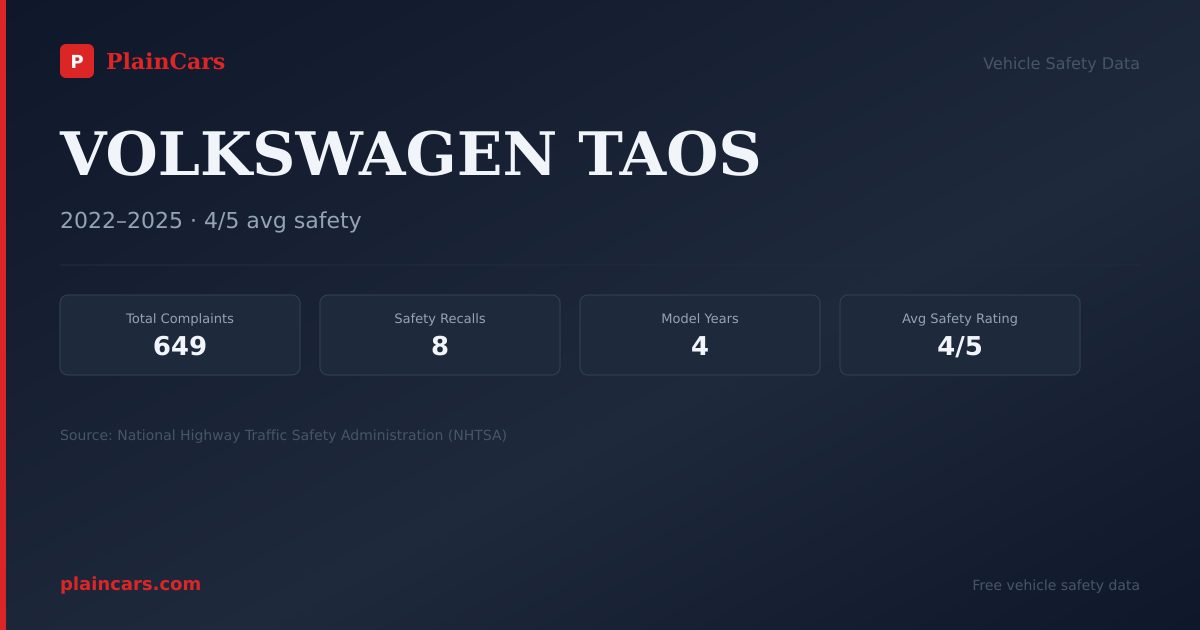
Total Complaints
3 filings
Volkswagen Taos · model year
3 NHTSA complaints, and 2 recall campaigns listed for this cohort. A VIN lookup is required to determine whether a specific vehicle has an unrepaired recall.
NHTSA overall rating
4 / 5 ★
New Car Assessment Program
The verdict
The 2025 Volkswagen Taos pairs top-1% complaint standing (fewest filings) with a strong NHTSA safety rating.
The 2025VolkswagenTaos carries 3 consumer safety complaints in NHTSA's Office of Defects Investigation database for this specific model-year cohort. Within that volume, owners reported 0 crashes, 0 fires, 0 injuries, and 0 fatalities. For crash performance, NHTSA's New Car Assessment Program gave this cohort an overall 4/5 rating, with 4/5 front crash, 5/5 side crash, and 4/5 rollover scores derived from standardized barrier and dynamic tests.
The most frequently selected component label in reports for the 2025 Taos is electrical system with 2 filings, followed by vehicle speed control (1). Complaint categories reflect owner reports and intake categorization; they do not establish a defect pattern or cause. This cohort has 2 NHTSA recall campaigns listed below. Enter a VIN in NHTSA's official recall lookup to determine whether a specific vehicle has an unrepaired recall.
NHTSA currently has 37 investigation files overlapping the 2025 Taos, and 2 remain open. Owners comparing this cohort against neighboring years should read the complaint-by-year trend as report volume, not a causal diagnosis. Use the related-complaint feed and the official recall lookup when researching a specific vehicle.
PlainCars' own composite of NHTSA NCAP crash-test ratings and rollover-risk assessment, each dimension normalized against the federal scale or the full national model-year corpus. Not an official NHTSA figure, and not a substitute for a specific vehicle's VIN-level recall check.
Total Complaints
3 filings
Crashes Reported
0 reports
Source
NHTSA ODI
Federal complaints database
At or below the fleet median complaint volume.
| Component | Count |
|---|---|
| ELECTRICAL SYSTEM | 2 |
| VEHICLE SPEED CONTROL | 1 |
ELECTRICAL SYSTEM: INSTRUMENT CLUSTER/PANEL
Volkswagen Group of America, Inc. (Volkswagen) is recalling certain 2025 Jetta and Taos vehicles. The instrument panel may fail to display warning lights or gauges. As such, these vehicles fail to comply with the requirements of Federal Motor Vehicle Safety Standard number 101, "Control and Displays
FUEL SYSTEM, GASOLINE:DELIVERY:PRESSURE SENSOR
Volkswagen Group of America, Inc. (Volkswagen) is recalling certain 2025-2026 Taos vehicles. In the event of a rear-end crash, the fuel pressure sensor may dislodge or separate from the fuel tank. As such, these vehicles fail to comply with the requirements of Federal Motor Vehicle Safety Standard n
While driving down the interstate I noticed that the speed in my Taos was not matching what google maps or apple maps was showing. It is very difficult to figure out. I noticed this more than once. Even If I am going below the speed limit that is only shows me not speeding. The interstate I was on was a speed of 70. Normally I am at 75 both map systems were showing 78-80. I would adjust to below 70 and everything matched then. Something in the taos is not accurate and is off. I am always fearful that I am going to get pulled over being to under/over the speed. Even using the digital speedometer in the vehicle, it is not showing the correct speed. This causes me to be at risk for tickets and unnecessary fines. My 2021 Hyundai Elantra did not have this issue. It was digital and alway accurate. The taos is not. From my understanding Volkswagen is aware and don't care. I plan on to sell it before anymore issue come up like my grinding front brakes under 5,000 miles. I am done.
The speedometer on the new 2025 Volkswagen Taos undervalues the speed by 5%. For example, if the SUV speedometer says 40 mph the actual speed of the vehicle is 42 mph. This seems to be a known problem on new Taos vehicles but is not being addressed by Volkswagen. They are saying legally a 10% variance is allowed and the vehicle passes electrical tests. This problem has been reported to corporate and two dealerships and has a case number. Speed was noticed by driver after going the speed limit on a street near a baseball field with a sign and flashing speedometer. Waze and Google Maps gps also confirm the 5% variance. This problem causes unintentional speeding, reduced reaction time and stopping distance, difficulty matching traffic flow and misjudgment of vehicle control.
The speedometer on the new 2025 Volkswagen Taos undervalues the speed by 5%. For example, if the SUV speedometer says 40 mph the actual speed of the vehicle is 42 mph. This seems to be a known problem on new Taos vehicles but is not being addressed by Volkswagen. They are saying legally a 10% variance is allowed and the vehicle passes electrical tests. This problem has been reported to corporate and two dealerships and has a case number. Speed was noticed by driver after going the speed limit on a street near a baseball field with a sign and flashing speedometer. Waze and Google Maps gps also confirm the 5% variance. This problem causes unintentional speeding, reduced reaction time and stopping distance, difficulty matching traffic flow and misjudgment of vehicle control.
Inadvertent Automatic Emergency Braking
Inadvertent Door Opening
Fuel Leak due to Suction Jet Pump Failure within Fuel Tank (Remedy Effectiveness of Recall 16V647)
Inadvertent Automatic Emergency Braking
LGES High Voltage Battery Failures
Data vintage: August 2026. Sources: NHTSA Office of Defects Investigation (ODI) complaints database, NHTSA recall campaign API, NHTSA NCAP crash-test ratings, and NHTSA FARS for fatality cross-reference.
Every figure on PlainCars is rendered directly from NHTSA complaint and safety data, no number is typed in by an editor. This year-specific record is rendered from NHTSA ODI, recall, and NCAP rows for the 2025 Volkswagen Taos; no figure is typed in by an editor. See our editorial standards & corrections policy, the methodology behind these numbers, or report a data error. Data current as of August 2026.
Read our methodology - how this data is sourced, computed, and verified.