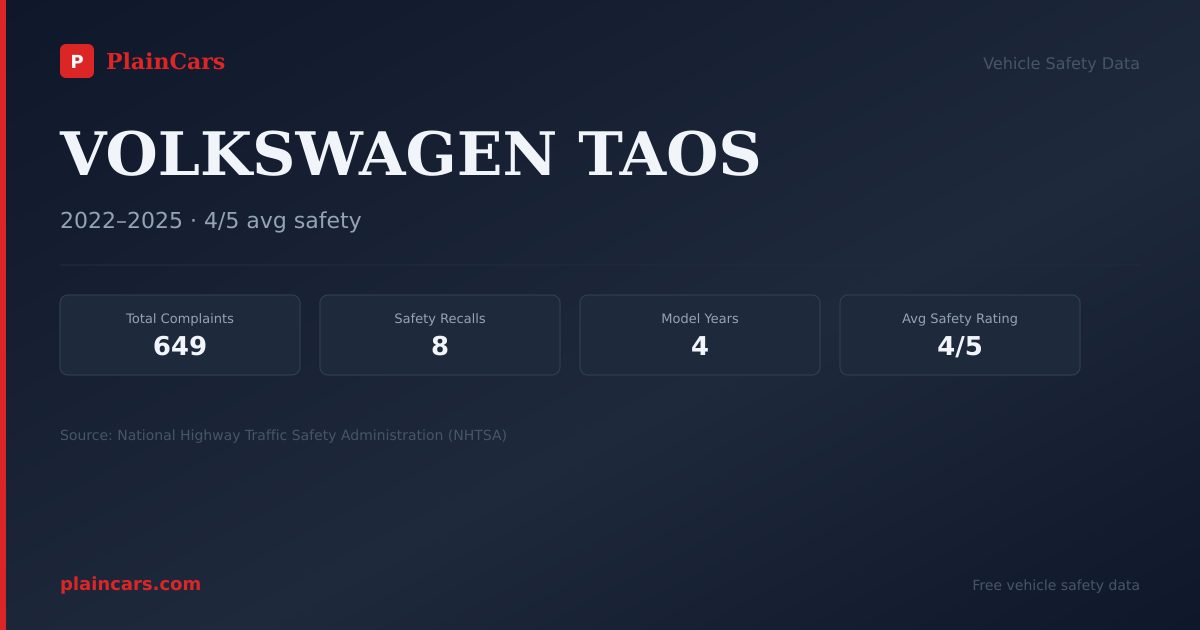
Total Complaints
449 filings
Volkswagen Taos · model year
449 NHTSA complaints, 8 crash reports, and 6 recall campaigns listed for this cohort. A VIN lookup is required to determine whether a specific vehicle has an unrepaired recall.
NHTSA overall rating
4 / 5 ★
New Car Assessment Program
The verdict
The 2022 Volkswagen Taos pairs above-average complaint volume with a strong NHTSA safety rating.
The 2022VolkswagenTaos carries 449 consumer safety complaints in NHTSA's Office of Defects Investigation database for this specific model-year cohort. Within that volume, owners reported 8 crashes, 0 fires, 2 injuries, and 0 fatalities. For crash performance, NHTSA's New Car Assessment Program gave this cohort an overall 4/5 rating, with 4/5 front crash, 5/5 side crash, and 4/5 rollover scores derived from standardized barrier and dynamic tests.
The most frequently selected component label in reports for the 2022 Taos is engine with 125 filings, followed by service brakes (59) and electrical system (52). Complaint categories reflect owner reports and intake categorization; they do not establish a defect pattern or cause. This cohort has 6 NHTSA recall campaigns listed below. Enter a VIN in NHTSA's official recall lookup to determine whether a specific vehicle has an unrepaired recall.
NHTSA currently has 37 investigation files overlapping the 2022 Taos, and 2 remain open. Owners comparing this cohort against neighboring years should read the complaint-by-year trend as report volume, not a causal diagnosis. Use the related-complaint feed and the official recall lookup when researching a specific vehicle.
PlainCars' own composite of NHTSA NCAP crash-test ratings and rollover-risk assessment, each dimension normalized against the federal scale or the full national model-year corpus. Not an official NHTSA figure, and not a substitute for a specific vehicle's VIN-level recall check.
Total Complaints
449 filings
Crashes Reported
8 reports
Source
NHTSA ODI
Federal complaints database
Above median complaint volume, review patterns below.
| Component | Count |
|---|---|
| ENGINE | 125 |
| SERVICE BRAKES | 59 |
| ELECTRICAL SYSTEM | 52 |
| FUEL/PROPULSION SYSTEM | 43 |
| UNKNOWN OR OTHER | 40 |
| POWER TRAIN | 39 |
| VEHICLE SPEED CONTROL | 14 |
| AIR BAGS | 8 |
| FORWARD COLLISION AVOIDANCE: WARNINGS | 7 |
| FUEL SYSTEM, GASOLINE | 6 |
| STRUCTURE:BODY | 6 |
| FORWARD COLLISION AVOIDANCE: AUTOMATIC EMERGENCY BRAKING | 5 |
| ENGINE AND ENGINE COOLING | 5 |
| VISIBILITY/WIPER | 4 |
| STEERING | 4 |
FUEL SYSTEM, GASOLINE:DELIVERY:FUEL PUMP
Volkswagen Group of America, Inc. (Volkswagen) is recalling certain 2022 TAOS vehicles. The fuel delivery pump may break, which could cause a sudden engine stall.
SUSPENSION
Volkswagen Group of America, Inc. (Volkswagen) is recalling certain 2022 Tiguan, Taos, and 2021 Tiguan long wheel base (LWB) vehicles. A second notice will be sent once remedy parts become available. The left or right rear suspension knuckles may corrode, crack, and break.
FUEL SYSTEM, GASOLINE:DELIVERY:HOSES, LINES/PIPING, AND FITTINGS
Volkswagen Group of America, Inc. (Volkswagen) is recalling certain 2022 Taos vehicles. The underhood fuel supply quick-connector may detach from the fuel supply line causing a fuel leak in the engine compartment.
BACK OVER PREVENTION: SENSING SYSTEM: CAMERA
Volkswagen Group of America, Inc. (Volkswagen) is recalling certain 2021 Golf GTI, Jetta GLI, Jetta NF, Arteon FL, Tiguan LWB, 2022 Taos, Jetta PA, Tiguan PA, 2021-2022 Atlas Cross Sport, and Atlas FL vehicles. The manufacturing process of the eMMC memory module in the infotainment system may cause
ENGINE AND ENGINE COOLING:ENGINE:ENGINE CONTROL MODULE (ECU/ECM):SOFTWARE
Volkswagen Group of America, Inc. (Volkswagen) is recalling certain 2022 TAOS vehicles equipped with all-wheel drive. The engine control unit (ECU) software may cause a stall when coming to a stop.
ENGINE AND ENGINE COOLING:ENGINE:ENGINE CONTROL MODULE (ECU/ECM):SOFTWARE
Volkswagen Group of America, Inc. (Volkswagen) is recalling certain 2022 Taos vehicles equipped with all-wheel drive. The engine control unit (ECU) software may cause a stall when coming to a stop.
The contact owns a 2022 Volkswagen Taos. The contact stated that while the vehicle was started and running, the low coolant warning light illuminated. The coolant reservoir was topped off, and the warning light disappeared. The contact referenced a Technical Service Bulletin with NHTSA ID Number: 10241177 (ENGINE AND ENGINE COOLING); and associated the failure with the TSB. The vehicle was towed to a local dealer but was not repaired. The manufacturer was notified of the failure. The failure mileage was 87,100.
Mileage: 87,100
Everytime the car warms after 10 minutes of driving depending on outside temperature, there is a loud popping noise that comes from the passenger side dash windshield area. It sounds like a rock hitting the windshield, startling everyone in the vehicle. Has been happening since new. Dealer will not address the issue.
The rear camera blacks out on the dashboard. Sometimes when I start the dashboard, the thing is dark. It doesn't come on even while driving. It mainly happens with the push start option. Occasionally, I've been driving on the highway. And it'll start flashing blinking and then blackout. Also, the gear shifting to accelerate on the gas get stuck. It won't shift, it'll go into neutral mode. Even though it's since drive mode
The rear camera blacks out on the dashboard. Sometimes when I start the dashboard, the thing is dark. It doesn't come on even while driving. It mainly happens with the push start option. Occasionally, I've been driving on the highway. And it'll start flashing blinking and then blackout. Also, the gear shifting to accelerate on the gas get stuck. It won't shift, it'll go into neutral mode. Even though it's since drive mode
Since the purchase of my 2022 VW Taos in 2022, there has been a repeated issue of the check engine light coming on at random times. Each time it has happened the code indicates a problem with the fuel evap system. The issue has been fixed multiple times by replacing parts. There has been no fix for the issue and it still persists. Problems with the fuel evap system puts the drivers and passengers at risk. Being unable to determine an issue with the car and the safety of operating a motor vehicle due to continued negligence by the manufacturer is the opposite of a safe motor vehicle. Additionally, since buying the vehicle there have been repeated issues with the communications module. The module had to be replaced just days after purchasing it. Now, it is not working once again and if there was an emergency, the technology presented when purchasing the car, SOS, information, crash detection, location, etc, is not available to help me. VW presents these as safety features then does nothi
Since the purchase of my 2022 VW Taos in 2022, there has been a repeated issue of the check engine light coming on at random times. Each time it has happened the code indicates a problem with the fuel evap system. The issue has been fixed multiple times by replacing parts. There has been no fix for the issue and it still persists. Problems with the fuel evap system puts the drivers and passengers at risk. Being unable to determine an issue with the car and the safety of operating a motor vehicle due to continued negligence by the manufacturer is the opposite of a safe motor vehicle. Additionally, since buying the vehicle there have been repeated issues with the communications module. The module had to be replaced just days after purchasing it. Now, it is not working once again and if there was an emergency, the technology presented when purchasing the car, SOS, information, crash detection, location, etc, is not available to help me. VW presents these as safety features then does nothi
while driving a 2022 VW Taos started experiencing a strong wobble in the front driver side tire. It started on a 2.5 hour drive back from dropping my son off at college. While accelerating from 0-40 MPH the wobble would be very strong. After reaching 45 MPH it leveled off. It would wobble more turning or moving to the left than the right side. It was frightening to drive my hour long commute and worry if my tire was going to fall of or, worse yet, would I crash. I could not get in to the VW dealership for a few days prior to this starting. I did not have any lights or warning signs prior to this. When I first spoke about the problem to a few places they were suggested the lug nuts were loose, or perhaps a tire bearing went bad. I took it to my VW dealer and they said the issue was the steering rack and I was originally quoted $7,500 to fix it. Steve at my dealership was great and moved mountains to get the price lowered and my car repaired. However I find it hard to believe
Since we bought the vehicle new in 2022, it has had an ongoing brake noise at low speeds. It sounds like a screeching or grinding, and I only hear it when I press the brake pedal. It is most noticeable right after startup when driving slowly. The main issue I am reporting is uneven rear brake pad wear, which may indicate the rear brake system is not applying evenly or not functioning correctly. The component involved is the rear brake system (rear brake pads and related parts). The vehicle is available for inspection upon request. A Volkswagen dealership confirmed an uneven wear condition. On 12/31/2025, the dealership performed an inspection and recorded that the left rear brake pad measured 3 mm while the right rear measured 8 mm. They recommended replacing the rear brake pads but did not diagnose or repair the cause of why one rear side is wearing much faster than the other. In prior visits, the dealership stated the noise was related to the type/quality of brake pads used. When
Component or system that failed or malfunctioned Rear brake rotors and rear brake pads. Both rear rotors have been diagnosed as requiring replacement along with rear brake pads. The front rotors and pads are reported to be in normal condition. The vehicle and all replaced components are available for inspection upon request. Safety risk Degraded rear braking performance increases stopping distance and could lead to brake vibration, uneven braking, or reduced control during emergency braking, posing a potential safety risk to the driver and others. Confirmation or reproduction of the problem The issue has been confirmed by a dealership service department, which recommended replacement of the rear rotors and rear brake pads. The vehicle has approximately 16,000 miles and is just over 4 years old. During the service visit, dealership staff stated that this type of rear brake wear occurs frequently with these vehicles. The dealership also indicated that Volkswagen previously replaced re
Component or system that failed or malfunctioned Rear brake rotors and rear brake pads. Both rear rotors have been diagnosed as requiring replacement along with rear brake pads. The front rotors and pads are reported to be in normal condition. The vehicle and all replaced components are available for inspection upon request. Safety risk Degraded rear braking performance increases stopping distance and could lead to brake vibration, uneven braking, or reduced control during emergency braking, posing a potential safety risk to the driver and others. Confirmation or reproduction of the problem The issue has been confirmed by a dealership service department, which recommended replacement of the rear rotors and rear brake pads. The vehicle has approximately 16,000 miles and is just over 4 years old. During the service visit, dealership staff stated that this type of rear brake wear occurs frequently with these vehicles. The dealership also indicated that Volkswagen previously replaced re
I purchased a 2022 Volkswagen Taos from TOM‘s VW, Union, New Jersey on Sep 23, 2023. At the time of purchase, the vehicle had approximately 19000 miles. Unfortunately, I experienced the engine light illuminating after starting the car at the end of October 2024. I brought this issue to Tom's VW's attention in Nov, 2024 - 1) I made an appointment with Tom's VW, and the first time I went to the dealership was on Nov 2, 2024. Since then, we have come to Tom's VW dealership to fix the same issue at least 6 times, the latest one was on May 15, 2025. 2) The car has been kept in the dealership's shop since it was drop off at the dealership on May 15, 2025. It's still kept in the dealership's shop now. 3) Several times we were told the problem was resolved and we could pick up the car, but the problem would usually reappear the next day. We immediately called Tom's VW to inform them and ask if it was safe to drive the car before it was delivered to Tom's VW again, since the problem involv
I am reporting a repeated safety-related defect involving exhaust intrusion into the cabin of my 2022 Volkswagen Taos. The vehicle experienced loss of power, coolant loss, and engine warning indicators, and was serviced twice by Volkswagen Southtowne in Sandy, Utah. First Incident – Vehicle Returned as “Safe to Drive” During the first repair visit, the dealer diagnosed issues involving the manifold/exhaust area, head gasket, coolant system, and catalytic converter. After keeping the vehicle for an extended period, the dealership informed me the vehicle was “safe to drive,” although the repair was not fully completed. I relied on this representation. After the vehicle was returned to me, I began experiencing significant physical symptoms only while driving the vehicle, including nausea, dizziness, and vomiting. These symptoms occurred repeatedly during operation and would subside after leaving the vehicle. At the time, I did not understand that these symptoms were caused by
I am reporting a repeated safety-related defect involving exhaust intrusion into the cabin of my 2022 Volkswagen Taos. The vehicle experienced loss of power, coolant loss, and engine warning indicators, and was serviced twice by Volkswagen Southtowne in Sandy, Utah. First Incident – Vehicle Returned as “Safe to Drive” During the first repair visit, the dealer diagnosed issues involving the manifold/exhaust area, head gasket, coolant system, and catalytic converter. After keeping the vehicle for an extended period, the dealership informed me the vehicle was “safe to drive,” although the repair was not fully completed. I relied on this representation. After the vehicle was returned to me, I began experiencing significant physical symptoms only while driving the vehicle, including nausea, dizziness, and vomiting. These symptoms occurred repeatedly during operation and would subside after leaving the vehicle. At the time, I did not understand that these symptoms were caused by
2022 Volkswagen Taos SE 1.5T (DNKA engine, <60,000 miles, <5 years old) developed internal coolant leak from cylinder head gasket. On 11/03/2025 Smith Volkswagen, Wilmington, DE (RO 692953/1) performed coolant system pressure test and confirmed leak coming from cylinder head gasket area at rear of engine below turbo (exactly as shown in Figures 1 & 2 of VW TSB 15-23-01). Dealer noted possible related engine damage that may require complete engine replacement in addition to head gasket. Vehicle available for inspection upon request. Safety risk: loss of coolant can cause sudden engine overheating, power loss, or seizure while driving, creating risk of crash, stranding, or fire. Symptoms began November 2025 with “Check Coolant” warning; reservoir was below MIN. Added coolant once; warning has not returned, but pressure test proved ongoing internal leak. No visible external drips. This exact failure is a known manufacturing defect per Volkswagen Technical Service Bulletin 15-23-01 (Tr
2022 Volkswagen Taos SE 1.5T (DNKA engine, <60,000 miles, <5 years old) developed internal coolant leak from cylinder head gasket. On 11/03/2025 Smith Volkswagen, Wilmington, DE (RO 692953/1) performed coolant system pressure test and confirmed leak coming from cylinder head gasket area at rear of engine below turbo (exactly as shown in Figures 1 & 2 of VW TSB 15-23-01). Dealer noted possible related engine damage that may require complete engine replacement in addition to head gasket. Vehicle available for inspection upon request. Safety risk: loss of coolant can cause sudden engine overheating, power loss, or seizure while driving, creating risk of crash, stranding, or fire. Symptoms began November 2025 with “Check Coolant” warning; reservoir was below MIN. Added coolant once; warning has not returned, but pressure test proved ongoing internal leak. No visible external drips. This exact failure is a known manufacturing defect per Volkswagen Technical Service Bulletin 15-23-01 (Tr
Paint is peeling along panel edges and roof seams. A VW inspector confirmed original OEM paint. Multiple VW Taos owners have reported similar clear coat failures. Not impact-related and not environmental damage. VW, however, refuses to accept responsibility.
The vehicle has had repeated issues related to the fuel system, including strong fuel odor inside the cabin, a gurgling sound coming from the fuel tank area, and recurring check engine lights shortly after a previous recall repair was completed. The most recent diagnostic from the dealer indicated a faulty fuel tank pressure sensor (G400), but I was initially told the vehicle needed a fuel pressure release valve. There has been inconsistency in the diagnostics and explanations provided to me. The fuel smell in the cabin and apparent pressure issues in the tank created a safety concern for me and my passengers, especially while driving with windows closed or using cabin heat. I am concerned about a potential fuel leak or improper tank venting. The problem has occurred multiple times, including at least five check engine lights after the recall repair. The dealer has inspected the vehicle several times, but the issue has not been fully resolved, and additional related parts (such as th
The vehicle has had repeated issues related to the fuel system, including strong fuel odor inside the cabin, a gurgling sound coming from the fuel tank area, and recurring check engine lights shortly after a previous recall repair was completed. The most recent diagnostic from the dealer indicated a faulty fuel tank pressure sensor (G400), but I was initially told the vehicle needed a fuel pressure release valve. There has been inconsistency in the diagnostics and explanations provided to me. The fuel smell in the cabin and apparent pressure issues in the tank created a safety concern for me and my passengers, especially while driving with windows closed or using cabin heat. I am concerned about a potential fuel leak or improper tank venting. The problem has occurred multiple times, including at least five check engine lights after the recall repair. The dealer has inspected the vehicle several times, but the issue has not been fully resolved, and additional related parts (such as th
The vehicle has had repeated issues related to the fuel system, including strong fuel odor inside the cabin, a gurgling sound coming from the fuel tank area, and recurring check engine lights shortly after a previous recall repair was completed. The most recent diagnostic from the dealer indicated a faulty fuel tank pressure sensor (G400), but I was initially told the vehicle needed a fuel pressure release valve. There has been inconsistency in the diagnostics and explanations provided to me. The fuel smell in the cabin and apparent pressure issues in the tank created a safety concern for me and my passengers, especially while driving with windows closed or using cabin heat. I am concerned about a potential fuel leak or improper tank venting. The problem has occurred multiple times, including at least five check engine lights after the recall repair. The dealer has inspected the vehicle several times, but the issue has not been fully resolved, and additional related parts (such as th
2022 VW Taos Head Gasket failure at 63,000 miles. Coolant leaking. Potential for engine seizure/fire. Manufacturer is aware of defect (TSB 2071245/1) but refuses to assist.
Inadvertent Automatic Emergency Braking
Inadvertent Door Opening
Fuel Leak due to Suction Jet Pump Failure within Fuel Tank (Remedy Effectiveness of Recall 16V647)
Inadvertent Automatic Emergency Braking
LGES High Voltage Battery Failures
Data vintage: August 2026. Sources: NHTSA Office of Defects Investigation (ODI) complaints database, NHTSA recall campaign API, NHTSA NCAP crash-test ratings, and NHTSA FARS for fatality cross-reference.
Every figure on PlainCars is rendered directly from NHTSA complaint and safety data, no number is typed in by an editor. This year-specific record is rendered from NHTSA ODI, recall, and NCAP rows for the 2022 Volkswagen Taos; no figure is typed in by an editor. See our editorial standards & corrections policy, the methodology behind these numbers, or report a data error. Data current as of August 2026.
Read our methodology - how this data is sourced, computed, and verified.