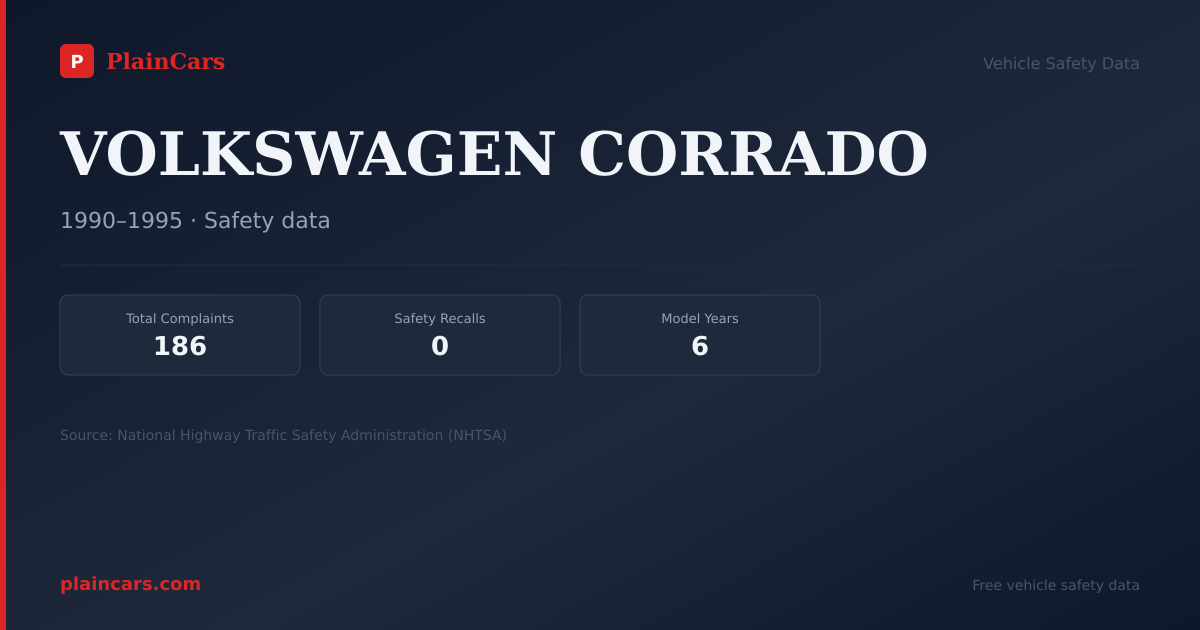
Total Complaints
4 filings
Volkswagen Corrado · model year
4 NHTSA complaints. A VIN lookup is required to determine whether a specific vehicle has an unrepaired recall.
NHTSA overall rating
Not crash-tested
New Car Assessment Program
The verdict
The 1994 Volkswagen Corrado posts top-quartile complaint standing among its own model-year siblings.
The 1994VolkswagenCorrado carries 4 consumer safety complaints in NHTSA's Office of Defects Investigation database for this specific model-year cohort. Within that volume, owners reported 0 crashes, 0 fires, 0 injuries, and 0 fatalities. No NCAP 5-star crash-test rating is available for this model year in the federal database.
The most frequently selected component label in reports for the 1994 Corrado is visibility:defroster/defogger/hvac system:heater core with 2 filings, followed by service brakes, hydraulic:foundation components (1) and engine and engine cooling:cooling system (1). Complaint categories reflect owner reports and intake categorization; they do not establish a defect pattern or cause.
NHTSA currently has 37 investigation files overlapping the 1994 Corrado, and 2 remain open. Owners comparing this cohort against neighboring years should read the complaint-by-year trend as report volume, not a causal diagnosis. Use the related-complaint feed and the official recall lookup when researching a specific vehicle.
PlainCars' own composite of NHTSA NCAP crash-test ratings and rollover-risk assessment, each dimension normalized against the federal scale or the full national model-year corpus. Not an official NHTSA figure, and not a substitute for a specific vehicle's VIN-level recall check.
Total Complaints
4 filings
Crashes Reported
0 reports
Source
NHTSA ODI
Federal complaints database
At or below the fleet median complaint volume.
| Component | Count |
|---|---|
| VISIBILITY:DEFROSTER/DEFOGGER/HVAC SYSTEM:HEATER CORE | 2 |
| SERVICE BRAKES, HYDRAULIC:FOUNDATION COMPONENTS | 1 |
| ENGINE AND ENGINE COOLING:COOLING SYSTEM | 1 |
CONSUMER STATES THAT HEATER CORE "EXPLODED" WHILE DRIVING AND STEAM CLOUDED ALL INTERIOR WINDOWS RESULTING IN NO VISIBILITY. THE HEATER CORE EXPLOSION ALSO CAUSED COOLANT TO LEAK FROM UNDER DASHBOARD INTO VEHICLE'S INTERIOR. TS
Mileage: 90,000
CONSUMER HAD WORK DONE FROM RECALL 98V295000/ COOLANT SYSTEM. FROM PRIOR WORK DONE THE AUXILIARY ELECTRIC COOLANT PUMP BROKE. OWNER PURCHASED A NEW, REDESIGNED PUMP AND INSTALLED IT HIMSELF. *AK *ML
IN OCTOBER 1999 VEHICLE HAD RECALL REMEDY DONE. BUT WITHIN 2,000, ENGINE COOLANT PUMP, WHICH WAS REPLACED DURING RECALL REPAIRS, WAS NOT DESIGED FOR THIS PROBLEM. IT CAUSED PRESSURE IN THE PUMP, CAUSING THE SEALS TO EXPLODE AND WATER TO LEAK ONTO ENGINE COMPARTMENT, RESULTED TIN VEHICLE STALLING WHICH MAY HAVE RESULTED IN A CRASH. COMMON PROBLEM. MANUFACTURER STATED IT WAS NOT PART OF THE RECALL, AND THE CONSUMER WAS RESPONSIBLE FOR FIXING THE RECALL. THE HEATER CORE RECALL DID NOT REPLACE THE HEATER CORE. A PRESSURE REDUCING VALVE AND A RELAY TO RUN THE COOLING FANS AND AUXILLARY WATER PUMP LONGER. *AK
ATTEMPTED TO STEP ON BRAKES AND THE BRAKES WENT TOO FAR DOWN TO THE FLOOR, ON THE SECOND ATTEMPT TO APPLY THE BRAKES THEY LOCKED UP. EXPLAIN IN MORE DETAILS. *AK
Inadvertent Automatic Emergency Braking
Inadvertent Door Opening
Fuel Leak due to Suction Jet Pump Failure within Fuel Tank (Remedy Effectiveness of Recall 16V647)
Inadvertent Automatic Emergency Braking
LGES High Voltage Battery Failures
Data vintage: August 2026. Sources: NHTSA Office of Defects Investigation (ODI) complaints database, NHTSA recall campaign API, NHTSA NCAP crash-test ratings, and NHTSA FARS for fatality cross-reference.
Every figure on PlainCars is rendered directly from NHTSA complaint and safety data, no number is typed in by an editor. This year-specific record is rendered from NHTSA ODI, recall, and NCAP rows for the 1994 Volkswagen Corrado; no figure is typed in by an editor. See our editorial standards & corrections policy, the methodology behind these numbers, or report a data error. Data current as of August 2026.
Read our methodology - how this data is sourced, computed, and verified.