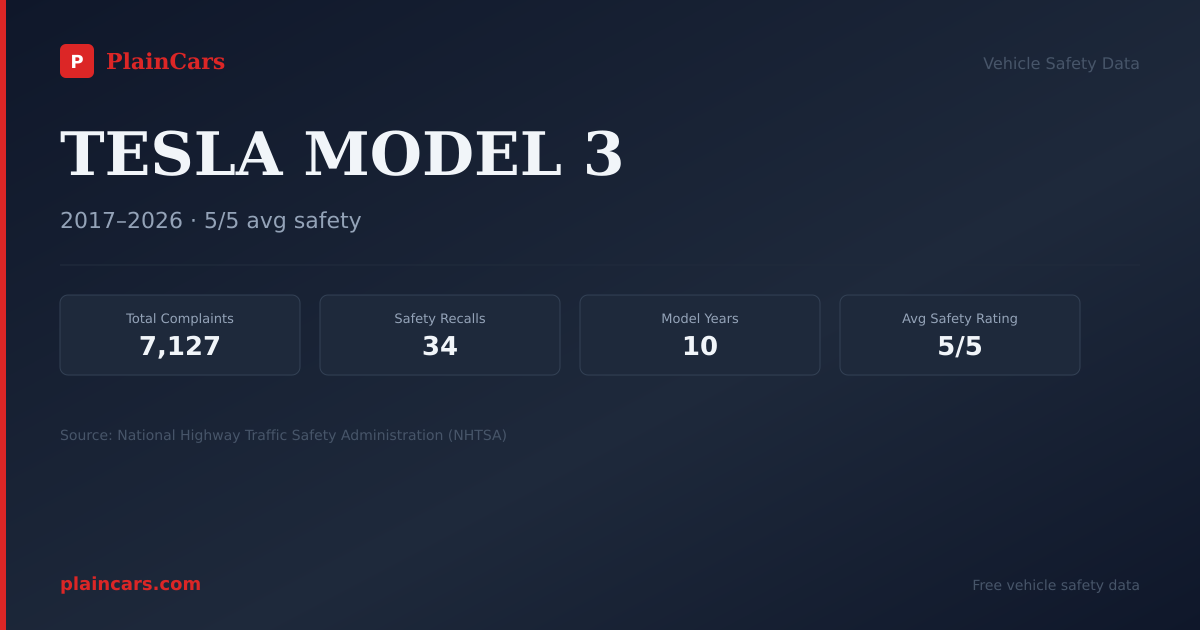
Total Complaints
284 filings
Tesla Model 3 · model year
284 NHTSA complaints, 33 crash reports, and 4 recall campaigns listed for this cohort. A VIN lookup is required to determine whether a specific vehicle has an unrepaired recall.
NHTSA overall rating
Not crash-tested
New Car Assessment Program
The verdict
The 2024 Tesla Model 3 posts below-average complaint volume among its own model-year siblings.
The 2024TeslaModel 3 carries 284 consumer safety complaints in NHTSA's Office of Defects Investigation database for this specific model-year cohort. Within that volume, owners reported 33 crashes, 0 fires, 37 injuries, and 0 fatalities. For crash performance, NHTSA's New Car Assessment Program gave this cohort an overall Not Rated/5 rating, with Not Rated/5 front crash, Not Rated/5 side crash, and Not Rated/5 rollover scores derived from standardized barrier and dynamic tests.
The most frequently selected component label in reports for the 2024 Model 3 is unknown or other with 58 filings, followed by steering (34) and electrical system (33). Complaint categories reflect owner reports and intake categorization; they do not establish a defect pattern or cause. This cohort has 4 NHTSA recall campaigns listed below. Enter a VIN in NHTSA's official recall lookup to determine whether a specific vehicle has an unrepaired recall.
NHTSA currently has 5 investigation files overlapping the 2024 Model 3. Owners comparing this cohort against neighboring years should read the complaint-by-year trend as report volume, not a causal diagnosis. Use the related-complaint feed and the official recall lookup when researching a specific vehicle.
PlainCars' own composite of NHTSA NCAP crash-test ratings and rollover-risk assessment, each dimension normalized against the federal scale or the full national model-year corpus. Not an official NHTSA figure, and not a substitute for a specific vehicle's VIN-level recall check.
Total Complaints
284 filings
Crashes Reported
33 reports
Source
NHTSA ODI
Federal complaints database
Above median complaint volume, review patterns below.
| Component | Count |
|---|---|
| UNKNOWN OR OTHER | 58 |
| STEERING | 34 |
| ELECTRICAL SYSTEM | 33 |
| EXTERIOR LIGHTING | 25 |
| FORWARD COLLISION AVOIDANCE: ADAPTIVE CRUISE CONTROL | 24 |
| VEHICLE SPEED CONTROL | 19 |
| FORWARD COLLISION AVOIDANCE: AUTOMATIC EMERGENCY BRAKING | 13 |
| FORWARD COLLISION AVOIDANCE: WARNINGS | 11 |
| LANE DEPARTURE: ASSIST | 8 |
| AIR BAGS | 7 |
| VISIBILITY/WIPER | 4 |
| ENGINE | 4 |
| FUEL/PROPULSION SYSTEM | 4 |
| ELECTRICAL SYSTEM:ADAS | 4 |
| WHEELS | 4 |
LATCHES/LOCKS/LINKAGES:HOOD:LATCH
Tesla, Inc. (Tesla) is recalling certain 2021-2024 Model 3, Model S, Model X, and 2020-2024 Model Y vehicles. The hood latch assembly may fail to detect an unlatched hood condition after the hood has been opened.
AIR BAGS:SIDE/WINDOW:THORAX
Tesla, Inc. (Tesla) is recalling one 2024 Model 3 vehicle. The driver seat side air bag module was assembled without a deflector that directs gas flow during deployment.
TIRES:PRESSURE MONITORING AND REGULATING SYSTEMS
Tesla, Inc. (Tesla) is recalling certain 2024 Cybertruck, 2017-2025 Model 3, and 2020-2025 Model Y vehicles. The tire pressure monitoring system (TPMS) warning light may not remain illuminated between drive cycles, failing to warn the driver of low tire pressure. As such, these vehicles fail to co
BACK OVER PREVENTION:SOFTWARE
Tesla, Inc. (Tesla) is recalling certain 2024-2025 Model 3, Model S, 2023-2025 Model X, and Model Y vehicles. The computer circuit board may short, resulting in the loss of the rearview camera image. As such, these vehicles fail to comply with the requirements of Federal Motor Vehicle Safety Stand
Screen is black and no app access. No power to accelerate.
Screen is black and no app access. No power to accelerate.
Screen is black and no app access. No power to accelerate.
I purchased a 2024 Tesla Model 3 a little over a year ago. Recently, and after an update, myself, and other drivers in my life, noticed the self-driving feature was malfunctioning - to the point I used the audio reporting feature to report this problem twice to Tesla. The car would veer off the road when flasing lights appeared and would jerk suddenly for no reason when it thought there was a obstruction in the road (sticks, plastic bags, etc.). Last month this malfunction has caused an accident, and my car has been totaled, my insurance will not cover it, and I have been advised by two separate attorneys to sue. This has been litigated in court with lawsuits against Tesla (See Benavides v. Tesla; see also IN RE: TESLA ADVANCED DRIVER ASSISTANCE SYSTEMS LITIGATION). I had notified Telsa twice of this issue, the car left the lane and did not notice a concrete barrier on the left side going north on I-95 in or around Broward County. To my knowledge no one has inspected the car. I was not
I purchased a 2024 Tesla Model 3 a little over a year ago. Recently, and after an update, myself, and other drivers in my life, noticed the self-driving feature was malfunctioning - to the point I used the audio reporting feature to report this problem twice to Tesla. The car would veer off the road when flasing lights appeared and would jerk suddenly for no reason when it thought there was a obstruction in the road (sticks, plastic bags, etc.). Last month this malfunction has caused an accident, and my car has been totaled, my insurance will not cover it, and I have been advised by two separate attorneys to sue. This has been litigated in court with lawsuits against Tesla (See Benavides v. Tesla; see also IN RE: TESLA ADVANCED DRIVER ASSISTANCE SYSTEMS LITIGATION). I had notified Telsa twice of this issue, the car left the lane and did not notice a concrete barrier on the left side going north on I-95 in or around Broward County. To my knowledge no one has inspected the car. I was not
I purchased a 2024 Tesla Model 3 a little over a year ago. Recently, and after an update, myself, and other drivers in my life, noticed the self-driving feature was malfunctioning - to the point I used the audio reporting feature to report this problem twice to Tesla. The car would veer off the road when flasing lights appeared and would jerk suddenly for no reason when it thought there was a obstruction in the road (sticks, plastic bags, etc.). Last month this malfunction has caused an accident, and my car has been totaled, my insurance will not cover it, and I have been advised by two separate attorneys to sue. This has been litigated in court with lawsuits against Tesla (See Benavides v. Tesla; see also IN RE: TESLA ADVANCED DRIVER ASSISTANCE SYSTEMS LITIGATION). I had notified Telsa twice of this issue, the car left the lane and did not notice a concrete barrier on the left side going north on I-95 in or around Broward County. To my knowledge no one has inspected the car. I was not
on Jan 4th 2026 my car popped a waring RCM2_a700 Front Right Safety Restraint System Issue - I took it in Jan 5th 2026 they said they could not replicate the warning and it was a GLITCH. On Jan 10th 2026 the warning popped up again
Incident Description (in my own words): This incident occurred in the parking lot of the [XXX] in Bretton Woods, New Hampshire. It was evening after sunset. The parking lot was dark but illuminated by overhead parking lights. My Tesla Model 3 headlights and vehicle lights were fully on. I was reversing slowly out of a tight parking space, traveling approximately 2–3 miles per hour. I was intentionally moving cautiously. My attention at the time was focused on the front right corner of the vehicle, as clearance there was tight. While reversing, the rear of my vehicle struck a parked truck behind me. The truck was relatively high (its headlights were positioned high on the vehicle). Neither I nor my passenger heard any rear collision warning, cross-traffic warning, or parking alert prior to impact. The vehicle also did not apply automatic braking. The contact occurred at very low speed and resulted in only minor cosmetic damage (a small dimple/deformation), but I was surprised that
Incident Description (in my own words): This incident occurred in the parking lot of the [XXX] in Bretton Woods, New Hampshire. It was evening after sunset. The parking lot was dark but illuminated by overhead parking lights. My Tesla Model 3 headlights and vehicle lights were fully on. I was reversing slowly out of a tight parking space, traveling approximately 2–3 miles per hour. I was intentionally moving cautiously. My attention at the time was focused on the front right corner of the vehicle, as clearance there was tight. While reversing, the rear of my vehicle struck a parked truck behind me. The truck was relatively high (its headlights were positioned high on the vehicle). Neither I nor my passenger heard any rear collision warning, cross-traffic warning, or parking alert prior to impact. The vehicle also did not apply automatic braking. The contact occurred at very low speed and resulted in only minor cosmetic damage (a small dimple/deformation), but I was surprised that
Incident Description (in my own words): This incident occurred in the parking lot of the [XXX] in Bretton Woods, New Hampshire. It was evening after sunset. The parking lot was dark but illuminated by overhead parking lights. My Tesla Model 3 headlights and vehicle lights were fully on. I was reversing slowly out of a tight parking space, traveling approximately 2–3 miles per hour. I was intentionally moving cautiously. My attention at the time was focused on the front right corner of the vehicle, as clearance there was tight. While reversing, the rear of my vehicle struck a parked truck behind me. The truck was relatively high (its headlights were positioned high on the vehicle). Neither I nor my passenger heard any rear collision warning, cross-traffic warning, or parking alert prior to impact. The vehicle also did not apply automatic braking. The contact occurred at very low speed and resulted in only minor cosmetic damage (a small dimple/deformation), but I was surprised that
SUPPLEMENT TO PREVIOUS COMPLAINT (VIN: ...XXX): CRITICAL NEW EVIDENCE OF MULTI-POINT SAFETY FAILURE. On Dec 10, 2025, Tesla Service performed a full diagnostic and repair of the airbag safety system. In addition to the previously reported "damaged wires" in the passenger seat (OCS Module), the technician ALSO had to replace the Steering Column Control Module (SCCM) to resolve the active safety faults. Safety Implication: The vehicle was sold with simultaneous hardware failures in both the passenger occupant sensing system AND the driver's steering column airbag controls. This confirms widespread physical/electrical trauma to the vehicle's Supplemental Restraint System (SRS) that was concealed at the time of sale. The dealer released a vehicle with compromised safety hardware in both the driver and passenger zones. I have attached the official Tesla Invoice confirming these replacements. INFORMATION REDACTED PURSUANT TO THE FREEDOM OF INFORMATION ACT (FOIA), 5 U.S.C. 552(B)(6)
SUPPLEMENT TO ODI # 11702355 and 11698467: Validated proof of physical defect: Tesla Service diagnosis (Dec 10, 2025) confirms "damaged wires at the OCS module" caused the airbag failure. This finding indicates the vehicle suffered physical trauma that was concealed prior to sale. The presence of damaged internal safety wiring is inconsistent with a factory-condition vehicle and suggests the vehicle was released to the public after substandard repairs to a prior wreck. The airbag system was disabled due to this physical damage.
I am leasing a 2024 Tesla Model 3. The vehicle has a steering column defect that was previously acknowledged and temporarily repaired by Tesla Service. Within days, the issue returned. Tesla has now informed me that the steering column has a known design flaw, that replacement parts are still in development, and that any repair attempted now would fail. Despite this, I am being asked to continue driving the vehicle until at least January. This defect affects the steering system, a critical safety component, and raises serious concerns regarding vehicle control and driver safety. Tesla has not offered a loaner vehicle or alternative transportation while awaiting a permanent fix. I believe this vehicle is unsafe to operate and am reporting this as a safety-related defect in the steering system.
When there’s heavy rain, the horn is muffled very badly you can barely hear it.
I purchased this used Tesla Model 3 (VIN: [XXX] ) from a licensed dealer on July 15th, 2025. The vehicle is still under the original manufacturer warranty. Since ownership, I have experienced a persistent metal-impact noise coming from the suspension and steering area, especially when going over speed bumps, uneven road surfaces, or low-speed turns. The noise sounds like loose metal parts making contact. Tesla service has attempted repairs multiple times, including a recent visit that lasted several weeks. Although some minor issues were addressed, the abnormal metal impact noise continues and has never been fully resolved. The repeated unresolved noise raises concerns about structural integrity and potential failure within components related to steering, wheels, or suspension. While the vehicle remains operable, the issue affects driving confidence, comfort, and concentration. Over time, the repeated metal noise has caused stress and anxiety because I am unsure whether a part will
I purchased this used Tesla Model 3 (VIN: [XXX] ) from a licensed dealer on July 15th, 2025. The vehicle is still under the original manufacturer warranty. Since ownership, I have experienced a persistent metal-impact noise coming from the suspension and steering area, especially when going over speed bumps, uneven road surfaces, or low-speed turns. The noise sounds like loose metal parts making contact. Tesla service has attempted repairs multiple times, including a recent visit that lasted several weeks. Although some minor issues were addressed, the abnormal metal impact noise continues and has never been fully resolved. The repeated unresolved noise raises concerns about structural integrity and potential failure within components related to steering, wheels, or suspension. While the vehicle remains operable, the issue affects driving confidence, comfort, and concentration. Over time, the repeated metal noise has caused stress and anxiety because I am unsure whether a part will
I purchased this used Tesla Model 3 (VIN: [XXX] ) from a licensed dealer on July 15th, 2025. The vehicle is still under the original manufacturer warranty. Since ownership, I have experienced a persistent metal-impact noise coming from the suspension and steering area, especially when going over speed bumps, uneven road surfaces, or low-speed turns. The noise sounds like loose metal parts making contact. Tesla service has attempted repairs multiple times, including a recent visit that lasted several weeks. Although some minor issues were addressed, the abnormal metal impact noise continues and has never been fully resolved. The repeated unresolved noise raises concerns about structural integrity and potential failure within components related to steering, wheels, or suspension. While the vehicle remains operable, the issue affects driving confidence, comfort, and concentration. Over time, the repeated metal noise has caused stress and anxiety because I am unsure whether a part will
NHTSA Complaint Narrative (Copy & Paste) CRITICAL SAFETY DEFECT: SALE OF VEHICLE WITH DISABLED AIRBAGS Incident: 10/24/2025 | Dealer: Braman Cadillac (Miami, FL) | VIN: [XXX] Braman Cadillac sold me this 2024 Tesla Model 3 representing it as "clean/no accidents." In reality, they released a vehicle with a disabled airbag system resulting from a crash that occurred in their inventory. 1. DISABLED RESTRAINT SYSTEM (RCM): Tesla Service Mode diagnostics confirm the Restraint Control Module (RCM) is in "Post Replacement" state, displaying the prompt: "Post Replacement Tasks - Routine requires Service Mode Plus authentication." This proves the airbag computer was replaced following a crash/electrical trauma but NEVER calibrated. Consequently, the SRS is disabled and will not deploy. The vehicle explicitly warns: "The Safety Restraint System may not perform as designed." The dealer released a non-roadworthy vehicle. 2. EVIDENCE OF DEALER KNOWLEDGE: Internal logs show critical crash fault
NHTSA Complaint Narrative (Copy & Paste) CRITICAL SAFETY DEFECT: SALE OF VEHICLE WITH DISABLED AIRBAGS Incident: 10/24/2025 | Dealer: Braman Cadillac (Miami, FL) | VIN: [XXX] Braman Cadillac sold me this 2024 Tesla Model 3 representing it as "clean/no accidents." In reality, they released a vehicle with a disabled airbag system resulting from a crash that occurred in their inventory. 1. DISABLED RESTRAINT SYSTEM (RCM): Tesla Service Mode diagnostics confirm the Restraint Control Module (RCM) is in "Post Replacement" state, displaying the prompt: "Post Replacement Tasks - Routine requires Service Mode Plus authentication." This proves the airbag computer was replaced following a crash/electrical trauma but NEVER calibrated. Consequently, the SRS is disabled and will not deploy. The vehicle explicitly warns: "The Safety Restraint System may not perform as designed." The dealer released a non-roadworthy vehicle. 2. EVIDENCE OF DEALER KNOWLEDGE: Internal logs show critical crash fault
Tesla Model 3 Software & Trunk Security Issue Vehicle: Tesla Model 3, 2024 Issue Date: September 25, 2025 I am reporting a serious software reliability and security defect in my Tesla Model 3. On September 25, 2025, the trunk opened on its own overnight due to what appears to be a software malfunction, resulting in the theft of $500 in personal belongings. The Tesla app sent only one notification while I was sleeping, with no alerts for over eight hours, failing to provide proper security warnings. Tesla customer support was unable to resolve the issue and suggested multiple drivers might have access, even though only one friend has access to the car and it was not her doing. Vehicle data from Tesla privacy support showed two hours missing during the trunk event, and Tesla could not explain why, only speculating a software glitch. This incident demonstrates a critical software and security failure that compromises vehicle safety and personal property. Tesla has failed to provide an
Emergency egress controls are not readily accessible and clearly identifiable.
Loss of steering control
Loss of steering control
Unexpected Brake Activation
Tesla Passenger Play
Data vintage: August 2026. Sources: NHTSA Office of Defects Investigation (ODI) complaints database, NHTSA recall campaign API, NHTSA NCAP crash-test ratings, and NHTSA FARS for fatality cross-reference.
Every figure on PlainCars is rendered directly from NHTSA complaint and safety data, no number is typed in by an editor. This year-specific record is rendered from NHTSA ODI, recall, and NCAP rows for the 2024 Tesla Model 3; no figure is typed in by an editor. See our editorial standards & corrections policy, the methodology behind these numbers, or report a data error. Data current as of August 2026.
Read our methodology - how this data is sourced, computed, and verified.