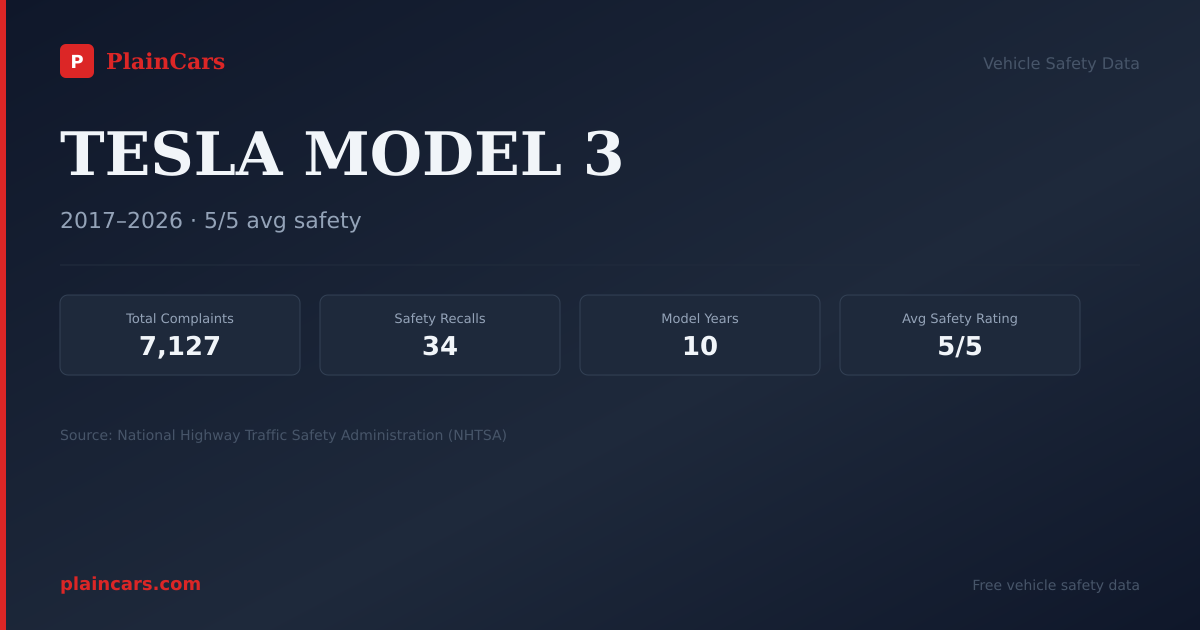
Total Complaints
686 filings
Tesla Model 3 · model year
686 NHTSA complaints, 137 crash reports, and 11 recall campaigns listed for this cohort. A VIN lookup is required to determine whether a specific vehicle has an unrepaired recall.
NHTSA overall rating
5 / 5 ★
New Car Assessment Program
The verdict
The 2023 Tesla Model 3 pairs below-average complaint volume with a top NHTSA safety rating.
The 2023TeslaModel 3 carries 686 consumer safety complaints in NHTSA's Office of Defects Investigation database for this specific model-year cohort. Within that volume, owners reported 137 crashes, 0 fires, 83 injuries, and 0 fatalities. For crash performance, NHTSA's New Car Assessment Program gave this cohort an overall 5/5 rating, with 5/5 front crash, 5/5 side crash, and 5/5 rollover scores derived from standardized barrier and dynamic tests.
The most frequently selected component label in reports for the 2023 Model 3 is forward collision avoidance: adaptive cruise control with 104 filings, followed by forward collision avoidance: automatic emergency braking (90) and steering (82). Complaint categories reflect owner reports and intake categorization; they do not establish a defect pattern or cause. This cohort has 11 NHTSA recall campaigns listed below. Enter a VIN in NHTSA's official recall lookup to determine whether a specific vehicle has an unrepaired recall.
NHTSA currently has 5 investigation files overlapping the 2023 Model 3. Owners comparing this cohort against neighboring years should read the complaint-by-year trend as report volume, not a causal diagnosis. Use the related-complaint feed and the official recall lookup when researching a specific vehicle.
PlainCars' own composite of NHTSA NCAP crash-test ratings and rollover-risk assessment, each dimension normalized against the federal scale or the full national model-year corpus. Not an official NHTSA figure, and not a substitute for a specific vehicle's VIN-level recall check.
Total Complaints
686 filings
Crashes Reported
137 reports
Source
NHTSA ODI
Federal complaints database
Above median complaint volume, review patterns below.
| Component | Count |
|---|---|
| FORWARD COLLISION AVOIDANCE: ADAPTIVE CRUISE CONTROL | 104 |
| FORWARD COLLISION AVOIDANCE: AUTOMATIC EMERGENCY BRAKING | 90 |
| STEERING | 82 |
| VEHICLE SPEED CONTROL | 62 |
| UNKNOWN OR OTHER | 53 |
| SERVICE BRAKES | 50 |
| ELECTRICAL SYSTEM | 39 |
| FORWARD COLLISION AVOIDANCE: WARNINGS | 28 |
| SUSPENSION | 18 |
| AIR BAGS | 17 |
| STRUCTURE:BODY | 15 |
| LANE DEPARTURE: ASSIST | 14 |
| LANE DEPARTURE: WARNING | 13 |
| VISIBILITY/WIPER | 12 |
| SEAT BELTS | 10 |
ELECTRICAL SYSTEM: INSTRUMENT CLUSTER/PANEL
Tesla, Inc. (Tesla) is recalling certain 2012-2023 Model S, 2016-2024 Model X, 2017-2023 Model 3, 2019-2024 Model Y, and 2024 Cybertruck vehicles. An incorrect font size is displayed on the instrument panel for the Brake, Park, and Antilock Brake System (ABS) warning lights. As such, these vehicle
SEAT BELTS:FRONT:WARNING LIGHT/DEVICES
Tesla, Inc. (Tesla) is recalling certain 2012-2024 Model S, 2015-2024 Model X, 2017-2023 Model 3, and 2020-2023 Model Y vehicles. In the event of an unbelted driver, the seat belt warning light and audible chime may not activate as intended. As such, these vehicles fail to comply with the requirem
AIR BAGS:SIDE/WINDOW:CURTAIN
Tesla, Inc. (Tesla) is recalling certain 2020-2021, 2023 Model 3 vehicles. The left and/or right side curtain air bag may have been improperly secured to the roof rail, which could result in a twisted air bag. As such, these vehicles fail to comply with the requirements of Federal Motor Vehicle Sa
LATCHES/LOCKS/LINKAGES:HOOD:LATCH
Tesla, Inc. (Tesla) is recalling certain 2021-2024 Model 3, Model S, Model X, and 2020-2024 Model Y vehicles. The hood latch assembly may fail to detect an unlatched hood condition after the hood has been opened.
ELECTRICAL SYSTEM:PROPULSION SYSTEM:TRACTION BATTERY
Tesla, Inc. (Tesla) is recalling certain 2023 Model 3 and Model Y vehicles. The pyrotechnic battery disconnect may be defective.
TIRES:PRESSURE MONITORING AND REGULATING SYSTEMS
Tesla, Inc. (Tesla) is recalling certain 2024 Cybertruck, 2017-2025 Model 3, and 2020-2025 Model Y vehicles. The tire pressure monitoring system (TPMS) warning light may not remain illuminated between drive cycles, failing to warn the driver of low tire pressure. As such, these vehicles fail to co
EXTERIOR LIGHTING:TAIL LIGHTS
Tesla, Inc. (Tesla) is recalling certain 2023 Model 3 and 2020-2023 Model Y vehicles. One or both taillights may intermittently fail to illuminate.
STEERING:AUTOMATED/ADAPTIVE STEERING
Tesla, Inc. (Tesla) is recalling certain 2016-2023 Model S, Model X, 2017-2023 Model 3, and 2020-2023 Model Y vehicles equipped with Full Self-Driving Beta (FSD Beta) software or pending installation. The FSD Beta system may allow the vehicle to act unsafe around intersections, such as traveling st
STEERING:ELECTRIC POWER ASSIST SYSTEM
Tesla, Inc. (Tesla) is recalling certain 2023 Model 3 and Model Y vehicles operating software prior to 2023.38.4. The printed circuit board for the electronic power steering assist may experience an overstress condition, causing a loss of power steering assist when the vehicle reaches a stop and th
ELECTRICAL SYSTEM:ADAS:AUTONOMOUS/SELF DRIVING:SOFTWARE
Tesla, Inc. (Tesla) is recalling 2012-2023 Model S, 2016-2023 Model X, 2017-2023 Model 3, and 2020-2023 Model Y vehicles equipped with all versions of Autosteer leading up to the version(s) that contains the recall remedy. In certain circumstances when Autosteer is engaged, the prominence and scope
BACK OVER PREVENTION:SOFTWARE
Tesla, Inc. (Tesla) is recalling certain 2017, 2021-2023 Model 3, 2020-2023 Model Y, 2021-2023 Model S, and Model X vehicles operating software version 2026.8.6. The rearview camera image may be delayed when the vehicle is placed in reverse. As such, these vehicles fail to comply with the requiremen
A bolt securing the rear subframe assembly is loose and missing its nut. This condition has caused damage to the rear subframe assembly, which now requires replacement. The vehicle was inspected by a licensed dealer who confirmed on video that no impact damage, scraping, bending, or collision damage is present on any surrounding components. The only affected area is the bolt and nut connection point. The dealer's professional assessment is that this is consistent with a factory assembly defect — either the nut was never installed or was not properly torqued during manufacturing. No routine service or alignment would require access to this fastener. Tesla's service records for this VIN should confirm no prior work has been performed in this area, meaning the fastener has not been touched since the vehicle left the factory. Factory-installed suspension bolts of this type are typically secured with a locking mechanism or thread locker; a properly installed nut does not detach through no
COMPONENT: Battery and Charging System SUMMARY: 2023 Tesla Model 3 Long Range lost 15% battery capacity (345→300 miles) in 2 months at 9,816 miles. Comparison vehicle shows this is a defect, not normal wear. DESCRIPTION: Vehicle: 2023 Tesla Model 3 Long Range, VIN: [insert VIN], 9,816 miles Defect: Between September 2025 and November 2025, displayed range at 100% charge dropped from 345 miles to 300 miles—a 15% loss in just 2 months. Evidence This Is A Defect: I own a second 2023 Model 3 (base model) with 66,680 miles that only dropped from 272→260 miles (4.4% loss). The Long Range with 7x FEWER miles has 3x MORE degradation, indicating a battery pack defect. Service Refusal: Tesla Service ran “range analysis” but refuses to test battery capacity or check for dead cells. Only provided scripted responses about EPA vs real-world driving, which doesn’t explain why my high-mileage vehicle has healthier batteries. Safety Concern: Rapid cell degradation may indicate failing cells
COMPONENT: Battery and Charging System SUMMARY: 2023 Tesla Model 3 Long Range lost 15% battery capacity (345→300 miles) in 2 months at 9,816 miles. Comparison vehicle shows this is a defect, not normal wear. DESCRIPTION: Vehicle: 2023 Tesla Model 3 Long Range, VIN: [insert VIN], 9,816 miles Defect: Between September 2025 and November 2025, displayed range at 100% charge dropped from 345 miles to 300 miles—a 15% loss in just 2 months. Evidence This Is A Defect: I own a second 2023 Model 3 (base model) with 66,680 miles that only dropped from 272→260 miles (4.4% loss). The Long Range with 7x FEWER miles has 3x MORE degradation, indicating a battery pack defect. Service Refusal: Tesla Service ran “range analysis” but refuses to test battery capacity or check for dead cells. Only provided scripted responses about EPA vs real-world driving, which doesn’t explain why my high-mileage vehicle has healthier batteries. Safety Concern: Rapid cell degradation may indicate failing cells
Tesla has completely removed the rear door manual release latch in my late 2023 Model 3 Performance. This elevates the concern of the ongoing NHTSA Defect Petition DP25002 (opened December 2025), which investigates similar issues with emergency egress controls on Model 3 vehicles, citing them as "hidden, unlabeled, and not intuitive." Again, in my late 2023 Model 3 Performance, these are entirely absent in the design. For some reason, Tesla has doubled down on the defect issue and completely removed the manual door release mechanism.
The contact owns a 2023 Tesla Model 3. The contact stated that while driving with the Autonomous Self Driving feature activated in rainy weather, the vehicle suddenly turned towards the left onto railroad tracks. The contact regained control of the vehicle and was able to drive off the railroad tracks. The tires and rims were damaged due to the failure. The vehicle was taken for repairs, and the tires and rims were replaced, and an alignment was scheduled to be performed. The manufacturer was informed of the failure, and a case was opened. The failure mileage was approximately 14,469.
Mileage: 14,469
There is no manual door release for rear doors in the Tesla model 3 RWD. This can pose a safety issue if the car has no power and passengers need to evacuate the vehicle.
am reporting an issue involving unexplained cracking of my Tesla windshield with no known impact or debris strike. Last night at approximately 6:20 PM, while in Chapel Hill, NC, I entered my vehicle and noticed a crack on the driver’s side of the windshield. The outside temperature at that time was about 28°F. There was no audible rock strike and I have no recollection of anything hitting the glass. The morning low temperature was approximately 14°F. To my awareness, the passenger-side crack was not present earlier that morning. Approximately 15 minutes ([XXX]EDT) before writing this statement, I was seated in the passenger seat and noticed a second crack on the passenger side. The temperature had risen to about 34°F. Again, there was no strike event that I recall while driving or parked. Both cracks appeared within a short time span during an unusually cold period with temperature changes between 14°F and 34°F. The passenger crack visually resembles an impact point, but I can
The entire bumper assembly fell off my Tesla Model 3 during the heavy rains on December 24. I didn't see it happen. It was just missing. But it may have happened on the freeway, when we drive through a flooded area. There is a history of this happening with this model when there is a lot of rain or you drive through a puddle. They admitted to this defect in 2020, but claim it was fixed. Apparently not. They are now telling me "we are unable to cover the repair under vehicle warranty because the condition was caused by outside factors," i.e., water. This cannot be normal.
There is NO mechanism to unlock the rear passenger doors in case of electrical failure. No Emergency mechanical door opening in case of emergency. Passengers will NOT be able to get out of the LOCKED vehicle during an emergency (i.e. crash, battery fire, submerged in water, etc). This is an EXTREMELY IMMINENT DANGER for small kids who are sitting in car seats, since it will take even longer to release them from their straps in order to get out. The small rear windows are useless for escape. THIS FLAW DESIGN HAS ALREADY CAUSED DEATHS. Changes SHOULD BE MADE to enable emergence mechanical opening of the rear doors.
There is NO mechanism to unlock the rear passenger doors in case of electrical failure. No Emergency mechanical door opening in case of emergency. Passengers will NOT be able to get out of the LOCKED vehicle during an emergency (i.e. crash, battery fire, submerged in water, etc). This is an EXTREMELY IMMINENT DANGER for small kids who are sitting in car seats, since it will take even longer to release them from their straps in order to get out. The small rear windows are useless for escape. THIS FLAW DESIGN HAS ALREADY CAUSED DEATHS. Changes SHOULD BE MADE to enable emergence mechanical opening of the rear doors.
There's a problem with the airbags, and the steering wheel is hard to turn.
There's a problem with the airbags, and the steering wheel is hard to turn.
There's a problem with the airbags, and the steering wheel is hard to turn.
The blinkers do not respond to the change in blinkers when I initiate the blinker (right or left) by using the stalk. There has been numerous times that I fully pull down or push up the blinker stall and it would not engage the blinker but today I am reporting it because now I almost changed the lane after engaging the blinker but it didn’t happen
Regen braking sporadically not working when going down mountain or steep roads. Sometimes they work and sometimes they won’t. This is after extensive driving on warm days while battery is between 70-80%. Support could not help me and they don’t have any technicians available. I’ve sent them videos and time stamps and they are ignoring the issue and unable to help due to lack of knowledgable representatives This is a serious safety concern
Compliance arm bolt securing it to the subframe is fractured. Tesla has dismissed my ongoing concerns of vibration and instability while driving. Stating they performed an in depth inspection of all suspension and subframe components and found nothing of concern during last service appointment. I did my own inspection and found the fractured bolt. Sent photo to service and they are trying to play it off as normal and safe to drive. Contacted several manufacturers and mechanics stating otherwise. Told this will end in catastrophic failure and loss of vehicle control but apparently Tesla wants me to drive it to the service department for next service
Compliance arm bolt securing it to the subframe is fractured. Tesla has dismissed my ongoing concerns of vibration and instability while driving. Stating they performed an in depth inspection of all suspension and subframe components and found nothing of concern during last service appointment. I did my own inspection and found the fractured bolt. Sent photo to service and they are trying to play it off as normal and safe to drive. Contacted several manufacturers and mechanics stating otherwise. Told this will end in catastrophic failure and loss of vehicle control but apparently Tesla wants me to drive it to the service department for next service
1. During summer months the wireless charger does not work and heats up the phone to hazardous levels, when I take it to service while under warranty, they are saying its a known issue and want to charge customers for replacing charging pad 2. The suspension of the car is making sounds, Tesla wants me to pay labor charges for fixing it under warranty. The suspension issue happened in almost all the Tesla cars of my friends and neighbors.it needs to be a recall
1. During summer months the wireless charger does not work and heats up the phone to hazardous levels, when I take it to service while under warranty, they are saying its a known issue and want to charge customers for replacing charging pad 2. The suspension of the car is making sounds, Tesla wants me to pay labor charges for fixing it under warranty. The suspension issue happened in almost all the Tesla cars of my friends and neighbors.it needs to be a recall
During a major car accident the airbags for my Tesla, Model 3, 2023 did not deploy airbags although other impacted cars had full airbags deployed. This posed a risk to my safety as a driver due to not having the proper equipment deployed during a major accident. This was noticed by the emergency personnel on the scene who stated that based on my impact the airbags should have been activated from my collision. According to the safety records associated with my car to date there are no safety reports regarding the airbags for my car. There was no warning of my airbags not being able to be fully functioning at the time of impact. This incident happened on November 1st and is in the process of being investigated by the Harris County sheriff's department.
Emergency egress controls are not readily accessible and clearly identifiable.
Loss of steering control
Loss of steering control
Unexpected Brake Activation
Tesla Passenger Play
Data vintage: August 2026. Sources: NHTSA Office of Defects Investigation (ODI) complaints database, NHTSA recall campaign API, NHTSA NCAP crash-test ratings, and NHTSA FARS for fatality cross-reference.
Every figure on PlainCars is rendered directly from NHTSA complaint and safety data, no number is typed in by an editor. This year-specific record is rendered from NHTSA ODI, recall, and NCAP rows for the 2023 Tesla Model 3; no figure is typed in by an editor. See our editorial standards & corrections policy, the methodology behind these numbers, or report a data error. Data current as of August 2026.
Read our methodology - how this data is sourced, computed, and verified.