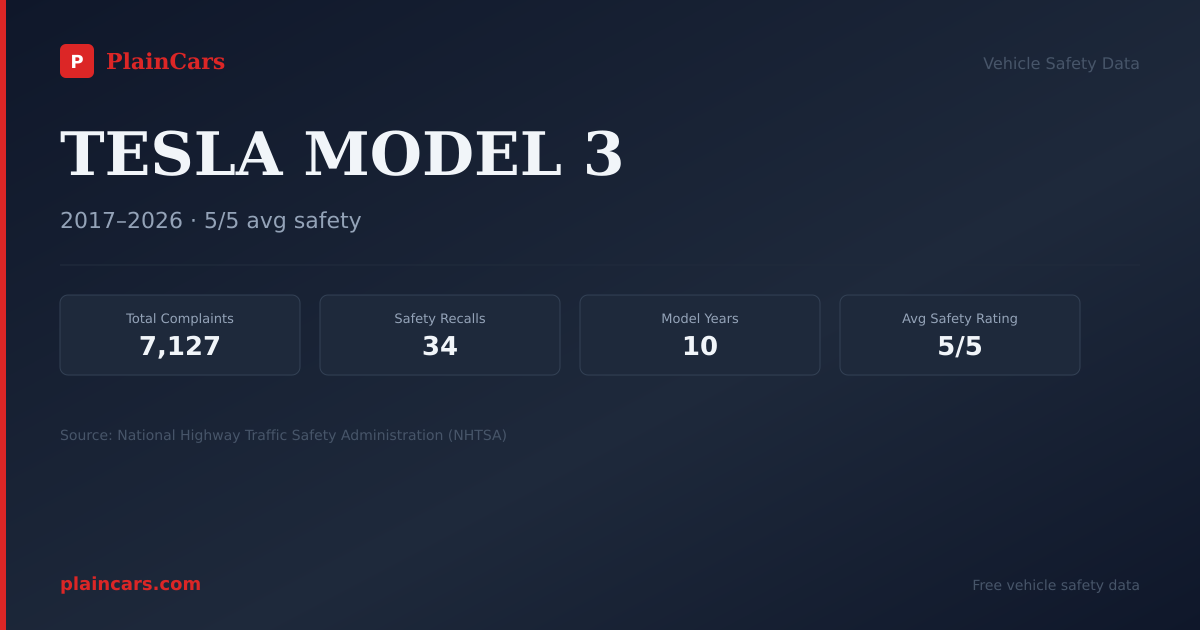
Total Complaints
1445 filings
Tesla Model 3 · model year
1445 NHTSA complaints, 97 crash reports, and 17 recall campaigns listed for this cohort. A VIN lookup is required to determine whether a specific vehicle has an unrepaired recall.
NHTSA overall rating
5 / 5 ★
New Car Assessment Program
The verdict
The 2022 Tesla Model 3 pairs above-average complaint volume with a top NHTSA safety rating.
The 2022TeslaModel 3 carries 1445 consumer safety complaints in NHTSA's Office of Defects Investigation database for this specific model-year cohort. Within that volume, owners reported 97 crashes, 5 fires, 71 injuries, and 1 fatality. For crash performance, NHTSA's New Car Assessment Program gave this cohort an overall 5/5 rating, with 5/5 front crash, 5/5 side crash, and 5/5 rollover scores derived from standardized barrier and dynamic tests.
The most frequently selected component label in reports for the 2022 Model 3 is forward collision avoidance: adaptive cruise control with 381 filings, followed by forward collision avoidance: automatic emergency braking (303) and service brakes (166). Complaint categories reflect owner reports and intake categorization; they do not establish a defect pattern or cause. This cohort has 17 NHTSA recall campaigns listed below. Enter a VIN in NHTSA's official recall lookup to determine whether a specific vehicle has an unrepaired recall.
NHTSA currently has 5 investigation files overlapping the 2022 Model 3. Owners comparing this cohort against neighboring years should read the complaint-by-year trend as report volume, not a causal diagnosis. Use the related-complaint feed and the official recall lookup when researching a specific vehicle.
PlainCars' own composite of NHTSA NCAP crash-test ratings and rollover-risk assessment, each dimension normalized against the federal scale or the full national model-year corpus. Not an official NHTSA figure, and not a substitute for a specific vehicle's VIN-level recall check.
Total Complaints
1445 filings
Crashes Reported
97 reports
Source
NHTSA ODI
Federal complaints database
Above median complaint volume, review patterns below.
| Component | Count |
|---|---|
| FORWARD COLLISION AVOIDANCE: ADAPTIVE CRUISE CONTROL | 381 |
| FORWARD COLLISION AVOIDANCE: AUTOMATIC EMERGENCY BRAKING | 303 |
| SERVICE BRAKES | 166 |
| VEHICLE SPEED CONTROL | 160 |
| FORWARD COLLISION AVOIDANCE: WARNINGS | 91 |
| UNKNOWN OR OTHER | 83 |
| ELECTRICAL SYSTEM | 42 |
| STEERING | 29 |
| LANE DEPARTURE: ASSIST | 26 |
| LANE DEPARTURE: BLIND SPOT DETECTION | 13 |
| POWER TRAIN | 13 |
| VISIBILITY/WIPER | 12 |
| SEAT BELTS | 12 |
| WHEELS | 11 |
| AIR BAGS | 10 |
ELECTRICAL SYSTEM: INSTRUMENT CLUSTER/PANEL
Tesla, Inc. (Tesla) is recalling certain 2012-2023 Model S, 2016-2024 Model X, 2017-2023 Model 3, 2019-2024 Model Y, and 2024 Cybertruck vehicles. An incorrect font size is displayed on the instrument panel for the Brake, Park, and Antilock Brake System (ABS) warning lights. As such, these vehicle
SEAT BELTS:FRONT:WARNING LIGHT/DEVICES
Tesla, Inc. (Tesla) is recalling certain 2012-2024 Model S, 2015-2024 Model X, 2017-2023 Model 3, and 2020-2023 Model Y vehicles. In the event of an unbelted driver, the seat belt warning light and audible chime may not activate as intended. As such, these vehicles fail to comply with the requirem
FORWARD COLLISION AVOIDANCE: WARNINGS:EXTERNAL/PEDESTRIAN ALERT
Tesla, Inc. (Tesla) is recalling certain 2013, 2018-2021 Model S, 2020-2021 Model X, 2018-2022 Model 3, and 2020-2022 Model Y vehicles. A factory reset muted the Pedestrian Warning System (PWS) sounds. As such, these vehicles fail to comply with the requirements of Federal Motor Vehicle Safety Sta
ELECTRICAL SYSTEM:ADAS:AUTONOMOUS/SELF DRIVING:SOFTWARE
Tesla, Inc. (Tesla) is recalling certain 2016-2022 Model S and Model X, 2017-2022 Model 3, and 2020-2022 Model Y vehicles. The "rolling stop" functionality available as part of the Full Self-Driving (Beta) software may allow the vehicle to travel through an all-way stop intersection without first c
LATCHES/LOCKS/LINKAGES:HOOD:LATCH
Tesla, Inc. (Tesla) is recalling certain 2021-2024 Model 3, Model S, Model X, and 2020-2024 Model Y vehicles. The hood latch assembly may fail to detect an unlatched hood condition after the hood has been opened.
SEAT BELTS:REAR/OTHER:ANCHORAGE
Tesla, Inc. (Tesla) is recalling certain 2017-2022 Model 3 vehicles. The second-row left seat belt buckle and second-row center seat belt anchor may have been incorrectly reassembled during vehicle service.
VISIBILITY:POWER WINDOW DEVICES AND CONTROLS
Tesla, Inc. (Tesla) is recalling certain 2017-2022 Model 3, 2020-2022 Model Y, and 2021-2022 Model S and Model X vehicles. The window automatic reversal system may not react correctly after detecting an obstruction. As such, these vehicles fail to comply with the requirements of Federal Motor Vehi
ELECTRICAL SYSTEM: INSTRUMENT CLUSTER/PANEL
Tesla, Inc. (Tesla) is recalling certain 2018-2022 Model 3 Performance vehicles. The unit of speed (mph or km/h) may fail to display on the speedometer while in Track Mode. As such, these vehicles fail to comply with the requirements of Federal Motor Vehicle Safety Standard number 101, "Control an
TIRES:PRESSURE MONITORING AND REGULATING SYSTEMS
Tesla, Inc. (Tesla) is recalling certain 2024 Cybertruck, 2017-2025 Model 3, and 2020-2025 Model Y vehicles. The tire pressure monitoring system (TPMS) warning light may not remain illuminated between drive cycles, failing to warn the driver of low tire pressure. As such, these vehicles fail to co
STEERING:AUTOMATED/ADAPTIVE STEERING
Tesla, Inc. (Tesla) is recalling certain 2016-2023 Model S, Model X, 2017-2023 Model 3, and 2020-2023 Model Y vehicles equipped with Full Self-Driving Beta (FSD Beta) software or pending installation. The FSD Beta system may allow the vehicle to act unsafe around intersections, such as traveling st
ELECTRICAL SYSTEM:ADAS:AUTONOMOUS/SELF DRIVING:SOFTWARE
Tesla, Inc. (Tesla) is recalling 2012-2023 Model S, 2016-2023 Model X, 2017-2023 Model 3, and 2020-2023 Model Y vehicles equipped with all versions of Autosteer leading up to the version(s) that contains the recall remedy. In certain circumstances when Autosteer is engaged, the prominence and scope
ELECTRICAL SYSTEM:SOFTWARE
Tesla, Inc. (Tesla) is recalling certain 2020-2022 Model Y, Model X, Model S, and 2017-2022 Model 3 vehicles. The Boombox function allows sounds to be played through an external speaker while the vehicle is in motion, which may obscure the Pedestrian Warning System (PWS) sounds. As such, these veh
BACK OVER PREVENTION:SOFTWARE
Tesla, Inc. (Tesla) is recalling certain 2017, 2021-2023 Model 3, 2020-2023 Model Y, 2021-2023 Model S, and Model X vehicles operating software version 2026.8.6. The rearview camera image may be delayed when the vehicle is placed in reverse. As such, these vehicles fail to comply with the requiremen
ELECTRICAL SYSTEM:SOFTWARE
Tesla, Inc. (Tesla) is recalling certain 2020-2022 Model S, Model X, Model Y, and 2017-2022 Model 3 vehicles. The Boombox function allows sounds to be played through an external speaker while the vehicle is in motion, which may obscure the Pedestrian Warning System (PWS) sounds. As such, these veh
BACK OVER PREVENTION:DISPLAY FUNCTION
Tesla, Inc. (Tesla) is recalling certain 2021-2022 Model S, Model X, and 2022 Model 3 and Model Y vehicles operating certain firmware releases. The infotainment central processing unit (CPU) may overheat during the preparation or process of fast-charging, causing the CPU to lag or restart.
ELECTRICAL SYSTEM:SOFTWARE
Tesla, Inc. (Tesla) is recalling certain 2021-2022 Model 3, Model S, Model X, and 2020-2022 Model Y vehicles. A software error may cause a valve in the heat pump to open unintentionally and trap the refrigerant inside the evaporator, resulting in decreased defrosting performance. As such, these ve
ELECTRICAL SYSTEM:SOFTWARE
Tesla, Inc. (Tesla) is recalling certain 2021-2022 Model S and Model X, 2017-2022 Model 3, and 2020-2022 Model Y vehicles. The audible chime may not activate when the vehicle starts and the driver has not buckled their seat belt. As such, these vehicles fail to comply with the requirements of Fede
While I was making a left turn my steering wheel suddenly got stuck. A vehicle almost hit me.
RECURRING 12V LOW-VOLTAGE SYSTEM FAILURE AND DEFECTIVE REAR DEFROSTER HEATER GRID VEHICLE: 2022 Tesla Model 3 (VIN: [XXX] ). ODOMETER: 114,093 miles at time of third service visit. SUMMARY OF DEFECT: Vehicle has experienced recurring low-voltage (12V) system alerts since late December 2025. The 12V battery has been replaced three times by Tesla service. After each replacement, the low-voltage alerts return within days. Tesla's diagnostic system detected a DCR (DC resistance) reading of 16.8 milliohms against a threshold of 16 milliohms, indicating the battery's internal resistance is too high for the vehicle's electrical system to function properly. A brand-new 12V battery showed "Degraded - Replace" status within one week of installation. These low-voltage errors did not exist before Tesla replaced the 12V battery during the first service visit. DIAGNOSTIC FINDINGS: During the third service visit (February 2026), Tesla technician performed a resistance check on the rear defroster heat
Tesla Full Self-Driving (FSD) drove the vehicle onto a curb inadvertently, a few days after a software update. The incident caused a scratch to the wheel and a cut in the tire. Tesla has refused to cover the repair, stating that FSD requires driver attention. The issue is that the vehicle had never driven into a curb on a 90-degree turn before. I had my hands on the wheel and did not anticipate the software making an incorrect decision and striking the curb. Full Self-Driving was engaged at the time, and the software made an incorrect calculation that resulted in the impact. Tesla should replace the damaged tire and repair the wheel. I have the 1 min recording of the incident but could not upload the video due ot its size being more than 10 MB.
When cabin heat is enabled, visible vapor/smoke emits from the front trunk area under the windshield cowl and is pulled directly into the cabin through the HVAC intake. The vapor has a chemical/sweet odor consistent with coolant or refrigerant. Smoke enters the passenger compartment, especially when stopped or idling. This occurs repeatedly in cold temperatures and stops immediately when HVAC heat is turned off. No warning lights appear. This appears to be a heat pump or coolant system leak upstream of the cabin intake, allowing chemical fumes to enter the cabin air stream. Occupants are exposed to fumes while driving. This is a safety concern due to inhalation risk and lack of driver warning.
When cabin heat is enabled, visible vapor/smoke emits from the front trunk area under the windshield cowl and is pulled directly into the cabin through the HVAC intake. The vapor has a chemical/sweet odor consistent with coolant or refrigerant. Smoke enters the passenger compartment, especially when stopped or idling. This occurs repeatedly in cold temperatures and stops immediately when HVAC heat is turned off. No warning lights appear. This appears to be a heat pump or coolant system leak upstream of the cabin intake, allowing chemical fumes to enter the cabin air stream. Occupants are exposed to fumes while driving. This is a safety concern due to inhalation risk and lack of driver warning.
When cabin heat is enabled, visible vapor/smoke emits from the front trunk area under the windshield cowl and is pulled directly into the cabin through the HVAC intake. The vapor has a chemical/sweet odor consistent with coolant or refrigerant. Smoke enters the passenger compartment, especially when stopped or idling. This occurs repeatedly in cold temperatures and stops immediately when HVAC heat is turned off. No warning lights appear. This appears to be a heat pump or coolant system leak upstream of the cabin intake, allowing chemical fumes to enter the cabin air stream. Occupants are exposed to fumes while driving. This is a safety concern due to inhalation risk and lack of driver warning.
While driving, the center display intermittently goes completely black. When this occurs, I lose access to the speedometer and all driver information. The issue has been ongoing and progressively worsening. The vehicle was purchased new. The issue was reported during the warranty period and initially attributed to software updates. A recent service visit confirmed the vehicle computer is failing, and the issue immediately recurred after pickup. Loss of speed and driver information while driving creates a safety concern.
While driving, the center display intermittently goes completely black. When this occurs, I lose access to the speedometer and all driver information. The issue has been ongoing and progressively worsening. The vehicle was purchased new. The issue was reported during the warranty period and initially attributed to software updates. A recent service visit confirmed the vehicle computer is failing, and the issue immediately recurred after pickup. Loss of speed and driver information while driving creates a safety concern.
While driving, the center display intermittently goes completely black. When this occurs, I lose access to the speedometer and all driver information. The issue has been ongoing and progressively worsening. The vehicle was purchased new. The issue was reported during the warranty period and initially attributed to software updates. A recent service visit confirmed the vehicle computer is failing, and the issue immediately recurred after pickup. Loss of speed and driver information while driving creates a safety concern.
This car uses auto-dimming rear view and side mirrors. However, the rear view mirror is only able to be dimmed automatically, or be disabled in the settings. The issue is that the dimming is not based on a light sensor at all, it is merely timed to dim around 30 minutes after sunset and return to normal 30 minutes before sunrise. I have confirmed this timing on many drives and it is repeatable. The safety concern is that there is no way to manually dim the rear view mirror, which is a big issue around sunrise and sunset when cars headlights turn on before the mirrors dim. This is especially an issue with larger trucks behind a sedan like my Model 3. The only option I have to fight the blinding glare from headlights is to manually move my mirror so that I can no longer see out of the rear window, which makes lane changes much more dangerous.
Submitted Under 49 CFR §552.3 Request for Defect Investigation & Safety Recall Tesla Model 3 / Model Y: Interior High-Voltage Heater Fire Hazard, Missing Firewall, and Entrapment Due to Electronic Door Failures. My 2022 Tesla Model 3 experienced an interior flash fire caused by a design defect. Tesla placed the high-voltage PTC cabin heater and HV wiring inside the dashboard with no firewall. After a crash, I saw a straight “strip flame” shoot out of the HVAC dash vent, exactly like a gas heater. The fire began INSIDE the dash/HVAC ducting within seconds of impact, not from the battery. This shows an arc-flash failure of the HV heater or wiring inside the cabin. The flame entered the cabin instantly because there is no firewall separating HV components from occupants. During the fire, all electronic door releases failed. Tesla hides the manual front releases and provides NO rear mechanical releases. I was trapped inside a burning cabin and suffered major injuries trying to esc
The vehicle has a manufacturing defect in the charge port body seal allowing water intrusion into the vehicle cabin and near high-voltage charging components. This has resulted in dampness and potential mold growth, posing a respiratory health hazard to occupants.
The vehicle has a manufacturing defect in the charge port body seal allowing water intrusion into the vehicle cabin and near high-voltage charging components. This has resulted in dampness and potential mold growth, posing a respiratory health hazard to occupants.
The vehicle has a manufacturing defect in the charge port body seal allowing water intrusion into the vehicle cabin and near high-voltage charging components. This has resulted in dampness and potential mold growth, posing a respiratory health hazard to occupants.
All safety and driver-assistance systems on my 2022 Tesla Model 3 failed due to an internal short in the vehicle’s computer, as confirmed in writing by Tesla’s technician. All cameras (rear, side, front) are non-functional, navigation does not work, and all ADAS features (Autopilot, lane-keeping, collision warning, blind-spot monitoring, emergency braking, etc.) are disabled. The vehicle has no visibility when reversing and no active safety protections while driving. Tesla documented the cause as an internal computer failure, not related to damage or misuse. This creates a dangerous condition on public roads since the car loses all safety systems. Tesla quoted ~$2,900 for a new computer even though the failure involves critical safety components. This may indicate a broader safety defect.
All safety and driver-assistance systems on my 2022 Tesla Model 3 failed due to an internal short in the vehicle’s computer, as confirmed in writing by Tesla’s technician. All cameras (rear, side, front) are non-functional, navigation does not work, and all ADAS features (Autopilot, lane-keeping, collision warning, blind-spot monitoring, emergency braking, etc.) are disabled. The vehicle has no visibility when reversing and no active safety protections while driving. Tesla documented the cause as an internal computer failure, not related to damage or misuse. This creates a dangerous condition on public roads since the car loses all safety systems. Tesla quoted ~$2,900 for a new computer even though the failure involves critical safety components. This may indicate a broader safety defect.
All safety and driver-assistance systems on my 2022 Tesla Model 3 failed due to an internal short in the vehicle’s computer, as confirmed in writing by Tesla’s technician. All cameras (rear, side, front) are non-functional, navigation does not work, and all ADAS features (Autopilot, lane-keeping, collision warning, blind-spot monitoring, emergency braking, etc.) are disabled. The vehicle has no visibility when reversing and no active safety protections while driving. Tesla documented the cause as an internal computer failure, not related to damage or misuse. This creates a dangerous condition on public roads since the car loses all safety systems. Tesla quoted ~$2,900 for a new computer even though the failure involves critical safety components. This may indicate a broader safety defect.
During a head-on collision on [XXX] in Georgia, the electrical system in my 2022 Tesla Model 3 lost power and the electric door releases stopped functioning. The vehicle interior caught fire and I was trapped inside. I was unaware of the location of the hidden mechanical emergency door release because it is not visibly labeled, not explained upon delivery, and not intuitive in an emergency. I was forced to climb to the back seat and break the rear passenger window with my legs to escape while the interior was burning. I suffered a broken hip, broken arm, and later required a full hip replacement. The mechanical emergency door release was concealed and unlabeled, resulting in entrapment during a fire, which is a violation of FMVSS 206 and presents a continuing and life-threatening safety hazard to all drivers and passengers. Tesla has not provided warnings, recall guidance, labeling, or owner education regarding how to exit the vehicle during a power-loss emergency. This defect can re
During a head-on collision on [XXX] in Georgia, the electrical system in my 2022 Tesla Model 3 lost power and the electric door releases stopped functioning. The vehicle interior caught fire and I was trapped inside. I was unaware of the location of the hidden mechanical emergency door release because it is not visibly labeled, not explained upon delivery, and not intuitive in an emergency. I was forced to climb to the back seat and break the rear passenger window with my legs to escape while the interior was burning. I suffered a broken hip, broken arm, and later required a full hip replacement. The mechanical emergency door release was concealed and unlabeled, resulting in entrapment during a fire, which is a violation of FMVSS 206 and presents a continuing and life-threatening safety hazard to all drivers and passengers. Tesla has not provided warnings, recall guidance, labeling, or owner education regarding how to exit the vehicle during a power-loss emergency. This defect can re
During a head-on collision on [XXX] in Georgia, the electrical system in my 2022 Tesla Model 3 lost power and the electric door releases stopped functioning. The vehicle interior caught fire and I was trapped inside. I was unaware of the location of the hidden mechanical emergency door release because it is not visibly labeled, not explained upon delivery, and not intuitive in an emergency. I was forced to climb to the back seat and break the rear passenger window with my legs to escape while the interior was burning. I suffered a broken hip, broken arm, and later required a full hip replacement. The mechanical emergency door release was concealed and unlabeled, resulting in entrapment during a fire, which is a violation of FMVSS 206 and presents a continuing and life-threatening safety hazard to all drivers and passengers. Tesla has not provided warnings, recall guidance, labeling, or owner education regarding how to exit the vehicle during a power-loss emergency. This defect can re
Emergency egress controls are not readily accessible and clearly identifiable.
Loss of steering control
Loss of steering control
Unexpected Brake Activation
Tesla Passenger Play
Data vintage: August 2026. Sources: NHTSA Office of Defects Investigation (ODI) complaints database, NHTSA recall campaign API, NHTSA NCAP crash-test ratings, and NHTSA FARS for fatality cross-reference.
Every figure on PlainCars is rendered directly from NHTSA complaint and safety data, no number is typed in by an editor. This year-specific record is rendered from NHTSA ODI, recall, and NCAP rows for the 2022 Tesla Model 3; no figure is typed in by an editor. See our editorial standards & corrections policy, the methodology behind these numbers, or report a data error. Data current as of August 2026.
Read our methodology - how this data is sourced, computed, and verified.