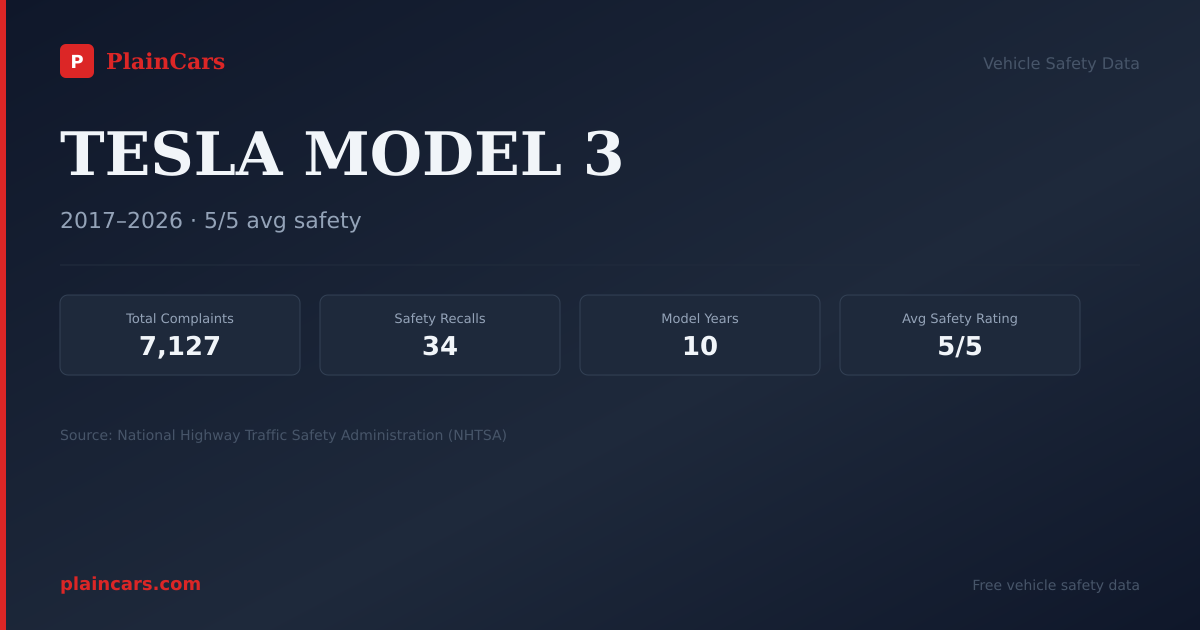
Total Complaints
1180 filings
Tesla Model 3 · model year
1180 NHTSA complaints, 78 crash reports, and 21 recall campaigns listed for this cohort. A VIN lookup is required to determine whether a specific vehicle has an unrepaired recall.
NHTSA overall rating
5 / 5 ★
New Car Assessment Program
The verdict
The 2021 Tesla Model 3 pairs above-average complaint volume with a top NHTSA safety rating.
The 2021TeslaModel 3 carries 1180 consumer safety complaints in NHTSA's Office of Defects Investigation database for this specific model-year cohort. Within that volume, owners reported 78 crashes, 9 fires, 41 injuries, and 6 fatalities. For crash performance, NHTSA's New Car Assessment Program gave this cohort an overall 5/5 rating, with 5/5 front crash, 5/5 side crash, and 5/5 rollover scores derived from standardized barrier and dynamic tests.
The most frequently selected component label in reports for the 2021 Model 3 is forward collision avoidance: adaptive cruise control with 275 filings, followed by forward collision avoidance: automatic emergency braking (224) and service brakes (123). Complaint categories reflect owner reports and intake categorization; they do not establish a defect pattern or cause. This cohort has 21 NHTSA recall campaigns listed below. Enter a VIN in NHTSA's official recall lookup to determine whether a specific vehicle has an unrepaired recall.
NHTSA currently has 5 investigation files overlapping the 2021 Model 3. Owners comparing this cohort against neighboring years should read the complaint-by-year trend as report volume, not a causal diagnosis. Use the related-complaint feed and the official recall lookup when researching a specific vehicle.
PlainCars' own composite of NHTSA NCAP crash-test ratings and rollover-risk assessment, each dimension normalized against the federal scale or the full national model-year corpus. Not an official NHTSA figure, and not a substitute for a specific vehicle's VIN-level recall check.
Total Complaints
1180 filings
Crashes Reported
78 reports
Source
NHTSA ODI
Federal complaints database
Above median complaint volume, review patterns below.
| Component | Count |
|---|---|
| FORWARD COLLISION AVOIDANCE: ADAPTIVE CRUISE CONTROL | 275 |
| FORWARD COLLISION AVOIDANCE: AUTOMATIC EMERGENCY BRAKING | 224 |
| SERVICE BRAKES | 123 |
| VEHICLE SPEED CONTROL | 119 |
| UNKNOWN OR OTHER | 89 |
| FORWARD COLLISION AVOIDANCE: WARNINGS | 72 |
| ELECTRICAL SYSTEM | 58 |
| VISIBILITY/WIPER | 28 |
| STEERING | 24 |
| LANE DEPARTURE: ASSIST | 18 |
| POWER TRAIN | 16 |
| STRUCTURE:BODY | 13 |
| LANE DEPARTURE: WARNING | 12 |
| SUSPENSION | 11 |
| SEAT BELTS | 11 |
ELECTRICAL SYSTEM: INSTRUMENT CLUSTER/PANEL
Tesla, Inc. (Tesla) is recalling certain 2012-2023 Model S, 2016-2024 Model X, 2017-2023 Model 3, 2019-2024 Model Y, and 2024 Cybertruck vehicles. An incorrect font size is displayed on the instrument panel for the Brake, Park, and Antilock Brake System (ABS) warning lights. As such, these vehicle
FORWARD COLLISION AVOIDANCE: SENSING SYSTEM: CAMERA
Tesla, Inc. (Tesla) is recalling certain 2017-2021 Model S, Model 3, Model X, and 2020-2021 Model Y vehicles operating software version 2021.36.5.2. A communication error may cause false forward-collision warning (FCW) or unexpected activation of the automatic emergency brake (AEB) system.
SEAT BELTS:FRONT:WARNING LIGHT/DEVICES
Tesla, Inc. (Tesla) is recalling certain 2012-2024 Model S, 2015-2024 Model X, 2017-2023 Model 3, and 2020-2023 Model Y vehicles. In the event of an unbelted driver, the seat belt warning light and audible chime may not activate as intended. As such, these vehicles fail to comply with the requirem
FORWARD COLLISION AVOIDANCE: WARNINGS:EXTERNAL/PEDESTRIAN ALERT
Tesla, Inc. (Tesla) is recalling certain 2013, 2018-2021 Model S, 2020-2021 Model X, 2018-2022 Model 3, and 2020-2022 Model Y vehicles. A factory reset muted the Pedestrian Warning System (PWS) sounds. As such, these vehicles fail to comply with the requirements of Federal Motor Vehicle Safety Sta
ELECTRICAL SYSTEM:ADAS:AUTONOMOUS/SELF DRIVING:SOFTWARE
Tesla, Inc. (Tesla) is recalling certain 2016-2022 Model S and Model X, 2017-2022 Model 3, and 2020-2022 Model Y vehicles. The "rolling stop" functionality available as part of the Full Self-Driving (Beta) software may allow the vehicle to travel through an all-way stop intersection without first c
AIR BAGS:SIDE/WINDOW:CURTAIN
Tesla, Inc. (Tesla) is recalling certain 2020-2021, 2023 Model 3 vehicles. The left and/or right side curtain air bag may have been improperly secured to the roof rail, which could result in a twisted air bag. As such, these vehicles fail to comply with the requirements of Federal Motor Vehicle Sa
SUSPENSION:CRITICAL FASTENERS
Tesla, Inc. (Tesla) is recalling certain 2020-2021 Model Y and 2019-2021 Model 3 vehicles. The front suspension lateral link fasteners may loosen, allowing the lateral link to separate from the sub-frame.
SERVICE BRAKES, HYDRAULIC:FOUNDATION COMPONENTS:DISC:CALIPER
Tesla, Inc. (Tesla) is recalling certain 2019-2021 Model 3 and 2020-2021 Model Y vehicles. The brake caliper bolts may be loose, allowing the brake caliper to separate and contact the wheel rim.
LATCHES/LOCKS/LINKAGES:HOOD:LATCH
Tesla, Inc. (Tesla) is recalling certain 2021-2024 Model 3, Model S, Model X, and 2020-2024 Model Y vehicles. The hood latch assembly may fail to detect an unlatched hood condition after the hood has been opened.
SEAT BELTS:REAR/OTHER:ANCHORAGE
Tesla, Inc. (Tesla) is recalling certain 2017-2022 Model 3 vehicles. The second-row left seat belt buckle and second-row center seat belt anchor may have been incorrectly reassembled during vehicle service.
VISIBILITY:POWER WINDOW DEVICES AND CONTROLS
Tesla, Inc. (Tesla) is recalling certain 2017-2022 Model 3, 2020-2022 Model Y, and 2021-2022 Model S and Model X vehicles. The window automatic reversal system may not react correctly after detecting an obstruction. As such, these vehicles fail to comply with the requirements of Federal Motor Vehi
ELECTRICAL SYSTEM: INSTRUMENT CLUSTER/PANEL
Tesla, Inc. (Tesla) is recalling certain 2018-2022 Model 3 Performance vehicles. The unit of speed (mph or km/h) may fail to display on the speedometer while in Track Mode. As such, these vehicles fail to comply with the requirements of Federal Motor Vehicle Safety Standard number 101, "Control an
TIRES:PRESSURE MONITORING AND REGULATING SYSTEMS
Tesla, Inc. (Tesla) is recalling certain 2024 Cybertruck, 2017-2025 Model 3, and 2020-2025 Model Y vehicles. The tire pressure monitoring system (TPMS) warning light may not remain illuminated between drive cycles, failing to warn the driver of low tire pressure. As such, these vehicles fail to co
STEERING:AUTOMATED/ADAPTIVE STEERING
Tesla, Inc. (Tesla) is recalling certain 2016-2023 Model S, Model X, 2017-2023 Model 3, and 2020-2023 Model Y vehicles equipped with Full Self-Driving Beta (FSD Beta) software or pending installation. The FSD Beta system may allow the vehicle to act unsafe around intersections, such as traveling st
ELECTRICAL SYSTEM:ADAS:AUTONOMOUS/SELF DRIVING:SOFTWARE
Tesla, Inc. (Tesla) is recalling 2012-2023 Model S, 2016-2023 Model X, 2017-2023 Model 3, and 2020-2023 Model Y vehicles equipped with all versions of Autosteer leading up to the version(s) that contains the recall remedy. In certain circumstances when Autosteer is engaged, the prominence and scope
ELECTRICAL SYSTEM:SOFTWARE
Tesla, Inc. (Tesla) is recalling certain 2020-2022 Model Y, Model X, Model S, and 2017-2022 Model 3 vehicles. The Boombox function allows sounds to be played through an external speaker while the vehicle is in motion, which may obscure the Pedestrian Warning System (PWS) sounds. As such, these veh
FORWARD COLLISION AVOIDANCE: AUTOMATIC EMERGENCY BRAKING
Tesla, Inc. (Tesla) is recalling certain 2020-2021 Model 3 and 2021 Model Y vehicles. The fisheye and narrow camera cable terminals were incorrectly installed in the cable harness connector, resulting in swapped camera views.
BACK OVER PREVENTION:SOFTWARE
Tesla, Inc. (Tesla) is recalling certain 2017, 2021-2023 Model 3, 2020-2023 Model Y, 2021-2023 Model S, and Model X vehicles operating software version 2026.8.6. The rearview camera image may be delayed when the vehicle is placed in reverse. As such, these vehicles fail to comply with the requiremen
ELECTRICAL SYSTEM:SOFTWARE
Tesla, Inc. (Tesla) is recalling certain 2020-2022 Model S, Model X, Model Y, and 2017-2022 Model 3 vehicles. The Boombox function allows sounds to be played through an external speaker while the vehicle is in motion, which may obscure the Pedestrian Warning System (PWS) sounds. As such, these veh
ELECTRICAL SYSTEM:SOFTWARE
Tesla, Inc. (Tesla) is recalling certain 2021-2022 Model 3, Model S, Model X, and 2020-2022 Model Y vehicles. A software error may cause a valve in the heat pump to open unintentionally and trap the refrigerant inside the evaporator, resulting in decreased defrosting performance. As such, these ve
ELECTRICAL SYSTEM:SOFTWARE
Tesla, Inc. (Tesla) is recalling certain 2021-2022 Model S and Model X, 2017-2022 Model 3, and 2020-2022 Model Y vehicles. The audible chime may not activate when the vehicle starts and the driver has not buckled their seat belt. As such, these vehicles fail to comply with the requirements of Fede
HVAC system which provides cooling/heating for all the systems including the powertrain, battery, inverters, Full-Self Driving computer malfunctions randomly shutting itself off due to a known issue of failing pressure and temperature sensors. Tesla is aware of this issue where the sensors may fail prematurely and in 2021 they issued a service bulletin SB-21-18-002. I was told It would be fixed with a software update... In other words it was never fixed. Now my car says that cooling and heating may randomly be unavailable due to invalid readings from the pressure and temperature sensors. They want me to pay to have the sensors replaced despite them acknowledging that they have a defect causing premature failure. This issue is safety related because in the event that I was supercharging and the HVAC system shuts down it could potentially lead to a battery fire or thermal runaway. Not to mention that the car left me without heat in subzero temperatures on a roadtrip.
I wrote several months ago about my 2021 tesla model 3 that the rear doors do not have any mechanical door handle release and is a big safety concern also how can a manufacturer get away with this and also not informing the consumer that anyone sat in the back may perish if involved in a accident and can't get out.
Full self driving system (fsd) has ran a red light twice. It slows almost to a stop then takes off.
The driver’s side belt makes a “click” sound when latch is inserted into the locking component but at times does NOT remain lock and the belt is released shortly after. The issue is sporadic. The belt is released with a low amount of force i.e. adjusting the body in the seat or twisting body to look over the shoulder
The high-voltage traction battery pack has failed twice on my 2021 Tesla Model 3, both times while the vehicle was under the original battery warranty. The failures occurred on: • 08/30/2022 at approximately 15,100 miles • 11/08/2025 at approximately 57,222 miles The exact error code by Tesla was bms_a079, which doesn’t let the vehicle charge at all. The vehicle was drivable before the battery depleted. The defect has been reproduced, confirmed, and repaired by the manufacturer twice, but the same critical system has failed again after replacement, raising concern of a recurring defect. The failed component is the high-voltage battery pack. The component was inspected by Tesla, and in both cases Tesla confirmed battery failure and replaced the entire HV battery pack with a remanufactured unit under warranty. The failed components were retained by Tesla and are available for inspection by the manufacturer.
HVAC system went out at 7500ish miles. It was repaired under warranty, and a "fix" was administered through software by tesla. My HVAC has gone out again at 84k miles FOR THE SAME REASON. about 77k miles after it was just repaired. Quick check online. this is still a very common issue. No heat creates a significant safety hazard due to lack of the ability to defrost the vehicle or frost building up on cold days.
HVAC system went out at 7500ish miles. It was repaired under warranty, and a "fix" was administered through software by tesla. My HVAC has gone out again at 84k miles FOR THE SAME REASON. about 77k miles after it was just repaired. Quick check online. this is still a very common issue. No heat creates a significant safety hazard due to lack of the ability to defrost the vehicle or frost building up on cold days.
To Whom It May Concern, I am submitting this complaint to report a serious and potentially dangerous safety defect affecting my 2021 Tesla Model 3 Performance. After exposure to heavy rain or wet conditions, the vehicle’s horn completely stops functioning. The failure occurs regardless of the activation method—neither pressing the steering wheel horn nor using the horn via the mobile app produces any sound. The horn remains nonfunctional even though the vehicle is otherwise operable. This issue has occurred after the vehicle becomes wet due to rain and appears to be related to moisture intrusion or an electrical/design flaw. Once the failure occurs, the driver fully loses the ability to use the horn for warnings or emergency signaling. This is a critical safety concern. The horn is a federally required safety device and is essential for alerting pedestrians, cyclists, and other drivers to avoid collisions. Losing horn functionality significantly increases the risk of accidents,
To Whom It May Concern, I am submitting this complaint to report a serious and potentially dangerous safety defect affecting my 2021 Tesla Model 3 Performance. After exposure to heavy rain or wet conditions, the vehicle’s horn completely stops functioning. The failure occurs regardless of the activation method—neither pressing the steering wheel horn nor using the horn via the mobile app produces any sound. The horn remains nonfunctional even though the vehicle is otherwise operable. This issue has occurred after the vehicle becomes wet due to rain and appears to be related to moisture intrusion or an electrical/design flaw. Once the failure occurs, the driver fully loses the ability to use the horn for warnings or emergency signaling. This is a critical safety concern. The horn is a federally required safety device and is essential for alerting pedestrians, cyclists, and other drivers to avoid collisions. Losing horn functionality significantly increases the risk of accidents,
There is no manual door release for the rear doors. Thus rear passengers are at risk should the electrical system fail in a crash. Tesla should be required to provide a modification that allows rear passengers to manually open the rear doors.
After Tesla replaced my high voltage battery in May of 2024 all of the following started to happen. Prior to the replacement none of these issues were present. While driving under normal conditions, my 2021 Tesla suddenly and violently steered into an oncoming lane or toward the roadside without any driver input. The steering wheel physically turned on its own with force. Full Self-Driving was NOT engaged at the time of the incident. This was not lane assist correction and occurred without warning. Importantly, the vehicle did NOT issue a warning at the time of the steering event. A “Take Control Immediately” message appeared several minutes AFTER the incident, not before or during, indicating a delayed or failed system response. This defect began immediately after a High-Voltage Battery replacement performed by Tesla Service in May 2024 and has occurred multiple times since. The incident presents a serious safety risk, including loss of vehicle control, roadway departure, or head
After Tesla replaced my high voltage battery in May of 2024 all of the following started to happen. Prior to the replacement none of these issues were present. While driving under normal conditions, my 2021 Tesla suddenly and violently steered into an oncoming lane or toward the roadside without any driver input. The steering wheel physically turned on its own with force. Full Self-Driving was NOT engaged at the time of the incident. This was not lane assist correction and occurred without warning. Importantly, the vehicle did NOT issue a warning at the time of the steering event. A “Take Control Immediately” message appeared several minutes AFTER the incident, not before or during, indicating a delayed or failed system response. This defect began immediately after a High-Voltage Battery replacement performed by Tesla Service in May 2024 and has occurred multiple times since. The incident presents a serious safety risk, including loss of vehicle control, roadway departure, or head
After Tesla replaced my high voltage battery in May of 2024 all of the following started to happen. Prior to the replacement none of these issues were present. While driving under normal conditions, my 2021 Tesla suddenly and violently steered into an oncoming lane or toward the roadside without any driver input. The steering wheel physically turned on its own with force. Full Self-Driving was NOT engaged at the time of the incident. This was not lane assist correction and occurred without warning. Importantly, the vehicle did NOT issue a warning at the time of the steering event. A “Take Control Immediately” message appeared several minutes AFTER the incident, not before or during, indicating a delayed or failed system response. This defect began immediately after a High-Voltage Battery replacement performed by Tesla Service in May 2024 and has occurred multiple times since. The incident presents a serious safety risk, including loss of vehicle control, roadway departure, or head
-- Summarized Explanation The automatic windshield wiper system behaves unpredictably and creates unsafe driving conditions. Wipers frequently activate when there is no rain, operate at excessive speeds during light rain, and, most critically, fail to activate during active rainfall. These failures reduce driver visibility and increase the risk of a motor vehicle crash. Automatic wipers are forcibly enabled whenever cruise control or Autopilot is activated, regardless of weather conditions. This requires the driver to repeatedly adjust or disable the wipers while driving. Sudden transitions to maximum speed during light rain are distracting and divert attention from the roadway, increasing cognitive load during vehicle operation. -- Attempted Remedies •Replaced windshield wipers multiple times using different manufacturers •Cleaned forward-facing camera/rain detection area •Applied windshield water-repellent treatments •Installed approximately 30–50 over-the-air software up
Central computer (motherboard), cameras (front/rear/side), autopilot/auto steer system. Error code: APS_w132. Description of Problem: On or around [XXX], Tesla pushed a mandatory over-the-air software update to my vehicle. Immediately after, multiple safety-critical systems failed: all cameras (including backup) became intermittent or non-functional, auto steer/autopilot stopped working, and the car emitted constant distracting beeping alerts due to a critical motherboard failure. This made driving hazardous—impaired visibility for parking/reversing, loss of collision avoidance features, and constant audio distractions that could lead to accidents. I had to drive in this unsafe condition for weeks while waiting for service. Tesla attempted a remote fix but it failed. I scheduled service on November 19 for December 3 (19-day delay). Diagnostics confirmed the update induced the hardware failure, a known issue reported by other 2021 Model 3 owners on forums like Reddit (e.g., software b
Central computer (motherboard), cameras (front/rear/side), autopilot/auto steer system. Error code: APS_w132. Description of Problem: On or around [XXX], Tesla pushed a mandatory over-the-air software update to my vehicle. Immediately after, multiple safety-critical systems failed: all cameras (including backup) became intermittent or non-functional, auto steer/autopilot stopped working, and the car emitted constant distracting beeping alerts due to a critical motherboard failure. This made driving hazardous—impaired visibility for parking/reversing, loss of collision avoidance features, and constant audio distractions that could lead to accidents. I had to drive in this unsafe condition for weeks while waiting for service. Tesla attempted a remote fix but it failed. I scheduled service on November 19 for December 3 (19-day delay). Diagnostics confirmed the update induced the hardware failure, a known issue reported by other 2021 Model 3 owners on forums like Reddit (e.g., software b
Central computer (motherboard), cameras (front/rear/side), autopilot/auto steer system. Error code: APS_w132. Description of Problem: On or around [XXX], Tesla pushed a mandatory over-the-air software update to my vehicle. Immediately after, multiple safety-critical systems failed: all cameras (including backup) became intermittent or non-functional, auto steer/autopilot stopped working, and the car emitted constant distracting beeping alerts due to a critical motherboard failure. This made driving hazardous—impaired visibility for parking/reversing, loss of collision avoidance features, and constant audio distractions that could lead to accidents. I had to drive in this unsafe condition for weeks while waiting for service. Tesla attempted a remote fix but it failed. I scheduled service on November 19 for December 3 (19-day delay). Diagnostics confirmed the update induced the hardware failure, a known issue reported by other 2021 Model 3 owners on forums like Reddit (e.g., software b
The car, with no known or evident driver, stopped the lane awareness, cruise control, etc. All of those just stopped working and per Tesla that's expected which is surprising since it's all part of the safety systems. The car's visual cues stopped identifying lanes and as a byproduct of that, none of the dependent features work.
The car, with no known or evident driver, stopped the lane awareness, cruise control, etc. All of those just stopped working and per Tesla that's expected which is surprising since it's all part of the safety systems. The car's visual cues stopped identifying lanes and as a byproduct of that, none of the dependent features work.
The car, with no known or evident driver, stopped the lane awareness, cruise control, etc. All of those just stopped working and per Tesla that's expected which is surprising since it's all part of the safety systems. The car's visual cues stopped identifying lanes and as a byproduct of that, none of the dependent features work.
Emergency egress controls are not readily accessible and clearly identifiable.
Loss of steering control
Loss of steering control
Unexpected Brake Activation
Tesla Passenger Play
Data vintage: August 2026. Sources: NHTSA Office of Defects Investigation (ODI) complaints database, NHTSA recall campaign API, NHTSA NCAP crash-test ratings, and NHTSA FARS for fatality cross-reference.
Every figure on PlainCars is rendered directly from NHTSA complaint and safety data, no number is typed in by an editor. This year-specific record is rendered from NHTSA ODI, recall, and NCAP rows for the 2021 Tesla Model 3; no figure is typed in by an editor. See our editorial standards & corrections policy, the methodology behind these numbers, or report a data error. Data current as of August 2026.
Read our methodology - how this data is sourced, computed, and verified.