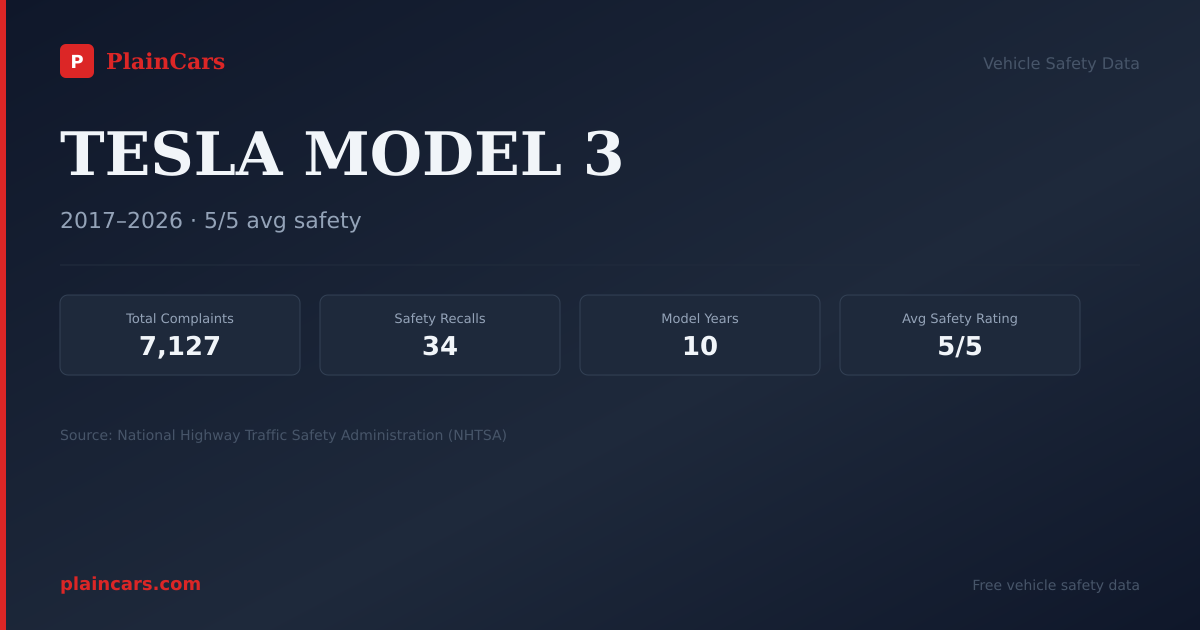
Total Complaints
994 filings
Tesla Model 3 · model year
994 NHTSA complaints, 93 crash reports, and 21 recall campaigns listed for this cohort. A VIN lookup is required to determine whether a specific vehicle has an unrepaired recall.
NHTSA overall rating
5 / 5 ★
New Car Assessment Program
The verdict
The 2019 Tesla Model 3 pairs above-average complaint volume with a top NHTSA safety rating.
The 2019TeslaModel 3 carries 994 consumer safety complaints in NHTSA's Office of Defects Investigation database for this specific model-year cohort. Within that volume, owners reported 93 crashes, 10 fires, 31 injuries, and 10 fatalities. For crash performance, NHTSA's New Car Assessment Program gave this cohort an overall 5/5 rating, with 5/5 front crash, 5/5 side crash, and 5/5 rollover scores derived from standardized barrier and dynamic tests.
The most frequently selected component label in reports for the 2019 Model 3 is forward collision avoidance: adaptive cruise control with 122 filings, followed by electrical system (82) and forward collision avoidance: automatic emergency braking (75). Complaint categories reflect owner reports and intake categorization; they do not establish a defect pattern or cause. This cohort has 21 NHTSA recall campaigns listed below. Enter a VIN in NHTSA's official recall lookup to determine whether a specific vehicle has an unrepaired recall.
NHTSA currently has 5 investigation files overlapping the 2019 Model 3. Owners comparing this cohort against neighboring years should read the complaint-by-year trend as report volume, not a causal diagnosis. Use the related-complaint feed and the official recall lookup when researching a specific vehicle.
PlainCars' own composite of NHTSA NCAP crash-test ratings and rollover-risk assessment, each dimension normalized against the federal scale or the full national model-year corpus. Not an official NHTSA figure, and not a substitute for a specific vehicle's VIN-level recall check.
Total Complaints
994 filings
Crashes Reported
93 reports
Source
NHTSA ODI
Federal complaints database
Above median complaint volume, review patterns below.
| Component | Count |
|---|---|
| FORWARD COLLISION AVOIDANCE: ADAPTIVE CRUISE CONTROL | 122 |
| ELECTRICAL SYSTEM | 82 |
| FORWARD COLLISION AVOIDANCE: AUTOMATIC EMERGENCY BRAKING | 75 |
| UNKNOWN OR OTHER | 73 |
| SUSPENSION | 73 |
| AIR BAGS | 70 |
| VEHICLE SPEED CONTROL | 69 |
| SERVICE BRAKES | 58 |
| LANE DEPARTURE: ASSIST | 58 |
| STEERING | 51 |
| SEAT BELTS | 45 |
| SEATS | 38 |
| VISIBILITY/WIPER | 24 |
| FORWARD COLLISION AVOIDANCE: WARNINGS | 22 |
| STRUCTURE:BODY | 19 |
SUSPENSION:FRONT
Tesla, Inc. (Tesla) is recalling certain 2018-2019 Model 3 vehicles. The front suspension lateral link fasteners may loosen, allowing the lateral link to separate from the sub-frame.
ELECTRICAL SYSTEM: INSTRUMENT CLUSTER/PANEL
Tesla, Inc. (Tesla) is recalling certain 2012-2023 Model S, 2016-2024 Model X, 2017-2023 Model 3, 2019-2024 Model Y, and 2024 Cybertruck vehicles. An incorrect font size is displayed on the instrument panel for the Brake, Park, and Antilock Brake System (ABS) warning lights. As such, these vehicle
FORWARD COLLISION AVOIDANCE: SENSING SYSTEM: CAMERA
Tesla, Inc. (Tesla) is recalling certain 2017-2021 Model S, Model 3, Model X, and 2020-2021 Model Y vehicles operating software version 2021.36.5.2. A communication error may cause false forward-collision warning (FCW) or unexpected activation of the automatic emergency brake (AEB) system.
SEAT BELTS:FRONT:WARNING LIGHT/DEVICES
Tesla, Inc. (Tesla) is recalling certain 2012-2024 Model S, 2015-2024 Model X, 2017-2023 Model 3, and 2020-2023 Model Y vehicles. In the event of an unbelted driver, the seat belt warning light and audible chime may not activate as intended. As such, these vehicles fail to comply with the requirem
FORWARD COLLISION AVOIDANCE: WARNINGS:EXTERNAL/PEDESTRIAN ALERT
Tesla, Inc. (Tesla) is recalling certain 2013, 2018-2021 Model S, 2020-2021 Model X, 2018-2022 Model 3, and 2020-2022 Model Y vehicles. A factory reset muted the Pedestrian Warning System (PWS) sounds. As such, these vehicles fail to comply with the requirements of Federal Motor Vehicle Safety Sta
ELECTRICAL SYSTEM:ADAS:AUTONOMOUS/SELF DRIVING:SOFTWARE
Tesla, Inc. (Tesla) is recalling certain 2016-2022 Model S and Model X, 2017-2022 Model 3, and 2020-2022 Model Y vehicles. The "rolling stop" functionality available as part of the Full Self-Driving (Beta) software may allow the vehicle to travel through an all-way stop intersection without first c
SUSPENSION:CRITICAL FASTENERS
Tesla, Inc. (Tesla) is recalling certain 2020-2021 Model Y and 2019-2021 Model 3 vehicles. The front suspension lateral link fasteners may loosen, allowing the lateral link to separate from the sub-frame.
SEAT BELTS
Tesla, Inc. (Tesla) is recalling certain 2018-2020 Model 3 and 2019-2021 Model Y vehicles. One or both fasteners that secure the front seat shoulder belt to the b-pillar may not be properly attached.
SERVICE BRAKES, HYDRAULIC:FOUNDATION COMPONENTS:DISC:CALIPER
Tesla, Inc. (Tesla) is recalling certain 2019-2021 Model 3 and 2020-2021 Model Y vehicles. The brake caliper bolts may be loose, allowing the brake caliper to separate and contact the wheel rim.
ELECTRICAL SYSTEM:WIRING: REAR COMPARTMENT/TRUNK
Tesla, Inc. (Tesla) is recalling all 2017-2020 Model 3 vehicles. The rearview camera cable harness may be damaged by the opening and closing of the trunk lid, preventing the rearview camera image from displaying.
SEAT BELTS:REAR/OTHER:ANCHORAGE
Tesla, Inc. (Tesla) is recalling certain 2017-2022 Model 3 vehicles. The second-row left seat belt buckle and second-row center seat belt anchor may have been incorrectly reassembled during vehicle service.
VISIBILITY:POWER WINDOW DEVICES AND CONTROLS
Tesla, Inc. (Tesla) is recalling certain 2017-2022 Model 3, 2020-2022 Model Y, and 2021-2022 Model S and Model X vehicles. The window automatic reversal system may not react correctly after detecting an obstruction. As such, these vehicles fail to comply with the requirements of Federal Motor Vehi
ELECTRICAL SYSTEM: INSTRUMENT CLUSTER/PANEL
Tesla, Inc. (Tesla) is recalling certain 2018-2022 Model 3 Performance vehicles. The unit of speed (mph or km/h) may fail to display on the speedometer while in Track Mode. As such, these vehicles fail to comply with the requirements of Federal Motor Vehicle Safety Standard number 101, "Control an
BACK OVER PREVENTION:DISPLAY FUNCTION
Tesla, Inc. (Tesla) is recalling certain 2018-2019 Model S, Model X, and 2017-2020 Model 3 vehicles equipped with Autopilot Computer 2.5 and operating certain firmware releases. The rearview image may not immediately display when the vehicle begins to reverse. As such, these vehicles fail to compl
TIRES:PRESSURE MONITORING AND REGULATING SYSTEMS
Tesla, Inc. (Tesla) is recalling certain 2024 Cybertruck, 2017-2025 Model 3, and 2020-2025 Model Y vehicles. The tire pressure monitoring system (TPMS) warning light may not remain illuminated between drive cycles, failing to warn the driver of low tire pressure. As such, these vehicles fail to co
STEERING:AUTOMATED/ADAPTIVE STEERING
Tesla, Inc. (Tesla) is recalling certain 2016-2023 Model S, Model X, 2017-2023 Model 3, and 2020-2023 Model Y vehicles equipped with Full Self-Driving Beta (FSD Beta) software or pending installation. The FSD Beta system may allow the vehicle to act unsafe around intersections, such as traveling st
ELECTRICAL SYSTEM:ADAS:AUTONOMOUS/SELF DRIVING:SOFTWARE
Tesla, Inc. (Tesla) is recalling 2012-2023 Model S, 2016-2023 Model X, 2017-2023 Model 3, and 2020-2023 Model Y vehicles equipped with all versions of Autosteer leading up to the version(s) that contains the recall remedy. In certain circumstances when Autosteer is engaged, the prominence and scope
ELECTRICAL SYSTEM:SOFTWARE
Tesla, Inc. (Tesla) is recalling certain 2020-2022 Model Y, Model X, Model S, and 2017-2022 Model 3 vehicles. The Boombox function allows sounds to be played through an external speaker while the vehicle is in motion, which may obscure the Pedestrian Warning System (PWS) sounds. As such, these veh
EQUIPMENT:OTHER:LABELS
Tesla Motors, Inc. (Tesla) is recalling certain 2019 Tesla Model 3 vehicles. The driver-side sun visor may not have the required air bag warning information. As such, these vehicles fail to comply with the requirements of Federal Motor Vehicle Safety Standard (FMVSS) number 208, "Occupant Crash Pro
ELECTRICAL SYSTEM:SOFTWARE
Tesla, Inc. (Tesla) is recalling certain 2020-2022 Model S, Model X, Model Y, and 2017-2022 Model 3 vehicles. The Boombox function allows sounds to be played through an external speaker while the vehicle is in motion, which may obscure the Pedestrian Warning System (PWS) sounds. As such, these veh
ELECTRICAL SYSTEM:SOFTWARE
Tesla, Inc. (Tesla) is recalling certain 2021-2022 Model S and Model X, 2017-2022 Model 3, and 2020-2022 Model Y vehicles. The audible chime may not activate when the vehicle starts and the driver has not buckled their seat belt. As such, these vehicles fail to comply with the requirements of Fede
While driving, the front driver-side suspension collapsed due to a complete detachment of the front lower lateral link. The fastener (bolt) backed out entirely and fell onto the road/under-shield. This matches the failure mode described in NHTSA Recall 21V-835, although Tesla has previously claimed my specific VIN was not included. The failure caused an immediate loss of steering control and structural instability. I am reporting this as a potential 'recall bypass' where the defect exists outside the currently identified recall population
The contact owns a 2019 Tesla Model 3. The contact stated that while the vehicle was parked, the rearview camera became inoperable while opening the trunk. The message “Camera Not Available” was displayed. The contact stated that the rearview camera functionality returned after opening and closing the trunk several times. The vehicle was taken to the dealer, where it was determined that the rearview camera wiring harness had failed and needed to be replaced. The vehicle was not repaired. The contact informed the dealer that the vehicle had previously been associated with a recall related to the failure; however, the dealer did not repair the vehicle under the recall. The manufacturer was made aware of the failure. The approximate failure mileage was 81,952.
Mileage: 81,952
At approximately 30,000 miles, the front left suspension lateral link/control arm separated while driving due to a missing mounting fastener (bolt), resulting in sudden steering instability and abnormal front wheel movement. Vehicle handling became unpredictable and felt unsafe to control, creating risk of loss of steering control. I stopped driving immediately. There was no collision, curb strike, pothole, or road hazard at the time of the incident. No warning lights or messages appeared prior to the failure; it occurred suddenly without advance notice. Tesla Service inspected and confirmed the separation and missing fastener. Suspension components and the front subframe assembly were replaced —$4,400 out of pocket. Tesla documented they could not make a formal cause determination. The recovered bolt is intact and available for inspection upon request. Insurance also reviewed the incident and classified it as mechanical rather than collision-related. Because this involves a safet
What component or system failed or malfunctioned, and is it available for inspection upon request? The steering system failed due to corrosion and water ingress affecting both the steering rack and the associated steering wiring harness. These components were replaced by Tesla and are no longer available for inspection. How was your safety or the safety of others put at risk? The steering system is a safety-critical component. Corrosion and water intrusion created a risk of reduced or sudden loss of steering assist while driving, which could lead to loss of vehicle control and increase the risk of a crash. Has the problem been reproduced or confirmed by a dealer or independent service center? Yes. Tesla service confirmed water ingress and corrosion affecting the steering rack and wiring harness and performed a full replacement of both components. Has the vehicle or component been inspected by the manufacturer, police, insurance representatives or others? Yes. The vehicle and ste
What component or system failed or malfunctioned, and is it available for inspection upon request? The steering system failed due to corrosion and water ingress affecting both the steering rack and the associated steering wiring harness. These components were replaced by Tesla and are no longer available for inspection. How was your safety or the safety of others put at risk? The steering system is a safety-critical component. Corrosion and water intrusion created a risk of reduced or sudden loss of steering assist while driving, which could lead to loss of vehicle control and increase the risk of a crash. Has the problem been reproduced or confirmed by a dealer or independent service center? Yes. Tesla service confirmed water ingress and corrosion affecting the steering rack and wiring harness and performed a full replacement of both components. Has the vehicle or component been inspected by the manufacturer, police, insurance representatives or others? Yes. The vehicle and ste
Warranty Alignment: This failure occurred at 47.7k miles, well under the 60,000-mile threshold of the Supplemental Restraint System Limited Warranty. Known Defect: This repair is the subject of a specific Service Bulletin (RCM_a078), confirming it is a known manufacturing issue and not standard wear-and-tear. Safety Criticality: The SRS is a primary safety system. Forcing a customer to pay for a known defect on a life-saving system at such low mileage is inconsistent with Tesla’s safety mission. I have already paid the high invoice to ensure the vehicle was safe to drive. Tesla did not consider the goodwill repair request for known manufacturing defect that puts passenger at risk. Such safety related repair should be part of safety recalls.
Warranty Alignment: This failure occurred at 47.7k miles, well under the 60,000-mile threshold of the Supplemental Restraint System Limited Warranty. Known Defect: This repair is the subject of a specific Service Bulletin (RCM_a078), confirming it is a known manufacturing issue and not standard wear-and-tear. Safety Criticality: The SRS is a primary safety system. Forcing a customer to pay for a known defect on a life-saving system at such low mileage is inconsistent with Tesla’s safety mission. I have already paid the high invoice to ensure the vehicle was safe to drive. Tesla did not consider the goodwill repair request for known manufacturing defect that puts passenger at risk. Such safety related repair should be part of safety recalls.
System error code RCM_a021 "Front left safety restraint system issue" The wiring under the front seat may be damaged due to the "easy entry" function which raises, lowers and moves the seat backward and forwards for easier entry and exit of the car. Safety restraint system or airbags may be compromised in the event of a collision if wiring or controls are damaged. Warning code RCM_a021 appeared every time the easy entry function was automatically started.
System error code RCM_a021 "Front left safety restraint system issue" The wiring under the front seat may be damaged due to the "easy entry" function which raises, lowers and moves the seat backward and forwards for easier entry and exit of the car. Safety restraint system or airbags may be compromised in the event of a collision if wiring or controls are damaged. Warning code RCM_a021 appeared every time the easy entry function was automatically started.
System error code RCM_a021 "Front left safety restraint system issue" The wiring under the front seat may be damaged due to the "easy entry" function which raises, lowers and moves the seat backward and forwards for easier entry and exit of the car. Safety restraint system or airbags may be compromised in the event of a collision if wiring or controls are damaged. Warning code RCM_a021 appeared every time the easy entry function was automatically started.
I am reporting a safety defect involving a welded rear subframe component. The welded section snapped under normal driving conditions, and this is a safety-critical structural suspension component. There was no collision, misuse, or accident prior to this failure. The vehicle is currently not safe to drive due to the compromised rear suspension structure. I have included photos showing the snapped weld and overall rear subframe area. This appears to be a premature structural defect, not normal wear. I am requesting that this failure be documented and reviewed as a potential safety defect. Additional Notes: This component is part of the rear suspension and is expected to last the life of the vehicle. The failure created a serious safety hazard, and I am not driving the vehicle. I have scheduled a service appointment, but I am filing this complaint to ensure the defect is officially reported.
I am reporting a safety defect involving a welded rear subframe component. The welded section snapped under normal driving conditions, and this is a safety-critical structural suspension component. There was no collision, misuse, or accident prior to this failure. The vehicle is currently not safe to drive due to the compromised rear suspension structure. I have included photos showing the snapped weld and overall rear subframe area. This appears to be a premature structural defect, not normal wear. I am requesting that this failure be documented and reviewed as a potential safety defect. Additional Notes: This component is part of the rear suspension and is expected to last the life of the vehicle. The failure created a serious safety hazard, and I am not driving the vehicle. I have scheduled a service appointment, but I am filing this complaint to ensure the defect is officially reported.
After 3 prior repairs 2 of which were recalls of the front suspension, control arms. I was driving when me and my 3 children’s life’s were almost taken. While driving on the expressway immediate loss of control of the car shaking while driving to work, I stopped immediately thank God no cars around next to me to crash into. We called for a ride and walked off the expressway. Immediately car was taken to Tesla where they told me they couldn’t help and come back in a few days. The car was later inspected by Tesla where instantly knew the issue and later the report came back where the lateral links on both sides of the front where completely out of socket, the compliance links bushing completely torn. This is critical failure and breakdown of critical safety components that almost took our life. We had moments before this happened and thank God we made it out before imminent life changing things happened. No warning no alerts in the car at any time.
After 3 prior repairs 2 of which were recalls of the front suspension, control arms. I was driving when me and my 3 children’s life’s were almost taken. While driving on the expressway immediate loss of control of the car shaking while driving to work, I stopped immediately thank God no cars around next to me to crash into. We called for a ride and walked off the expressway. Immediately car was taken to Tesla where they told me they couldn’t help and come back in a few days. The car was later inspected by Tesla where instantly knew the issue and later the report came back where the lateral links on both sides of the front where completely out of socket, the compliance links bushing completely torn. This is critical failure and breakdown of critical safety components that almost took our life. We had moments before this happened and thank God we made it out before imminent life changing things happened. No warning no alerts in the car at any time.
Brakes failed to stop the car. The car sat at Tesla service center for one month with no action from Tesla.My wife rear ended another car. The air bags deployed. No one was injuryed and the other was not damaged. Both people could have been seriously hurt or killed. Car was finally towed to Classic Collision November 24 by State Farm Insurance for repair. Estimate to be repaired January 8, 2026.
The two bolts that hold the front lower control arm on fell out (driver side). Luckily this happened when we were backing out of the driveway and not at speed. There were no warnings lights, just a loud noise from the wheel when it failed. There is already a recall about this problem for the same year and model of my car, but the dealer is saying my car is not part of the recall. Here is a link to the recall. [XXX] INFORMATION REDACTED PURSUANT TO THE FREEDOM OF INFORMATION ACT (FOIA), 5 U.S.C. 552(B)(6)
My vehicle has developed a rapidly worsening battery performance issue. It loses range far faster than expected, shows inconsistent energy usage, and experiences sudden drops in projected mileage even during normal driving. Charging behavior is irregular, and the vehicle’s energy regeneration is inconsistent. There was no crash, fire, or damage. Based on the symptoms, this appears to be a potential battery or propulsion system defect. The issue continues to worsen and affects the safe and reliable operation of the vehicle.
My vehicle has developed a rapidly worsening battery performance issue. It loses range far faster than expected, shows inconsistent energy usage, and experiences sudden drops in projected mileage even during normal driving. Charging behavior is irregular, and the vehicle’s energy regeneration is inconsistent. There was no crash, fire, or damage. Based on the symptoms, this appears to be a potential battery or propulsion system defect. The issue continues to worsen and affects the safe and reliable operation of the vehicle.
My vehicle has developed a rapidly worsening battery performance issue. It loses range far faster than expected, shows inconsistent energy usage, and experiences sudden drops in projected mileage even during normal driving. Charging behavior is irregular, and the vehicle’s energy regeneration is inconsistent. There was no crash, fire, or damage. Based on the symptoms, this appears to be a potential battery or propulsion system defect. The issue continues to worsen and affects the safe and reliable operation of the vehicle.
Lower lateral link , and front lower compliance link and upper control arm assembly all broken and needed repair. Tesla service shop confirmed lower links were broken on both side, causing major safety concerns. They said it needed to be fixed or car could not be driven. This is a WELL DOCUMENTED issue all over the internet. The shop confirmed and said this repair is made all the time, and typically needs to be performed every 30,000-50,000 miles. The car has not been abused, only normal driving. The problem started as a squeak coming from the upper control arms and turned into a clunk when accelerating. How has a recall not been issued? People have been talking about this issue for years. Tesla acts like the front suspension is a consumable part like a spark plug in a ICE car. really? the front suspension should be rebuilt as often as every 30k miles?
Emergency egress controls are not readily accessible and clearly identifiable.
Loss of steering control
Loss of steering control
Unexpected Brake Activation
Tesla Passenger Play
Data vintage: August 2026. Sources: NHTSA Office of Defects Investigation (ODI) complaints database, NHTSA recall campaign API, NHTSA NCAP crash-test ratings, and NHTSA FARS for fatality cross-reference.
Every figure on PlainCars is rendered directly from NHTSA complaint and safety data, no number is typed in by an editor. This year-specific record is rendered from NHTSA ODI, recall, and NCAP rows for the 2019 Tesla Model 3; no figure is typed in by an editor. See our editorial standards & corrections policy, the methodology behind these numbers, or report a data error. Data current as of August 2026.
Read our methodology - how this data is sourced, computed, and verified.