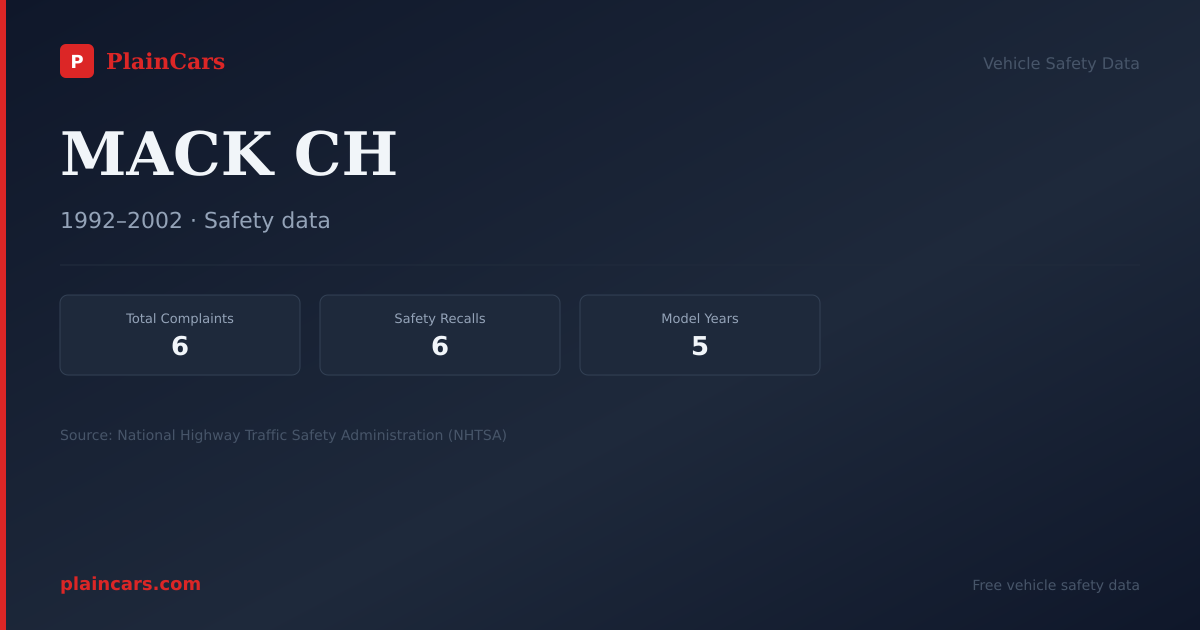
Total Complaints
2 filings
Mack CH · model year
2 NHTSA complaints, 1 crash report, and 6 recall campaigns listed for this cohort. A VIN lookup is required to determine whether a specific vehicle has an unrepaired recall.
NHTSA overall rating
Not crash-tested
New Car Assessment Program
The verdict
The 2002 Mack CH posts above-average complaint volume among its own model-year siblings.
The 2002MackCH carries 2 consumer safety complaints in NHTSA's Office of Defects Investigation database for this specific model-year cohort. Within that volume, owners reported 1 crash, 0 fires, 0 injuries, and 0 fatalities. No NCAP 5-star crash-test rating is available for this model year in the federal database.
The most frequently selected component label in reports for the 2002 CH is tires with 1 filings, followed by power train:axle assembly (1). Complaint categories reflect owner reports and intake categorization; they do not establish a defect pattern or cause. This cohort has 6 NHTSA recall campaigns listed below. Enter a VIN in NHTSA's official recall lookup to determine whether a specific vehicle has an unrepaired recall.
NHTSA currently has 5 investigation files overlapping the 2002 CH. Owners comparing this cohort against neighboring years should read the complaint-by-year trend as report volume, not a causal diagnosis. Use the related-complaint feed and the official recall lookup when researching a specific vehicle.
PlainCars' own composite of NHTSA NCAP crash-test ratings and rollover-risk assessment, each dimension normalized against the federal scale or the full national model-year corpus. Not an official NHTSA figure, and not a substitute for a specific vehicle's VIN-level recall check.
Total Complaints
2 filings
Crashes Reported
1 reports
Source
NHTSA ODI
Federal complaints database
At or below the fleet median complaint volume.
| Component | Count |
|---|---|
| TIRES | 1 |
| POWER TRAIN:AXLE ASSEMBLY | 1 |
SERVICE BRAKES, AIR
ON CERTAIN TRUCKS EQUIPPED WITH MANIFOLD DASH VALVES WITH PUSH TO CONNECT FITTINGS USED TO CONTROL THE PARK BRAKE FUNCTION ON TRUCKS AND TRAILERS WITH AIR BRAKES, THE PARK KNOB CAN POP OUT UNEXPECTEDLY WHILE THE VEHICLE IS IN MOTION. THIS WILL EXHAUST THE AIR FROM THE PARK BRAKE SYSTEM ON THE TRAIL
FUEL SYSTEM, GASOLINE:DELIVERY:HOSES, LINES/PIPING, AND FITTINGS
ON CERTAIN HEAVY DUTY CLASS 8 DIESEL TRUCKS EQUIPPED WITH ASET AC ENGINES, THE LOCATION OF THE FUEL INLET HOSE MAY RESULT IN OVERHEATING OR ABRASION OF THE HOSE, WHICH MAY LEAD TO A PREMATURE FAILURE.
FUEL SYSTEM, OTHER:STORAGE:TANK ASSEMBLY:PRESSURE RELIEF DEVICES
ON CERTAIN CHASSIS BUILT WITH LNG ENGINES, THE NEXGEN LNG TANK'S PRIMARY AND SECONDARY RELIEF VALVES COULD FAIL TO OPEN AND RELIEVE TANK PRESSURE.
FUEL SYSTEM, DIESEL
ON CERTAIN TRUCKS EQUIPPED WITH ASET AC MODEL ENGINES, THE ENGINE AS CONFIGURED WITH AN EXTERNAL EXHAUST GAS RECIRCULATION SYSTEM MAKES SERVICING THE FUEL INJECTION LINES DIFFICULT WHEN USING TRADITIONAL TOOLS. THEREFORE, IT IS POSSIBLE FOR FUEL LEAKS TO DEVELOP WHEN REMOVING AND INSTALLING THE FU
STEERING:HYDRAULIC POWER ASSIST:HOSE, PIPING, AND CONNECTIONS
ON CERTAIN CLASS 8 CHASSIS EQUIPPED WITH R. H. SHEPPARD "M100" STEERING GEARS AND TRW "TAS65" STEERING GEARS, A POWER STEERING HOSE WITH AN INCORRECT PRESSURE RATING WAS INSTALLED BY THE FACTORY.
PARKING BRAKE
CERTAIN CLASS 8 CHASSIS FAIL TO COMPLY WITH REQUIREMENTS OF FEDERAL MOTOR VEHICLE SAFETY STANDARD NO. 121, "AIR BRAKE SYSTEMS." THE INSTALLATION OF THE ADDITIONAL AXLE(S), RAISES THE GVW CAPABILITY OF THE VEHICLE AND THEREFORE REQUIRES AN INCREASE IN THE PARKING BRAKE PERFORMANCE TO HOLD ON A 20% G
2002 MACK TRUCK CH SERIES AXLE BROKE FORCING THE TRUCK TO STRIKE THE MEDIAN WALL. *NJ (OHIO TRAFFIC CRASH REPORT # 101-0517-91) *JB LETTER UPDATED 03/17/10*BF
2002 MACK CONVENTIONAL TIRE BLEW OUT. *JB DUE TO THE TIRE BLOW OUT ON THE TRAILER. *JB
mDrive Transmission Failure to Disengage
Vehicle Roll Away
Failing 5th wheel attachment bolts
AIR COMPRESSOR DISCHARGE LINE
INTEGRAL HUB AND BEARING ASSEMBLY
Data vintage: August 2026. Sources: NHTSA Office of Defects Investigation (ODI) complaints database, NHTSA recall campaign API, NHTSA NCAP crash-test ratings, and NHTSA FARS for fatality cross-reference.
Every figure on PlainCars is rendered directly from NHTSA complaint and safety data, no number is typed in by an editor. This year-specific record is rendered from NHTSA ODI, recall, and NCAP rows for the 2002 Mack CH; no figure is typed in by an editor. See our editorial standards & corrections policy, the methodology behind these numbers, or report a data error. Data current as of August 2026.
Read our methodology - how this data is sourced, computed, and verified.