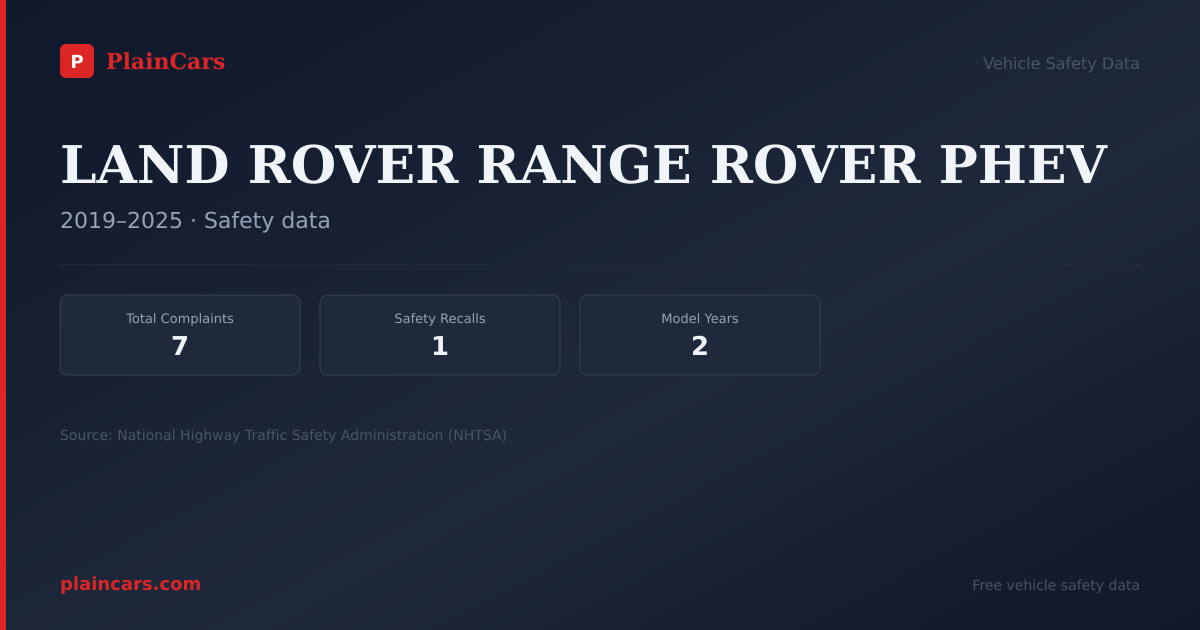
Total Complaints
5 filings
Land Rover Range Rover PHEV · model year
5 NHTSA complaints. A VIN lookup is required to determine whether a specific vehicle has an unrepaired recall.
NHTSA overall rating
Not crash-tested
New Car Assessment Program
The 2025Land RoverRange Rover PHEV carries 5 consumer safety complaints in NHTSA's Office of Defects Investigation database for this specific model-year cohort. Within that volume, owners reported 0 crashes, 3 fires, 0 injuries, and 0 fatalities. No NCAP 5-star crash-test rating is available for this model year in the federal database.
The most frequently selected component label in reports for the 2025 Range Rover PHEV is electrical system:12v/24v/48v battery with 1 filings, followed by electrical system (1) and engine (1). Complaint categories reflect owner reports and intake categorization; they do not establish a defect pattern or cause.
NHTSA currently has 11 investigation files overlapping the 2025 Range Rover PHEV, and 2 remain open. Owners comparing this cohort against neighboring years should read the complaint-by-year trend as report volume, not a causal diagnosis. Use the related-complaint feed and the official recall lookup when researching a specific vehicle.
PlainCars' own composite of NHTSA NCAP crash-test ratings and rollover-risk assessment, each dimension normalized against the federal scale or the full national model-year corpus. Not an official NHTSA figure, and not a substitute for a specific vehicle's VIN-level recall check.
Total Complaints
5 filings
Crashes Reported
0 reports
Source
NHTSA ODI
Federal complaints database
At or below the fleet median complaint volume.
| Component | Count |
|---|---|
| ELECTRICAL SYSTEM:12V/24V/48V BATTERY | 1 |
| ELECTRICAL SYSTEM | 1 |
| ENGINE | 1 |
| FUEL/PROPULSION SYSTEM | 1 |
| POWER TRAIN | 1 |
This is a plug-in hybrid vehicle. Twice now the car has powered on but would not go into gear or move. Selecting drive did nothing and pressing the accelerator had no effect, leaving the vehicle completely immobile. In both instances I was left stranded and had to have the vehicle towed (once on 10/10/25 and again on 11/11/25). This did not happen while driving in traffic, but it created a safety concern because the car was unable to move when it should have. The issue has not been explained or resolved through service.
While driving on the highway, a strong burning smell began inside the vehicle, similar to a brush or forest fire. At first it was unclear whether the smell was coming from outside, but when traffic slowed, smoke was seen coming from the driver-side wheel well and from under the front hood. No warning lights, alerts, temperature warnings, or malfunction messages appeared before or during the smoke. The vehicle was moved off the highway to a side road. Upon opening the hood, light but steady smoke continued from the engine area. The coolant reservoir was full and there were no visible leaks. The vehicle continued to smoke consistently for approximately 50 minutes while waiting for a tow truck. After the vehicle was loaded onto the flatbed and transported back toward the highway, an orange glow became visible inside the cabin, indicating an active fire had started inside the interior. The tow truck driver immediately pulled over, used a fire extinguisher, and unloaded the vehicle from t
While driving on the highway, a strong burning smell began inside the vehicle, similar to a brush or forest fire. At first it was unclear whether the smell was coming from outside, but when traffic slowed, smoke was seen coming from the driver-side wheel well and from under the front hood. No warning lights, alerts, temperature warnings, or malfunction messages appeared before or during the smoke. The vehicle was moved off the highway to a side road. Upon opening the hood, light but steady smoke continued from the engine area. The coolant reservoir was full and there were no visible leaks. The vehicle continued to smoke consistently for approximately 50 minutes while waiting for a tow truck. After the vehicle was loaded onto the flatbed and transported back toward the highway, an orange glow became visible inside the cabin, indicating an active fire had started inside the interior. The tow truck driver immediately pulled over, used a fire extinguisher, and unloaded the vehicle from t
While driving on the highway, a strong burning smell began inside the vehicle, similar to a brush or forest fire. At first it was unclear whether the smell was coming from outside, but when traffic slowed, smoke was seen coming from the driver-side wheel well and from under the front hood. No warning lights, alerts, temperature warnings, or malfunction messages appeared before or during the smoke. The vehicle was moved off the highway to a side road. Upon opening the hood, light but steady smoke continued from the engine area. The coolant reservoir was full and there were no visible leaks. The vehicle continued to smoke consistently for approximately 50 minutes while waiting for a tow truck. After the vehicle was loaded onto the flatbed and transported back toward the highway, an orange glow became visible inside the cabin, indicating an active fire had started inside the interior. The tow truck driver immediately pulled over, used a fire extinguisher, and unloaded the vehicle from t
The contact owns a 2025 Land Rover Range Rover. The contact stated that while depressing the accelerator pedal, the vehicle shut off independently and drove in Hybrid Mode and switched back to Electrical Battery Mode. Several warning lights were illuminated. The vehicle was taken to the dealer, where it was diagnosed that the electrical battery converter needed to be replaced. The contact stated that the failure had occurred approximately eight times. The vehicle was repaired for the same failure over nine times. The manufacturer was notified of the failure, opened a case, offered an extended warranty, and the contact was informed that the system had been hacked. The approximate failure mileage was 4,800.
Mileage: 4,800
Rear Seat Belt Stitching Failure and Detachment
High Voltage Coolant Heaters may fail to defrost windshield
Loss of Brake Power Assist
Spoiler Cover Detachment
Fuel Tank Flange Leak
Data vintage: August 2026. Sources: NHTSA Office of Defects Investigation (ODI) complaints database, NHTSA recall campaign API, NHTSA NCAP crash-test ratings, and NHTSA FARS for fatality cross-reference.
Every figure on PlainCars is rendered directly from NHTSA complaint and safety data, no number is typed in by an editor. This year-specific record is rendered from NHTSA ODI, recall, and NCAP rows for the 2025 Land Rover Range Rover PHEV; no figure is typed in by an editor. See our editorial standards & corrections policy, the methodology behind these numbers, or report a data error. Data current as of August 2026.
Read our methodology - how this data is sourced, computed, and verified.