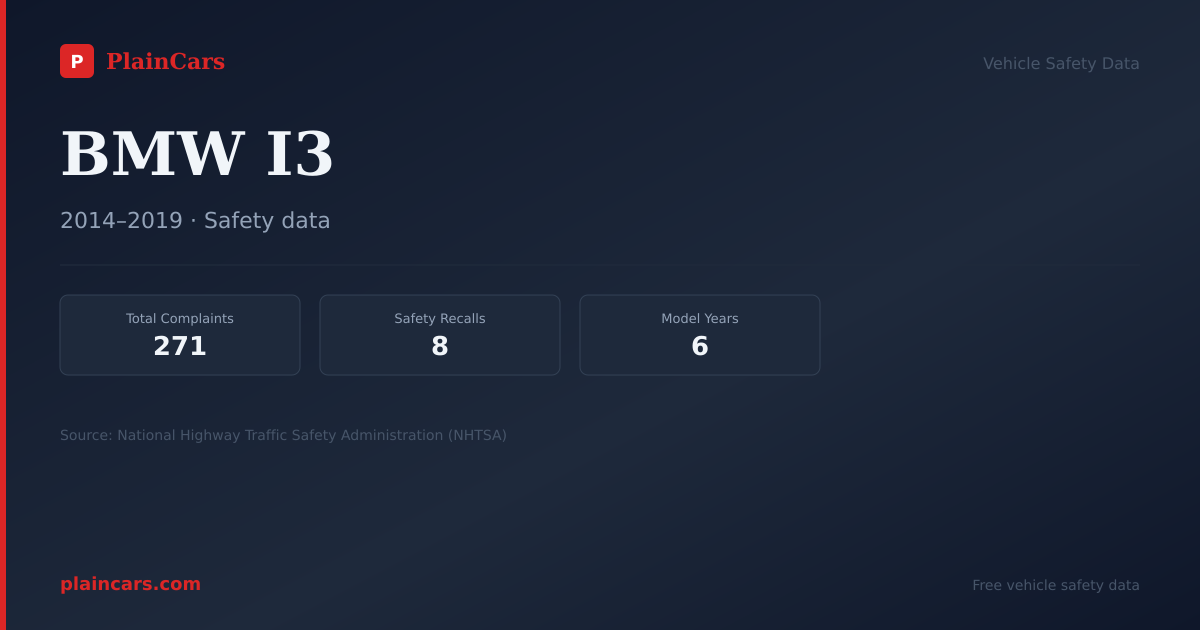
Total Complaints
40 filings
BMW I3 · model year
40 NHTSA complaints, 3 crash reports, and 2 recall campaigns listed for this cohort. A VIN lookup is required to determine whether a specific vehicle has an unrepaired recall.
NHTSA overall rating
Not crash-tested
New Car Assessment Program
The verdict
The 2016 BMW I3 posts below-average complaint volume among its own model-year siblings.
The 2016BMWI3 carries 40 consumer safety complaints in NHTSA's Office of Defects Investigation database for this specific model-year cohort. Within that volume, owners reported 3 crashes, 0 fires, 1 injury, and 0 fatalities. For crash performance, NHTSA's New Car Assessment Program gave this cohort an overall Not Rated/5 rating, with Not Rated/5 front crash, Not Rated/5 side crash, and Not Rated/5 rollover scores derived from standardized barrier and dynamic tests.
The most frequently selected component label in reports for the 2016 I3 is structure:body with 10 filings, followed by steering (8) and electrical system (5). Complaint categories reflect owner reports and intake categorization; they do not establish a defect pattern or cause. This cohort has 2 NHTSA recall campaigns listed below. Enter a VIN in NHTSA's official recall lookup to determine whether a specific vehicle has an unrepaired recall.
NHTSA currently has 34 investigation files overlapping the 2016 I3. Owners comparing this cohort against neighboring years should read the complaint-by-year trend as report volume, not a causal diagnosis. Use the related-complaint feed and the official recall lookup when researching a specific vehicle.
PlainCars' own composite of NHTSA NCAP crash-test ratings and rollover-risk assessment, each dimension normalized against the federal scale or the full national model-year corpus. Not an official NHTSA figure, and not a substitute for a specific vehicle's VIN-level recall check.
Total Complaints
40 filings
Crashes Reported
3 reports
Source
NHTSA ODI
Federal complaints database
At or below the fleet median complaint volume.
| Component | Count |
|---|---|
| STRUCTURE:BODY | 10 |
| STEERING | 8 |
| ELECTRICAL SYSTEM | 5 |
| AIR BAGS | 4 |
| POWER TRAIN | 3 |
| VEHICLE SPEED CONTROL | 2 |
| UNKNOWN OR OTHER | 2 |
| ENGINE | 2 |
| SERVICE BRAKES | 1 |
| AIR BAGS: AIR BAG/RESTRAINT CONTROL MODULE | 1 |
| FUEL SYSTEM, GASOLINE | 1 |
| FUEL/PROPULSION SYSTEM | 1 |
AIR BAGS:FRONTAL
BMW of North America, LLC (BMW) is recalling certain 2014-2018 BMW i3 electric and hybrid electric vehicles. Unbelted, small adult, drivers may be at a higher risk of neck injury in the event of a frontal crash. These vehicles fail to comply with the requirements of Federal Motor Vehicle Safety St
FUEL SYSTEM, GASOLINE:DELIVERY:HOSES, LINES/PIPING, AND FITTINGS
BMW of North America, LLC (BMW) is recalling certain 2014-2017 i3 REx hybrid electric vehicles. The fuel tank vent line may rub against the ribbed wire protection sleeve of the battery positive (B+) cable, creating a hole in the vent line and causing a fuel vapor leak.
While driving my 2016 BMW i3 with Range Extender, the vehicle experiences sudden and complete loss of propulsion at very low state of charge (0–1%). The car abruptly loses motive power, forcing me to pull over, sometimes while in traffic. After sitting for several minutes, limited power may return, but the vehicle often shuts down again, and in some cases the Range Extender engine does not engage at all. This has occurred repeatedly and creates a serious risk of being stranded or hit while merging or driving on public roads. BMW has inspected the vehicle twice (07 Nov 2025 and 13 Jan 2026) and confirmed the loss of propulsion and need to pull over but classified the behavior as “normal” without performing high-voltage battery diagnostics. The failure appears consistent with high-voltage battery voltage collapse under load, causing the battery management system to shut down the drivetrain. This is not normal power limiting — it is a sudden drivetrain shutdown that occurs withou
While driving my 2016 BMW i3 with Range Extender, the vehicle experiences sudden and complete loss of propulsion at very low state of charge (0–1%). The car abruptly loses motive power, forcing me to pull over, sometimes while in traffic. After sitting for several minutes, limited power may return, but the vehicle often shuts down again, and in some cases the Range Extender engine does not engage at all. This has occurred repeatedly and creates a serious risk of being stranded or hit while merging or driving on public roads. BMW has inspected the vehicle twice (07 Nov 2025 and 13 Jan 2026) and confirmed the loss of propulsion and need to pull over but classified the behavior as “normal” without performing high-voltage battery diagnostics. The failure appears consistent with high-voltage battery voltage collapse under load, causing the battery management system to shut down the drivetrain. This is not normal power limiting — it is a sudden drivetrain shutdown that occurs withou
While driving my 2016 BMW i3 with Range Extender, the vehicle experiences sudden and complete loss of propulsion at very low state of charge (0–1%). The car abruptly loses motive power, forcing me to pull over, sometimes while in traffic. After sitting for several minutes, limited power may return, but the vehicle often shuts down again, and in some cases the Range Extender engine does not engage at all. This has occurred repeatedly and creates a serious risk of being stranded or hit while merging or driving on public roads. BMW has inspected the vehicle twice (07 Nov 2025 and 13 Jan 2026) and confirmed the loss of propulsion and need to pull over but classified the behavior as “normal” without performing high-voltage battery diagnostics. The failure appears consistent with high-voltage battery voltage collapse under load, causing the battery management system to shut down the drivetrain. This is not normal power limiting — it is a sudden drivetrain shutdown that occurs withou
Faulty airbag warning
Faulty airbag warning
The contact owns a 2016 BMW I3. The contact stated that while driving at an undisclosed speed, the check engine and the air bag warning lights illuminated. The vehicle was taken to the dealer, where it was diagnosed and determined that the fuel filler had failed and needed to be replaced. The vehicle was not repaired. The manufacturer was made aware of the failure and referred the contact to the NHTSA Hotline for further assistance. The approximate failure mileage was 40,000.
Mileage: 40,000
The contact owns a 2016 BMW I3. The contact stated that while driving at an undisclosed speed, the check engine and the air bag warning lights illuminated. The vehicle was taken to the dealer, where it was diagnosed and determined that the fuel filler had failed and needed to be replaced. The vehicle was not repaired. The manufacturer was made aware of the failure and referred the contact to the NHTSA Hotline for further assistance. The approximate failure mileage was 40,000.
Mileage: 40,000
The contact owns a 2016 BMW I3. The contact stated that while driving at an undisclosed speed, the check engine and the air bag warning lights illuminated. The vehicle was taken to the dealer, where it was diagnosed and determined that the fuel filler had failed and needed to be replaced. The vehicle was not repaired. The manufacturer was made aware of the failure and referred the contact to the NHTSA Hotline for further assistance. The approximate failure mileage was 40,000.
Mileage: 40,000
The roof has bubbled and peeled away leaving an exposed permeable roof, meaning if it rains, water will get into the car because of the roof material being not safe, not strong, peeling away. Just terrible! Looking online, so many people with i3s ha e all had the same issue!
Translucent protection coat on roof delaminated; pieces blown into air. Bare roof and some coat pieces available for inspection upon request (no inspection yet). Other BMW i3 owners have reported same issue. No prior indication of problem on vehicle itself.
Roof panel is deteriorating and loosing integrity. Outer laminate coat broke down in general sun conditions, and now underlying roof structure is breaking down as well. The dealer has not inspected the roof yet, but this is an issue widely discussed on community forums, and it’s breaking down on my vehicle now.
The roof is bubbling and peeling up. Water gets in it when it rains, then it bubbles greatly. BMW won’t fix it, repair shops don’t want to fix it because it’s an obscure roof. They recommend I take it to BMW which won’t fix it (roof replacement suggested). I just bought this car and drive it as normal, and the special carbon fiber roof is degrading too fast.
The carbon fiber roof of my 2016 BMW i3 REx is really starting to bubble and wrinkle. After taking it to two shops any mitigation would cost hundreds of dollars to address. The roof is starting to peel and am worried about water getting to the car. BMW should have engineered these roofs differently. They should be responsible to cost associated with fixing them.
The carbon fiber roof of my 2016 BMW i3 REx is really starting to bubble and wrinkle. After taking it to two shops any mitigation would cost hundreds of dollars to address. The roof is starting to peel and am worried about water getting to the car. BMW should have engineered these roofs differently. They should be responsible to cost associated with fixing them.
Roof peeling
Battery degradation
The roof on outside is starting to flake off in chunks and expose bottom layers.
The contact owns a 2016 BMW I3. The contact stated while driving 75 MPH, the contact heard a whistling sound, and the roof detached from the vehicle. The vehicle was taken to the dealer, but no assistance was provided. The vehicle was not repaired. The manufacturer was contacted, but no assistance was provided. The failure mileage was 19,000.
Mileage: 19,000
My bmw i3 has a faulty wiring harness or some other defect that is causing my car to turn off the airbag system. This is a chronic issue with bmw i3’s. Either the wiring harness is bad or the airbag becomes too stiff and the car deactivated the entire airbag system. Dangerous!
My bmw i3 has a faulty wiring harness or some other defect that is causing my car to turn off the airbag system. This is a chronic issue with bmw i3’s. Either the wiring harness is bad or the airbag becomes too stiff and the car deactivated the entire airbag system. Dangerous!
Data vintage: August 2026. Sources: NHTSA Office of Defects Investigation (ODI) complaints database, NHTSA recall campaign API, NHTSA NCAP crash-test ratings, and NHTSA FARS for fatality cross-reference.
Every figure on PlainCars is rendered directly from NHTSA complaint and safety data, no number is typed in by an editor. This year-specific record is rendered from NHTSA ODI, recall, and NCAP rows for the 2016 BMW I3; no figure is typed in by an editor. See our editorial standards & corrections policy, the methodology behind these numbers, or report a data error. Data current as of August 2026.
Read our methodology - how this data is sourced, computed, and verified.