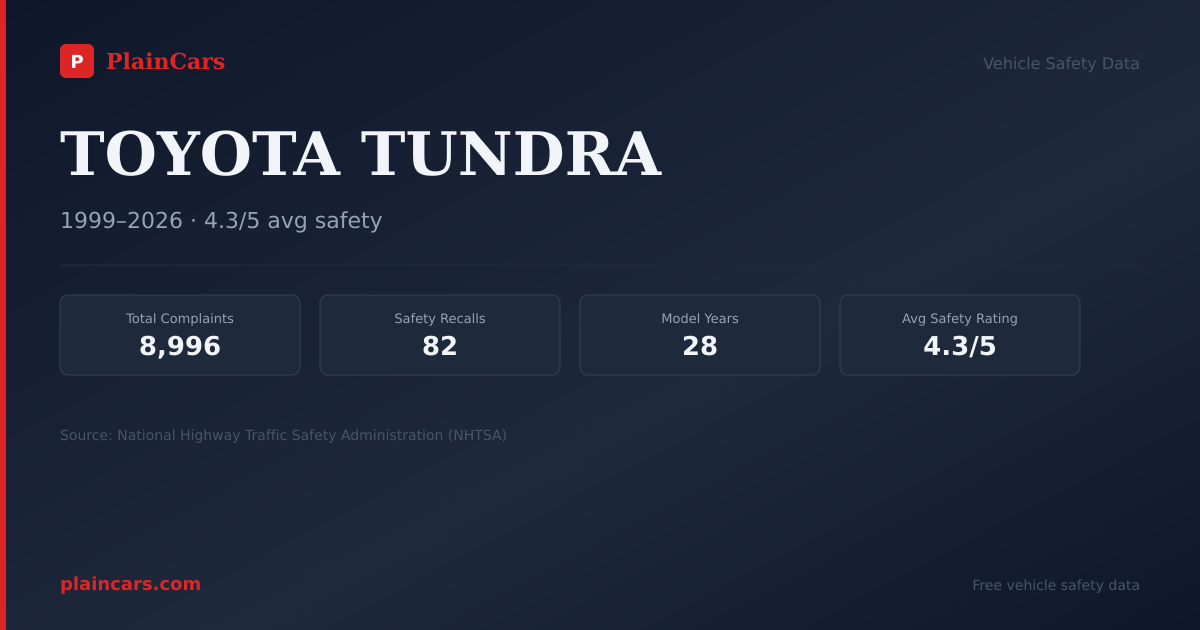
Total Complaints
643 filings
Toyota Tundra · model year
643 NHTSA complaints, 39 crash reports, and 6 recall campaigns listed for this cohort. A VIN lookup is required to determine whether a specific vehicle has an unrepaired recall.
NHTSA overall rating
Not crash-tested
New Car Assessment Program
The verdict
The 2002 Toyota Tundra posts above-average complaint volume among its own model-year siblings.
The 2002ToyotaTundra carries 643 consumer safety complaints in NHTSA's Office of Defects Investigation database for this specific model-year cohort. Within that volume, owners reported 39 crashes, 2 fires, 27 injuries, and 5 fatalities. No NCAP 5-star crash-test rating is available for this model year in the federal database.
The most frequently selected component label in reports for the 2002 Tundra is structure:body with 76 filings, followed by service brakes, hydraulic (54) and structure:frame and members (45). Complaint categories reflect owner reports and intake categorization; they do not establish a defect pattern or cause. This cohort has 6 NHTSA recall campaigns listed below. Enter a VIN in NHTSA's official recall lookup to determine whether a specific vehicle has an unrepaired recall.
NHTSA currently has 51 investigation files overlapping the 2002 Tundra, and 1 remain open. Owners comparing this cohort against neighboring years should read the complaint-by-year trend as report volume, not a causal diagnosis. Use the related-complaint feed and the official recall lookup when researching a specific vehicle.
PlainCars' own composite of NHTSA NCAP crash-test ratings and rollover-risk assessment, each dimension normalized against the federal scale or the full national model-year corpus. Not an official NHTSA figure, and not a substitute for a specific vehicle's VIN-level recall check.
Total Complaints
643 filings
Crashes Reported
39 reports
Source
NHTSA ODI
Federal complaints database
Above median complaint volume, review patterns below.
| Component | Count |
|---|---|
| STRUCTURE:BODY | 76 |
| SERVICE BRAKES, HYDRAULIC | 54 |
| STRUCTURE:FRAME AND MEMBERS | 45 |
| SUSPENSION | 42 |
| STEERING | 34 |
| SUSPENSION:FRONT:CONTROL ARM:LOWER BALL JOINT | 32 |
| UNKNOWN OR OTHER | 28 |
| SERVICE BRAKES, HYDRAULIC:FOUNDATION COMPONENTS:DISC:ROTOR | 27 |
| STRUCTURE | 22 |
| POWER TRAIN | 22 |
| STRUCTURE:FRAME AND MEMBERS:UNDERBODY SHIELDS | 19 |
| AIR BAGS | 18 |
| VEHICLE SPEED CONTROL | 13 |
| FUEL SYSTEM, GASOLINE | 13 |
| SERVICE BRAKES | 12 |
EXTERIOR LIGHTING
CERTAIN PRO-A MOTORS CORNER LAMPS, TURN SIGNALS, AND HEADLIGHTS SOLD AS REPLACEMENT LAMPS FOR USE ON CERTAIN PASSENGER VEHICLES LISTED ABOVE. SOME COMBINATION LAMPS THAT ARE NOT EQUIPPED WITH AMBER SIDE REFLECTORS FAIL TO CONFORM TO FEDERAL MOTOR VEHICLE SAFETY STANDARD NO. 108, LAMPS, REFLECTIVE D
STRUCTURE:FRAME AND MEMBERS:UNDERBODY SHIELDS
TOYOTA IS RECALLING MODEL YEAR 2000-2003 TUNDRA VEHICLES ORIGINALLY SOLD IN OR CURRENTLY REGISTERED IN THE FOLLOWING STATES: CONNECTICUT, DELAWARE, ILLINOIS, INDIANA, KENTUCKY, MAINE, MARYLAND, MASSACHUSETTS, MICHIGAN, MINNESOTA, NEW HAMPSHIRE, NEW JERSEY, NEW YORK, OHIO, PENNSYLVANIA, RHODE ISLAND,
EXTERIOR LIGHTING
CERTAIN AJ MOTORSPORT COMBINATION LAMPS SOLD AS REPLACEMENT LAMPS FOR USE ON THE ABOVE LISTED PASSENGER VEHICLES. COMBINATION LAMPS NOT EQUIPPED WITH AMBER SIDE REFLECTORS FAIL TO CONFORM WITH THE REQUIREMENTS OF FEDERAL MOTOR VEHICLE SAFETY STANDARD NO. 108, LAMPS, REFLECTIVE DEVICES, AND ASSOCIAT
SUSPENSION:FRONT:CONTROL ARM:LOWER BALL JOINT
ON CERTAIN SPORT UTILITY VEHICLES, DUE TO A MANUFACTURING ISSUE IN THE FRONT SUSPENSION LOWER BALL JOINT, THERE IS A POSSIBILITY THAT THE SURFACE OF THE BALL OF THE JOINT MAY HAVE BEEN SCRATCHED. THE BALL JOINT MAY EVENTUALLY EXPERIENCE EXCESSIVE WEAR AND LOOSENESS, RESULTING IN INCREASED STEERING
EXTERIOR LIGHTING:HEADLIGHTS
DOPE, INC. IS RECALLING 42,540 COMBINATION CORNER AND BUMPER LAMP ASSEMBLIES OF VARIOUS PART NUMBERS SOLD FOR USE AS AFTERMARKET EQUIPMENT FOR VARIOUS PASSENGER VEHICLES. THESE HEADLAMPS FAIL TO CONFORM TO THE REQUIREMENTS OF FEDERAL MOTOR VEHICLE SAFETY STANDARD NO. 108, "LAMPS, REFLECTIVE DEVICES
WHEELS
ON CERTAIN 4X2 VEHICLES EQUIPPED WITH AN ALLOY WHEEL TIRE UPGRADE (OPTIONS WM4, WM8, ZL1-ZL4, DH4, OR DH5) INSTALLED BY THE PROCESSING CENTERS IN JACKSONVILLE, FLORIDA OR COMMERCE, GEORGIA, A LABEL IDENTIFYING THE SPARE TIRE AS A TEMPORARY USE SPARE TIRE WAS NOT INSTALLED. THE UPGRADE INCLUDES 4 LA
Toyota won’t cover the safety recalls on my truck
Excessive frame corrosion and corrosion holes involving even rear subframe
Frame needs replacement
The date it started happening was probably late March now into April to present day as the receptacle on the driver side doesn’t click always and comes undone while on the road and can not get the seatbelt to go back in and has not been assessed or replaced by my local Toyota Dealer and the issue is getting worse these are Stock parts
The headlights and high beams are dim . When the high beams are on other cars oncoming are not affected as they never flash their lights because my high beams seem as though they are just headlights. Also the fact that the high beams shine like headlights, there is no option for brighter lighting which makes it hard to see far ahead. I live in a rural location off of a narrow highway with down slopes with water at the bottom on both sides of the highway where large wildlife such as deer are plentiful . Insufficient high beam lighting imposes unsafe travel conditions since the headlights are dim and the high beams are how the headlights should be leaving no option for brighter visibility. I noticed the lighting being dim years ago but I thought it was just something to do with my trucks lighting until I began searching online again for a remedy and found many other owners of the same year make and model with exactly the same issue. Therefore in conclusion perhaps is a manufacturer d
Was told about the recall awhile ago and they said that my frame was ok. But now I have a perfectly good truck in good condition other than a rusted frame. Had some work done and mechanic said it is unsafe to drive due to rusted frame. They know of the defect and only replace a few and it looks like others are dealing with what I am.
The contact owns a 2002 Toyota Tundra. The contact, who is an independent mechanic, stated that the fuel tank had detached. The contact stated that the subframe was extremely rusted. There were no warning lights illuminated. The contact stated that the failure was related to NHTSA Campaign Number: 09V444000 (Structure). The contact called the local dealer, but the vehicle was not diagnosed or repaired. The manufacturer was not contacted. The failure mileage was approximately 190,000.
Mileage: 190,000
The contact owns a 2002 Toyota Tundra. The contact, who is an independent mechanic, stated that the fuel tank had detached. The contact stated that the subframe was extremely rusted. There were no warning lights illuminated. The contact stated that the failure was related to NHTSA Campaign Number: 09V444000 (Structure). The contact called the local dealer, but the vehicle was not diagnosed or repaired. The manufacturer was not contacted. The failure mileage was approximately 190,000.
Mileage: 190,000
My original owner 2002 Toyota Tundra Truck was being backed up in reverse with a utility trailer attached up a very, very moderate incline on a driveway pushing the trailer onto a gravel pad ALONGSIDE (parallel) the driveway. As it started to spin gravel the truck was put into a 4 wheel Drive LOW RANGE. This is in keeping with the TOYOTA owners manual publication 0M34417U Part Number 01999-34417 Print date 02-0109-01. We followed the manual instruction on 4 WD operation. Within a few feet the truck stopped as if the wheels had hit a curb and there was no further movement no matter the accelerator pedal position and the engine speed was unchanged as if it was in a stall. All of a sudden there was a loud bang underneath the truck and the truck raced rearward 8-10 feet jackknifing the trailer into a tree and upending the truck and trailer. We contacted Toyota on the incident and they had a third party look at the truck for brake condition, floor mat placement and throttle freedo
My original owner 2002 Toyota Tundra Truck was being backed up in reverse with a utility trailer attached up a very, very moderate incline on a driveway pushing the trailer onto a gravel pad ALONGSIDE (parallel) the driveway. As it started to spin gravel the truck was put into a 4 wheel Drive LOW RANGE. This is in keeping with the TOYOTA owners manual publication 0M34417U Part Number 01999-34417 Print date 02-0109-01. We followed the manual instruction on 4 WD operation. Within a few feet the truck stopped as if the wheels had hit a curb and there was no further movement no matter the accelerator pedal position and the engine speed was unchanged as if it was in a stall. All of a sudden there was a loud bang underneath the truck and the truck raced rearward 8-10 feet jackknifing the trailer into a tree and upending the truck and trailer. We contacted Toyota on the incident and they had a third party look at the truck for brake condition, floor mat placement and throttle freedo
The contact owns a 2002 Toyota Tundra. The contact stated that the frame and the front bumper were severely rusted. The vehicle was not diagnosed or repaired by an independent mechanic or dealer. The manufacturer was notified of the failure and referred the contact to the NHTSA Hotline for assistance. The failure mileage was approximately 117,000.
Mileage: 117,000
The contact owns a 2002 Toyota Tundra. The contact stated that after taking the vehicle to be checked for corrosion to the subframe, the contact was advised that there was significant corrosion on the subframe and the supports underneath the truck bed. The contact was informed that the vehicle was unsafe to drive with any type of load in the truck bed. The vehicle was not repaired. The manufacturer was not informed of the failure. The failure mileage was approximately 180,000.
Mileage: 180,000
My frame have a big hole
I was doing maintenance on front and lifted splash guard for access to bolt. On top of the frame, near the firewall, was severe rust. It looks as if the frame could crack at any time. If this happened in highway speed or in traffic, severe risk of injuries. These are known to have issues in salt states (had recalls) and I thought I checked it pretty good before buying. I think this may be from the air conditioning drain system.
There are several issues with these seatbelts. They either lock before we can get them buckled or once we unbuckle them, they do not retract and hang out the door, thus draining the battery. They get twisted and stuck in the plastic guide toward the top of the door. The last time this happened, I could not get the seatbelt unstuck despite working on it for almost an hour. I ended up cutting the seatbelt to get it unstuck. Now it is EXTREMELY difficult to use. I need to get it replaced ASAP at my own expense. Very unsafe not to mention frustrating. Also, worth noting is this has been an ongoing problem for years.
The contact owns 2002 Toyota Tundra. The contact stated that upon taking the vehicle to an independent mechanic for an oil change and tire rotation, she was informed that the subframe was severely corroded, and the vehicle was unsafe to be driven. The dealer and the manufacturer were not notified of the failure. The vehicle was not repaired. The failure mileage was approximately 250,000.
Mileage: 250,000
The contact owns a 2002 Toyota Tundra. The contact stated that while the vehicle was in for routine maintenance, the mechanic discovered severe rusting and corrosion on the subframe of the vehicle. The vehicle was taken to the local dealer who determined that the vehicle was unsafe to drive due to the severe rusting of the subframe. The contact was informed that the subframe needed to be replaced. The vehicle was not yet repaired. The manufacturer was not yet notified of the failure. The failure mileage was 200,000.
Mileage: 200,000
The contact owns a 2002 Toyota Tundra. The contact stated that while driving at an undisclosed speed, the vehicle began to vibrate, prompting the contact to maintain low speeds. After a visual inspection, the contact observed that the front passenger wheels had a negative toe. No warning lights were illuminated. The vehicle was taken to the dealer, who determined that the lower ball joint had separated from the knuckle. The vehicle was not repaired. After investigating the failure, the contact related it to NHTSA Campaign Number: 05V225000 (Suspension), but the VIN was not included. The manufacturer was notified of the failure but provided no assistance. The failure mileage was 249,000.
Mileage: 249,000
Sudden maximum acceleration accompanied by brake failure, without warnings, occurred on my 2002 Toyota Tundra 4.7L V8 causing loss of control of the vehicle, which ended in a rollover crash, resulting in total loss of the vehicle and injury to me. While departing a 25 mph zone (sign read "END 25 SPEED LIMIT") on a relatively straight section of the road, I very gently accelerated from 20 mph to 30 mph. As soon as the vehicle reached 30 mph, sudden maximum acceleration occurred. Taking my foot off of the gas pedal, first I verified that the gas pedal was not stuck or blocked, but the gas pedal was in the fully up position. I then pressed the brake pedal very hard, but it was locked in the fully up position and the brakes would not engage. I then verified that nothing was blocking the brake pedal underneath it. At that point, around 3 to 4 seconds after the sudden acceleration began, I had entered the first turn of a 30 mph "S" turn at a high rate of speed, while acceleration continued a
Sudden maximum acceleration accompanied by brake failure, without warnings, occurred on my 2002 Toyota Tundra 4.7L V8 causing loss of control of the vehicle, which ended in a rollover crash, resulting in total loss of the vehicle and injury to me. While departing a 25 mph zone (sign read "END 25 SPEED LIMIT") on a relatively straight section of the road, I very gently accelerated from 20 mph to 30 mph. As soon as the vehicle reached 30 mph, sudden maximum acceleration occurred. Taking my foot off of the gas pedal, first I verified that the gas pedal was not stuck or blocked, but the gas pedal was in the fully up position. I then pressed the brake pedal very hard, but it was locked in the fully up position and the brakes would not engage. I then verified that nothing was blocking the brake pedal underneath it. At that point, around 3 to 4 seconds after the sudden acceleration began, I had entered the first turn of a 30 mph "S" turn at a high rate of speed, while acceleration continued a
Data vintage: August 2026. Sources: NHTSA Office of Defects Investigation (ODI) complaints database, NHTSA recall campaign API, NHTSA NCAP crash-test ratings, and NHTSA FARS for fatality cross-reference.
Every figure on PlainCars is rendered directly from NHTSA complaint and safety data, no number is typed in by an editor. This year-specific record is rendered from NHTSA ODI, recall, and NCAP rows for the 2002 Toyota Tundra; no figure is typed in by an editor. See our editorial standards & corrections policy, the methodology behind these numbers, or report a data error. Data current as of August 2026.
Read our methodology - how this data is sourced, computed, and verified.