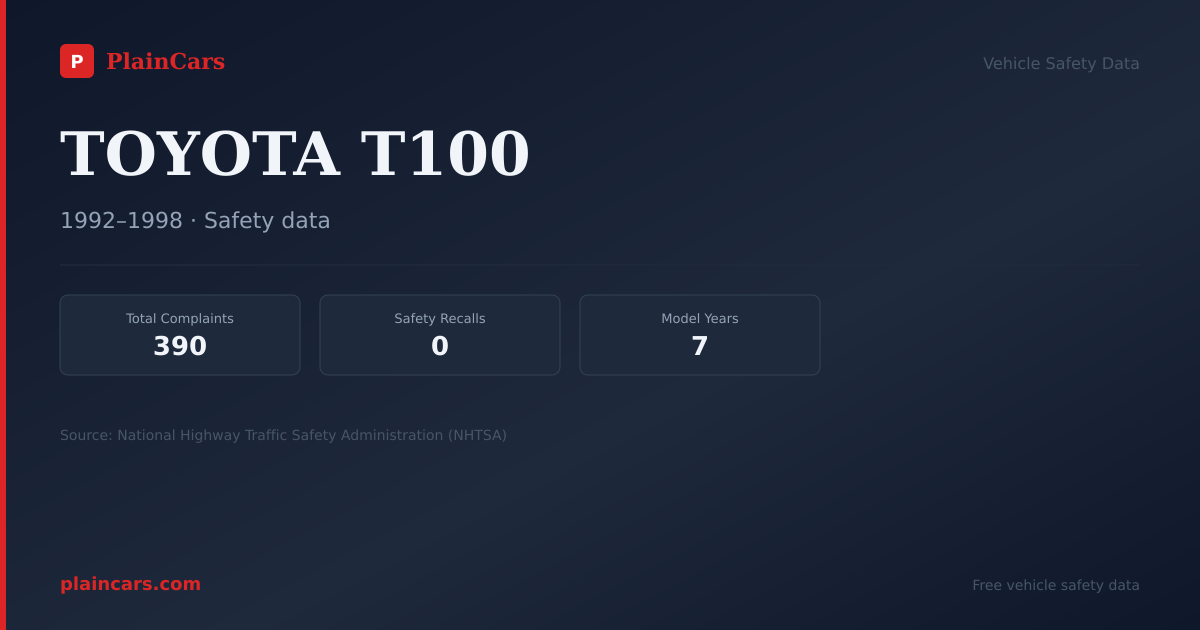
Total Complaints
2 filings
Toyota T100 · model year
2 NHTSA complaints. A VIN lookup is required to determine whether a specific vehicle has an unrepaired recall.
NHTSA overall rating
Not crash-tested
New Car Assessment Program
The verdict
The 1992 Toyota T100 posts top-1% complaint standing (fewest filings) among its own model-year siblings.
The 1992ToyotaT100 carries 2 consumer safety complaints in NHTSA's Office of Defects Investigation database for this specific model-year cohort. Within that volume, owners reported 0 crashes, 0 fires, 0 injuries, and 0 fatalities. No NCAP 5-star crash-test rating is available for this model year in the federal database.
The most frequently selected component label in reports for the 1992 T100 is structure with 1 filings, followed by vehicle speed control (1). Complaint categories reflect owner reports and intake categorization; they do not establish a defect pattern or cause.
NHTSA currently has 51 investigation files overlapping the 1992 T100, and 1 remain open. Owners comparing this cohort against neighboring years should read the complaint-by-year trend as report volume, not a causal diagnosis. Use the related-complaint feed and the official recall lookup when researching a specific vehicle.
PlainCars' own composite of NHTSA NCAP crash-test ratings and rollover-risk assessment, each dimension normalized against the federal scale or the full national model-year corpus. Not an official NHTSA figure, and not a substitute for a specific vehicle's VIN-level recall check.
Total Complaints
2 filings
Crashes Reported
0 reports
Source
NHTSA ODI
Federal complaints database
At or below the fleet median complaint volume.
| Component | Count |
|---|---|
| STRUCTURE | 1 |
| VEHICLE SPEED CONTROL | 1 |
TL*THE CONTACT OWNS A 1992 TOYOTA T-100. THE CONTACT WAS DRIVING UP AN INCLINE; APPROXIMATELY 90 MPH. THE CRUISE CONTROL WAS IN ACTIVATION. THE ACCELERATOR PEDAL BEGAN TO STICK. THE CRUISE CONTROL WAS DEACTIVATED. THE VEHICLE CONTINUED TO PROCEED AT HIGH SPEEDS. THE VEHICLE FAILED TO SLOW DOWN. THE BRAKES "BURNED OUT" AS A RESULT OF THE CONTINUOUS FORCE APPLIED TO THE BRAKE SYSTEM. THE VEHICLE WAS ABLE TO STOP. THE DRIVER STATED THE CAUSE OF FAILURE WAS CONTRIBUTED TO A NEST BUILT IN THE AIR FILTER. THERE WERE EXPOSED WIRES WHICH ALLOWED SQUIRRELS TO ENTER THE VEHICLE. THE DEBRIS WAS REMOVED FROM THE VEHICLE. THE CURRENT AND FAILURE MILEAGES WERE UNKNOWN. THE VIN WAS UNAVAILABLE. THE CONTACT NO LONGER OWNS THE VEHICLE.
TL*THE CONTACT OWNS A 1992 TOYOTA T-100. THE CONTACT WAS DRIVING UP AN INCLINE; APPROXIMATELY 90 MPH. THE CRUISE CONTROL WAS IN ACTIVATION. THE ACCELERATOR PEDAL BEGAN TO STICK. THE CRUISE CONTROL WAS DEACTIVATED. THE VEHICLE CONTINUED TO PROCEED AT HIGH SPEEDS. THE VEHICLE FAILED TO SLOW DOWN. THE BRAKES "BURNED OUT" AS A RESULT OF THE CONTINUOUS FORCE APPLIED TO THE BRAKE SYSTEM. THE VEHICLE WAS ABLE TO STOP. THE DRIVER STATED THE CAUSE OF FAILURE WAS CONTRIBUTED TO A NEST BUILT IN THE AIR FILTER. THERE WERE EXPOSED WIRES WHICH ALLOWED SQUIRRELS TO ENTER THE VEHICLE. THE DEBRIS WAS REMOVED FROM THE VEHICLE. THE CURRENT AND FAILURE MILEAGES WERE UNKNOWN. THE VIN WAS UNAVAILABLE. THE CONTACT NO LONGER OWNS THE VEHICLE.
Data vintage: August 2026. Sources: NHTSA Office of Defects Investigation (ODI) complaints database, NHTSA recall campaign API, NHTSA NCAP crash-test ratings, and NHTSA FARS for fatality cross-reference.
Every figure on PlainCars is rendered directly from NHTSA complaint and safety data, no number is typed in by an editor. This year-specific record is rendered from NHTSA ODI, recall, and NCAP rows for the 1992 Toyota T100; no figure is typed in by an editor. See our editorial standards & corrections policy, the methodology behind these numbers, or report a data error. Data current as of August 2026.
Read our methodology - how this data is sourced, computed, and verified.