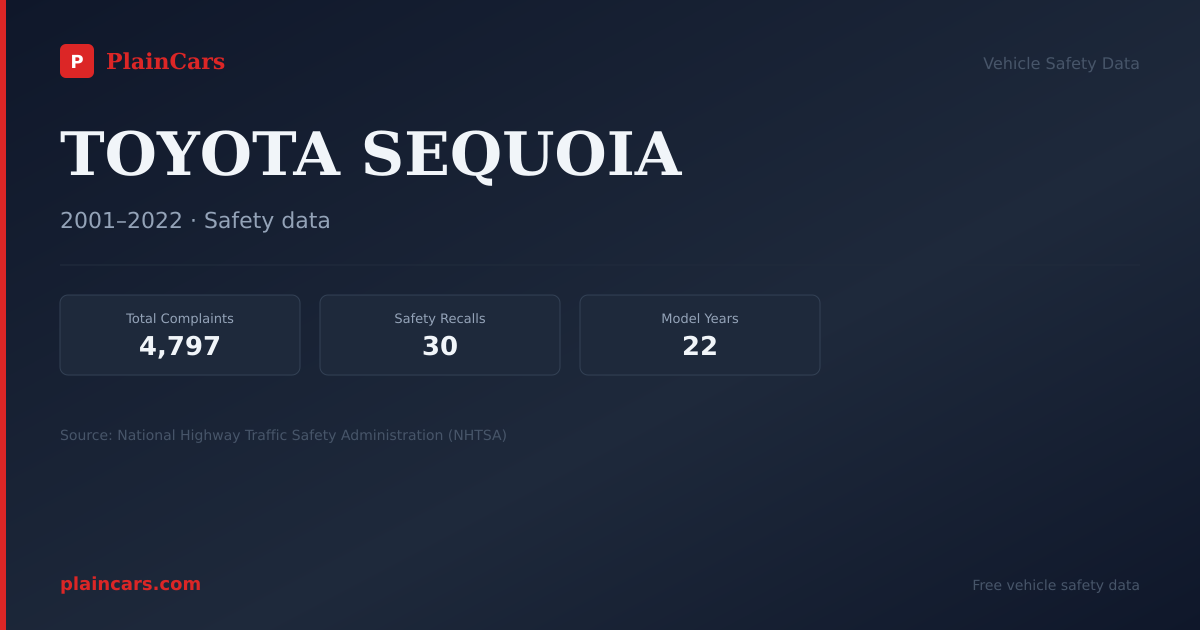
Total Complaints
857 filings
Toyota Sequoia · model year
857 NHTSA complaints, 31 crash reports, and 3 recall campaigns listed for this cohort. A VIN lookup is required to determine whether a specific vehicle has an unrepaired recall.
NHTSA overall rating
Not crash-tested
New Car Assessment Program
The verdict
The 2001 Toyota Sequoia posts above-average complaint volume among its own model-year siblings.
The 2001ToyotaSequoia carries 857 consumer safety complaints in NHTSA's Office of Defects Investigation database for this specific model-year cohort. Within that volume, owners reported 31 crashes, 0 fires, 20 injuries, and 1 fatality. No NCAP 5-star crash-test rating is available for this model year in the federal database.
The most frequently selected component label in reports for the 2001 Sequoia is electronic stability control (esc) with 124 filings, followed by vehicle speed control (100) and service brakes (76). Complaint categories reflect owner reports and intake categorization; they do not establish a defect pattern or cause. This cohort has 3 NHTSA recall campaigns listed below. Enter a VIN in NHTSA's official recall lookup to determine whether a specific vehicle has an unrepaired recall.
NHTSA currently has 4 investigation files overlapping the 2001 Sequoia. Owners comparing this cohort against neighboring years should read the complaint-by-year trend as report volume, not a causal diagnosis. Use the related-complaint feed and the official recall lookup when researching a specific vehicle.
PlainCars' own composite of NHTSA NCAP crash-test ratings and rollover-risk assessment, each dimension normalized against the federal scale or the full national model-year corpus. Not an official NHTSA figure, and not a substitute for a specific vehicle's VIN-level recall check.
Total Complaints
857 filings
Crashes Reported
31 reports
Source
NHTSA ODI
Federal complaints database
Above median complaint volume, review patterns below.
| Component | Count |
|---|---|
| ELECTRONIC STABILITY CONTROL (ESC) | 124 |
| VEHICLE SPEED CONTROL | 100 |
| SERVICE BRAKES | 76 |
| TRACTION CONTROL SYSTEM | 54 |
| STEERING | 50 |
| STRUCTURE:BODY | 44 |
| SERVICE BRAKES, HYDRAULIC | 40 |
| SUSPENSION | 36 |
| UNKNOWN OR OTHER | 30 |
| STRUCTURE:FRAME AND MEMBERS | 26 |
| STRUCTURE:FRAME AND MEMBERS:UNDERBODY SHIELDS | 25 |
| SERVICE BRAKES, HYDRAULIC:FOUNDATION COMPONENTS:DISC:ROTOR | 22 |
| ELECTRICAL SYSTEM | 22 |
| POWER TRAIN:AUTOMATIC TRANSMISSION | 18 |
| POWER TRAIN | 11 |
SERVICE BRAKES, HYDRAULIC:FOUNDATION COMPONENTS:MASTER CYLINDER
CERTAIN CARDONE MASTER CYLINDERS WITH PART NUMBERS 10-2925, 10-2987, 10-2987MZA, 10-3083, 11-3015, 11-3042, 11-3044, 11-3045, 11-3047, 11-3064, AND 11-3156, AND WITH DATE CODES LOWER THAN DCA7078 SOLD AS REPLACEMENT EQUIPMENT FOR USE ON THE VEHICLES LISTED ABOVE. THE SEAL ON MASTER CYLINDER CAN FAI
EXTERIOR LIGHTING
CERTAIN CK MOTORSPORTS COMBINATION HEADLIGHTS, CLEAR CORNER, BUMPER, AND SIDE MARKER LIGHTS SOLD AS REPLACEMENT LAMPS FOR USE ON THE PASSENGER VEHICLES LISTED ABOVE. SOME COMBINATION LAMPS THAT ARE NOT EQUIPPED WITH AMBER SIDE REFLECTORS FAIL TO CONFORM TO FEDERAL MOTOR VEHICLE SAFETY STANDARD NO.
WHEELS
ON CERTAIN 4X2 VEHICLES EQUIPPED WITH AN ALLOY WHEEL TIRE UPGRADE (OPTIONS WM4, WM8, ZL1-ZL4, DH4, OR DH5) INSTALLED BY THE PROCESSING CENTERS IN JACKSONVILLE, FLORIDA OR COMMERCE, GEORGIA, A LABEL IDENTIFYING THE SPARE TIRE AS A TEMPORARY USE SPARE TIRE WAS NOT INSTALLED. THE UPGRADE INCLUDES 4 LA
Took my toyota in for repair at they deemed it not safe to drive
I own a 2001 Toyota Sequoia SR5, which I purchased new in Colorado and moved to Virginia in 2004. I received a Toyota Limited Service Campaign Program notice in 2013 about excessive corrosion on the frame. Alexandria Toyota inspected the vehicle and applied a Corrosion-Resistant Compound to the frame. They also replaced the spare tire carrier assembly due to rusting. Over the years, I've had mechanics mention the rust on the frame but Toyota never issued a recall on the 2001 Sequoia. In November 2024, the following dashboard lights remained on while driving: Vehicle Skid Control (VSC) OFF, VSC TRAC and Brake Lights. I took it to Steven’s Auto Clinic in Alexandria. They found low brake fluid levels were causing the brake system failure. The brake pipes are leaking due to heavy rust. In addition, rust was destroying the under carriage. The brake system and frame would require extensive maintenance. They warned me NOT to drive the car. They refilled the brake fluid to allow me to take
I own a 2001 Toyota Sequoia SR5, which I purchased new in Colorado and moved to Virginia in 2004. I received a Toyota Limited Service Campaign Program notice in 2013 about excessive corrosion on the frame. Alexandria Toyota inspected the vehicle and applied a Corrosion-Resistant Compound to the frame. They also replaced the spare tire carrier assembly due to rusting. Over the years, I've had mechanics mention the rust on the frame but Toyota never issued a recall on the 2001 Sequoia. In November 2024, the following dashboard lights remained on while driving: Vehicle Skid Control (VSC) OFF, VSC TRAC and Brake Lights. I took it to Steven’s Auto Clinic in Alexandria. They found low brake fluid levels were causing the brake system failure. The brake pipes are leaking due to heavy rust. In addition, rust was destroying the under carriage. The brake system and frame would require extensive maintenance. They warned me NOT to drive the car. They refilled the brake fluid to allow me to take
The contact owns a 2001 Toyota Sequoia. The contact stated while driving at various speeds, he became aware of a cranking sound and the vehicle suddenly started jerking and shaking. An unknown warning light was illuminated. The contact stated that the vehicle was repaired, and the front wheel speed sensor was replaced; however, the failure persisted. The contact stated the failure had gotten worse over time. The contact also stated that while searching online, he became aware that the failure was a common failure with similar vehicles. The vehicle was not diagnosed or repaired by an independent mechanic or local dealer. The manufacturer was not made aware of the failure. The failure mileage was 181,000.
Mileage: 181,000
The contact owns a 2001 Toyota Sequoia. The contact stated that the vehicle was at the dealer for a diagnostic test; however, the dealer declined to perform the diagnostic test, stating that the sub frame was unstable, and an unknown recall campaign had expired. The manufacturer was made aware of the failure. The contact stated the dealer informed him there was a recall for the sub frame, however, the recall had expired. The failure mileage was unknown.
No accident. Just frame issues. If you can. Can I please get a voucher for frame repair. I really like this SUV. Thank you!
No accident. Just frame issues. If you can. Can I please get a voucher for frame repair. I really like this SUV. Thank you!
No accident. Just frame issues. If you can. Can I please get a voucher for frame repair. I really like this SUV. Thank you!
Rear axle is rusted to the point where differential fluid is leaking out of the body. There is extreme rust in general which has led to the failure of multiple components such as the oil pressure sending unit. Check engine light is on. This hasn't been verified by a shop or agency, only by me. These issues were discovered shortly after purchase this year.
Rear axle is rusted to the point where differential fluid is leaking out of the body. There is extreme rust in general which has led to the failure of multiple components such as the oil pressure sending unit. Check engine light is on. This hasn't been verified by a shop or agency, only by me. These issues were discovered shortly after purchase this year.
While driving my 2001 Sequoia SR5 with only 74,750 miles on freeways at speeds between 55 and 65 mph, the SUV's braking system activates unexpectedly and without cause. The VSC check engine lighting and warning sound illuminate. My SUV veered to the right, the steering wheel vibrated, and it went into a skid when the brakes were abruptly engaged, causing it to skid. My SUV abruptly decelerated as if it had lost power. This situation was hazardous for other vehicles who could not tell if they were applying the brakes due to the absence of visible brake lights to prevent a collision. Fortunately, I responded defensively and avoided collisions with other vehicles and roadside obstacles. This issue is a safety concern; if it occurs at the wrong moment, a tragedy can be avoided. I've seen more than a hundred complaints from other proprietors and a completed NHTSA investigation. Sequoia models from 2001 and subsequent years were recalled for the same issue. Before a life is lost, Toyota mus
While driving my 2001 Sequoia SR5 with only 74,750 miles on freeways at speeds between 55 and 65 mph, the SUV's braking system activates unexpectedly and without cause. The VSC check engine lighting and warning sound illuminate. My SUV veered to the right, the steering wheel vibrated, and it went into a skid when the brakes were abruptly engaged, causing it to skid. My SUV abruptly decelerated as if it had lost power. This situation was hazardous for other vehicles who could not tell if they were applying the brakes due to the absence of visible brake lights to prevent a collision. Fortunately, I responded defensively and avoided collisions with other vehicles and roadside obstacles. This issue is a safety concern; if it occurs at the wrong moment, a tragedy can be avoided. I've seen more than a hundred complaints from other proprietors and a completed NHTSA investigation. Sequoia models from 2001 and subsequent years were recalled for the same issue. Before a life is lost, Toyota mus
While driving my 2001 Sequoia SR5 with only 74,750 miles on freeways at speeds between 55 and 65 mph, the SUV's braking system activates unexpectedly and without cause. The VSC check engine lighting and warning sound illuminate. My SUV veered to the right, the steering wheel vibrated, and it went into a skid when the brakes were abruptly engaged, causing it to skid. My SUV abruptly decelerated as if it had lost power. This situation was hazardous for other vehicles who could not tell if they were applying the brakes due to the absence of visible brake lights to prevent a collision. Fortunately, I responded defensively and avoided collisions with other vehicles and roadside obstacles. This issue is a safety concern; if it occurs at the wrong moment, a tragedy can be avoided. I've seen more than a hundred complaints from other proprietors and a completed NHTSA investigation. Sequoia models from 2001 and subsequent years were recalled for the same issue. Before a life is lost, Toyota mus
No incident. Frame is getting a little rusted. Can you please send me a voucher for a recall.
Complete failure and separation of the lower ball joint. Caused the wheel to fall off, damaging the front fender and jamming the front door making the door stuck closed. Fortunate we did not crash into anything and kill anyone. A very close call.
The contact owns a 2001 Toyota Sequoia. The contact stated while driving 15 MPH, the front driver’s side wheel bearing fracture causing the tire to detach from the vehicle. The vehicle was towed to the dealer and the front wheel bearing was repaired; however, the failure reoccurred. The manufacturer was not contacted. The failure mileage was 200,000.
Mileage: 200,000
The tread came off on the freeway. The actual tire is still in tact. The tread flew off and ripped our bumper and quarter panel off. The back latch and window to open the vehicle to retrieve the spare no longer work. We are now concerned with the other tires quality and tread.
I was coming off the highway goi g down the off ramp at a rate of speed in line with the speed limit, and the vsc/abs/brake lights all came on. The truck started making a grinding noise and was difficult to control. I pulled over and checked underneath. Everything was fine and there was no sign of an issue. I turned the truck off and on, and all the lights cleared; however, the lights turn on again when the vehicle is cold. Once it warms up, and you turn the car on and off, the clear. No codes on the scanner. Forums say this happens regularly with this make, model and year, but no one is sure what it is. Everything from emissions, to the brake sensor to the yaw rate sensor.
I was coming off the highway goi g down the off ramp at a rate of speed in line with the speed limit, and the vsc/abs/brake lights all came on. The truck started making a grinding noise and was difficult to control. I pulled over and checked underneath. Everything was fine and there was no sign of an issue. I turned the truck off and on, and all the lights cleared; however, the lights turn on again when the vehicle is cold. Once it warms up, and you turn the car on and off, the clear. No codes on the scanner. Forums say this happens regularly with this make, model and year, but no one is sure what it is. Everything from emissions, to the brake sensor to the yaw rate sensor.
I was coming off the highway goi g down the off ramp at a rate of speed in line with the speed limit, and the vsc/abs/brake lights all came on. The truck started making a grinding noise and was difficult to control. I pulled over and checked underneath. Everything was fine and there was no sign of an issue. I turned the truck off and on, and all the lights cleared; however, the lights turn on again when the vehicle is cold. Once it warms up, and you turn the car on and off, the clear. No codes on the scanner. Forums say this happens regularly with this make, model and year, but no one is sure what it is. Everything from emissions, to the brake sensor to the yaw rate sensor.
Data vintage: August 2026. Sources: NHTSA Office of Defects Investigation (ODI) complaints database, NHTSA recall campaign API, NHTSA NCAP crash-test ratings, and NHTSA FARS for fatality cross-reference.
Every figure on PlainCars is rendered directly from NHTSA complaint and safety data, no number is typed in by an editor. This year-specific record is rendered from NHTSA ODI, recall, and NCAP rows for the 2001 Toyota Sequoia; no figure is typed in by an editor. See our editorial standards & corrections policy, the methodology behind these numbers, or report a data error. Data current as of August 2026.
Read our methodology - how this data is sourced, computed, and verified.