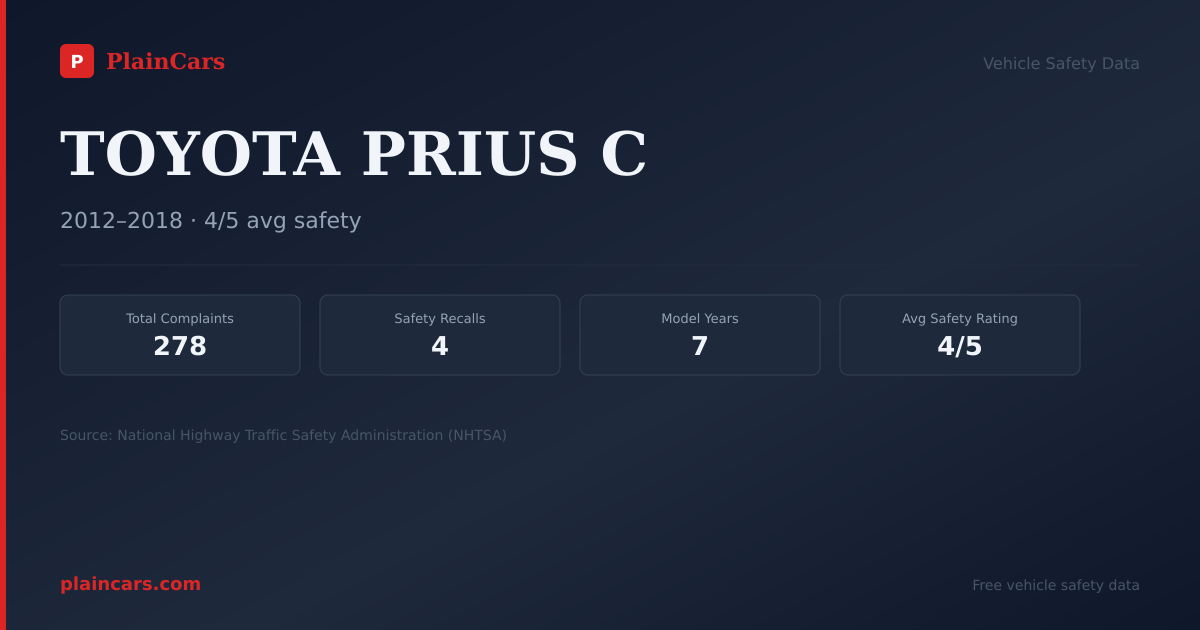
Total Complaints
88 filings
Toyota Prius C · model year
88 NHTSA complaints, 18 crash reports. A VIN lookup is required to determine whether a specific vehicle has an unrepaired recall.
NHTSA overall rating
4 / 5 ★
New Car Assessment Program
The verdict
The 2013 Toyota Prius C pairs above-average complaint volume with a strong NHTSA safety rating.
The 2013ToyotaPrius C carries 88 consumer safety complaints in NHTSA's Office of Defects Investigation database for this specific model-year cohort. Within that volume, owners reported 18 crashes, 0 fires, 3 injuries, and 0 fatalities. For crash performance, NHTSA's New Car Assessment Program gave this cohort an overall 4/5 rating, with 4/5 front crash, 4/5 side crash, and 4/5 rollover scores derived from standardized barrier and dynamic tests.
The most frequently selected component label in reports for the 2013 Prius C is electrical system with 21 filings, followed by service brakes (16) and engine (7). Complaint categories reflect owner reports and intake categorization; they do not establish a defect pattern or cause.
NHTSA currently has 51 investigation files overlapping the 2013 Prius C, and 1 remain open. Owners comparing this cohort against neighboring years should read the complaint-by-year trend as report volume, not a causal diagnosis. Use the related-complaint feed and the official recall lookup when researching a specific vehicle.
PlainCars' own composite of NHTSA NCAP crash-test ratings and rollover-risk assessment, each dimension normalized against the federal scale or the full national model-year corpus. Not an official NHTSA figure, and not a substitute for a specific vehicle's VIN-level recall check.
Total Complaints
88 filings
Crashes Reported
18 reports
Source
NHTSA ODI
Federal complaints database
At or below the fleet median complaint volume.
| Component | Count |
|---|---|
| ELECTRICAL SYSTEM | 21 |
| SERVICE BRAKES | 16 |
| ENGINE | 7 |
| FUEL/PROPULSION SYSTEM | 5 |
| UNKNOWN OR OTHER | 5 |
| AIR BAGS | 4 |
| EXTERIOR LIGHTING | 4 |
| HYBRID PROPULSION SYSTEM | 4 |
| VEHICLE SPEED CONTROL | 3 |
| STEERING | 3 |
| POWER TRAIN | 3 |
| STRUCTURE:BODY | 3 |
| EQUIPMENT:ELECTRICAL:NAVIGATIONAL SYSTEM(GLOBAL POSITIONING SYSTEM) | 1 |
| VISIBILITY:GLASS, SIDE/REAR | 1 |
| ELECTRICAL SYSTEM: INSTRUMENT CLUSTER/PANEL | 1 |
The contact owns a 2013 Toyota Prius C. The contact stated that while his wife was attempting to cold-start the vehicle, the vehicle failed to start. The contact stated that on several occasions the vehicle was started; however, the instrument cluster and other electrical devices failed to operate as needed. The contact replaced the auxiliary battery. The vehicle was repaired, but the failure reoccurred, and the vehicle needed to be jump-started. The vehicle was not taken to a local dealer or independent mechanic to be diagnosed or repaired. The contact researched online and related the failure to NHTSA Campaign Number: 20V369000 (Hybrid Propulsion System); however, the VIN was not included in the recall. The manufacturer was not informed of the failure. The failure mileage was approximately 150,000.
Mileage: 150,000
Brake master cylinder failure.
Brake master cylinder failure.
Car suddenly needed a jump start and again after a day or two of non-use. On the third day Brakes, ABS and traction control warnings were lighted up and remains. Brakes are mostly ineffective. My own scan returns the code C1252 and C1256 that says brake booster system failing. Took it to the dealer who charged $290 again to scan and came up with failed brake booster and pump assembly. The dealers is quoting total $4000 to fix. Toyota Customer Support Program Bulletin dated 8/2018 and revised on 8/2019 extends the warranty on for this issue (for Toyota Prius C 2013) for 10 years or 150000 miles. I was never informed by Toyota or the seller (Stevens Creek Toyota, San Jose CA) about this defect under warranty that I could have gotten repaired well before the dead line of 10 years. Now Both Toyota or the dealer's service department refuse to bear the repair cost.
Warning lamps for ABS and others and the chiming dings came on while pulling away from the bank drive through and parking for a second. I shut the engine off and turned back on with no success. I was barely able to park in a spot because of difficulties braking. My car had been making an electric noise every 15 seconds or so previously, at different times when parked, but I thought it was the hybrid engine. Now I think it was the brake pump trying to build up pressure due to a faulty, leaking brake actuator.
My 2013 Toyota Prius has a failed inverter/converter assembly, including the Intelligent Power Module (IPM). This component is critical for vehicle operation and designed to last the life of the car. Premature IPM shorting and inverter failure is a known defect acknowledged by Toyota through multiple recalls and service campaigns for other VINs with the same part number. My vehicle is giving codes P0A94 and P0A1A which are also listed in the recalls for other Prius models of similar age. My vehicle experiences the same failure, yet Toyota has denied goodwill coverage, claiming “insufficient service history.” Routine maintenance like oil changes and brake inspections does not affect this component, making the denial unreasonable. There is nothing to service on the inverter. This defect poses a serious safety risk, sudden inverter failure caused total loss of power while driving and loss of power steering, it was difficult to pull my car off the road. This poses a danger to drivers
My 2013 Toyota Prius has a failed inverter/converter assembly, including the Intelligent Power Module (IPM). This component is critical for vehicle operation and designed to last the life of the car. Premature IPM shorting and inverter failure is a known defect acknowledged by Toyota through multiple recalls and service campaigns for other VINs with the same part number. My vehicle is giving codes P0A94 and P0A1A which are also listed in the recalls for other Prius models of similar age. My vehicle experiences the same failure, yet Toyota has denied goodwill coverage, claiming “insufficient service history.” Routine maintenance like oil changes and brake inspections does not affect this component, making the denial unreasonable. There is nothing to service on the inverter. This defect poses a serious safety risk, sudden inverter failure caused total loss of power while driving and loss of power steering, it was difficult to pull my car off the road. This poses a danger to drivers
The contact owns a 2013 Toyota Prius C. The contact stated that while driving at 25 MPH, the vehicle stalled and failed to restart. The contact stated that he and his wife were in the vehicle during the failure, and the vehicle was almost crashed into. The contact stated that he and his wife were left stranded in oncoming traffic. The vehicle was towed to the dealer, where it was diagnosed that there was a computer failure and that the inverter converter assembly needed to be replaced. The vehicle was repaired. The manufacturer was notified of the failure. The failure mileage was 75,421.
Mileage: 75,421
failure of the Intelligent Power Module (IPM) within the inverter assembly
failure of the Intelligent Power Module (IPM) within the inverter assembly
Recently the dash board lights started intermittently coming on. When they are on, the brakes do not work until pressed all the way to the floor and even then the car takes a long time to stop. The lights will randomly turn off and suddenly the car brakes work normally again. It is happening intermittently with no rhyme or reason as to when it will happen. It's scary to drive because I dont know if the brakes will work or not and I almost ran into another car when trying to stop at a stop light. I took the car to be inspected at the Toyota service center for $190 and after inspection they said the brake booster and master cylinder assembly need to be replaced and it will cost $2300.
Require replacement of brake booster pump, decreased braking ability
There was a driver side collision and the airbags did not deploy. Brakes do not slowly apply they slam down causing vehicle to slide/skid in emergency braking, ABS does not function properly. The dealership recently did an appraisal (4/2/25) on the vehicle that states “Lost communication with side airbag sensor LH, Side airbag sensor LH initialization incomplete, front speed sensor RH & LH circuit, and D- Door Motor ECU communication stop”. Insurance company inspected vehicle after crash, and there was a police report filed. There were no warning indicators prior to incident or after.
There was a driver side collision and the airbags did not deploy. Brakes do not slowly apply they slam down causing vehicle to slide/skid in emergency braking, ABS does not function properly. The dealership recently did an appraisal (4/2/25) on the vehicle that states “Lost communication with side airbag sensor LH, Side airbag sensor LH initialization incomplete, front speed sensor RH & LH circuit, and D- Door Motor ECU communication stop”. Insurance company inspected vehicle after crash, and there was a police report filed. There were no warning indicators prior to incident or after.
There was a driver side collision and the airbags did not deploy. Brakes do not slowly apply they slam down causing vehicle to slide/skid in emergency braking, ABS does not function properly. The dealership recently did an appraisal (4/2/25) on the vehicle that states “Lost communication with side airbag sensor LH, Side airbag sensor LH initialization incomplete, front speed sensor RH & LH circuit, and D- Door Motor ECU communication stop”. Insurance company inspected vehicle after crash, and there was a police report filed. There were no warning indicators prior to incident or after.
the vehicle exhibits several warning lights on the dash including ABS, VSC brake and handbrake. Diagnosed code as C1391 which toyota had released a bulletin to admit this issue, but they don’t make a recall instead of only repair it when occurred within their limited time line. now my vehicle falls in their bulletin scope but out of their “warranty “ scope. and quoted for thousands of repair. as a matter of fact, this put me at a great risk in driving it. and toyota didn’t make a public recall to solve this problem.
Immobilized failure due to combination of brake hose failure preventing hybrid control/shift actuator. Hybrid steering lock became disengaged and could not communicate with the certification ecu due constant power being disabled due to complete main body failure. Hybrid system cannot go back into park however ecm side did. Ecm was not receiving power as dealer coded main body as a plug in hybrid effectively disabling fuel systems (including emissions/fuel safety) causing full misclassification in the smart key certification process. Car starts, goes into ready and disables LIN comms alongside cutting main relay due to tailgate and fuel constant powers being cut while driving.
Immobilized failure due to combination of brake hose failure preventing hybrid control/shift actuator. Hybrid steering lock became disengaged and could not communicate with the certification ecu due constant power being disabled due to complete main body failure. Hybrid system cannot go back into park however ecm side did. Ecm was not receiving power as dealer coded main body as a plug in hybrid effectively disabling fuel systems (including emissions/fuel safety) causing full misclassification in the smart key certification process. Car starts, goes into ready and disables LIN comms alongside cutting main relay due to tailgate and fuel constant powers being cut while driving.
Immobilized failure due to combination of brake hose failure preventing hybrid control/shift actuator. Hybrid steering lock became disengaged and could not communicate with the certification ecu due constant power being disabled due to complete main body failure. Hybrid system cannot go back into park however ecm side did. Ecm was not receiving power as dealer coded main body as a plug in hybrid effectively disabling fuel systems (including emissions/fuel safety) causing full misclassification in the smart key certification process. Car starts, goes into ready and disables LIN comms alongside cutting main relay due to tailgate and fuel constant powers being cut while driving.
Driving on the highway at 70mph my warning lights for my ABS, traction control, and other brake related warning lights came on. My brakes became soft and hard to stop the car. Immediately brought to dealer who said that my booster accumulator was leaking and needed to replace both the accumulator and pump for over $3,500. This is a know. Issue with Toyota because they have a service bulletin that they wouldn’t honor because my car is more than 10 years old. This is a serious issue and someone is going to get badly hurt.
Data vintage: August 2026. Sources: NHTSA Office of Defects Investigation (ODI) complaints database, NHTSA recall campaign API, NHTSA NCAP crash-test ratings, and NHTSA FARS for fatality cross-reference.
Every figure on PlainCars is rendered directly from NHTSA complaint and safety data, no number is typed in by an editor. This year-specific record is rendered from NHTSA ODI, recall, and NCAP rows for the 2013 Toyota Prius C; no figure is typed in by an editor. See our editorial standards & corrections policy, the methodology behind these numbers, or report a data error. Data current as of August 2026.
Read our methodology - how this data is sourced, computed, and verified.