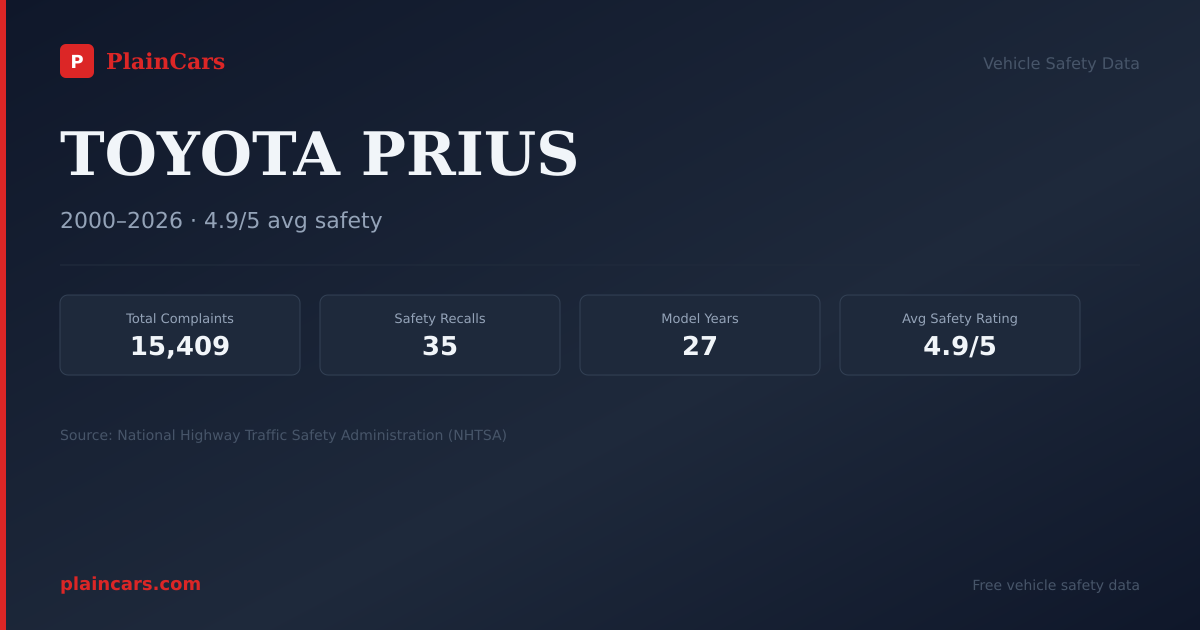
Total Complaints
189 filings
Toyota Prius · model year
189 NHTSA complaints, 50 crash reports, and 1 recall campaign listed for this cohort. A VIN lookup is required to determine whether a specific vehicle has an unrepaired recall.
NHTSA overall rating
4 / 5 ★
New Car Assessment Program
The verdict
The 2015 Toyota Prius pairs below-average complaint volume with a strong NHTSA safety rating.
The 2015ToyotaPrius carries 189 consumer safety complaints in NHTSA's Office of Defects Investigation database for this specific model-year cohort. Within that volume, owners reported 50 crashes, 1 fire, 28 injuries, and 3 fatalities. For crash performance, NHTSA's New Car Assessment Program gave this cohort an overall 4/5 rating, with 4/5 front crash, 5/5 side crash, and 4/5 rollover scores derived from standardized barrier and dynamic tests.
The most frequently selected component label in reports for the 2015 Prius is service brakes with 71 filings, followed by electrical system (23) and unknown or other (14). Complaint categories reflect owner reports and intake categorization; they do not establish a defect pattern or cause. This cohort has 1 NHTSA recall campaign listed below. Enter a VIN in NHTSA's official recall lookup to determine whether a specific vehicle has an unrepaired recall.
NHTSA currently has 51 investigation files overlapping the 2015 Prius, and 1 remain open. Owners comparing this cohort against neighboring years should read the complaint-by-year trend as report volume, not a causal diagnosis. Use the related-complaint feed and the official recall lookup when researching a specific vehicle.
PlainCars' own composite of NHTSA NCAP crash-test ratings and rollover-risk assessment, each dimension normalized against the federal scale or the full national model-year corpus. Not an official NHTSA figure, and not a substitute for a specific vehicle's VIN-level recall check.
Total Complaints
189 filings
Crashes Reported
50 reports
Source
NHTSA ODI
Federal complaints database
At or below the fleet median complaint volume.
| Component | Count |
|---|---|
| SERVICE BRAKES | 71 |
| ELECTRICAL SYSTEM | 23 |
| UNKNOWN OR OTHER | 14 |
| POWER TRAIN | 13 |
| VEHICLE SPEED CONTROL | 7 |
| ENGINE | 7 |
| AIR BAGS | 6 |
| EXTERIOR LIGHTING | 6 |
| FUEL/PROPULSION SYSTEM | 6 |
| STRUCTURE:BODY | 4 |
| VISIBILITY/WIPER | 4 |
| STEERING | 3 |
| SUSPENSION | 3 |
| HYBRID PROPULSION SYSTEM | 3 |
| FORWARD COLLISION AVOIDANCE: AUTOMATIC EMERGENCY BRAKING | 3 |
HYBRID PROPULSION SYSTEM: INVERTER
Toyota Motor Engineering & Manufacturing (Toyota) is recalling certain 2013-2015 Prius and 2014-2017 Prius V vehicles not included in recall 18V-684. Excessive voltage in the Intelligent Power Module (IPM) within the inverter may cause the hybrid system to shut down, causing the vehicle to stall wh
Inferior brake system on 2015 Prius master brake cylinder and vacuum booster. Extended warranty issues identified by Toyota for 10 years or 150, 000 miles. I bought my Prius used in 2021 with 92,000 miles at age [XXX] old intending it to last as long as I did. I am now [XXX] old and essentially totally independent. The above mentioned parts were identified as not functioning properly on 2/3/2026 (mileage 139, 106). On 2/6/26, I took it to Goettle Toyota, Ocala FL (mileage. 139,160) knowing there was an extended warranty program available that was admitting the parts were defective but not worthy of recall. I was advised the warranty for my vehicle expired 10/26/2025 (3 months and 8 days prior) and was now invalid. Brake replacement cost is $3675.00 + taxð¥´. I was provided warranty information and instructed to call Toyota. I called, spoke with Brook and was advised the warranty was invalid due to date even though the car has less than the 150, 000 mile covered and nothing could be
The brake booster suddenly fails at 54k mile. Brake responds slower and need to push the brake pedal all the way It seems a lot of 2010-2015 Prius are facing this problem ABS light, skid light, and brake light was on when it happened, first appeared on Feb 6, 2026 Have to replace brake boost for ~$1500
The contact owns a 2015 Toyota Prius. The contact stated that while driving at an undisclosed speed, the ABS and the traction control warning lights illuminated. The vehicle was taken to an independent mechanic, where it was diagnosed with a leak in the brake fluid hose. The contact was unsure what repair was performed, but the vehicle was repaired. The contact stated that the failure reoccurred with an abnormal sound. The vehicle was taken back to the independent mechanic, and the contact was informed that the vehicle needed to be taken to the dealer for a complete diagnostic test. The vehicle was taken to the dealer, where it was diagnosed with brake booster failure. The contact was informed that the brake booster needed to be replaced. The vehicle was not repaired. The contact was notified of Customer Support Campaign: ZJB; however, the contact was informed that the repair was not covered under the Customer Support Program because of the 10-year 100,000-mile limitation. The manufact
Mileage: 114,000
ABS break actuator and abs pump failed while driving losing loss of breaking. Toyota is aware of this problem but refuse to fix this notorious and dangerous problem they have with multiple model years. I was not informed of the limited service campaign. This should be recalled as a safety to the public.
Clear coat and paint is peeling, especially on the roof. Toyota is not acknowledging that this happening with the 2015 Prius seaglass pearl paint.
Defected brake booster hard brake suddenly car less than 100 000 miles many vehicles with the problem
I purchased a vehicle a year ago whenever my vehicle was still under the tenure and the 10 year and it’s still under 150,000 mile range. The vehicle was purchased strictly from the Toyota dealership in Lakeland, Florida, and shortly thereafter my brakes completely went out and the booster actuator assembly looking it up by further realize that is a very common issue and that there is so much that there’s class action lawsuits and also instead of it having a recall, it has a customer support to replace parts. My car is very dangerous and doesn’t have any brakes and it’s still very new from the dealership. What it’s very interesting is that it’s not throwing any codes at all, though it beeps the entire time that I’m in the vehicle with the ABS light on and I know that it’s that problem why is it not showing any codes I think that for sure, the dealership would’ve had to done something to prevent that in order to sell the car unsafely
While driving, my brakes became mushy and ineffective. Brake warning lights came on, also. It was very scary driving in rush hour traffic with little to no brakes. There was no reliability. Just keeping as much as possible space between cars, using Hazard lights &prayer.
While driving, my brakes became mushy and ineffective. Brake warning lights came on, also. It was very scary driving in rush hour traffic with little to no brakes. There was no reliability. Just keeping as much as possible space between cars, using Hazard lights &prayer.
The ABS failed while driving on the highway. There was no accident, but it was substantially harder to brake when needed.
The ABS failed while driving on the highway. There was no accident, but it was substantially harder to brake when needed.
The vehicle has 95k miles on it and both brake actuator assembly and booster pump have gone bad. This is a defective issue, I called toyota and was told too bad since the program that fixed this ended 02/25. The car met the mileage requirement, but being 10 months out of the date gives toyota the right to wash their hands on a defective part. The part is over $1500 just in parts to replace! This is wrong on their part. Not one option offered.
This vehicle has 95k miles, now the vehicle has a brake problem which can cause deadly problems. The parts that have gone bad on this car are defective parts that toyota knows about. The warranty they extended for this ended in 02/2015. They had 150k miles or 10 years limit on that warranty. We are well under the mileage and 10 months over according to toyota. Can’t believe they will dismiss something this delicate and dangerous. The parts are not cheap and it’s something we can’t afford to fix right now. I can’t believe Toyota will just wash their hands on something this important in a vehicle. This is a know defective part! They should have some sort of responsibility and resolution. I called and was told they cant do anything. Even a part offer so we can fix nothing. Please review this and hopefully you can help.
The brake accumulator went out thanksgiving day on my way home nearly causing an accident. I also missed dinner due to the issue creating a clearly unsafe driving condition where I was barely able to use my brakes. This is a known issue by Toyota, whom extended the warranty to 10 years. Of course, my warranty was 3 days past the 10 years even though it is under the mileage requirement. This should have been a recall, as it is a known and reported problem. I am now out 3300$ for the repair just to get my car in an operable condition. There were no warnings, the abs light as well as the traction alert went off and I lost the ability to properly brake in an instant. There was no warning, nor was I notified about this part.
Hi, I am reporting a brake system failure on my 2015 Toyota Prius. In July 2025, the ABS and brake warning lights suddenly appeared, and a Toyota service center confirmed it is the known Prius brake system defect. The repair estimate ranges from $4,502 to $27,814, but Toyota declined coverage because the vehicle is just past the 10-year warranty limit. This issue poses a safety risk due to reduced braking performance. 1) The brake system / ABS actuator assembly malfunctioned. and yes, the component is still installed in the vehicle and available for inspection upon request. 2)The ABS is no longer functioning properly, significantly increases the risk of losing control or extended stopping distance, especially in wet or emergency braking conditions. I rely on this car for daily transportation in a car-dependent area, so this issue directly affects my ability to drive safely and could endanger others on the road. 3)Yes. The issue was diagnosed and confirmed by an authorized Toyota deale
The Brake Booster system failed two weeks after the Toyota Customer Confidence Program for that condition ended and they will not reimburse me for a $3000 repair. I knew there was a problem because all the dash lights came on at once while we were driving on a highway. I had it towed away to be repaired and it was found that the brake booster system was failing. Had I ignored it or not acted as immediately as I did the brakes could have failed while the car was in use and hurt or killed me or someone else. They should issue a recall for this condition and fix it for Prius models that still need it and they should reimburse me.
The contact owns a 2015 Toyota Prius. The contact stated that while driving approximately 15-20 MPH, the ABS, brakes, and the traction control warning lights, and the malfunction indicator light were illuminated. Additionally, the vehicle hesitated to respond while depressing the brake pedal, causing the braking distance to be extended. The vehicle was taken to the dealer, where it was diagnosed with an abnormal leak in the accumulator and a leak in the brake booster pump. The dealer determined that the brake master cylinder and the brake booster pump needed to be replaced. The vehicle was not repaired. The manufacturer was not notified of the failure. The failure mileage was approximately 94,100.
Mileage: 94,100
The ABS, BREAK, and Traction Control, suddenly turned on when I was traveling on the freeway in mild traffic. I was traveling at about 60-65 mph. I attempted to use the breaks and could feel a substantial difference in how much and how hard I had to push in order to stop. The problem has not been confirmed by a dealer or service center. The vehicle was inspected by my brother in law who works on cars frequently. There were no warning symptoms prior to the problem. The problem first occurred on Saturday November 1st at about 12:30. According to my brother in law, it was the break pump that failed; you can hear air escaping when you push on the break pedal.
I was driving from Las Vegas to my home in Los Angeles. An alarming message began flashing on the dashboard telling me to pull over. The vehicle became hard to control. I somehow managed to get it off an exit. I was "lucky" enough to get it towed to a nearby Toyota dealership where I was told the inverter had failed and that that inverter and associated parts had to be replaced. On my 2015 Prius with only 50,000 miles on it. I SPECIFICALLY asked if there had been a recall on the electrical system of any 2015 Priuses, and they flatly said no. I also CALLED TOYOTA, and they also said there were no recalls involving the electrical system or inverters. The Barstow Toyota dealership said it would cost over $5,000 to repair AND that they wouldn't have the parts they needed for a WEEK. As it was, I had been stranded in the desert at a hotel for two days. I then had to pay $1,100 to be towed back to LA and took it to a hybrid mechanic I trust and paid them to do the work. But this cost me THOU
I was driving from Las Vegas to my home in Los Angeles. An alarming message began flashing on the dashboard telling me to pull over. The vehicle became hard to control. I somehow managed to get it off an exit. I was "lucky" enough to get it towed to a nearby Toyota dealership where I was told the inverter had failed and that that inverter and associated parts had to be replaced. On my 2015 Prius with only 50,000 miles on it. I SPECIFICALLY asked if there had been a recall on the electrical system of any 2015 Priuses, and they flatly said no. I also CALLED TOYOTA, and they also said there were no recalls involving the electrical system or inverters. The Barstow Toyota dealership said it would cost over $5,000 to repair AND that they wouldn't have the parts they needed for a WEEK. As it was, I had been stranded in the desert at a hotel for two days. I then had to pay $1,100 to be towed back to LA and took it to a hybrid mechanic I trust and paid them to do the work. But this cost me THOU
Data vintage: August 2026. Sources: NHTSA Office of Defects Investigation (ODI) complaints database, NHTSA recall campaign API, NHTSA NCAP crash-test ratings, and NHTSA FARS for fatality cross-reference.
Every figure on PlainCars is rendered directly from NHTSA complaint and safety data, no number is typed in by an editor. This year-specific record is rendered from NHTSA ODI, recall, and NCAP rows for the 2015 Toyota Prius; no figure is typed in by an editor. See our editorial standards & corrections policy, the methodology behind these numbers, or report a data error. Data current as of August 2026.
Read our methodology - how this data is sourced, computed, and verified.