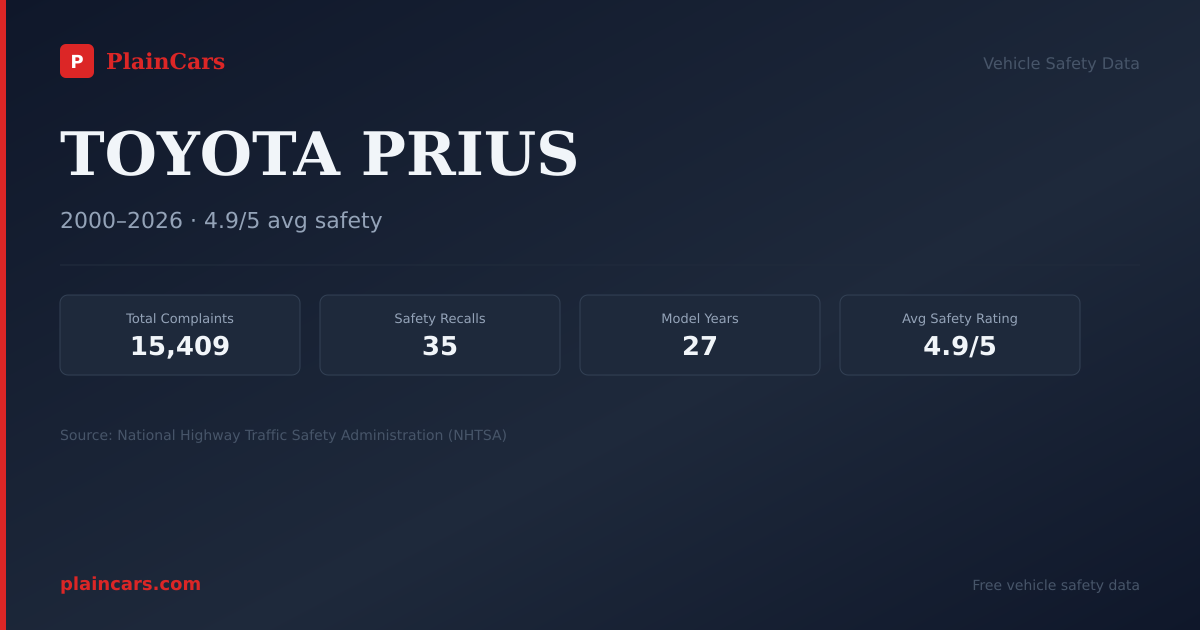
Total Complaints
261 filings
Toyota Prius · model year
261 NHTSA complaints, 45 crash reports, and 3 recall campaigns listed for this cohort. A VIN lookup is required to determine whether a specific vehicle has an unrepaired recall.
NHTSA overall rating
4 / 5 ★
New Car Assessment Program
The verdict
The 2014 Toyota Prius pairs above-average complaint volume with a strong NHTSA safety rating.
The 2014ToyotaPrius carries 261 consumer safety complaints in NHTSA's Office of Defects Investigation database for this specific model-year cohort. Within that volume, owners reported 45 crashes, 2 fires, 22 injuries, and 0 fatalities. For crash performance, NHTSA's New Car Assessment Program gave this cohort an overall 4/5 rating, with 4/5 front crash, 5/5 side crash, and 4/5 rollover scores derived from standardized barrier and dynamic tests.
The most frequently selected component label in reports for the 2014 Prius is service brakes with 79 filings, followed by electrical system (30) and unknown or other (23). Complaint categories reflect owner reports and intake categorization; they do not establish a defect pattern or cause. This cohort has 3 NHTSA recall campaigns listed below. Enter a VIN in NHTSA's official recall lookup to determine whether a specific vehicle has an unrepaired recall.
NHTSA currently has 51 investigation files overlapping the 2014 Prius, and 1 remain open. Owners comparing this cohort against neighboring years should read the complaint-by-year trend as report volume, not a causal diagnosis. Use the related-complaint feed and the official recall lookup when researching a specific vehicle.
PlainCars' own composite of NHTSA NCAP crash-test ratings and rollover-risk assessment, each dimension normalized against the federal scale or the full national model-year corpus. Not an official NHTSA figure, and not a substitute for a specific vehicle's VIN-level recall check.
Total Complaints
261 filings
Crashes Reported
45 reports
Source
NHTSA ODI
Federal complaints database
Above median complaint volume, review patterns below.
| Component | Count |
|---|---|
| SERVICE BRAKES | 79 |
| ELECTRICAL SYSTEM | 30 |
| UNKNOWN OR OTHER | 23 |
| ENGINE | 15 |
| VEHICLE SPEED CONTROL | 14 |
| AIR BAGS | 14 |
| VISIBILITY/WIPER | 9 |
| STEERING | 8 |
| ELECTRONIC STABILITY CONTROL (ESC) | 8 |
| STRUCTURE:BODY | 7 |
| POWER TRAIN | 6 |
| EXTERIOR LIGHTING | 6 |
| SERVICE BRAKES, HYDRAULIC | 6 |
| FUEL/PROPULSION SYSTEM | 5 |
| HYBRID PROPULSION SYSTEM | 4 |
HYBRID PROPULSION SYSTEM: INVERTER
Toyota Motor Engineering & Manufacturing (Toyota) is recalling certain 2013-2015 Prius and 2014-2017 Prius V vehicles not included in recall 18V-684. Excessive voltage in the Intelligent Power Module (IPM) within the inverter may cause the hybrid system to shut down, causing the vehicle to stall wh
HYBRID PROPULSION SYSTEM: INVERTER
Toyota is recalling certain model year 2010 through 2014 Prius vehicles. In the affected vehicles, the Intelligent Power Module (IPM) inside the inverter module (a component of the hybrid system) contains transistors that may become damaged from high operating temperatures. If this occurs, various
HYBRID PROPULSION SYSTEM
Toyota Motor Engineering & Manufacturing (Toyota) is recalling certain 2010-2014 Toyota Prius and 2012-2014 Toyota Prius V vehicles. Excessive voltage in the Intelligent Power Module (IPM) within the inverter may cause the hybrid system to shut down, causing the vehicle to stall while being driven.
The brake booster/accumulator failed on my vehicle. This part was a common failure during the 2010-2015 production run so much so that Toyota extended coverage to replace. Mine failed recently beyond the warranty extension of 10 years/150k miles. My vehicle has only 108k miles and is 15 months beyond warranty. Toyota Corporate will not replace this vital part, despite the fact it was a defective design. I can’t drive it any longer since I don’t have the $4000 to make repair. Toyota Corporate has shown little concern despite this critical safety defect.
The slip notification, abs, and brake lights turned on while driving on the highway. The brakes then became very stiff and the vehicle did not brake as fast or as well as it normally does without the lights.
2014 Prius HB with 135k miles , onboard system warning lights for Brakes, ABS system, TPMS and Traction Ctrl all came one suddenly. Brake losing pressure while vehicle making strange noise under front driver side
On Jan 5, 2026 I was driving locally at about 40-45 mph. All of a sudden 3 indicator lights came on ABS, Brake, and Brake System Warning Light. There were no noises, but the brakes felt different. They did stop when needed. I left space between myself and others just in case, did not want an accident. Called my regular mechanic. They advised to not drive the car, but to bring it into the shop at 8am the following day. On Jan 6th, the mechanic stated it was beyond their expertise. It was towed to the local Toyota Dealer for repairs. It ended up being the Brake Booster and Pump. Upon investigation online, we saw this was a recall, but we were not notified by Toyota.
On Jan 5, 2026 I was driving locally at about 40-45 mph. All of a sudden 3 indicator lights came on ABS, Brake, and Brake System Warning Light. There were no noises, but the brakes felt different. They did stop when needed. I left space between myself and others just in case, did not want an accident. Called my regular mechanic. They advised to not drive the car, but to bring it into the shop at 8am the following day. On Jan 6th, the mechanic stated it was beyond their expertise. It was towed to the local Toyota Dealer for repairs. It ended up being the Brake Booster and Pump. Upon investigation online, we saw this was a recall, but we were not notified by Toyota.
I was driving on the freeway, and a few lights(including ABS, brake lights) all came on and a beeping noise started, as i immediately lost complete control of my brakes! That God it was late, and no cars were in front of me. The car slowed down as I removed my foot of the gas right away. I tried to pull over as soon as I heard the lights, and that’s when I realized my brakes were completely gone! I was able to stop after about two miles; car stop on its own as it slowed down. Apparently, this was a major known issue and had warranty up to 150k miles. At the time of the incident, my car had about 165k miles. I had the car for years, and no one at the dealer ever mentioned anything about this or even tried to make me aware of it! I called the Toyota dealer and corporate number several times and they declined providing me with any help at all! This caused me fear and traume because I never thought this was possible! It could’ve ended my life and the life of people around me if there w
Hello, We were informed that the vehicle paint had a recall due to paint chipping. Unfortunately we never received the notice and was unaware until after the recall program had ended. We are contacting you now to see how we can address this issue as our vehicle paint is chipping all around the car.
The brake booster system (electric brake booster pump) in my 2014 Toyota Prius has been making frequent, audible cycling noises inside the cabin, particularly during cold weather. I have also noticed a faint odor outside the vehicle that seems related to electrical movement. No ABS or brake warning lights have illuminated, but the cycling pump may indicate increased stress on the brake system. The issue has not yet been diagnosed or confirmed by a dealer or independent service center. The problem has not caused a loss of braking ability to date, but the unusual noises and electrical odor suggest potential risk if the booster were to fail completely. No recall or customer support program currently covers this issue. The component is part of the vehicle’s brake system and would be available for inspection by a dealer or manufacturer upon request. Toyota has offered no help or possibility of Goodwill assistance inspection for this issue.
The brake system malfunctioned suddenly. While driving and while stopped, the brake pedal became very hard and braking behavior became unpredictable. The vehicle sometimes brakes aggressively and other times requires excessive pedal force to stop. The ABS and BRAKE warning lights illuminated. The vehicle no longer provides normal braking assistance. This issue is related to a failure of the brake actuator / brake booster, which is a known issue affecting Toyota Prius models from 2010 to 2015. This defect creates a serious safety risk, as braking performance is inconsistent and may increase stopping distance or cause loss of control during emergency braking situations. The vehicle has not been repaired yet because the cost is very high and the manufacturer has declined assistance despite this being a known safety-related defect.
The brake system malfunctioned suddenly. While driving and while stopped, the brake pedal became very hard and braking behavior became unpredictable. The vehicle sometimes brakes aggressively and other times requires excessive pedal force to stop. The ABS and BRAKE warning lights illuminated. The vehicle no longer provides normal braking assistance. This issue is related to a failure of the brake actuator / brake booster, which is a known issue affecting Toyota Prius models from 2010 to 2015. This defect creates a serious safety risk, as braking performance is inconsistent and may increase stopping distance or cause loss of control during emergency braking situations. The vehicle has not been repaired yet because the cost is very high and the manufacturer has declined assistance despite this being a known safety-related defect.
The brake system malfunctioned suddenly. While driving and while stopped, the brake pedal became very hard and braking behavior became unpredictable. The vehicle sometimes brakes aggressively and other times requires excessive pedal force to stop. The ABS and BRAKE warning lights illuminated. The vehicle no longer provides normal braking assistance. This issue is related to a failure of the brake actuator / brake booster, which is a known issue affecting Toyota Prius models from 2010 to 2015. This defect creates a serious safety risk, as braking performance is inconsistent and may increase stopping distance or cause loss of control during emergency braking situations. The vehicle has not been repaired yet because the cost is very high and the manufacturer has declined assistance despite this being a known safety-related defect.
misfire code along with rough starts/light load. T-SB-0116-15
misfire code along with rough starts/light load. T-SB-0116-15
My 2014 Toyota Prius (VIN [XXX] , 77,000 miles) displayed Brake, ABS, and Slip warning lights. A mechanic confirmed failure of the Brake Booster and Pump Assembly (DTC C1391). Toyota previously acknowledged this as a safety-related defect under Customer Support Program ZJB, but my coverage expired because I never received Toyota’s notice dated May 21, 2019. My car has been undrivable for weeks and Toyota refuses goodwill repair. This is a serious brake safety issue that should be reviewed for recall or extended coverage since many Prius owners have experienced the same failure. INFORMATION REDACTED PURSUANT TO THE FREEDOM OF INFORMATION ACT (FOIA), 5 U.S.C. 552(B)(6)
ABS complete and total failure while driving.
ABS complete and total failure while driving.
The ADS, traction light, and brake light all came on at once. Apparently this is a known problem with these cars and Toyota was fixing them for awhile but has stopped. No brake issues were reported when I brought it in for inspection in 2023. I never received any mail stating that this was a know defect and I needed to bring my car in to get it inspected. It's obvious to me that Toyota designed a defective part that impacts safety, and is forcing the owner to bear the cost of the fix by creating parameters that can never be met before the warranty expires.
My brakes consistently lock and the car lunges forward. Driving down the highway I tapped my brakes and they didn’t work. I lost traction in the brakes. I had no control over the car or speed. I’m scared everyday I have to drive it. This is extremely dangerous and I've seen this comment often with this vehicle. Toyota said they had an extended warranty for this but it expired. I never received any mail or phone calls stating that this was a known defect. They say they can’t do anything now and are quoting me over $3000 to fix it.
The brake actuator failed, it can be available for inspection anytime. My ABS light, brake light, and traction control lights all came on to indicate the failure. Since the hybrid engine requires the breaking system to recharge, failure of this part will eventually lead you to be stranded if it isn’t functional. Additionally, the responsiveness of the breaks makes driving at higher speeds a lot riskier. Toyota offered an "extended warranty" to have the parts replaced for free for 10 years or 150,000 miles, whichever came first. My make is 2014, at only 89,000 miles.
The contact owns a 2014 Toyota Prius. The contact stated that the ABS and the traction control warning lights were illuminated. The vehicle was taken to the dealer to be diagnosed, and the contact was informed that the brake master cylinder needed to be replaced. The vehicle was not repaired. The vehicle was taken to a certified mechanic and was diagnosed, and it was determined that the brake booster had failed and needed to be replaced. The vehicle was repaired; however, one day later, both warning lights returned. The vehicle was returned to the mechanic and air was blown into the hydraulic valves and the other valves were cleaned; however, the failure persisted. The manufacturer was not informed of the failure. The failure mileage was approximately 150,000.
Mileage: 150,000
Data vintage: August 2026. Sources: NHTSA Office of Defects Investigation (ODI) complaints database, NHTSA recall campaign API, NHTSA NCAP crash-test ratings, and NHTSA FARS for fatality cross-reference.
Every figure on PlainCars is rendered directly from NHTSA complaint and safety data, no number is typed in by an editor. This year-specific record is rendered from NHTSA ODI, recall, and NCAP rows for the 2014 Toyota Prius; no figure is typed in by an editor. See our editorial standards & corrections policy, the methodology behind these numbers, or report a data error. Data current as of August 2026.
Read our methodology - how this data is sourced, computed, and verified.