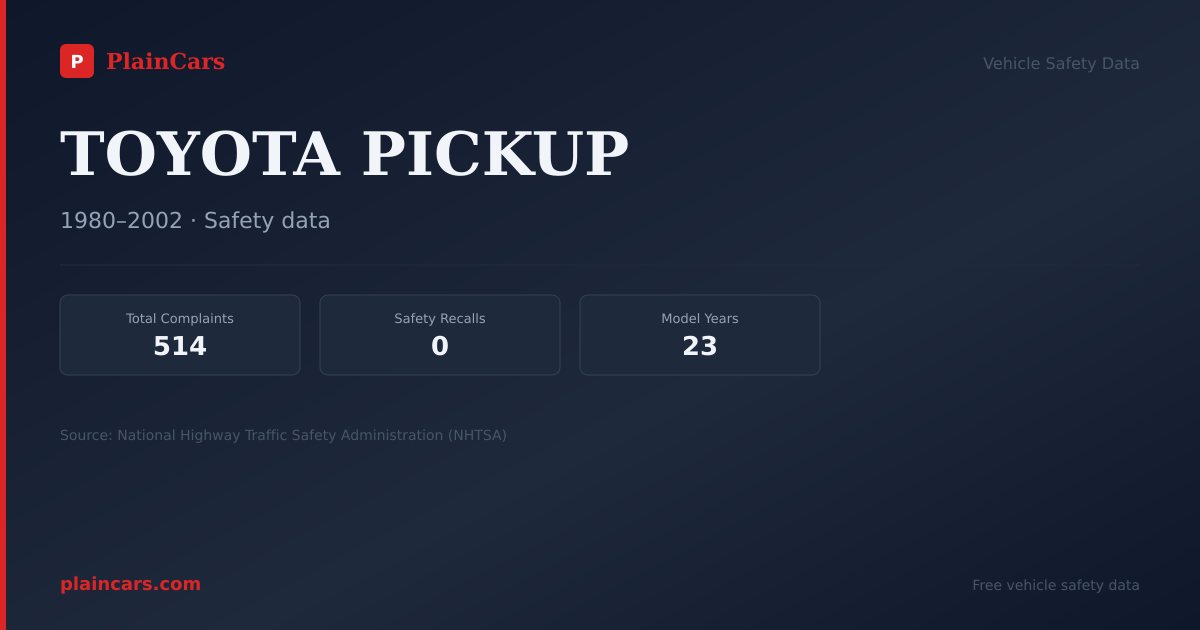
Total Complaints
5 filings
Toyota Pickup · model year
5 NHTSA complaints. A VIN lookup is required to determine whether a specific vehicle has an unrepaired recall.
NHTSA overall rating
Not crash-tested
New Car Assessment Program
The verdict
The 2000 Toyota Pickup posts below-average complaint volume among its own model-year siblings.
The 2000ToyotaPickup carries 5 consumer safety complaints in NHTSA's Office of Defects Investigation database for this specific model-year cohort. Within that volume, owners reported 0 crashes, 0 fires, 0 injuries, and 0 fatalities. No NCAP 5-star crash-test rating is available for this model year in the federal database.
The most frequently selected component label in reports for the 2000 Pickup is structure:body:door with 1 filings, followed by power train:automatic transmission (1) and service brakes, hydraulic:foundation components (1). Complaint categories reflect owner reports and intake categorization; they do not establish a defect pattern or cause.
NHTSA currently has 51 investigation files overlapping the 2000 Pickup, and 1 remain open. Owners comparing this cohort against neighboring years should read the complaint-by-year trend as report volume, not a causal diagnosis. Use the related-complaint feed and the official recall lookup when researching a specific vehicle.
PlainCars' own composite of NHTSA NCAP crash-test ratings and rollover-risk assessment, each dimension normalized against the federal scale or the full national model-year corpus. Not an official NHTSA figure, and not a substitute for a specific vehicle's VIN-level recall check.
Total Complaints
5 filings
Crashes Reported
0 reports
Source
NHTSA ODI
Federal complaints database
At or below the fleet median complaint volume.
| Component | Count |
|---|---|
| STRUCTURE:BODY:DOOR | 1 |
| POWER TRAIN:AUTOMATIC TRANSMISSION | 1 |
| SERVICE BRAKES, HYDRAULIC:FOUNDATION COMPONENTS | 1 |
| SERVICE BRAKES | 1 |
| VEHICLE SPEED CONTROL | 1 |
ENGINE LIGHT CAME ON, THEN THE VEHICLE LOST POWER AT 65 MPH AS IF IT HAD BEEN SHUT OFF, ALMOST CAUSING AN ACCIDENT. THE CODE READER INDICATED A PROBLEM WITH THE ACCELERATOR PEDAL SENSOR. THE SHOP CLEANED IT, BUT IT HAS OCCURRED A SECOND TIME, THIS TIME AT 55 MPH.
Mileage: 130,000
I CAME TO A LEFT TURN WITH MY TUNDRA AT APPROXIMATELY 50 MPH AND THERE WAS SOMEBODY WAITING ON THE ROAD I WAS APPROACHING TO TURN ON. THERE WAS ALSO SOMEBODY COMING TOWARDS ME IN ONCOMING LANE. WHEN I WENT TO BRAKE FOR THE TURN THE PEDAL WENT COMPLETELY TO THE FLOOR AND I PUMPED THEM QUICKLY AND EVERY TIME THEY WENT TO THE FLOOR. AT THAT POINT I REALIZED I WOULD NOT MAKE THE CORNER AND HAD TO EITHER HIT THE DITCH OR RIDE OUT ONCOMING LANE SHOULDER. I CHOSE THE SHOULDER. WHEN I CAME TO A STOP I REALIZED I BLEW A FRONT BRAKE LINE(A STEEL LINE). UPON FURTHER INSPECTION TOYOTA TUNDRAS HAVE A LOAD BALANCING SYSTEM FOR THE REAR BRAKES. WITH THIS SYSTEM THERE IS A PRO PORTIONING VALVE MOUNTED TO THE FRAME IN THE REAR. THERE IS ALSO A LINKAGE ROD MOUNTED TO REAR DIFFERENTIAL THAT ACTUATES VALVE . THIS ROD WAS RUSTED AWAY INSIDE A RUBBER BOOT ATTACHED TO THE VALVE AND WAS NOT ALLOWING ANY PRESSURE TO REACH REAR BRAKES SO WHEN I BLEW THE FRONT LINE I HAD ABSOLUTELY NO BRAKES! I REPAIRED THE BRAK
Mileage: 140,000
WEIGHT OF VEHICLE IS TOO HEAVY, TAKES A LONG TIME TO STOP VEHICLE, CAUSING BRAKES TO OVERHEAT AND BE INOPERATIVE. *AK *SCC
WHEN DRIVING AT HIGHWAY SPEEDS, ALL THE DOOR AJAR LIGHTS AND THE DOOR LIGHTS COME ON. ELECTRIC DOOR LOCKS OPENED, AND THE TRANSMISSION IS SLIPPING INTERMITTENTLY IN FIRST AND SECOND GEAR. THE VEHICLE IS SHIFTING HARD. DEALER IS AWARE OF THE PROBLEM. *AK *ML
WHEN DRIVING AT HIGHWAY SPEEDS, ALL THE DOOR AJAR LIGHTS AND THE DOOR LIGHTS COME ON. ELECTRIC DOOR LOCKS OPENED, AND THE TRANSMISSION IS SLIPPING INTERMITTENTLY IN FIRST AND SECOND GEAR. THE VEHICLE IS SHIFTING HARD. DEALER IS AWARE OF THE PROBLEM. *AK *ML
Data vintage: August 2026. Sources: NHTSA Office of Defects Investigation (ODI) complaints database, NHTSA recall campaign API, NHTSA NCAP crash-test ratings, and NHTSA FARS for fatality cross-reference.
Every figure on PlainCars is rendered directly from NHTSA complaint and safety data, no number is typed in by an editor. This year-specific record is rendered from NHTSA ODI, recall, and NCAP rows for the 2000 Toyota Pickup; no figure is typed in by an editor. See our editorial standards & corrections policy, the methodology behind these numbers, or report a data error. Data current as of August 2026.
Read our methodology - how this data is sourced, computed, and verified.