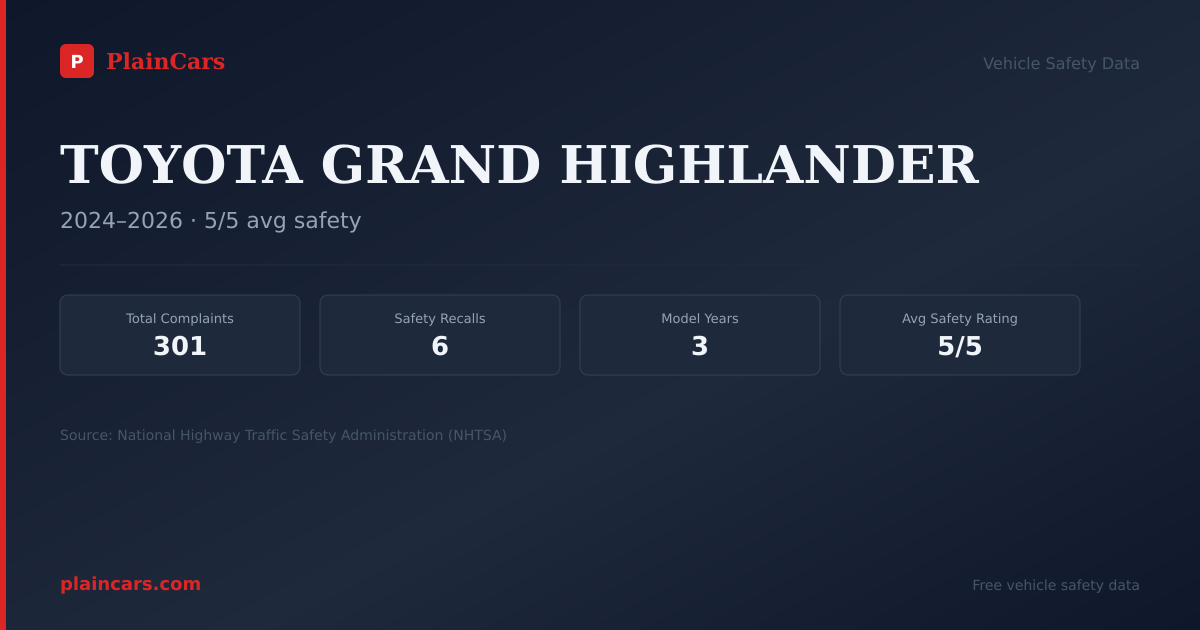
Total Complaints
47 filings
Toyota Grand Highlander · model year
47 NHTSA complaints, and 3 recall campaigns listed for this cohort. A VIN lookup is required to determine whether a specific vehicle has an unrepaired recall.
NHTSA overall rating
5 / 5 ★
New Car Assessment Program
The verdict
The 2025 Toyota Grand Highlander carries a top NHTSA safety rating.
The 2025ToyotaGrand Highlander carries 47 consumer safety complaints in NHTSA's Office of Defects Investigation database for this specific model-year cohort. Within that volume, owners reported 0 crashes, 0 fires, 0 injuries, and 0 fatalities. For crash performance, NHTSA's New Car Assessment Program gave this cohort an overall 5/5 rating, with 4/5 front crash, 5/5 side crash, and 4/5 rollover scores derived from standardized barrier and dynamic tests.
The most frequently selected component label in reports for the 2025 Grand Highlander is unknown or other with 11 filings, followed by power train (9) and fuel/propulsion system (4). Complaint categories reflect owner reports and intake categorization; they do not establish a defect pattern or cause. This cohort has 3 NHTSA recall campaigns listed below. Enter a VIN in NHTSA's official recall lookup to determine whether a specific vehicle has an unrepaired recall.
NHTSA currently has 51 investigation files overlapping the 2025 Grand Highlander, and 1 remain open. Owners comparing this cohort against neighboring years should read the complaint-by-year trend as report volume, not a causal diagnosis. Use the related-complaint feed and the official recall lookup when researching a specific vehicle.
PlainCars' own composite of NHTSA NCAP crash-test ratings and rollover-risk assessment, each dimension normalized against the federal scale or the full national model-year corpus. Not an official NHTSA figure, and not a substitute for a specific vehicle's VIN-level recall check.
Total Complaints
47 filings
Crashes Reported
0 reports
Source
NHTSA ODI
Federal complaints database
At or below the fleet median complaint volume.
| Component | Count |
|---|---|
| UNKNOWN OR OTHER | 11 |
| POWER TRAIN | 9 |
| FUEL/PROPULSION SYSTEM | 4 |
| ENGINE | 4 |
| STRUCTURE:BODY | 3 |
| VEHICLE SPEED CONTROL | 3 |
| STRUCTURE:BODY:HOOD | 2 |
| BACK OVER PREVENTION | 2 |
| VISIBILITY/WIPER | 2 |
| ELECTRICAL SYSTEM: INSTRUMENT CLUSTER/PANEL | 1 |
| FORWARD COLLISION AVOIDANCE | 1 |
| SUSPENSION | 1 |
| ELECTRICAL SYSTEM | 1 |
| CHILD SEAT | 1 |
| VISIBILITY:DEFROSTER/DEFOGGER/HVAC SYSTEM | 1 |
BACK OVER PREVENTION:DISPLAY FUNCTION
Toyota Motor Engineering & Manufacturing (Toyota) is recalling certain 2022-2026 Toyota, Lexus, and Subaru Solterra vehicles equipped with a Panoramic View Monitor (PVM) system. Please see the recall report for a complete list of models. A software error may cause the rearview camera to freeze or di
EQUIPMENT:OTHER:LABELS
Toyota Motor Engineering & Manufacturing (Toyota) is recalling certain 2024-2025 Toyota Tundra, Tacoma Hybrid, Tacoma, RAV4 Hybrid, Land Cruiser Hybrid, Lexus GX550, 2024-2026 Tundra Hybrid, 2025 Sequoia Hybrid, Crown Signia, Grand Highlander, Lexus TX500 Hybrid, Lexus NX350 Hybrid, 2025-2026 Grand
ELECTRICAL SYSTEM: INSTRUMENT CLUSTER/PANEL
Toyota Motor Engineering & Manufacturing (Toyota) is recalling certain 2023-2024 Toyota Venza, 2023-2025 RAV4 Prime, RAV4, Highlander, GR Corolla, Crown, 2024-2025 Lexus TX, LS, Toyota Tacoma, Grand Highlander, and 2025 Lexus RX, Toyota Crown Signia, Camry, RAV 4 Plug-in Hybrid (PHEV), and 4 Runner
The front panel of the sunroof shattered while the vehicle was parked in our garage. Glass shards are inside the car. The dealership submitted a claim to Toyota who denied any material defect and refused to repair under warranty.
Dear National Highway Traffic Safety Administration, I am submitting this complaint to formally report a serious safety issue involving the left front axle of my Toyota Grand Highlander Hybrid XLE. The vehicle was first diagnosed by my local Toyota dealer on January 14, 2026, at which time the left front axle issue was identified. I contacted **Toyota Motor Corporation**, and I was initially informed that the required replacement part would arrive on February 6, 2026. After that date passed, I was told the part would arrive in early March. I have now been told it will not arrive until late March. Based on these repeated delays, I am concerned that “late March” could easily become late April or even later, with no firm commitment or guaranteed repair date. I have contacted Toyota dealership multiple times and made several phone calls seeking assistance, updates, or a definitive timeline. Unfortunately, no one has been able to provide a clear solution, firm delivery date, or alter
outside temperature reading is 2 to 7 degrees high, which is not good when it makes the difference between freezing temps and not freezing temps
The car was running perfect, 9 months after I bought this car, before 20,000 miles Front Left Axle become defective, and therefore, the dealer promised to reemplaced it, but I am still waiting from the dealer. It is a big risk to runs the car like that.
At a complete stop my car started shaking violently back and forth. It felt like we were in an earthquake. It has happened before but not as violently and not as long. No warning lights or anything. It has had problems with lurching and stuttering since we bought it. The dealership said they fixed it once (the stuttering) but it’s still happening. They cannot duplicate it and it’s not throwing any codes.
At a complete stop my car started shaking violently back and forth. It felt like we were in an earthquake. It has happened before but not as violently and not as long. No warning lights or anything. It has had problems with lurching and stuttering since we bought it. The dealership said they fixed it once (the stuttering) but it’s still happening. They cannot duplicate it and it’s not throwing any codes.
The entire life of the car from initial purchase the fuel gauge is incorrect. The car has a 17 gallon gas tank and the fuel gauge is calibrated to around 13 gallons. The car thinks it is out of gas around 13 gallons when there is actually 4 more gallons left.
The contact owns a 2025 Toyota Grand Highlander. The contact received notification of NHTSA Campaign Number: 25V744000 (Back Over Prevention); however, the part to do the recall repair was unavailable. The contact stated that the manufacturer had exceeded a reasonable amount of time for the recall repair. The dealer was contacted and diagnosed the vehicle and determined that the camera had failed, and that the contact would be notified when the remedy was available. The contact stated that after leaving the vehicle with the dealer, the back over camera started to fail. The back over prevention camera no longer switched the screen for the camera while in reverse, but remained on the home screen or radio instead. The contact had not heard from the dealer regarding the parts availability for the repair. The manufacturer was not made aware of the failure. The failure mileage was approximately 29,000.
Mileage: 29,000
2025 Toyota Grand Highlander Hybrid AWD, with about 16000 miles. While driving, the brakes failed. The brakes would only work if the pedal was pushed all the way to the floor. A "Low Brake Power" warning light came on the dash. The following warnings came on at the same time. Parking Brake System, Advanced Ultrasonic Detection, Vehicle Stability Control, Check Engine, Smart Stop System, Brake System, Electronically controlled Brake, Secondary Collision Brake, Anti-lock Brake System. I was lucky to have been traveling on a road that was not busy and was traveling at less than 30 mph very close to my home. Had I been driving on the interstate, on a busy road, or near pedestrians, the event could have injured or killed myself, my family, or others. The car was towed into the dealership. The dealership said that the issue was not current and the car operated normally when after it was towed in. The following DTC codes where present (P05E000, P05E062). This indicates an issue in w
The vehicle takes an excessively long time to make heat, I know NHTSA only has requirements related to defrosting the windshield and it's clear Toyota is aware of the heating issue because they added an electronic defrost to be able to pass the defrost test. The vehicle when it is less than 20f outside takes 40+minutes to warm the cabin to a reasonable temperature. The dealership let the vehicle warm up in their 80deg F shop and said it took 20minutes to get heat out of the vents and claimed that this was normal behavior. I have owned several new cars and also work as an engineer in testing so I've driven countless new vehicles to do various tests and have never had it even take 20 minutes to have heat in a vehicle.
While driving under normal conditions, the air conditioning system in my Toyota Grand Highlander suddenly stopped working. The vehicle was inspected by a Toyota dealership, which determined that the AC condenser had a hole/puncture that caused a refrigerant leak and complete AC failure. Toyota denied warranty coverage, classifying the damage as “road hazard,” despite acknowledging that this is a common issue with the Grand Highlander. There was no collision, no unusual road event, and no warning prior to failure. The condenser appears to be positioned in a highly exposed and vulnerable location, allowing small road debris to puncture it easily. Based on discussions with the dealership and reports from other owners, this issue is occurring repeatedly and results in expensive repairs (approximately $1,500–$2,000). This appears to be a design-related vulnerability, not an isolated incident or abnormal use. A failure of the air conditioning system significantly impacts vehicle saf
While accelerating from low speeds and turning, the car exhibits a rotational clicking noise from one or both front drive shaft assemblies. Seems to be the identical issue noted in the 2024 Grand Highlander that was presumably fixed during later production lots (T-SB-0082-24). That issue was seemingly solved with driveshaft replacement. The dealer said they “could not duplicate” the issue; however, it happens often while I am driving the vehicle and others have reported it to the same dealer as well. It seems to be an existing related safety issue that the dealer, and potentially the manufacturer, are ignoring until we get past the warranty.
The contact owns a 2025 Toyota Grand Highlander with an Evenflo Revolve 360 Slim car seat, Model Number: 36812470A, Manufactured Date: December 12, 2022, installed in the vehicle. The contact received notification of NHTSA Campaign Number: 25C010000 (Child Seat). The contact stated that while driving at an undisclosed speed with the child secured in the car seat, the contact became aware that there was an object in the child’s mouth. The contact pulled over to the side of the road and removed a foam piece from the child's mouth. The contact inspected the car seat and became aware that the foam was from the headrest. Medical attention was not needed. The manufacturer was not notified of the failure, but the contact stated that the manufacturer mailed tape to cover the exposed areas of the car seat.
Shortly after powering on the GHHM vehicle, driving a short distance, coming to a stop and depressing the accelerator the vehicle does not accelerate as though no power is getting to the drive train. This does not often happen but has always happened when the EV battery level is 3 bars or less and the vehicle is in its Normal mode (as opposed to Sport or ECO). This acceleration failure event lasts for a few seconds. No warning indicators are displayed prior to, during or after this happens. The dealer checked the vehicle on 30AUG2025, was not able to reproduce, but applied a firmware update TSB-0040-25, which has not solved the problem. Took it back to dealer on 14OCT2025, but the dealer was again not able to reproduce the problem. It poses a safety risk when attempting to cross intersections or entering round-abouts and the vehicle can only move at a coasting speed instead of the expected normal acceleration.
Shortly after powering on the GHHM vehicle, driving a short distance, coming to a stop and depressing the accelerator the vehicle does not accelerate as though no power is getting to the drive train. This does not often happen but has always happened when the EV battery level is 3 bars or less and the vehicle is in its Normal mode (as opposed to Sport or ECO). This acceleration failure event lasts for a few seconds. No warning indicators are displayed prior to, during or after this happens. The dealer checked the vehicle on 30AUG2025, was not able to reproduce, but applied a firmware update TSB-0040-25, which has not solved the problem. Took it back to dealer on 14OCT2025, but the dealer was again not able to reproduce the problem. It poses a safety risk when attempting to cross intersections or entering round-abouts and the vehicle can only move at a coasting speed instead of the expected normal acceleration.
While driving at approximately 50 MPH with no other vehicles around, there was a loud bang and then the sound of air. We identified that the panoramic sunroof had exploded. We pulled over immediately and took photos of the sunroof which at that time was shattered but intact. There was a clear bulge upward and no sign of impact from an outside force. We then continued driving to our home approximately another 40 miles, during that drive shards of glass flew onto the roadway leaving a hole in the sunroof of approximately 10-12 inches. We brought the vehicle to Toyota dealership for a warranty repair. Toyota refuses to cover under warranty, stating outside influence. I am confident there was no outside influence causing the glass to explode. The vehicle is a 2025 Grand Toyota Highlander Hybrid Limited with approximately 9000 miles on it, the incident happened on Nov 2nd. 2025 around noon. Weather was mild, 50-60 degrees F, no precipitation or severe winds.
Inconsistently but on numerous occasions, this vehicle has experienced harsh shifting, hesitation, or jerking during low-speed acceleration (e.g., 20-40 mph) or gear engagement. This was a known and reported issue with the 2024 model for which Toyota provided a fix. They have not provided one for the 2025 models. This issue is a safety risk while driving because with the surge you feel you must quickly let off the pedal, and with the hesitation you let off the brake indicating you will move forward yet the vehicle doesn’t accelerate.
On 11/02/2025 with the cruise at 55mph all glass closed. Heater on with no vehicles around, the sunroof exploded. It pushed up from the inside. With less than 9k miles on the vehicle. It took my dealer 8 days to look at it then Toyota denied the warranty. Then Quoted me over $2,100 to replace. This vehicle isn't safe to drive as told to me from the dealer.
There is a coolant leak in the hybrid radiator caused by a puncture. When taken to the dealer, they said a rock must have punctured it. The dealer currently has the part. Me, my husband, and 2 children were driving on I-5 when the car stopped accelerating and a "hybrid malfucntion" code and "engine malfunction" code started flashing. Prior to this, there were no warnings. I was thankfully able to full over safely, but we were stuck on the side of I-5 for at least an hour waiting for a tow. I am reading online that this is an issue with the car and seems to be a design flaw. The gaps in the grill are too large, and there is no mesh or anything else behind the grill to protect the front end of the car.
Poor acceleration from 0 to 40. Vehicle will start shuttering at a dead stop. The engine has shut off once with this issue. It happened around 4800 miles.
Data vintage: August 2026. Sources: NHTSA Office of Defects Investigation (ODI) complaints database, NHTSA recall campaign API, NHTSA NCAP crash-test ratings, and NHTSA FARS for fatality cross-reference.
Every figure on PlainCars is rendered directly from NHTSA complaint and safety data, no number is typed in by an editor. This year-specific record is rendered from NHTSA ODI, recall, and NCAP rows for the 2025 Toyota Grand Highlander; no figure is typed in by an editor. See our editorial standards & corrections policy, the methodology behind these numbers, or report a data error. Data current as of August 2026.
Read our methodology - how this data is sourced, computed, and verified.