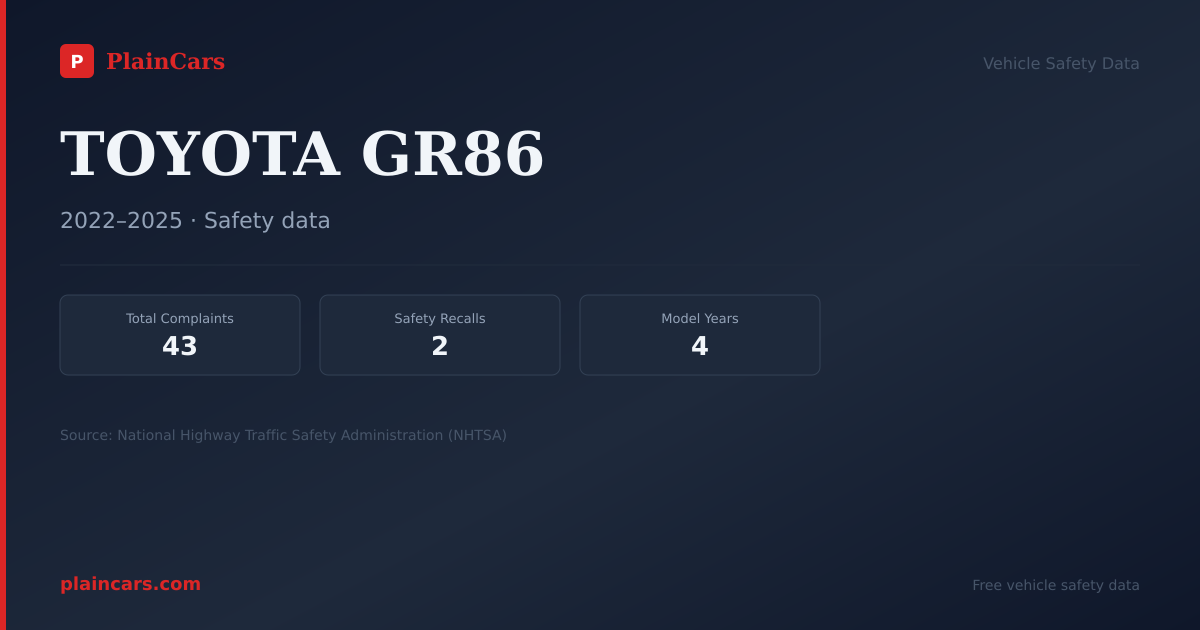
Total Complaints
11 filings
Toyota Gr86 · model year
11 NHTSA complaints, and 1 recall campaign listed for this cohort. A VIN lookup is required to determine whether a specific vehicle has an unrepaired recall.
NHTSA overall rating
Not crash-tested
New Car Assessment Program
The verdict
The 2023 Toyota Gr86 posts below-average complaint volume among its own model-year siblings.
The 2023ToyotaGr86 carries 11 consumer safety complaints in NHTSA's Office of Defects Investigation database for this specific model-year cohort. Within that volume, owners reported 0 crashes, 0 fires, 0 injuries, and 0 fatalities. For crash performance, NHTSA's New Car Assessment Program gave this cohort an overall Not Rated/5 rating, with Not Rated/5 front crash, Not Rated/5 side crash, and Not Rated/5 rollover scores derived from standardized barrier and dynamic tests.
The most frequently selected component label in reports for the 2023 Gr86 is engine with 3 filings, followed by fuel/propulsion system (3) and air bags (1). Complaint categories reflect owner reports and intake categorization; they do not establish a defect pattern or cause. This cohort has 1 NHTSA recall campaign listed below. Enter a VIN in NHTSA's official recall lookup to determine whether a specific vehicle has an unrepaired recall.
NHTSA currently has 51 investigation files overlapping the 2023 Gr86, and 1 remain open. Owners comparing this cohort against neighboring years should read the complaint-by-year trend as report volume, not a causal diagnosis. Use the related-complaint feed and the official recall lookup when researching a specific vehicle.
PlainCars' own composite of NHTSA NCAP crash-test ratings and rollover-risk assessment, each dimension normalized against the federal scale or the full national model-year corpus. Not an official NHTSA figure, and not a substitute for a specific vehicle's VIN-level recall check.
Total Complaints
11 filings
Crashes Reported
0 reports
Source
NHTSA ODI
Federal complaints database
At or below the fleet median complaint volume.
| Component | Count |
|---|---|
| ENGINE | 3 |
| FUEL/PROPULSION SYSTEM | 3 |
| AIR BAGS | 1 |
| ELECTRICAL SYSTEM | 1 |
| FORWARD COLLISION AVOIDANCE: AUTOMATIC EMERGENCY BRAKING | 1 |
| STRUCTURE:BODY | 1 |
| EXTERIOR LIGHTING | 1 |
EQUIPMENT:OTHER:LABELS
Gulf States Toyota, Inc. (GST) is recalling certain Toyota 2023 GR Supra, 2024 4 Runner, Corolla, Grand Highlander, Grand Highlander Hybrid, Land Cruiser Hybrid, Tacoma, Tacoma Hybrid, 2023-2024 BZ4X, Corolla Cross Hybrid, GR Corolla, GR86, Highlander, Highlander Hybrid, Prius, Prius Prime, Sequoia
A defective set of spark plugs with certain model year 2023 Toyota GR86 to have premature failure. While driving at highway speed spark plug blew up resulting in a cylinder 4 misfire and loss of drivability. The service advisor from the Toyota dealership unofficially confirmed this has happened to multiple other gr86 models. Along with being unofficially confirmed by an aftermarket specialist. Original diagnostic from the dealership was to replace the motor due to all of the issues, while a local certified mechanic has replaced the spark plug, coil pack, and is continuing to troubleshoot as the head gasket also needs to be replaced. No warnings lights or signs were present prior to failure.
There are two fuel lines on each side of the engine bay, driver and passenger going into the injector rails. One of the fuel lines on the driver side is rubbing on the underside of the hood, when closed, causing marks, and potentially a burst on a fuel lines, causing fires. The fuel line on my car has rub marks, and visually “wearing it down”. No bursts, yet. There has been about 10-15 cases of GR86/BRZ (essentially the same car), with fires starting randomly from the engine bay on the driver side, rising the chances of this being a reality, and a VERY SERIOUS issue with these cars. And with this issue arising from FB groups, many other owners have come forward and confirmed the same rubbing marks on the same fuel line, or even in both on the same side instead of just the one.
Fuel lines in the engine bay are rubbing against the hood insulation and wearing down. The first generation GR86 fuel lines had sleeves compared to the second generation..
Fuel lines on right hand side of engine bay (when viewed from front of vehicle) show signs of wear due to contact with other components. I am unsure what components exactly, but wear significant enough to cause material removal from EPDM fuel line outer sleeve.
The contact owned a 2023 Toyota GR86 Sport vehicle. The contact stated that while driving 139 MPH for a couple of minutes, the vehicle stalled. Several unknown warning lights were illuminated. The contact was able to pull to the side of the road. The vehicle failed to restart and was towed to the dealer, where it was diagnosed that the engine had failed and needed to be replaced. The contact stated that the vehicle was covered under warranty; however, the dealer informed the contact that the repair could not be covered under warranty because the engine failure occurred due to customer abuse. The contact stated that the vehicle was designed with a maximum speed of 140 MPH. The contact was charged a repair fee, and the vehicle was traded for another vehicle. The manufacturer was not notified of the failure. The failure mileage was approximately 33,000.
Mileage: 33,000
Oil leak caused from poor/bad spark tube seals Fire Hazard: Oil leaks, especially from hot engine parts, can increase the risk of fire. Oil on the exhaust system or other components can ignite, causing a dangerous situation. Car was brought to dealership for a leak. Oil was found leaking from engine gasket cover from spark tube seals. Toyota only fixes the seals that are found cracked. ALL seals should be replaced as preventative measure. It is a known issue that these seals are bad from various forums. Subaru has a service bulletin SB22-168 related to spark plug pipe gasket leaks. (same engine as their Subaru BRZ)
One day I noticed something dangling near the rear license plate while parked. It was the right-side license plate light. Upon inspection of the (good) left-side license plate light, everything seemed pretty secure. The right-side license plate light has a plastic bracket on the one side and a plastic clip on the other side. The plastic clip broke off. I don't think it's been that way long, and I can't think of anything that could have caused it as a daily driver. I do drive it in the snow, and I only noticed it while wiping snow away with my snow brush. I don't think the brush ripped it off, but I also don't know if it was hanging out prior. Maybe the brush bristles got between the light assembly and the bumper, but it's such an unusual spot for anything to interface with the light assembly. There doesn't appear to be a vapor barrier between either of the license plate lights (for better or worse). The rectangular light assembly is somewhat obstructed from dangling further o
The drivers side window imploded on me while driving on the highway. A rock did not hit it, it just cracked into a thousands pieces on me.
The car began throwing alerts about SRS system failure, RAB failure and eyesight (safety system) being disabled suddenly while driving. Dealership said dashcam plugged into the 12v port in the car overloaded the fuse. Issue remains that the dashcam remained functional before and after and fuse for 12v is independent of the electrical wiring for the safety features. Dealership dismissed as it as a non warranty/safety issue as a third party device was connected to the car. Claimed this is applicable for any devices connected into the car including a phone. 10amp fuse independent of the safety system (7.5amp fuse) was replaced to remedy the problem. Concern is any device connected to the vehicle may disable all safety system of the car including the airbags or possible manufacturer defects made during assembly of this vehicle.
The car began throwing alerts about SRS system failure, RAB failure and eyesight (safety system) being disabled suddenly while driving. Dealership said dashcam plugged into the 12v port in the car overloaded the fuse. Issue remains that the dashcam remained functional before and after and fuse for 12v is independent of the electrical wiring for the safety features. Dealership dismissed as it as a non warranty/safety issue as a third party device was connected to the car. Claimed this is applicable for any devices connected into the car including a phone. 10amp fuse independent of the safety system (7.5amp fuse) was replaced to remedy the problem. Concern is any device connected to the vehicle may disable all safety system of the car including the airbags or possible manufacturer defects made during assembly of this vehicle.
The car began throwing alerts about SRS system failure, RAB failure and eyesight (safety system) being disabled suddenly while driving. Dealership said dashcam plugged into the 12v port in the car overloaded the fuse. Issue remains that the dashcam remained functional before and after and fuse for 12v is independent of the electrical wiring for the safety features. Dealership dismissed as it as a non warranty/safety issue as a third party device was connected to the car. Claimed this is applicable for any devices connected into the car including a phone. 10amp fuse independent of the safety system (7.5amp fuse) was replaced to remedy the problem. Concern is any device connected to the vehicle may disable all safety system of the car including the airbags or possible manufacturer defects made during assembly of this vehicle.
Data vintage: August 2026. Sources: NHTSA Office of Defects Investigation (ODI) complaints database, NHTSA recall campaign API, NHTSA NCAP crash-test ratings, and NHTSA FARS for fatality cross-reference.
Every figure on PlainCars is rendered directly from NHTSA complaint and safety data, no number is typed in by an editor. This year-specific record is rendered from NHTSA ODI, recall, and NCAP rows for the 2023 Toyota Gr86; no figure is typed in by an editor. See our editorial standards & corrections policy, the methodology behind these numbers, or report a data error. Data current as of August 2026.
Read our methodology - how this data is sourced, computed, and verified.