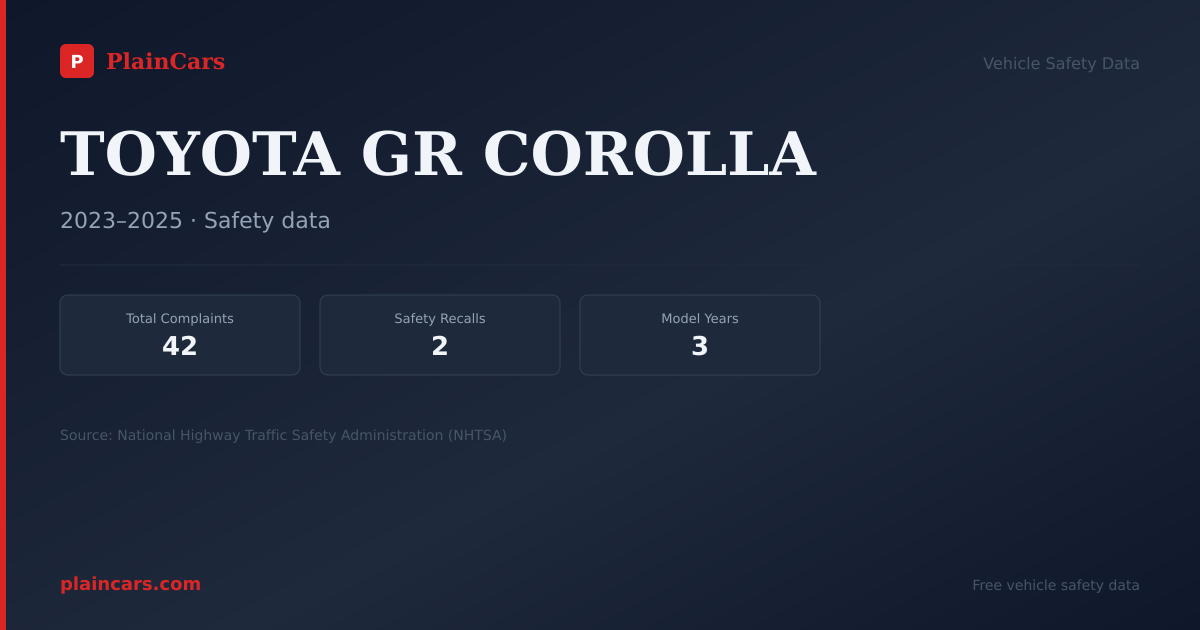
Total Complaints
15 filings
Toyota GR Corolla · model year
15 NHTSA complaints, and 1 recall campaign listed for this cohort. A VIN lookup is required to determine whether a specific vehicle has an unrepaired recall.
NHTSA overall rating
Not crash-tested
New Car Assessment Program
The 2025ToyotaGR Corolla carries 15 consumer safety complaints in NHTSA's Office of Defects Investigation database for this specific model-year cohort. Within that volume, owners reported 0 crashes, 0 fires, 0 injuries, and 0 fatalities. For crash performance, NHTSA's New Car Assessment Program gave this cohort an overall Not Rated/5 rating, with Not Rated/5 front crash, Not Rated/5 side crash, and Not Rated/5 rollover scores derived from standardized barrier and dynamic tests.
The most frequently selected component label in reports for the 2025 GR Corolla is power train with 3 filings, followed by fuel/propulsion system (2) and forward collision avoidance: warnings (2). Complaint categories reflect owner reports and intake categorization; they do not establish a defect pattern or cause. This cohort has 1 NHTSA recall campaign listed below. Enter a VIN in NHTSA's official recall lookup to determine whether a specific vehicle has an unrepaired recall.
NHTSA currently has 51 investigation files overlapping the 2025 GR Corolla, and 1 remain open. Owners comparing this cohort against neighboring years should read the complaint-by-year trend as report volume, not a causal diagnosis. Use the related-complaint feed and the official recall lookup when researching a specific vehicle.
PlainCars' own composite of NHTSA NCAP crash-test ratings and rollover-risk assessment, each dimension normalized against the federal scale or the full national model-year corpus. Not an official NHTSA figure, and not a substitute for a specific vehicle's VIN-level recall check.
Total Complaints
15 filings
Crashes Reported
0 reports
Source
NHTSA ODI
Federal complaints database
At or below the fleet median complaint volume.
| Component | Count |
|---|---|
| POWER TRAIN | 3 |
| FUEL/PROPULSION SYSTEM | 2 |
| FORWARD COLLISION AVOIDANCE: WARNINGS | 2 |
| FORWARD COLLISION AVOIDANCE: AUTOMATIC EMERGENCY BRAKING | 2 |
| ENGINE | 2 |
| FORWARD COLLISION AVOIDANCE: ADAPTIVE CRUISE CONTROL | 2 |
| LANE DEPARTURE: WARNING | 1 |
| ELECTRICAL SYSTEM | 1 |
ELECTRICAL SYSTEM: INSTRUMENT CLUSTER/PANEL
Toyota Motor Engineering & Manufacturing (Toyota) is recalling certain 2023-2024 Toyota Venza, 2023-2025 RAV4 Prime, RAV4, Highlander, GR Corolla, Crown, 2024-2025 Lexus TX, LS, Toyota Tacoma, Grand Highlander, and 2025 Lexus RX, Toyota Crown Signia, Camry, RAV 4 Plug-in Hybrid (PHEV), and 4 Runner
The car showed a message that there is a system error and many warning lights came on, including the check engine light. Most of the warning lights indicated that many of the car's ADAS functions were disabled. The car also switched from AWD to FWD. The error code turned out to be P2C90 which relates to the PCV system. So, the car turned off all the safety features as a result of a minor emissions issue! Toyota has no repair for this; they just clear the code, ignoring completely that the safety features are turned off until the error is cleared.
The car showed a message that there is a system error and many warning lights came on, including the check engine light. Most of the warning lights indicated that many of the car's ADAS functions were disabled. The car also switched from AWD to FWD. The error code turned out to be P2C90 which relates to the PCV system. So, the car turned off all the safety features as a result of a minor emissions issue! Toyota has no repair for this; they just clear the code, ignoring completely that the safety features are turned off until the error is cleared.
The car showed a message that there is a system error and many warning lights came on, including the check engine light. Most of the warning lights indicated that many of the car's ADAS functions were disabled. The car also switched from AWD to FWD. The error code turned out to be P2C90 which relates to the PCV system. So, the car turned off all the safety features as a result of a minor emissions issue! Toyota has no repair for this; they just clear the code, ignoring completely that the safety features are turned off until the error is cleared.
Driving my car normally when, at around 3,800 miles, my car threw a CEL and went into limp mode, while in traffic. I had to pull over safely, immediately shut off vehicle and have it towed to the dealership for diagnostic & repair. The code was the infamous P2C90 Crankcase ventilation leak check engine light code. This has happened over the course of 14k miles, 4+ more times. Each time, the CEL turns on and disables: cruise control, lane assist, blind spot assist, AWD (limp mode) and directly affects driving. I have taken the vehicle back to the same dealer for the same instance 3 recurring times, and I am now pursuing the "final repair" request under Florida Lemon Law. Furthermore, the dealer has stated they don't know why this issue arises, and they send notification Toyota Corporate on guidance for this common issue among GR Corollas. I have also received numerous TSB ECU updates in hopes to "solve" this issue but nonetheless the P2C90 code has been persistent in coming back in my b
Driving my car normally when, at around 3,800 miles, my car threw a CEL and went into limp mode, while in traffic. I had to pull over safely, immediately shut off vehicle and have it towed to the dealership for diagnostic & repair. The code was the infamous P2C90 Crankcase ventilation leak check engine light code. This has happened over the course of 14k miles, 4+ more times. Each time, the CEL turns on and disables: cruise control, lane assist, blind spot assist, AWD (limp mode) and directly affects driving. I have taken the vehicle back to the same dealer for the same instance 3 recurring times, and I am now pursuing the "final repair" request under Florida Lemon Law. Furthermore, the dealer has stated they don't know why this issue arises, and they send notification Toyota Corporate on guidance for this common issue among GR Corollas. I have also received numerous TSB ECU updates in hopes to "solve" this issue but nonetheless the P2C90 code has been persistent in coming back in my b
Driving my car normally when, at around 3,800 miles, my car threw a CEL and went into limp mode, while in traffic. I had to pull over safely, immediately shut off vehicle and have it towed to the dealership for diagnostic & repair. The code was the infamous P2C90 Crankcase ventilation leak check engine light code. This has happened over the course of 14k miles, 4+ more times. Each time, the CEL turns on and disables: cruise control, lane assist, blind spot assist, AWD (limp mode) and directly affects driving. I have taken the vehicle back to the same dealer for the same instance 3 recurring times, and I am now pursuing the "final repair" request under Florida Lemon Law. Furthermore, the dealer has stated they don't know why this issue arises, and they send notification Toyota Corporate on guidance for this common issue among GR Corollas. I have also received numerous TSB ECU updates in hopes to "solve" this issue but nonetheless the P2C90 code has been persistent in coming back in my b
Hello, Today (01/21/2026), on my 2025 Toyota GR Corolla vehicle (odometer 5243 miles), after 3200 miles of driving with the updated engine control unit (ECU) as of 10/14/2025 according to the T-SB-0071-25, a P2C90 error appeared again with an Check Engine Light. This happened during acceleration while entering the highway, when the engine speed reached between 3000 and 4000 RPM. This situation disables many of the vehicle's active safety systems (all-wheel drive, vehicle stability control, traction control, adaptive cruise control, lane keeping assist, etc.), exposing owners to unwarranted safety risks due to unexplained fluctuations in the crankcase ventilation monitoring system of a new and otherwise healthy engine. How can we get Toyota to release a better ECU firmware update to fix this problem? Obviously, the previous fix was not effective enough. Regards!
Hello, Today (01/21/2026), on my 2025 Toyota GR Corolla vehicle (odometer 5243 miles), after 3200 miles of driving with the updated engine control unit (ECU) as of 10/14/2025 according to the T-SB-0071-25, a P2C90 error appeared again with an Check Engine Light. This happened during acceleration while entering the highway, when the engine speed reached between 3000 and 4000 RPM. This situation disables many of the vehicle's active safety systems (all-wheel drive, vehicle stability control, traction control, adaptive cruise control, lane keeping assist, etc.), exposing owners to unwarranted safety risks due to unexplained fluctuations in the crankcase ventilation monitoring system of a new and otherwise healthy engine. How can we get Toyota to release a better ECU firmware update to fix this problem? Obviously, the previous fix was not effective enough. Regards!
Hello, Today (01/21/2026), on my 2025 Toyota GR Corolla vehicle (odometer 5243 miles), after 3200 miles of driving with the updated engine control unit (ECU) as of 10/14/2025 according to the T-SB-0071-25, a P2C90 error appeared again with an Check Engine Light. This happened during acceleration while entering the highway, when the engine speed reached between 3000 and 4000 RPM. This situation disables many of the vehicle's active safety systems (all-wheel drive, vehicle stability control, traction control, adaptive cruise control, lane keeping assist, etc.), exposing owners to unwarranted safety risks due to unexplained fluctuations in the crankcase ventilation monitoring system of a new and otherwise healthy engine. How can we get Toyota to release a better ECU firmware update to fix this problem? Obviously, the previous fix was not effective enough. Regards!
Manual transmission having problem going into third gear when putting in the clutch to shift. The vehicle would have a transmission grind noise, and the weirdest thing is the clutch is all the way to the ground when shifting. Vehicle can be a hazard for the road if the vehicle cannot shift properly, leaving a little bit of stall time. especially if the vehicle isn’t being driven hard and just calmly shifting through that grinding noise doesn’t sound too good. Maybe something is wrong with the clutch.
The vehicle's clutch started slipping under acceleration thus making merging on to the interstate or crossing an intersection from a yield very dangerous.
The car randomly reports an Engine Malfunction which results in many warning lights indicating that certain systems are non-functional. These include (but are not limited to): - Forward collision warning - Automatic emergency braking - Cruise control - Basically, any driver assistance feature that requires external sensors is turned off Also, the rear wheel drive is turned off so the car only drives using the front wheels. On each successive drive, with the engine turned off in between, some of these systems start functioning again. After 3 or 4 such driving cycles all the systems come back on. The dealer detected error code P2C90 (P2C9000) which refers to the positive crankcase ventilation system. The ventilation system was inspected and nothing was found to require repair. Others have reported this issue: - the video here shows the dash warning indicators: [XXX] - this person had to use the lemon law to return the car to Toyota [XXX] It is crazy that an errant emissions err
The car randomly reports an Engine Malfunction which results in many warning lights indicating that certain systems are non-functional. These include (but are not limited to): - Forward collision warning - Automatic emergency braking - Cruise control - Basically, any driver assistance feature that requires external sensors is turned off Also, the rear wheel drive is turned off so the car only drives using the front wheels. On each successive drive, with the engine turned off in between, some of these systems start functioning again. After 3 or 4 such driving cycles all the systems come back on. The dealer detected error code P2C90 (P2C9000) which refers to the positive crankcase ventilation system. The ventilation system was inspected and nothing was found to require repair. Others have reported this issue: - the video here shows the dash warning indicators: [XXX] - this person had to use the lemon law to return the car to Toyota [XXX] It is crazy that an errant emissions err
The car randomly reports an Engine Malfunction which results in many warning lights indicating that certain systems are non-functional. These include (but are not limited to): - Forward collision warning - Automatic emergency braking - Cruise control - Basically, any driver assistance feature that requires external sensors is turned off Also, the rear wheel drive is turned off so the car only drives using the front wheels. On each successive drive, with the engine turned off in between, some of these systems start functioning again. After 3 or 4 such driving cycles all the systems come back on. The dealer detected error code P2C90 (P2C9000) which refers to the positive crankcase ventilation system. The ventilation system was inspected and nothing was found to require repair. Others have reported this issue: - the video here shows the dash warning indicators: [XXX] - this person had to use the lemon law to return the car to Toyota [XXX] It is crazy that an errant emissions err
While driving home from dinner I pulled off from a stop light as normal and shifted from 1st into 2nd then 3rd with zero issues. As I went to shift into 4th it was as if the gear was locked out, thinking there was just something I was missing I tried 5th and was met with the same issue, tried 4th again and still nothing and I couldn’t get into 3rd. At this point I was rapidly losing speed and I was on a busy road. I pulled into a left turn lane brought the vehicle to a stop until it was safe to proceed with the turn tried to go into first gear and I couldn’t. I had to push my car across oncoming traffic into the safety of a parking lot. There was ZERO signs the clutch was going out as this is a brand new car with only 5k miles on it. The dealership has stated the entire clutch assembly needs to be replaced and that it is user responsibility as they are claiming “abuse” however if it was user abuse the clutch wouldn’t have blown up it would’ve simply been ground down to the
Data vintage: August 2026. Sources: NHTSA Office of Defects Investigation (ODI) complaints database, NHTSA recall campaign API, NHTSA NCAP crash-test ratings, and NHTSA FARS for fatality cross-reference.
Every figure on PlainCars is rendered directly from NHTSA complaint and safety data, no number is typed in by an editor. This year-specific record is rendered from NHTSA ODI, recall, and NCAP rows for the 2025 Toyota GR Corolla; no figure is typed in by an editor. See our editorial standards & corrections policy, the methodology behind these numbers, or report a data error. Data current as of August 2026.
Read our methodology - how this data is sourced, computed, and verified.