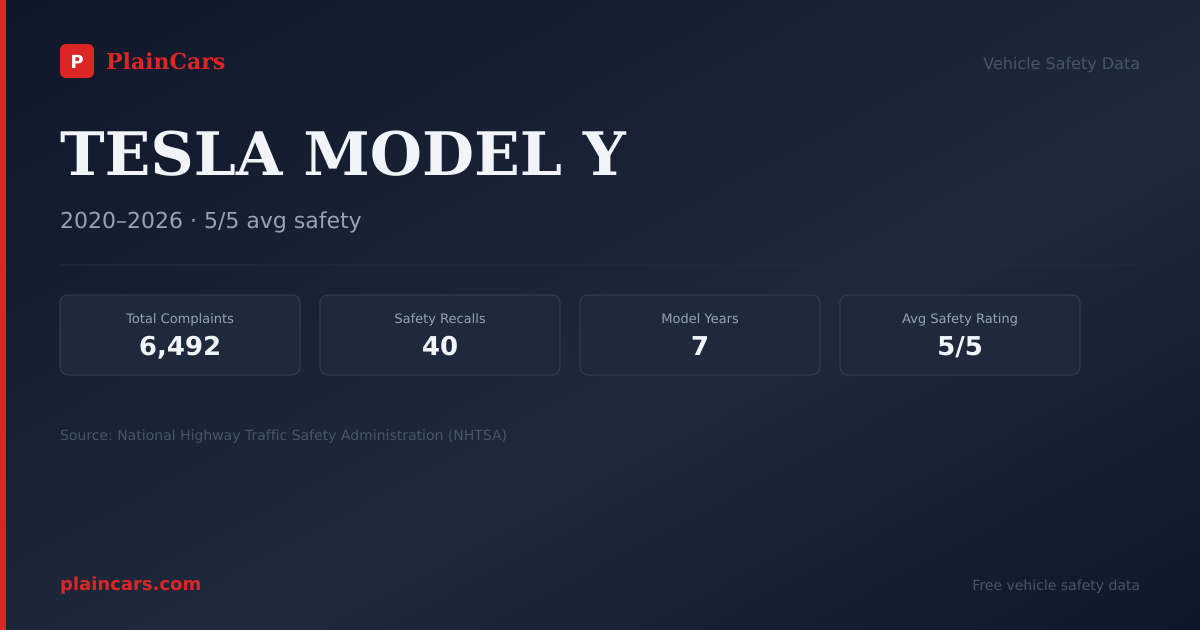
Total Complaints
148 filings
Tesla Model Y · model year
148 NHTSA complaints, 48 crash reports, and 3 recall campaigns listed for this cohort. A VIN lookup is required to determine whether a specific vehicle has an unrepaired recall.
NHTSA overall rating
5 / 5 ★
New Car Assessment Program
The verdict
The 2025 Tesla Model Y pairs top-1% complaint standing (fewest filings) with a top NHTSA safety rating.
The 2025TeslaModel Y carries 148 consumer safety complaints in NHTSA's Office of Defects Investigation database for this specific model-year cohort. Within that volume, owners reported 48 crashes, 4 fires, 23 injuries, and 9 fatalities. For crash performance, NHTSA's New Car Assessment Program gave this cohort an overall 5/5 rating, with 5/5 front crash, 5/5 side crash, and 5/5 rollover scores derived from standardized barrier and dynamic tests.
The most frequently selected component label in reports for the 2025 Model Y is forward collision avoidance: adaptive cruise control with 20 filings, followed by forward collision avoidance: automatic emergency braking (19) and electrical system (12). Complaint categories reflect owner reports and intake categorization; they do not establish a defect pattern or cause. This cohort has 3 NHTSA recall campaigns listed below. Enter a VIN in NHTSA's official recall lookup to determine whether a specific vehicle has an unrepaired recall.
NHTSA currently has 2 investigation files overlapping the 2025 Model Y, and 1 remain open. Owners comparing this cohort against neighboring years should read the complaint-by-year trend as report volume, not a causal diagnosis. Use the related-complaint feed and the official recall lookup when researching a specific vehicle.
PlainCars' own composite of NHTSA NCAP crash-test ratings and rollover-risk assessment, each dimension normalized against the federal scale or the full national model-year corpus. Not an official NHTSA figure, and not a substitute for a specific vehicle's VIN-level recall check.
Total Complaints
148 filings
Crashes Reported
48 reports
Source
NHTSA ODI
Federal complaints database
At or below the fleet median complaint volume.
| Component | Count |
|---|---|
| FORWARD COLLISION AVOIDANCE: ADAPTIVE CRUISE CONTROL | 20 |
| FORWARD COLLISION AVOIDANCE: AUTOMATIC EMERGENCY BRAKING | 19 |
| ELECTRICAL SYSTEM | 12 |
| UNKNOWN OR OTHER | 12 |
| SERVICE BRAKES | 12 |
| LANE DEPARTURE: BLIND SPOT DETECTION | 8 |
| VEHICLE SPEED CONTROL | 7 |
| BACK OVER PREVENTION: SENSING SYSTEM: CAMERA | 6 |
| FORWARD COLLISION AVOIDANCE: WARNINGS | 6 |
| STEERING | 5 |
| LANE DEPARTURE: ASSIST | 4 |
| BACK OVER PREVENTION: WARNINGS | 4 |
| BACK OVER PREVENTION: REARVIEW SYSTEM BRAKING | 4 |
| AIR BAGS | 4 |
| SEAT BELTS | 4 |
EQUIPMENT:OTHER:LABELS
Tesla, Inc. (Tesla) is recalling certain 2025-2026 Model Y vehicles. The certification label may not have been installed. As such, these vehicles fail to comply with the requirements of 49 C.F.R. Part 567, "Certification."
TIRES:PRESSURE MONITORING AND REGULATING SYSTEMS
Tesla, Inc. (Tesla) is recalling certain 2024 Cybertruck, 2017-2025 Model 3, and 2020-2025 Model Y vehicles. The tire pressure monitoring system (TPMS) warning light may not remain illuminated between drive cycles, failing to warn the driver of low tire pressure. As such, these vehicles fail to co
BACK OVER PREVENTION:SOFTWARE
Tesla, Inc. (Tesla) is recalling certain 2024-2025 Model 3, Model S, 2023-2025 Model X, and Model Y vehicles. The computer circuit board may short, resulting in the loss of the rearview camera image. As such, these vehicles fail to comply with the requirements of Federal Motor Vehicle Safety Stand
On January 28, 2026, the vehicle (a Tesla Model Y) was operating with the Full Self-Driving (FSD) system actively engaged in normal highway traffic conditions. Without any prior warning messages, chimes, or system alerts, the FSD system abruptly disengaged approximately 1 second before the vehicle steered into a concrete road divider. Component failed: The Tesla Full Self-Driving (FSD) software and underlying perception/control systems failed to maintain the lane and abruptly handed over control with insufficient time to react. The vehicle and its data are available for inspection. Safety risk: The sudden, sub-second disengagement provided the driver with zero time to react, take manual control, or perform an evasive maneuver. This system failure directly resulted in a high-speed collision with a road divider, causing significant vehicle damage and physical injuries to the driver that required medical treatment. Inspection/Confirmation: The vehicle is currently subject to an open in
On January 28, 2026, the vehicle (a Tesla Model Y) was operating with the Full Self-Driving (FSD) system actively engaged in normal highway traffic conditions. Without any prior warning messages, chimes, or system alerts, the FSD system abruptly disengaged approximately 1 second before the vehicle steered into a concrete road divider. Component failed: The Tesla Full Self-Driving (FSD) software and underlying perception/control systems failed to maintain the lane and abruptly handed over control with insufficient time to react. The vehicle and its data are available for inspection. Safety risk: The sudden, sub-second disengagement provided the driver with zero time to react, take manual control, or perform an evasive maneuver. This system failure directly resulted in a high-speed collision with a road divider, causing significant vehicle damage and physical injuries to the driver that required medical treatment. Inspection/Confirmation: The vehicle is currently subject to an open in
On January 28, 2026, the vehicle (a Tesla Model Y) was operating with the Full Self-Driving (FSD) system actively engaged in normal highway traffic conditions. Without any prior warning messages, chimes, or system alerts, the FSD system abruptly disengaged approximately 1 second before the vehicle steered into a concrete road divider. Component failed: The Tesla Full Self-Driving (FSD) software and underlying perception/control systems failed to maintain the lane and abruptly handed over control with insufficient time to react. The vehicle and its data are available for inspection. Safety risk: The sudden, sub-second disengagement provided the driver with zero time to react, take manual control, or perform an evasive maneuver. This system failure directly resulted in a high-speed collision with a road divider, causing significant vehicle damage and physical injuries to the driver that required medical treatment. Inspection/Confirmation: The vehicle is currently subject to an open in
On February 11, 2026, the 2025 Tesla Model Y "Vision AutoPark" system initiated an uncommanded high-speed reverse acceleration into a stationary yellow concrete bollard in a parking lot. The vehicle's vision-only parking assist hardware failed to detect a clearly visible, fixed obstruction and displayed a clear path on the system interface immediately before impact. No warning lamps, chimes, messages, or other alerts preceded the failure. The system provided zero indication of the imminent collision. The vehicle closed the distance to the bollard in under one second, exceeding human reaction time and making manual braking intervention impossible before impact. This failure mode — autonomous acceleration toward a stationary object without detection or warning — creates a severe crush hazard for pedestrians and property. The vehicle and its onboard data logs are available for inspection upon request. High-definition video evidence of the failure has been preserved showing the system
On February 11, 2026, the 2025 Tesla Model Y "Vision AutoPark" system initiated an uncommanded high-speed reverse acceleration into a stationary yellow concrete bollard in a parking lot. The vehicle's vision-only parking assist hardware failed to detect a clearly visible, fixed obstruction and displayed a clear path on the system interface immediately before impact. No warning lamps, chimes, messages, or other alerts preceded the failure. The system provided zero indication of the imminent collision. The vehicle closed the distance to the bollard in under one second, exceeding human reaction time and making manual braking intervention impossible before impact. This failure mode — autonomous acceleration toward a stationary object without detection or warning — creates a severe crush hazard for pedestrians and property. The vehicle and its onboard data logs are available for inspection upon request. High-definition video evidence of the failure has been preserved showing the system
On February 11, 2026, the 2025 Tesla Model Y "Vision AutoPark" system initiated an uncommanded high-speed reverse acceleration into a stationary yellow concrete bollard in a parking lot. The vehicle's vision-only parking assist hardware failed to detect a clearly visible, fixed obstruction and displayed a clear path on the system interface immediately before impact. No warning lamps, chimes, messages, or other alerts preceded the failure. The system provided zero indication of the imminent collision. The vehicle closed the distance to the bollard in under one second, exceeding human reaction time and making manual braking intervention impossible before impact. This failure mode — autonomous acceleration toward a stationary object without detection or warning — creates a severe crush hazard for pedestrians and property. The vehicle and its onboard data logs are available for inspection upon request. High-definition video evidence of the failure has been preserved showing the system
Vehicle Information 2025 Tesla Model Y Approx. 30,000 miles Purchased new ~11 months ago Incident Description While driving at highway speed, the front trunk (frunk/hood) of my 2025 Tesla Model Y unexpectedly opened. The hood immediately flew upward, flipped backward over the windshield, and shattered the windshield. The frunk had not been opened in approximately two weeks prior to the incident. The vehicle had not undergone recent service or repair involving the hood or latch assembly. There were no prior warnings or alerts indicating that the frunk was unlatched or not latched properly before driving. The hood appeared fully closed prior to the trip. However, after the incident once we pulled over, a bolt was completely out of place, as shown in my video. Even if the primary latch was faulty, the secondary latch / catch should have prevented the hood from opening all the way and slamming the windshield. This failure to notify improper latching created an immediate and total o
Vehicle Information 2025 Tesla Model Y Approx. 30,000 miles Purchased new ~11 months ago Incident Description While driving at highway speed, the front trunk (frunk/hood) of my 2025 Tesla Model Y unexpectedly opened. The hood immediately flew upward, flipped backward over the windshield, and shattered the windshield. The frunk had not been opened in approximately two weeks prior to the incident. The vehicle had not undergone recent service or repair involving the hood or latch assembly. There were no prior warnings or alerts indicating that the frunk was unlatched or not latched properly before driving. The hood appeared fully closed prior to the trip. However, after the incident once we pulled over, a bolt was completely out of place, as shown in my video. Even if the primary latch was faulty, the secondary latch / catch should have prevented the hood from opening all the way and slamming the windshield. This failure to notify improper latching created an immediate and total o
A few weeks ago my seatbelt censor started acting up, and then two weeks later that my heater quit. They blamed Chewed wiring because of soy based coatings, and set its not in the warranty and accused rodent damage since the rear seat was eaten. I got the call during diagnosis demanding i bring the loaner car because they wanted $1,349.07 which i did not have because a 9/11 first responder and don't have other insurance accept mandated state minimums, they told me bring the loaner back, on the way home FSD worked till i got towards my putnam county rural route 22 when power steering FSD and power breaks died. I skidded at 25 mph managed to get to park and plug it and leaving it this. So the tech put the plugs together and made the situation worse by plugging chewed harness together. No heat, transport, no car, no door dash money for me, no medical appointment and cant risk losing all steering. When TESLA works, it works very and great car. had they refused to use soy coatings and staye
A few weeks ago my seatbelt censor started acting up, and then two weeks later that my heater quit. They blamed Chewed wiring because of soy based coatings, and set its not in the warranty and accused rodent damage since the rear seat was eaten. I got the call during diagnosis demanding i bring the loaner car because they wanted $1,349.07 which i did not have because a 9/11 first responder and don't have other insurance accept mandated state minimums, they told me bring the loaner back, on the way home FSD worked till i got towards my putnam county rural route 22 when power steering FSD and power breaks died. I skidded at 25 mph managed to get to park and plug it and leaving it this. So the tech put the plugs together and made the situation worse by plugging chewed harness together. No heat, transport, no car, no door dash money for me, no medical appointment and cant risk losing all steering. When TESLA works, it works very and great car. had they refused to use soy coatings and staye
A few weeks ago my seatbelt censor started acting up, and then two weeks later that my heater quit. They blamed Chewed wiring because of soy based coatings, and set its not in the warranty and accused rodent damage since the rear seat was eaten. I got the call during diagnosis demanding i bring the loaner car because they wanted $1,349.07 which i did not have because a 9/11 first responder and don't have other insurance accept mandated state minimums, they told me bring the loaner back, on the way home FSD worked till i got towards my putnam county rural route 22 when power steering FSD and power breaks died. I skidded at 25 mph managed to get to park and plug it and leaving it this. So the tech put the plugs together and made the situation worse by plugging chewed harness together. No heat, transport, no car, no door dash money for me, no medical appointment and cant risk losing all steering. When TESLA works, it works very and great car. had they refused to use soy coatings and staye
We are currently experiencing single-digit temperatures here in Pittsburgh. I placed my vehicle in “defrost” mode, and while it did clear the windshield, it also caused the glass to crack. I contacted Tesla and brought the vehicle in for an assessment, at which point I was informed the damage would not be covered. My car has only 14,000 miles and will be one year old next month. It is essentially brand new and has been meticulously maintained. There were no prior flaws or damage to the windshield. Despite this, Tesla refused coverage for what is a known issue: windshield cracking caused by defrost mode in extreme cold temperatures. This issue is widely documented online. Customer service confirmed that Tesla does not cover glass damage, even when it cracks spontaneously as a result of using defrost mode as intended. The quoted repair cost is $1,500. This experience reflects a lack of accountability and failure to stand behind the product.
All safety and most computer related features in the vehicle have failed. Cruise control, backup cameras, all other cameras, the navigation (assuming this is also impacting the projection of remaining battery life as my car always thinks it is at my home), warning signals for approaching obstacles/dangers, cruise control of any kind does now work, lane departure warning has failed, and automatic windshield wipers do not work. This happened without warning and was not related to an update. On January 13, 2026, the car worked in the morning and then all of these issues started happening. I made a Tesla service appointment, but they are not able to see me until February 3, 2026.
All safety and most computer related features in the vehicle have failed. Cruise control, backup cameras, all other cameras, the navigation (assuming this is also impacting the projection of remaining battery life as my car always thinks it is at my home), warning signals for approaching obstacles/dangers, cruise control of any kind does now work, lane departure warning has failed, and automatic windshield wipers do not work. This happened without warning and was not related to an update. On January 13, 2026, the car worked in the morning and then all of these issues started happening. I made a Tesla service appointment, but they are not able to see me until February 3, 2026.
All safety and most computer related features in the vehicle have failed. Cruise control, backup cameras, all other cameras, the navigation (assuming this is also impacting the projection of remaining battery life as my car always thinks it is at my home), warning signals for approaching obstacles/dangers, cruise control of any kind does now work, lane departure warning has failed, and automatic windshield wipers do not work. This happened without warning and was not related to an update. On January 13, 2026, the car worked in the morning and then all of these issues started happening. I made a Tesla service appointment, but they are not able to see me until February 3, 2026.
On January 17, 2026 the vehicle self-accelerated when put in reverse and crashed into a parked truck. This was the second time this occurred. The prior incident occurred on November 29, 2025 when backing out of the garage at our home. The new incident occurred the FIRST time we put the car in reverse after receiving it back after repair from the prior accident (we received it on January 15. 2026 and this was the first time we drove it since then). We had driven the car forward with the full self driving feature turned on and engaged (part of the time and part manually) without incident. However when placed in reverse with the full delf driving turned on but not enagaged the car "took off." It is only through good fortune no one was seriously injured or killed. Self acceleration in reverse only occurred after the vehicle was serviced by Tesla to repair the full self driving system which, at that time, would only engage intermittently.
On January 17, 2026 the vehicle self-accelerated when put in reverse and crashed into a parked truck. This was the second time this occurred. The prior incident occurred on November 29, 2025 when backing out of the garage at our home. The new incident occurred the FIRST time we put the car in reverse after receiving it back after repair from the prior accident (we received it on January 15. 2026 and this was the first time we drove it since then). We had driven the car forward with the full self driving feature turned on and engaged (part of the time and part manually) without incident. However when placed in reverse with the full delf driving turned on but not enagaged the car "took off." It is only through good fortune no one was seriously injured or killed. Self acceleration in reverse only occurred after the vehicle was serviced by Tesla to repair the full self driving system which, at that time, would only engage intermittently.
On or about May 23 or 24, 2025, while using FSD to park the vehicle, I engaged reverse mode. The vehicle was fully under FSD control during this maneuver. Unexpectedly, the car reversed into a fixed pole, impacting the rear of the vehicle and causing a noticeable dent. The system did detect the collision and stopped upon impact, but failed to avoid it entirely. This incident occurred despite my hands being on the wheel and full attention as a supervising driver, in accordance with Tesla's guidelines for FSD use. I believe this represents a malfunction in the FSD system's object detection or path planning during reverse parking.
On or about May 23 or 24, 2025, while using FSD to park the vehicle, I engaged reverse mode. The vehicle was fully under FSD control during this maneuver. Unexpectedly, the car reversed into a fixed pole, impacting the rear of the vehicle and causing a noticeable dent. The system did detect the collision and stopped upon impact, but failed to avoid it entirely. This incident occurred despite my hands being on the wheel and full attention as a supervising driver, in accordance with Tesla's guidelines for FSD use. I believe this represents a malfunction in the FSD system's object detection or path planning during reverse parking.
On or about May 23 or 24, 2025, while using FSD to park the vehicle, I engaged reverse mode. The vehicle was fully under FSD control during this maneuver. Unexpectedly, the car reversed into a fixed pole, impacting the rear of the vehicle and causing a noticeable dent. The system did detect the collision and stopped upon impact, but failed to avoid it entirely. This incident occurred despite my hands being on the wheel and full attention as a supervising driver, in accordance with Tesla's guidelines for FSD use. I believe this represents a malfunction in the FSD system's object detection or path planning during reverse parking.
Data vintage: August 2026. Sources: NHTSA Office of Defects Investigation (ODI) complaints database, NHTSA recall campaign API, NHTSA NCAP crash-test ratings, and NHTSA FARS for fatality cross-reference.
Every figure on PlainCars is rendered directly from NHTSA complaint and safety data, no number is typed in by an editor. This year-specific record is rendered from NHTSA ODI, recall, and NCAP rows for the 2025 Tesla Model Y; no figure is typed in by an editor. See our editorial standards & corrections policy, the methodology behind these numbers, or report a data error. Data current as of August 2026.
Read our methodology - how this data is sourced, computed, and verified.