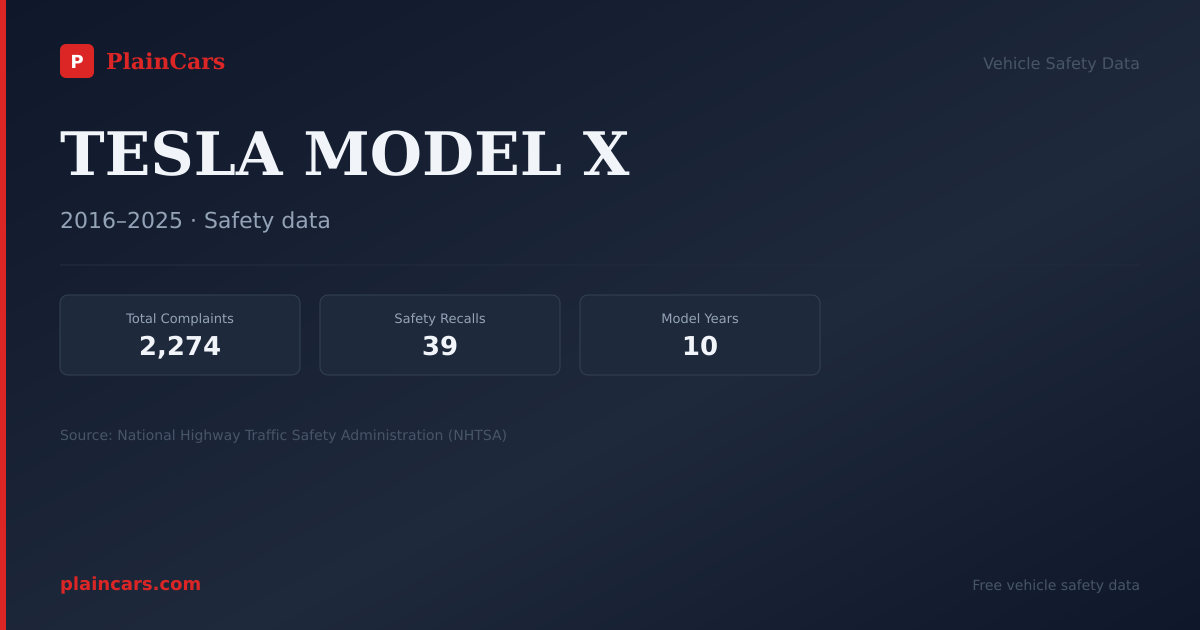
Total Complaints
197 filings
Tesla Model X · model year
197 NHTSA complaints, 31 crash reports, and 10 recall campaigns listed for this cohort. A VIN lookup is required to determine whether a specific vehicle has an unrepaired recall.
NHTSA overall rating
Not crash-tested
New Car Assessment Program
The verdict
The 2020 Tesla Model X posts below-average complaint volume among its own model-year siblings.
The 2020TeslaModel X carries 197 consumer safety complaints in NHTSA's Office of Defects Investigation database for this specific model-year cohort. Within that volume, owners reported 31 crashes, 0 fires, 12 injuries, and 0 fatalities. No NCAP 5-star crash-test rating is available for this model year in the federal database.
The most frequently selected component label in reports for the 2020 Model X is suspension with 35 filings, followed by electrical system (19) and vehicle speed control (18). Complaint categories reflect owner reports and intake categorization; they do not establish a defect pattern or cause. This cohort has 10 NHTSA recall campaigns listed below. Enter a VIN in NHTSA's official recall lookup to determine whether a specific vehicle has an unrepaired recall.
NHTSA currently has 1 investigation file overlapping the 2020 Model X. Owners comparing this cohort against neighboring years should read the complaint-by-year trend as report volume, not a causal diagnosis. Use the related-complaint feed and the official recall lookup when researching a specific vehicle.
PlainCars' own composite of NHTSA NCAP crash-test ratings and rollover-risk assessment, each dimension normalized against the federal scale or the full national model-year corpus. Not an official NHTSA figure, and not a substitute for a specific vehicle's VIN-level recall check.
Total Complaints
197 filings
Crashes Reported
31 reports
Source
NHTSA ODI
Federal complaints database
At or below the fleet median complaint volume.
| Component | Count |
|---|---|
| SUSPENSION | 35 |
| ELECTRICAL SYSTEM | 19 |
| VEHICLE SPEED CONTROL | 18 |
| UNKNOWN OR OTHER | 18 |
| STEERING | 18 |
| FORWARD COLLISION AVOIDANCE: AUTOMATIC EMERGENCY BRAKING | 15 |
| FORWARD COLLISION AVOIDANCE: ADAPTIVE CRUISE CONTROL | 12 |
| STRUCTURE:BODY | 8 |
| SERVICE BRAKES | 8 |
| POWER TRAIN | 6 |
| WHEELS | 4 |
| LANE DEPARTURE: BLIND SPOT DETECTION | 4 |
| SEATS | 4 |
| LANE DEPARTURE: ASSIST | 4 |
| ELECTRICAL SYSTEM:ADAS:AUTONOMOUS/SELF DRIVING | 4 |
ELECTRICAL SYSTEM: INSTRUMENT CLUSTER/PANEL
Tesla, Inc. (Tesla) is recalling certain 2012-2023 Model S, 2016-2024 Model X, 2017-2023 Model 3, 2019-2024 Model Y, and 2024 Cybertruck vehicles. An incorrect font size is displayed on the instrument panel for the Brake, Park, and Antilock Brake System (ABS) warning lights. As such, these vehicle
FORWARD COLLISION AVOIDANCE: SENSING SYSTEM: CAMERA
Tesla, Inc. (Tesla) is recalling certain 2017-2021 Model S, Model 3, Model X, and 2020-2021 Model Y vehicles operating software version 2021.36.5.2. A communication error may cause false forward-collision warning (FCW) or unexpected activation of the automatic emergency brake (AEB) system.
SEAT BELTS:FRONT:WARNING LIGHT/DEVICES
Tesla, Inc. (Tesla) is recalling certain 2012-2024 Model S, 2015-2024 Model X, 2017-2023 Model 3, and 2020-2023 Model Y vehicles. In the event of an unbelted driver, the seat belt warning light and audible chime may not activate as intended. As such, these vehicles fail to comply with the requirem
FORWARD COLLISION AVOIDANCE: WARNINGS:EXTERNAL/PEDESTRIAN ALERT
Tesla, Inc. (Tesla) is recalling certain 2013, 2018-2021 Model S, 2020-2021 Model X, 2018-2022 Model 3, and 2020-2022 Model Y vehicles. A factory reset muted the Pedestrian Warning System (PWS) sounds. As such, these vehicles fail to comply with the requirements of Federal Motor Vehicle Safety Sta
ELECTRICAL SYSTEM:ADAS:AUTONOMOUS/SELF DRIVING:SOFTWARE
Tesla, Inc. (Tesla) is recalling certain 2016-2022 Model S and Model X, 2017-2022 Model 3, and 2020-2022 Model Y vehicles. The "rolling stop" functionality available as part of the Full Self-Driving (Beta) software may allow the vehicle to travel through an all-way stop intersection without first c
STEERING:AUTOMATED/ADAPTIVE STEERING
Tesla, Inc. (Tesla) is recalling certain 2016-2023 Model S, Model X, 2017-2023 Model 3, and 2020-2023 Model Y vehicles equipped with Full Self-Driving Beta (FSD Beta) software or pending installation. The FSD Beta system may allow the vehicle to act unsafe around intersections, such as traveling st
ELECTRICAL SYSTEM:ADAS:AUTONOMOUS/SELF DRIVING:SOFTWARE
Tesla, Inc. (Tesla) is recalling 2012-2023 Model S, 2016-2023 Model X, 2017-2023 Model 3, and 2020-2023 Model Y vehicles equipped with all versions of Autosteer leading up to the version(s) that contains the recall remedy. In certain circumstances when Autosteer is engaged, the prominence and scope
ELECTRICAL SYSTEM:SOFTWARE
Tesla, Inc. (Tesla) is recalling certain 2020-2022 Model Y, Model X, Model S, and 2017-2022 Model 3 vehicles. The Boombox function allows sounds to be played through an external speaker while the vehicle is in motion, which may obscure the Pedestrian Warning System (PWS) sounds. As such, these veh
ELECTRICAL SYSTEM:SOFTWARE
Tesla, Inc. (Tesla) is recalling certain 2020-2022 Model S, Model X, Model Y, and 2017-2022 Model 3 vehicles. The Boombox function allows sounds to be played through an external speaker while the vehicle is in motion, which may obscure the Pedestrian Warning System (PWS) sounds. As such, these veh
STEERING:ELECTRIC POWER ASSIST SYSTEM
Tesla, Inc. (Tesla) is recalling certain 2017-2021 Model S and Model X vehicles. The electronic power assist steering (EPAS) system may experience a loss of power steering assist when driving on rough roads or after hitting a pothole.
Making a loud squeaky noise and knocking while I turn. The noise is coming from the steering and front suspension arms I believe.
Making a loud squeaky noise and knocking while I turn. The noise is coming from the steering and front suspension arms I believe.
I am a software engineer and owner of two 2020 Tesla Model X (Raven) vehicles. Both exhibit a serious safety defect after installing firmware 2025.44.25.4 with FSD v12.6.4. Vehicle configuration: Model S/X with MCU2 (Intel Atom) and Hardware 3 (HW3). Defect description: When Full Self-Driving (FSD) is engaged, the vehicle intermittently enters a critical failure state while in motion: • The instrument cluster (driver display) suddenly goes completely black • The center screen issues a red “Take Control Immediately” alert with alarms • The infotainment computer performs a watchdog reset and reboots (Tesla logo appears) while the vehicle is traveling at highway speeds This has occurred multiple times on both vehicles. Suspected cause: The 2025.44 software update appears to introduce additional dashcam telemetry writes (speed, steering, FSD state) to the USB device while recording video. On MCU2 (Intel Atom), this creates an I/O and CPU bottleneck that starves display and s
My 2020 Tesla Model X experiences severe vibration, shaking, and rattling during acceleration, especially between about 20–45 mph and at higher suspension settings. The vibration is strong enough to affect steering stability and safe control of the vehicle during acceleration and lane changes. Tesla has already replaced the front half-shafts twice under warranty for this same problem, but the issue has returned again. This is a known defect documented by Tesla in Service Bulletin SB-21-39-001, which describes excessive front drive unit half-shaft vibration during acceleration and defines the repair with updated components. The latest revision of this bulletin (R3, dated January 19, 2024) explicitly adds “Customer Pay billing” instructions. Despite this, my local Tesla Service Center in Tempe, AZ (Supervisor: Lewis Holguin) refused to apply the SB-21-39-001 Customer Pay billing and instead charged full retail for the repair. On 11/28/2025, I was billed $1,694.86 out of pocket to
My 2020 Tesla Model X experiences severe vibration, shaking, and rattling during acceleration, especially between about 20–45 mph and at higher suspension settings. The vibration is strong enough to affect steering stability and safe control of the vehicle during acceleration and lane changes. Tesla has already replaced the front half-shafts twice under warranty for this same problem, but the issue has returned again. This is a known defect documented by Tesla in Service Bulletin SB-21-39-001, which describes excessive front drive unit half-shaft vibration during acceleration and defines the repair with updated components. The latest revision of this bulletin (R3, dated January 19, 2024) explicitly adds “Customer Pay billing” instructions. Despite this, my local Tesla Service Center in Tempe, AZ (Supervisor: Lewis Holguin) refused to apply the SB-21-39-001 Customer Pay billing and instead charged full retail for the repair. On 11/28/2025, I was billed $1,694.86 out of pocket to
My 2020 Tesla Model X experiences severe vibration, shaking, and rattling during acceleration, especially between about 20–45 mph and at higher suspension settings. The vibration is strong enough to affect steering stability and safe control of the vehicle during acceleration and lane changes. Tesla has already replaced the front half-shafts twice under warranty for this same problem, but the issue has returned again. This is a known defect documented by Tesla in Service Bulletin SB-21-39-001, which describes excessive front drive unit half-shaft vibration during acceleration and defines the repair with updated components. The latest revision of this bulletin (R3, dated January 19, 2024) explicitly adds “Customer Pay billing” instructions. Despite this, my local Tesla Service Center in Tempe, AZ (Supervisor: Lewis Holguin) refused to apply the SB-21-39-001 Customer Pay billing and instead charged full retail for the repair. On 11/28/2025, I was billed $1,694.86 out of pocket to
On or about 20Jun2025: Tesla Driver Assistance Features - After the most recent 2025.20.3 softball update and installation my safety feature of the blind spot monitoring doesn't chim when a car is in my blind spot the car will show red in the font display but the sounds are now inoperable
I would like to report a significant safety concern affecting Tesla Model X vehicles, and potentially Model S as well. Numerous reports across Tesla forums have highlighted persistent issues with unadjustable negative camber, which results in excessive inner tire wear on all four wheels. In some cases, owners have reported needing to replace their tires as early as 5,000 miles. In my own experience, I had to replace mine at just 14,000 miles. Additionally, I’ve experienced repeated failures of the front axle half-shafts on both the left and right sides. The first replacement occurred at 14,000 miles under warranty, and the second at 38,000 miles—this time at my own expense. Independent automotive professionals have pointed out that the angle at which the half-shafts are installed is too steep for optimal performance. The front motor sits significantly higher than the wheels, forcing the half-shafts to transfer power at an extreme downward angle. This off-axis setup, combined with
The contact owns a 2020 Tesla Model X. The contact stated while driving at an undisclosed speed, the accelerator pedal was depressed, and the vehicle shook erratically. No warning light was illuminated. The vehicle was taken to the dealer where it was diagnosed with a malfunction with the front driver's side half shaft. The contact stated that the front driver's side half shaft needed to be repositioned. The vehicle was being repaired. The contact was informed that it was a known failure. The manufacturer was made aware of the failure. The failure mileage was approximately 28,000.
Mileage: 28,000
Hello - I'm having extreme Inner tire wear on rear tires due to a bad camber arm design on my Tesla model X. The negative chamber is way outside of normal standards. I had an issue recently where my tire blew out. I did not notice until I had to replace it. I have changed tires three times in the last year. That's just egregious.
This is a major safety issue --- we got an error that steering assistance was "reduced" for about 12 hours. Then on [XXX] at around [XXX], we were pulling out of a parked area (after being parked for 2 hours) -- and proceeded to increase speed on [XXX] in Newark, the car steering wheel abruptly LOCKED ITSELF - you couldn't even move the steering wheel. It just locked and shut down completely. We proceeded to do a rest (hitting two scroll buttons) to reset the system over 5-6 times. Each time it takes about 10 mins to complete. It was pure HORROR - sitting on the road with cars just passing by and honking at me behind. I had the hazard lights on, but it was a dangerous situation. I was completely STUCK and immobile. After some time, the steering wheel "magically" started working again. We've dropped the Tesla off at Springfield and they are charging us over $6,000 in damages for this. This is a SAFETY issue (we bought the car in March of 2024) and it's only been 15 months since we
This is a major safety issue --- we got an error that steering assistance was "reduced" for about 12 hours. Then on [XXX] at around [XXX], we were pulling out of a parked area (after being parked for 2 hours) -- and proceeded to increase speed on [XXX] in Newark, the car steering wheel abruptly LOCKED ITSELF - you couldn't even move the steering wheel. It just locked and shut down completely. We proceeded to do a rest (hitting two scroll buttons) to reset the system over 5-6 times. Each time it takes about 10 mins to complete. It was pure HORROR - sitting on the road with cars just passing by and honking at me behind. I had the hazard lights on, but it was a dangerous situation. I was completely STUCK and immobile. After some time, the steering wheel "magically" started working again. We've dropped the Tesla off at Springfield and they are charging us over $6,000 in damages for this. This is a SAFETY issue (we bought the car in March of 2024) and it's only been 15 months since we
Steering assist reduced. It has been faulty for the past six months and auto pilot doesn’t work. Not repaired as the cost of repair is 5K.
Steering assist reduced. It has been faulty for the past six months and auto pilot doesn’t work. Not repaired as the cost of repair is 5K.
Steering assist reduced. It has been faulty for the past six months and auto pilot doesn’t work. Not repaired as the cost of repair is 5K.
The contact owns a 2020 Tesla Model X. The contact stated while driving approximately 55 MPH, the self-driving mode disengaged unintendedly. There was no warning light illuminated. The vehicle was taken to a Tesla Service Center, where it was diagnosed that the self-driving system had completely failed. The Service Center determined that the self-driving computer needed to be replaced. The vehicle was in the process of being repaired. The manufacturer was notified of the failure. The failure mileage was approximately 76,000.
Mileage: 76,000
We purchased a Tesla Model X 2 years ago and have driven a little over 10,000 miles on it. The car has had continuous suspension problems which resulted in replacing the half shaft twice, control arms and now suspension pins. We drive solely on city roads and highways, it does not seem safe that a car used for regular commute to/from work and school would have such serious mechanical problems so early on.
I preordered a 2020 Tesla Model X on [XXX], totaling $112,590, with $62,617 paid in cash and the rest financed. On November 30, 2021, I brought the car to the Renton Tesla Service Center for axle noise when accelerating, but they couldn’t replicate it. On February 7, 2022, I returned with the same complaint and was asked to provide a video of the issue. On April 13, 2022, with video proof of the noise, Tesla verified the issue and replaced the axle halfshafts, temporarily resolving it. On [XXX], the noise recurred. Renton Tesla couldn’t replicate it and suggested a wheel alignment, which I paid for. On November 30, 2022, I took the car to Tesla of Bellevue, where they diagnosed worn-out suspension and made repairs, ordering additional parts. On January 9, 2023, Tesla replaced the Drive Unit during follow-up work. On [XXX], the knocking noise returned, but Tesla Bellevue couldn’t replicate the issue, providing no solution. On [XXX], I returned with the ongoing issue. Tesla aga
Eil
Eil
Data vintage: August 2026. Sources: NHTSA Office of Defects Investigation (ODI) complaints database, NHTSA recall campaign API, NHTSA NCAP crash-test ratings, and NHTSA FARS for fatality cross-reference.
Every figure on PlainCars is rendered directly from NHTSA complaint and safety data, no number is typed in by an editor. This year-specific record is rendered from NHTSA ODI, recall, and NCAP rows for the 2020 Tesla Model X; no figure is typed in by an editor. See our editorial standards & corrections policy, the methodology behind these numbers, or report a data error. Data current as of August 2026.
Read our methodology - how this data is sourced, computed, and verified.