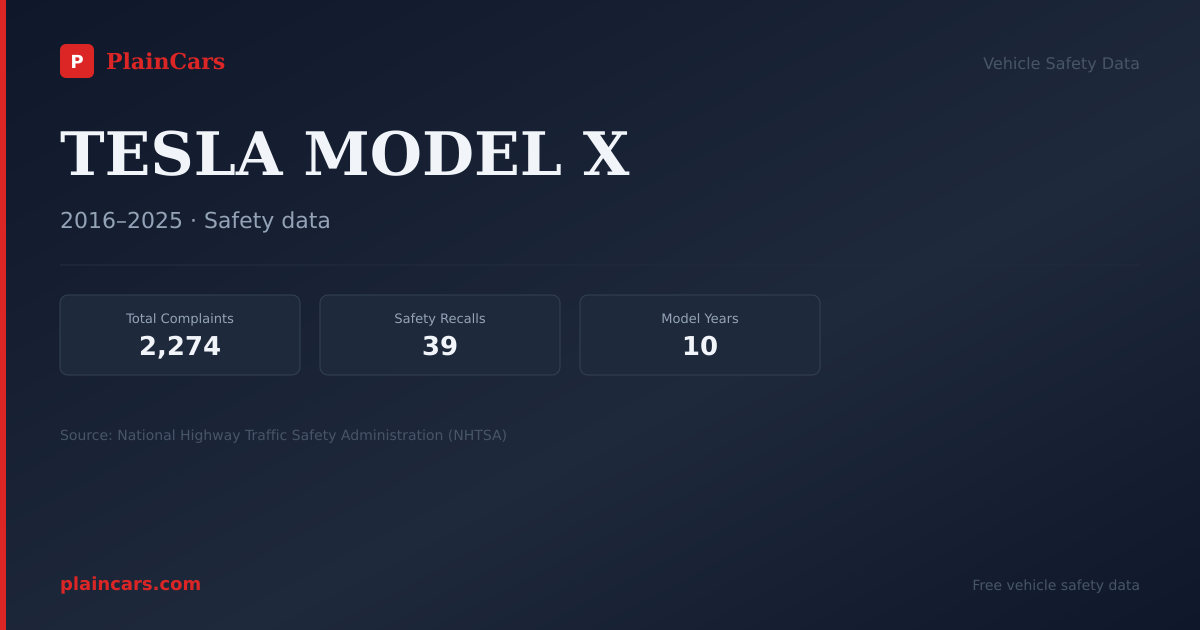
Total Complaints
161 filings
Tesla Model X · model year
161 NHTSA complaints, 27 crash reports, and 8 recall campaigns listed for this cohort. A VIN lookup is required to determine whether a specific vehicle has an unrepaired recall.
NHTSA overall rating
Not crash-tested
New Car Assessment Program
The verdict
The 2019 Tesla Model X posts below-average complaint volume among its own model-year siblings.
The 2019TeslaModel X carries 161 consumer safety complaints in NHTSA's Office of Defects Investigation database for this specific model-year cohort. Within that volume, owners reported 27 crashes, 4 fires, 10 injuries, and 0 fatalities. No NCAP 5-star crash-test rating is available for this model year in the federal database.
The most frequently selected component label in reports for the 2019 Model X is suspension with 23 filings, followed by unknown or other (18) and electrical system (17). Complaint categories reflect owner reports and intake categorization; they do not establish a defect pattern or cause. This cohort has 8 NHTSA recall campaigns listed below. Enter a VIN in NHTSA's official recall lookup to determine whether a specific vehicle has an unrepaired recall.
NHTSA currently has 1 investigation file overlapping the 2019 Model X. Owners comparing this cohort against neighboring years should read the complaint-by-year trend as report volume, not a causal diagnosis. Use the related-complaint feed and the official recall lookup when researching a specific vehicle.
PlainCars' own composite of NHTSA NCAP crash-test ratings and rollover-risk assessment, each dimension normalized against the federal scale or the full national model-year corpus. Not an official NHTSA figure, and not a substitute for a specific vehicle's VIN-level recall check.
Total Complaints
161 filings
Crashes Reported
27 reports
Source
NHTSA ODI
Federal complaints database
At or below the fleet median complaint volume.
| Component | Count |
|---|---|
| SUSPENSION | 23 |
| UNKNOWN OR OTHER | 18 |
| ELECTRICAL SYSTEM | 17 |
| FORWARD COLLISION AVOIDANCE: ADAPTIVE CRUISE CONTROL | 13 |
| STRUCTURE:BODY | 12 |
| VEHICLE SPEED CONTROL | 10 |
| STEERING | 10 |
| SERVICE BRAKES | 9 |
| FORWARD COLLISION AVOIDANCE: AUTOMATIC EMERGENCY BRAKING | 7 |
| AIR BAGS | 6 |
| WHEELS | 5 |
| ELECTRONIC STABILITY CONTROL (ESC) | 3 |
| EXTERIOR LIGHTING | 3 |
| FORWARD COLLISION AVOIDANCE: WARNINGS | 3 |
| FUEL/PROPULSION SYSTEM | 3 |
ELECTRICAL SYSTEM: INSTRUMENT CLUSTER/PANEL
Tesla, Inc. (Tesla) is recalling certain 2012-2023 Model S, 2016-2024 Model X, 2017-2023 Model 3, 2019-2024 Model Y, and 2024 Cybertruck vehicles. An incorrect font size is displayed on the instrument panel for the Brake, Park, and Antilock Brake System (ABS) warning lights. As such, these vehicle
FORWARD COLLISION AVOIDANCE: SENSING SYSTEM: CAMERA
Tesla, Inc. (Tesla) is recalling certain 2017-2021 Model S, Model 3, Model X, and 2020-2021 Model Y vehicles operating software version 2021.36.5.2. A communication error may cause false forward-collision warning (FCW) or unexpected activation of the automatic emergency brake (AEB) system.
SEAT BELTS:FRONT:WARNING LIGHT/DEVICES
Tesla, Inc. (Tesla) is recalling certain 2012-2024 Model S, 2015-2024 Model X, 2017-2023 Model 3, and 2020-2023 Model Y vehicles. In the event of an unbelted driver, the seat belt warning light and audible chime may not activate as intended. As such, these vehicles fail to comply with the requirem
ELECTRICAL SYSTEM:ADAS:AUTONOMOUS/SELF DRIVING:SOFTWARE
Tesla, Inc. (Tesla) is recalling certain 2016-2022 Model S and Model X, 2017-2022 Model 3, and 2020-2022 Model Y vehicles. The "rolling stop" functionality available as part of the Full Self-Driving (Beta) software may allow the vehicle to travel through an all-way stop intersection without first c
BACK OVER PREVENTION:DISPLAY FUNCTION
Tesla, Inc. (Tesla) is recalling certain 2018-2019 Model S, Model X, and 2017-2020 Model 3 vehicles equipped with Autopilot Computer 2.5 and operating certain firmware releases. The rearview image may not immediately display when the vehicle begins to reverse. As such, these vehicles fail to compl
STEERING:AUTOMATED/ADAPTIVE STEERING
Tesla, Inc. (Tesla) is recalling certain 2016-2023 Model S, Model X, 2017-2023 Model 3, and 2020-2023 Model Y vehicles equipped with Full Self-Driving Beta (FSD Beta) software or pending installation. The FSD Beta system may allow the vehicle to act unsafe around intersections, such as traveling st
ELECTRICAL SYSTEM:ADAS:AUTONOMOUS/SELF DRIVING:SOFTWARE
Tesla, Inc. (Tesla) is recalling 2012-2023 Model S, 2016-2023 Model X, 2017-2023 Model 3, and 2020-2023 Model Y vehicles equipped with all versions of Autosteer leading up to the version(s) that contains the recall remedy. In certain circumstances when Autosteer is engaged, the prominence and scope
STEERING:ELECTRIC POWER ASSIST SYSTEM
Tesla, Inc. (Tesla) is recalling certain 2017-2021 Model S and Model X vehicles. The electronic power assist steering (EPAS) system may experience a loss of power steering assist when driving on rough roads or after hitting a pothole.
The front passenger seat sensor failed. Without the sensor properly detecting weight, the airbag will deploy no matter the weight of the front seat passenger. Tesla has fixed the sensor placement in newer models as the service tech told us this is a common issue in later models where the only fix is to pay over $5k to replace the entire seat otherwise the airbag will go off no matter what.
The front passenger seat sensor failed. Without the sensor properly detecting weight, the airbag will deploy no matter the weight of the front seat passenger. Tesla has fixed the sensor placement in newer models as the service tech told us this is a common issue in later models where the only fix is to pay over $5k to replace the entire seat otherwise the airbag will go off no matter what.
After charging, the car threw over 16 error codes and would not drive. Tesla advised the car experienced a High Voltage battery failure. Some the error codes experienced were: GTW_w370 Battery charge level too low Charge now - Vehicle may not wake from sleep BMS_w017 Service is required PULL OVER SAFELY DI_u014 Unable to drive Voltage supply too low MORGANVILLE GTW_W157 Power reduced Vehicle systems shutting down BMS_f017 Service is required PULL OVER SAFELY TAS_a218 Air suspension adjustment unavailable Functionality may be restored on next drive BMS_u018 Maximum battery charge level reduced OK to drive - Schedule service BMS_u008 Acceleration and top speed reduced Performance may be restored on next drive BMS_W107 Vehicle may not restart Service is required BMS_f107
After charging, the car threw over 16 error codes and would not drive. Tesla advised the car experienced a High Voltage battery failure. Some the error codes experienced were: GTW_w370 Battery charge level too low Charge now - Vehicle may not wake from sleep BMS_w017 Service is required PULL OVER SAFELY DI_u014 Unable to drive Voltage supply too low MORGANVILLE GTW_W157 Power reduced Vehicle systems shutting down BMS_f017 Service is required PULL OVER SAFELY TAS_a218 Air suspension adjustment unavailable Functionality may be restored on next drive BMS_u018 Maximum battery charge level reduced OK to drive - Schedule service BMS_u008 Acceleration and top speed reduced Performance may be restored on next drive BMS_W107 Vehicle may not restart Service is required BMS_f107
I own a 2019 Model X which I have been driving for six years without any driving issues. I did have a few incidents in which the screen went black while driving. That was scary - driving without controls. These issues reported to Tesla and were addressed by Tesla. Today I was pulling into a parking lot when all of a sudden my Tesla automatically accelerated to high speed. I could not control or stop the vehicle despite applying hard brakes. The car crashed through a metal fence and continued to accelerate through the wall of a building. The only reason it finally stopped was because the back tires got stuck on the ledge of the wall. The Tesla went through the metal gates and walls of the building, but the safety airbag never deployed. The car has been towed away and reported to the insurance immediately after the police report. There was no warning messages or indication prior to the incident.
I own a 2019 Model X which I have been driving for six years without any driving issues. I did have a few incidents in which the screen went black while driving. That was scary - driving without controls. These issues reported to Tesla and were addressed by Tesla. Today I was pulling into a parking lot when all of a sudden my Tesla automatically accelerated to high speed. I could not control or stop the vehicle despite applying hard brakes. The car crashed through a metal fence and continued to accelerate through the wall of a building. The only reason it finally stopped was because the back tires got stuck on the ledge of the wall. The Tesla went through the metal gates and walls of the building, but the safety airbag never deployed. The car has been towed away and reported to the insurance immediately after the police report. There was no warning messages or indication prior to the incident.
I own a 2019 Model X which I have been driving for six years without any driving issues. I did have a few incidents in which the screen went black while driving. That was scary - driving without controls. These issues reported to Tesla and were addressed by Tesla. Today I was pulling into a parking lot when all of a sudden my Tesla automatically accelerated to high speed. I could not control or stop the vehicle despite applying hard brakes. The car crashed through a metal fence and continued to accelerate through the wall of a building. The only reason it finally stopped was because the back tires got stuck on the ledge of the wall. The Tesla went through the metal gates and walls of the building, but the safety airbag never deployed. The car has been towed away and reported to the insurance immediately after the police report. There was no warning messages or indication prior to the incident.
The contact owns a 2019 Tesla Model X. The contact stated that the Full Self-Driving system was updated in June 2025. Since the update, while idling at red traffic lights, the vehicle was surging forward as if it were trying to run the red light. The contact had to immediately depress the brake pedal to prevent the vehicle from accelerating unintendedly. While attempting to make a right lane change, the vehicle suddenly seize mid-lane-change and returned the vehicle to the original lane. The contact made 2 to 3 attempts before being able to make the lane change successfully. The vehicle also independently attempted to make the lane change as if self-correcting the vehicle. The failure was intermittent. The vehicle was taken to the dealer, and the vehicle suddenly ran a red-light while being test driven. The contact stated that the dealer expressed that it was a known issue after the software update was completed. The vehicle was not diagnosed or repaired. The vehicle was taken to anoth
Mileage: 5,000
The contact owns a 2019 Tesla Model X. The contact stated that the Full Self-Driving system was updated in June 2025. Since the update, while idling at red traffic lights, the vehicle was surging forward as if it were trying to run the red light. The contact had to immediately depress the brake pedal to prevent the vehicle from accelerating unintendedly. While attempting to make a right lane change, the vehicle suddenly seize mid-lane-change and returned the vehicle to the original lane. The contact made 2 to 3 attempts before being able to make the lane change successfully. The vehicle also independently attempted to make the lane change as if self-correcting the vehicle. The failure was intermittent. The vehicle was taken to the dealer, and the vehicle suddenly ran a red-light while being test driven. The contact stated that the dealer expressed that it was a known issue after the software update was completed. The vehicle was not diagnosed or repaired. The vehicle was taken to anoth
Mileage: 5,000
Advanced Driver Assistance Systems (ADAS) – Safety Incident Report: While using the vehicle’s ‘Summon’ feature, the car failed to stop when I released the control button. It continued forward, drove up and over a large curb, struck a signpost, and came to rest with one tire elevated on the curb/grass and the other three tires on the pavement. This “jumping curbs” behavior and collision with fixed objects represents a serious safety hazard. I am extremely grateful that no person was nearby or inside the vehicle at the time, as this failure could have resulted in injury or death. The incident is documented on video. The vehicle is currently pending inspection. Despite my request, Tesla has not responded or addressed the issue, leaving the defect unmitigated. At no point did the vehicle display any warning lights or messages indicating a malfunction before or after the incident. Given the nature of this failure, its potential to cause harm, and the lack of response from the
Advanced Driver Assistance Systems (ADAS) – Safety Incident Report: While using the vehicle’s ‘Summon’ feature, the car failed to stop when I released the control button. It continued forward, drove up and over a large curb, struck a signpost, and came to rest with one tire elevated on the curb/grass and the other three tires on the pavement. This “jumping curbs” behavior and collision with fixed objects represents a serious safety hazard. I am extremely grateful that no person was nearby or inside the vehicle at the time, as this failure could have resulted in injury or death. The incident is documented on video. The vehicle is currently pending inspection. Despite my request, Tesla has not responded or addressed the issue, leaving the defect unmitigated. At no point did the vehicle display any warning lights or messages indicating a malfunction before or after the incident. Given the nature of this failure, its potential to cause harm, and the lack of response from the
Advanced Driver Assistance Systems (ADAS) – Safety Incident Report: While using the vehicle’s ‘Summon’ feature, the car failed to stop when I released the control button. It continued forward, drove up and over a large curb, struck a signpost, and came to rest with one tire elevated on the curb/grass and the other three tires on the pavement. This “jumping curbs” behavior and collision with fixed objects represents a serious safety hazard. I am extremely grateful that no person was nearby or inside the vehicle at the time, as this failure could have resulted in injury or death. The incident is documented on video. The vehicle is currently pending inspection. Despite my request, Tesla has not responded or addressed the issue, leaving the defect unmitigated. At no point did the vehicle display any warning lights or messages indicating a malfunction before or after the incident. Given the nature of this failure, its potential to cause harm, and the lack of response from the
I own a 2019 Tesla Model X. After Tesla upgraded my vehicle from AP2.5 to the FSD hardware module, the front camera view became blurry. I disassembled the camera housing and found that a heated line in the windshield, intended to prevent fog or ice buildup in front of the camera, runs directly through the camera’s field of view. This line now causes noticeable image distortion, which interferes with safety-critical features such as FSD, forward collision warning, and lane keeping assistance. The Tesla service supervisor confirmed this is not my fault. He explained the issue may have been caused by heat from the line gradually affecting the glass, or that the upgraded FSD hardware, which captures clearer images, is now revealing a flaw that was previously less visible. He also mentioned that Tesla redesigned this component in newer Model X vehicles to prevent this issue. However, because my car is out of warranty, they are refusing to replace the windshield. Since the FSD upgrade, I
I own a 2019 Tesla Model X. After Tesla upgraded my vehicle from AP2.5 to the FSD hardware module, the front camera view became blurry. I disassembled the camera housing and found that a heated line in the windshield, intended to prevent fog or ice buildup in front of the camera, runs directly through the camera’s field of view. This line now causes noticeable image distortion, which interferes with safety-critical features such as FSD, forward collision warning, and lane keeping assistance. The Tesla service supervisor confirmed this is not my fault. He explained the issue may have been caused by heat from the line gradually affecting the glass, or that the upgraded FSD hardware, which captures clearer images, is now revealing a flaw that was previously less visible. He also mentioned that Tesla redesigned this component in newer Model X vehicles to prevent this issue. However, because my car is out of warranty, they are refusing to replace the windshield. Since the FSD upgrade, I
I own a 2019 Tesla Model X. After Tesla upgraded my vehicle from AP2.5 to the FSD hardware module, the front camera view became blurry. I disassembled the camera housing and found that a heated line in the windshield, intended to prevent fog or ice buildup in front of the camera, runs directly through the camera’s field of view. This line now causes noticeable image distortion, which interferes with safety-critical features such as FSD, forward collision warning, and lane keeping assistance. The Tesla service supervisor confirmed this is not my fault. He explained the issue may have been caused by heat from the line gradually affecting the glass, or that the upgraded FSD hardware, which captures clearer images, is now revealing a flaw that was previously less visible. He also mentioned that Tesla redesigned this component in newer Model X vehicles to prevent this issue. However, because my car is out of warranty, they are refusing to replace the windshield. Since the FSD upgrade, I
While driving normally at around 30mph and without warning, the vehicle displayed multiple warning messages related to the HV Battery and lost all motive power in the middle of the road with insufficient time to pull over, creating a safety hazard. Upon inspection by a mechanic independent of Tesla, the HV Battery was found to have multiple voltage sense leads disconnected from the flexible PCB pads that lead to the BMB for each module. One of the 96 bricks had all four sense leads disconnected, resulting in the loss of motive power due to the inability for the BMS to accurately measure the voltage of that brick. In fact, the vehicle displayed module over voltage and under voltage alerts due to this open/high resistance sense harness connection. Out of all 96 bricks, 13 bricks had at least one loose sense lead, and one brick (besides the affected brick) had 3 out of 4 sense leads loose/disconnected from the PCB pad. Any loose leads were only at the PCB pad end, not at the current co
I got my suspension replaced on my 2019 Model X (that I bought used from Tesla directly) in June 2023. Tesla was suppose to do a through 140 point inspection before putting the car for sale on their website but after less than 2 years and 15000 miles (after the suspension was replaced). The same suspension same issue came up. Tesla told me that they need to replace the suspension again and will bill me $2100. I have owned multiple cars but I have not have to replace suspension on any of my cars ever. How can a suspension fail first at 35000 miles and then again 15000 miles. This seems like Tesla is knowingly putting faulty parts in the car to keep making money on parts and labor. This should be looked into and investigated by National Highway Safety. And Tesla should issue a recall for these and replace them with good quality parts.
I plugged in a tester into the 7 pin trailer harness that is factory installed and the harness does not work. Specifically, there is no 12V power coming from the harness. I googled the issue and it is very common on 2018 and 2019 Tesla Model X’s, and people say when they went to the dealer they said that the factory wired it incorrectly but that it was a simple fix. I went to my dealer and they wanted to charge me money to fix this issue that has been present but unnoticeable on my vehicle until recently. Not having 12V power to the harness is vary dangerous because if towing a trailer with electric brakes, they will not work, and there is no way to tell this except for using a tester at the harness.
To Whom It May Concern, I am writing to you to emphasize and provide additional details regarding the critical safety issue concerning the Tesla Model X vehicles. My personal experience underscores the severity of this problem: I have had to replace over 8 tires in 3 years due to accelerated inner wall wear. This specific wear pattern is a direct result of improper camber alignment, an issue that Tesla has continuously refused to rectify. This problem is not isolated to my vehicle alone. A growing number of Tesla Model X and Model S owners have reported similar experiences, indicating a widespread and systemic issue. The accelerated inner wall tire wear poses significant safety risks, as it can lead to unexpected and dangerous tire failures on the road, which has happened to me. Very dangerous. Despite the clear evidence and numerous complaints from Tesla owners, Tesla has consistently declined to address this issue adequately. It appears that the company’s reluctance is rooted i
There was a recall on these cars (22V-818) and manufacture said a software update would solve the issue. But the actual issue is the I-shaft, which is not sealed on those cars. Now the manufacture is replacing the I- shaft, with the same issues which they said that was corrected with a software update, by charging customers thousands of dollars with sealed ones. All those cars having the issue which I am facing now. I have escaped a crash narrowly and it is dangerous.
Data vintage: August 2026. Sources: NHTSA Office of Defects Investigation (ODI) complaints database, NHTSA recall campaign API, NHTSA NCAP crash-test ratings, and NHTSA FARS for fatality cross-reference.
Every figure on PlainCars is rendered directly from NHTSA complaint and safety data, no number is typed in by an editor. This year-specific record is rendered from NHTSA ODI, recall, and NCAP rows for the 2019 Tesla Model X; no figure is typed in by an editor. See our editorial standards & corrections policy, the methodology behind these numbers, or report a data error. Data current as of August 2026.
Read our methodology - how this data is sourced, computed, and verified.