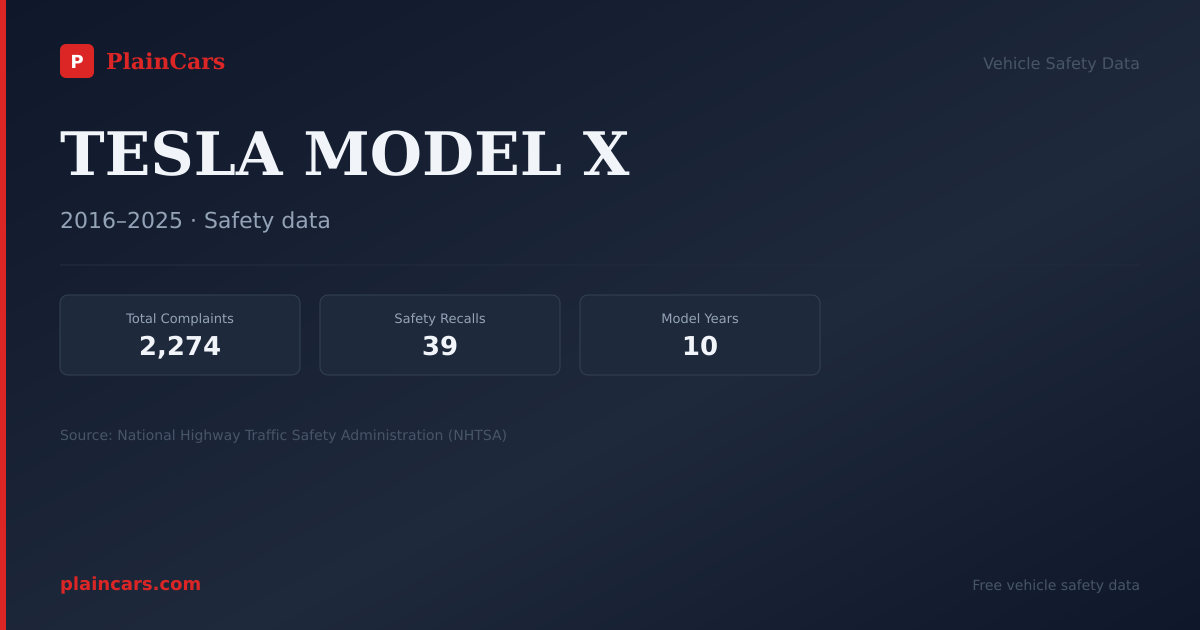
Total Complaints
292 filings
Tesla Model X · model year
292 NHTSA complaints, 55 crash reports, and 9 recall campaigns listed for this cohort. A VIN lookup is required to determine whether a specific vehicle has an unrepaired recall.
NHTSA overall rating
Not crash-tested
New Car Assessment Program
The verdict
The 2018 Tesla Model X posts above-average complaint volume among its own model-year siblings.
The 2018TeslaModel X carries 292 consumer safety complaints in NHTSA's Office of Defects Investigation database for this specific model-year cohort. Within that volume, owners reported 55 crashes, 4 fires, 23 injuries, and 0 fatalities. No NCAP 5-star crash-test rating is available for this model year in the federal database.
The most frequently selected component label in reports for the 2018 Model X is unknown or other with 38 filings, followed by suspension (37) and electrical system (28). Complaint categories reflect owner reports and intake categorization; they do not establish a defect pattern or cause. This cohort has 9 NHTSA recall campaigns listed below. Enter a VIN in NHTSA's official recall lookup to determine whether a specific vehicle has an unrepaired recall.
NHTSA currently has 1 investigation file overlapping the 2018 Model X. Owners comparing this cohort against neighboring years should read the complaint-by-year trend as report volume, not a causal diagnosis. Use the related-complaint feed and the official recall lookup when researching a specific vehicle.
PlainCars' own composite of NHTSA NCAP crash-test ratings and rollover-risk assessment, each dimension normalized against the federal scale or the full national model-year corpus. Not an official NHTSA figure, and not a substitute for a specific vehicle's VIN-level recall check.
Total Complaints
292 filings
Crashes Reported
55 reports
Source
NHTSA ODI
Federal complaints database
Above median complaint volume, review patterns below.
| Component | Count |
|---|---|
| UNKNOWN OR OTHER | 38 |
| SUSPENSION | 37 |
| ELECTRICAL SYSTEM | 28 |
| FORWARD COLLISION AVOIDANCE: ADAPTIVE CRUISE CONTROL | 19 |
| VEHICLE SPEED CONTROL | 18 |
| STEERING | 18 |
| STRUCTURE:BODY | 16 |
| FORWARD COLLISION AVOIDANCE: AUTOMATIC EMERGENCY BRAKING | 16 |
| SERVICE BRAKES | 13 |
| SEATS | 11 |
| POWER TRAIN | 11 |
| SEAT BELTS | 8 |
| FORWARD COLLISION AVOIDANCE: WARNINGS | 8 |
| AIR BAGS | 7 |
| WHEELS | 6 |
ELECTRICAL SYSTEM: INSTRUMENT CLUSTER/PANEL
Tesla, Inc. (Tesla) is recalling certain 2012-2023 Model S, 2016-2024 Model X, 2017-2023 Model 3, 2019-2024 Model Y, and 2024 Cybertruck vehicles. An incorrect font size is displayed on the instrument panel for the Brake, Park, and Antilock Brake System (ABS) warning lights. As such, these vehicle
FORWARD COLLISION AVOIDANCE: SENSING SYSTEM: CAMERA
Tesla, Inc. (Tesla) is recalling certain 2017-2021 Model S, Model 3, Model X, and 2020-2021 Model Y vehicles operating software version 2021.36.5.2. A communication error may cause false forward-collision warning (FCW) or unexpected activation of the automatic emergency brake (AEB) system.
BACK OVER PREVENTION:SOFTWARE
Tesla, Inc. (Tesla) is recalling certain 2012-2018 Tesla Model S and 2016-2018 Model X vehicles with a center display equipped with a NVIDIA Tegra 3 processor and an 8GB eMMC NAND flash memory device. When the 8GB eMMC NAND flash memory device for the center display reaches lifetime wear, the eMMC
SEAT BELTS:FRONT:WARNING LIGHT/DEVICES
Tesla, Inc. (Tesla) is recalling certain 2012-2024 Model S, 2015-2024 Model X, 2017-2023 Model 3, and 2020-2023 Model Y vehicles. In the event of an unbelted driver, the seat belt warning light and audible chime may not activate as intended. As such, these vehicles fail to comply with the requirem
ELECTRICAL SYSTEM:ADAS:AUTONOMOUS/SELF DRIVING:SOFTWARE
Tesla, Inc. (Tesla) is recalling certain 2016-2022 Model S and Model X, 2017-2022 Model 3, and 2020-2022 Model Y vehicles. The "rolling stop" functionality available as part of the Full Self-Driving (Beta) software may allow the vehicle to travel through an all-way stop intersection without first c
BACK OVER PREVENTION:DISPLAY FUNCTION
Tesla, Inc. (Tesla) is recalling certain 2018-2019 Model S, Model X, and 2017-2020 Model 3 vehicles equipped with Autopilot Computer 2.5 and operating certain firmware releases. The rearview image may not immediately display when the vehicle begins to reverse. As such, these vehicles fail to compl
STEERING:AUTOMATED/ADAPTIVE STEERING
Tesla, Inc. (Tesla) is recalling certain 2016-2023 Model S, Model X, 2017-2023 Model 3, and 2020-2023 Model Y vehicles equipped with Full Self-Driving Beta (FSD Beta) software or pending installation. The FSD Beta system may allow the vehicle to act unsafe around intersections, such as traveling st
ELECTRICAL SYSTEM:ADAS:AUTONOMOUS/SELF DRIVING:SOFTWARE
Tesla, Inc. (Tesla) is recalling 2012-2023 Model S, 2016-2023 Model X, 2017-2023 Model 3, and 2020-2023 Model Y vehicles equipped with all versions of Autosteer leading up to the version(s) that contains the recall remedy. In certain circumstances when Autosteer is engaged, the prominence and scope
STEERING:ELECTRIC POWER ASSIST SYSTEM
Tesla, Inc. (Tesla) is recalling certain 2017-2021 Model S and Model X vehicles. The electronic power assist steering (EPAS) system may experience a loss of power steering assist when driving on rough roads or after hitting a pothole.
The 2018 Model X experienced a sudden and complete loss of power and became totally inaccessible. All doors and access points were inoperable and the vehicle could not be unlocked, disconnected, powered on, or placed into any service or tow mode. Emergency front-trunk release cables had to be used and external 12-volt power applied at the jump terminals to wake the vehicle. The inability to access the vehicle was unexpected and alarming. Children, pets, elderly, and others could have been inside of the vehicle. Thankfully, they were not. Tesla inspected the vehicle and stated the failure was related to the battery coolant heater. The failure resulted in a complete vehicle immobilization and access failure. I had previously experienced restart warnings on the dashboard, but I did not expect a total lockout and loss of access. The inability to access the vehicle was unexpected and alarming. It may be a known safety issue. It should be recalled. This condition presents a serious safet
The 2018 Model X experienced a sudden and complete loss of power and became totally inaccessible. All doors and access points were inoperable and the vehicle could not be unlocked, disconnected, powered on, or placed into any service or tow mode. Emergency front-trunk release cables had to be used and external 12-volt power applied at the jump terminals to wake the vehicle. The inability to access the vehicle was unexpected and alarming. Children, pets, elderly, and others could have been inside of the vehicle. Thankfully, they were not. Tesla inspected the vehicle and stated the failure was related to the battery coolant heater. The failure resulted in a complete vehicle immobilization and access failure. I had previously experienced restart warnings on the dashboard, but I did not expect a total lockout and loss of access. The inability to access the vehicle was unexpected and alarming. It may be a known safety issue. It should be recalled. This condition presents a serious safet
The 2018 Model X experienced a sudden and complete loss of power and became totally inaccessible. All doors and access points were inoperable and the vehicle could not be unlocked, disconnected, powered on, or placed into any service or tow mode. Emergency front-trunk release cables had to be used and external 12-volt power applied at the jump terminals to wake the vehicle. The inability to access the vehicle was unexpected and alarming. Children, pets, elderly, and others could have been inside of the vehicle. Thankfully, they were not. Tesla inspected the vehicle and stated the failure was related to the battery coolant heater. The failure resulted in a complete vehicle immobilization and access failure. I had previously experienced restart warnings on the dashboard, but I did not expect a total lockout and loss of access. The inability to access the vehicle was unexpected and alarming. It may be a known safety issue. It should be recalled. This condition presents a serious safet
During a recent incident where a tire issue caused damage to the wiring harness for the parking brake, resulting in a Parking Brake Failure notification on the screen, the vehicle would not stop or turn off. The vehicle displayed N for neutral on the dash, but the vehicle would drive forward unless the brake was depressed. In addition, we were unable to place the vehicle in Park, which meant that we were unable to shut it off. The only way to stop the vehicle from driving on its own and crashing into something was to place concrete blocks under the tires! Unplugging the 12v battery also had no effect! The vehicle kept driving as if it was in drive, and there as no way to stop it without placing the foot on the brake pedal the entire time or placing the blocks I referenced. The only way I was able to shut it off, was to pull what's known as the Fireman's Loop, which I'm guessing firemen pull in the case of an accident. I wasn't aware of this mechanism, and only learned of it after
During a recent incident where a tire issue caused damage to the wiring harness for the parking brake, resulting in a Parking Brake Failure notification on the screen, the vehicle would not stop or turn off. The vehicle displayed N for neutral on the dash, but the vehicle would drive forward unless the brake was depressed. In addition, we were unable to place the vehicle in Park, which meant that we were unable to shut it off. The only way to stop the vehicle from driving on its own and crashing into something was to place concrete blocks under the tires! Unplugging the 12v battery also had no effect! The vehicle kept driving as if it was in drive, and there as no way to stop it without placing the foot on the brake pedal the entire time or placing the blocks I referenced. The only way I was able to shut it off, was to pull what's known as the Fireman's Loop, which I'm guessing firemen pull in the case of an accident. I wasn't aware of this mechanism, and only learned of it after
During a recent incident where a tire issue caused damage to the wiring harness for the parking brake, resulting in a Parking Brake Failure notification on the screen, the vehicle would not stop or turn off. The vehicle displayed N for neutral on the dash, but the vehicle would drive forward unless the brake was depressed. In addition, we were unable to place the vehicle in Park, which meant that we were unable to shut it off. The only way to stop the vehicle from driving on its own and crashing into something was to place concrete blocks under the tires! Unplugging the 12v battery also had no effect! The vehicle kept driving as if it was in drive, and there as no way to stop it without placing the foot on the brake pedal the entire time or placing the blocks I referenced. The only way I was able to shut it off, was to pull what's known as the Fireman's Loop, which I'm guessing firemen pull in the case of an accident. I wasn't aware of this mechanism, and only learned of it after
On 02/01/2026 at approximately 2:07 p.m., my 2018 Tesla Model X (VIN [XXX] , approximately 151,099 miles, software version 2026.2.3) experienced Sudden Unintended Acceleration while I was driving near [XXX] . I was [briefly describe what you were doing, for example: “slowing to a stop in traffic,” or “slowly pulling into a parking space,” or “braking to turn into a driveway”]. My foot was on the brake and I was NOT attempting to accelerate when the vehicle suddenly and unexpectedly surged [forward/backward] with far more power than appropriate for the situation. I had to [firmly press the brake / shift to neutral / steer away] to avoid a collision. At or around the same time, a “Sudden Unintended Acceleration” warning/message appeared on the vehicle’s display. This acceleration did not match my pedal input and created a serious risk of a crash. [There was no contact, damage, or injury / or briefly describe any damage or injuries, if applicable.] The vehicle was ope
The contact owned a 2018 Tesla Model X. The contact stated that while his wife was driving at approximately 17 MPH, the vehicle suddenly made a right turn and crashed into a bridge. No warning lights illuminated. The contact's wife did seek medical attention; however, she sustained minor whiplash. A police report was not filed, but a Police Department did report on scene. Upon further inspection, the contact arrived on scene and noticed that the Rear passenger-side tire had detached, possibly due to the axle. The vehicle was towed to a local Collision shop, where it was deemed a total loss. In addition, prior to the accident, the vehicle was taken to a local independent tire shop, where the front two Tire and Brake pads were replaced. The local dealer was not contacted. The vehicle was not diagnosed or repaired. The manufacturer was not made aware of the failure. The failure mileage was approximately 100,726.
Mileage: 100,726
The contact owns a 2018 Tesla Model X equipped with Lexani Tires, Tire Line: LX-20 Performance, Tire Size: 265/45/R20, DOT Number: 1TBA7B95C3724. The contact stated that while driving at an undisclosed speed, there was a loud sound coming from the front of the vehicle. After the vehicle was inspected, the contact observed tread separation on the driver’s side rear tire, and that the top tread portion of the tire was separating. Due to the tire failure, the vehicle became inoperable. Additionally, the transmission failed to properly shift into park(P), and there was a wiring harness failure following the failure. Due to the failure the vehicle was not drivable and required to be towed. The dealer was contacted; however, the vehicle was not diagnosed or repaired. The manufacturer was notified of the failure. The contact stated that the failure was associated with NHTSA Campaign Number: 23T009000 (TIRES). The tire was a replacement tire. The tire failure mileage was approximately 8,000.
Mileage: 78,886
The contact owns a 2018 Tesla Model X equipped with Lexani Tires, Tire Line: LX-20 Performance, Tire Size: 265/45/R20, DOT Number: 1TBA7B95C3724. The contact stated that while driving at an undisclosed speed, there was a loud sound coming from the front of the vehicle. After the vehicle was inspected, the contact observed tread separation on the driver’s side rear tire, and that the top tread portion of the tire was separating. Due to the tire failure, the vehicle became inoperable. Additionally, the transmission failed to properly shift into park(P), and there was a wiring harness failure following the failure. Due to the failure the vehicle was not drivable and required to be towed. The dealer was contacted; however, the vehicle was not diagnosed or repaired. The manufacturer was notified of the failure. The contact stated that the failure was associated with NHTSA Campaign Number: 23T009000 (TIRES). The tire was a replacement tire. The tire failure mileage was approximately 8,000.
Mileage: 78,886
265 45R 20 As I was driving down the road, I heard a flapping sound. I couldn't pull over right away, as I was in the left lane, and there was a lot of traffic. I pulled over, but I couldn't put the vehicle into park or turn it off! After a family member showed up. i had them put their foot on the brake, while I investigated the issue. I noticed a long piece of tread that was handing from the inner tread. Then I noticed that an entire line of tread was missing as well. The hanging tread cut through the protective lining for the wiring of the vehicle. Then it tore up some wires, which I later came to realize were the brake wires. This is a Tesla, and I was not able to put it into park. The car is is still in drive, with no way of putting it into park or turning it off! This tire has caused significant damage to my rims and vehicle!
Water entered the passenger cabin of my vehicle during normal rain exposure while the vehicle was parked overnight. The failure occurred at the roof glass/seal system, allowing rainwater to intrude into the interior behind the second-row seating area and soak the carpet and underlying padding. This resulted in persistent moisture and a strong musty odor inside the cabin, consistent with microbial growth and mold risk. The condition affects interior air quality and poses a potential health risk to vehicle occupants, particularly children or passengers seated in the rear. Prolonged moisture inside the cabin also raises safety concerns related to corrosion and possible impact to electrical components, sensors, and restraint systems routed through the interior floor area. The condition substantially impairs safe and normal vehicle use. The presence of moisture and microbial odor makes the vehicle unsuitable for passenger transport and creates uncertainty regarding the integrity of interior
Water entered the passenger cabin of my vehicle during normal rain exposure while the vehicle was parked overnight. The failure occurred at the roof glass/seal system, allowing rainwater to intrude into the interior behind the second-row seating area and soak the carpet and underlying padding. This resulted in persistent moisture and a strong musty odor inside the cabin, consistent with microbial growth and mold risk. The condition affects interior air quality and poses a potential health risk to vehicle occupants, particularly children or passengers seated in the rear. Prolonged moisture inside the cabin also raises safety concerns related to corrosion and possible impact to electrical components, sensors, and restraint systems routed through the interior floor area. The condition substantially impairs safe and normal vehicle use. The presence of moisture and microbial odor makes the vehicle unsuitable for passenger transport and creates uncertainty regarding the integrity of interior
My 2018 Tesla Model X experienced repeated over-the-air software update failures starting in late December 2025. Each update attempt would run for hours and then fail with a timeout error. This pattern continued for several weeks with the same error every time. After these repeated failed update attempts, the Autopilot ECU (computer) completely failed. Tesla service diagnosed the issue on January 6, 2026 as a failed Autopilot ECU 3.0 requiring full replacement at a cost of $1,808. The failure has disabled Full Self-Driving, adaptive cruise control, lane keeping assistance, automatic emergency braking, and all driver-assistance safety features. I am concerned this represents a systemic defect where Tesla's software updates are damaging or exposing failures in Autopilot hardware. Multiple other Tesla owners have reported this same pattern in 2024-2025: update timeout errors followed by complete Autopilot computer failure requiring expensive replacement. Tesla is charging customers to fix
Vehicle: 2018 Tesla Model X Recall Reference: Tesla eMMC Recall – NHTSA Campaign Number 21V-035 (Recall 21V035000) Defect Description: In March 2021, Tesla notified me by email of a recall involving failure of the eMMC memory chip in the Media Control Unit (MCU). This defect is known to cause loss of vehicle system functionality and safety-related features. Despite this notification, Tesla has refused to honor the recall and replace the eMMC when I brought my vehicle in for service. Current Vehicle Condition: My vehicle exhibits severe and worsening symptoms consistent with eMMC failure, including: System freezing and frequent unresponsiveness GPS extremely slow or nonfunctional Turn signal indicators intermittently fail Horn fails to operate approximately 95% of the time Vehicle reset/reboot does not work Touchscreen and vehicle controls are very slow or nonresponsive These issues occur regularly and without warning. Safety Risk: This defect creates a significant safety hazard. The
Vehicle: 2018 Tesla Model X Recall Reference: Tesla eMMC Recall – NHTSA Campaign Number 21V-035 (Recall 21V035000) Defect Description: In March 2021, Tesla notified me by email of a recall involving failure of the eMMC memory chip in the Media Control Unit (MCU). This defect is known to cause loss of vehicle system functionality and safety-related features. Despite this notification, Tesla has refused to honor the recall and replace the eMMC when I brought my vehicle in for service. Current Vehicle Condition: My vehicle exhibits severe and worsening symptoms consistent with eMMC failure, including: System freezing and frequent unresponsiveness GPS extremely slow or nonfunctional Turn signal indicators intermittently fail Horn fails to operate approximately 95% of the time Vehicle reset/reboot does not work Touchscreen and vehicle controls are very slow or nonresponsive These issues occur regularly and without warning. Safety Risk: This defect creates a significant safety hazard. The
Vehicle: 2018 Tesla Model X Recall Reference: Tesla eMMC Recall – NHTSA Campaign Number 21V-035 (Recall 21V035000) Defect Description: In March 2021, Tesla notified me by email of a recall involving failure of the eMMC memory chip in the Media Control Unit (MCU). This defect is known to cause loss of vehicle system functionality and safety-related features. Despite this notification, Tesla has refused to honor the recall and replace the eMMC when I brought my vehicle in for service. Current Vehicle Condition: My vehicle exhibits severe and worsening symptoms consistent with eMMC failure, including: System freezing and frequent unresponsiveness GPS extremely slow or nonfunctional Turn signal indicators intermittently fail Horn fails to operate approximately 95% of the time Vehicle reset/reboot does not work Touchscreen and vehicle controls are very slow or nonresponsive These issues occur regularly and without warning. Safety Risk: This defect creates a significant safety hazard. The
After the latest software update, the icons to show your headlights are on and high beams are active are now blocked in the top left corner of the dash. There's no seating position possible that the steering wheel doesn't block this critical information.
Car lost power on the highway suddenly and would not start after and we pulled over on the side of the highway. Took a picture of all the alerts. Heard a loud thunk noise when the car lost power, did not hit anything in the road. Event: 2:21pm March 31,2024. Was needed to be towed to service center. BMS u008 error displayed on screen among others. No alerts until the immediate loss of power. _ _ limpMode Acceleration and top speed reduced Performance may be restored on next drive After the Tesla service center ran diagnostics they discovered that the HV battery failed and needed to be replaced. This put my entire family (wife and two children) at risk to a major accident either due to the sudden deceleration of the vehicle and being rear ended by another vehicle on the highway (I was traveling at highway speeds when the failure occured).
Car lost power on the highway suddenly while driving at highway speeds and would not start after we pulled over off the highway. Took a picture of all the alerts. This is the second catastrophic event with this vehicle due to the HV battery. Event: 11:32am November 27,2025. Was needed to be towed to service center. BMS u008 error displayed on screen among others. No alerts until the immediate loss of power. After the Tesla service center ran diagnostics they discovered that the HV battery failed and needed to be replaced. This put my entire family (wife and two children) at risk to a major accident again due to the sudden deceleration of the vehicle and being rear ended by another vehicle on the highway (I was traveling at highway speeds when the failure occurred) or being unable to stop suddenly as the braking system was not effective / difficult to press the brake pedal. I used my Meta Ray Ban Smart Glasses to take a photo hands free using a voice command to capture my speed and t
Data vintage: August 2026. Sources: NHTSA Office of Defects Investigation (ODI) complaints database, NHTSA recall campaign API, NHTSA NCAP crash-test ratings, and NHTSA FARS for fatality cross-reference.
Every figure on PlainCars is rendered directly from NHTSA complaint and safety data, no number is typed in by an editor. This year-specific record is rendered from NHTSA ODI, recall, and NCAP rows for the 2018 Tesla Model X; no figure is typed in by an editor. See our editorial standards & corrections policy, the methodology behind these numbers, or report a data error. Data current as of August 2026.
Read our methodology - how this data is sourced, computed, and verified.