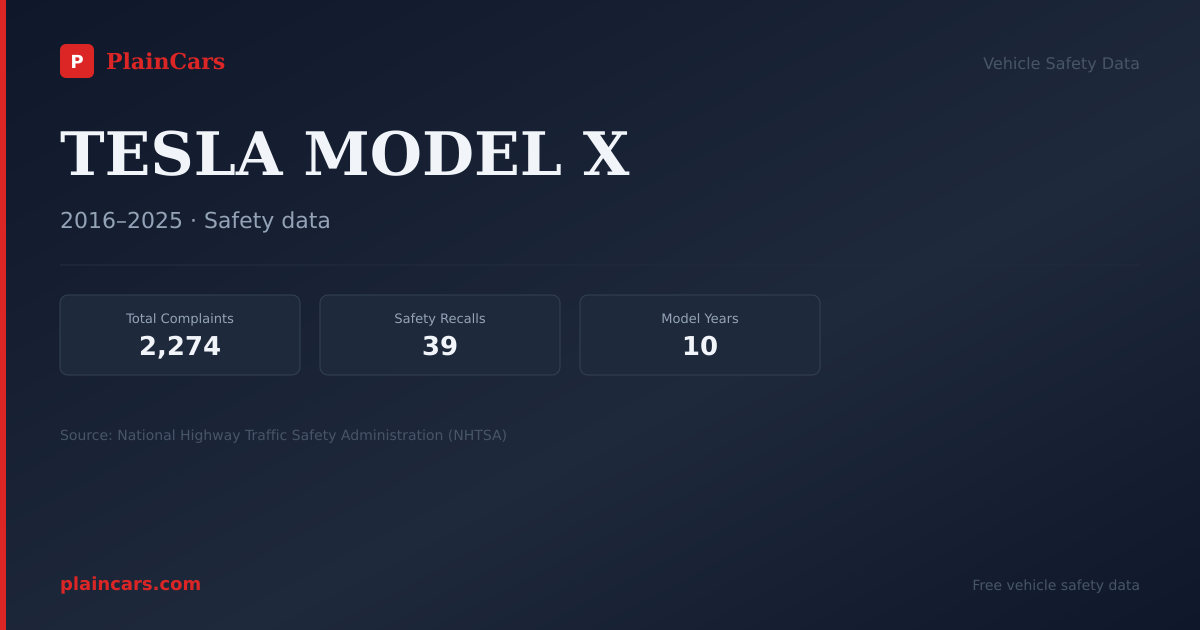
Total Complaints
408 filings
Tesla Model X · model year
408 NHTSA complaints, 38 crash reports, and 10 recall campaigns listed for this cohort. A VIN lookup is required to determine whether a specific vehicle has an unrepaired recall.
NHTSA overall rating
Not crash-tested
New Car Assessment Program
The verdict
The 2017 Tesla Model X posts above-average complaint volume among its own model-year siblings.
The 2017TeslaModel X carries 408 consumer safety complaints in NHTSA's Office of Defects Investigation database for this specific model-year cohort. Within that volume, owners reported 38 crashes, 1 fire, 65 injuries, and 56 fatalities. No NCAP 5-star crash-test rating is available for this model year in the federal database.
The most frequently selected component label in reports for the 2017 Model X is electrical system with 70 filings, followed by suspension (59) and unknown or other (48). Complaint categories reflect owner reports and intake categorization; they do not establish a defect pattern or cause. This cohort has 10 NHTSA recall campaigns listed below. Enter a VIN in NHTSA's official recall lookup to determine whether a specific vehicle has an unrepaired recall.
NHTSA currently has 1 investigation file overlapping the 2017 Model X. Owners comparing this cohort against neighboring years should read the complaint-by-year trend as report volume, not a causal diagnosis. Use the related-complaint feed and the official recall lookup when researching a specific vehicle.
PlainCars' own composite of NHTSA NCAP crash-test ratings and rollover-risk assessment, each dimension normalized against the federal scale or the full national model-year corpus. Not an official NHTSA figure, and not a substitute for a specific vehicle's VIN-level recall check.
Total Complaints
408 filings
Crashes Reported
38 reports
Source
NHTSA ODI
Federal complaints database
Above median complaint volume, review patterns below.
| Component | Count |
|---|---|
| ELECTRICAL SYSTEM | 70 |
| SUSPENSION | 59 |
| UNKNOWN OR OTHER | 48 |
| STEERING | 45 |
| FORWARD COLLISION AVOIDANCE: ADAPTIVE CRUISE CONTROL | 22 |
| SERVICE BRAKES | 17 |
| VEHICLE SPEED CONTROL | 16 |
| FORWARD COLLISION AVOIDANCE: AUTOMATIC EMERGENCY BRAKING | 15 |
| EXTERIOR LIGHTING | 10 |
| POWER TRAIN | 9 |
| VISIBILITY/WIPER | 9 |
| STRUCTURE:BODY | 8 |
| AIR BAGS | 8 |
| FUEL/PROPULSION SYSTEM | 8 |
| LANE DEPARTURE: ASSIST | 8 |
ELECTRICAL SYSTEM: INSTRUMENT CLUSTER/PANEL
Tesla, Inc. (Tesla) is recalling certain 2012-2023 Model S, 2016-2024 Model X, 2017-2023 Model 3, 2019-2024 Model Y, and 2024 Cybertruck vehicles. An incorrect font size is displayed on the instrument panel for the Brake, Park, and Antilock Brake System (ABS) warning lights. As such, these vehicle
FORWARD COLLISION AVOIDANCE: SENSING SYSTEM: CAMERA
Tesla, Inc. (Tesla) is recalling certain 2017-2021 Model S, Model 3, Model X, and 2020-2021 Model Y vehicles operating software version 2021.36.5.2. A communication error may cause false forward-collision warning (FCW) or unexpected activation of the automatic emergency brake (AEB) system.
BACK OVER PREVENTION:SOFTWARE
Tesla, Inc. (Tesla) is recalling certain 2012-2018 Tesla Model S and 2016-2018 Model X vehicles with a center display equipped with a NVIDIA Tegra 3 processor and an 8GB eMMC NAND flash memory device. When the 8GB eMMC NAND flash memory device for the center display reaches lifetime wear, the eMMC
SEAT BELTS:FRONT:WARNING LIGHT/DEVICES
Tesla, Inc. (Tesla) is recalling certain 2012-2024 Model S, 2015-2024 Model X, 2017-2023 Model 3, and 2020-2023 Model Y vehicles. In the event of an unbelted driver, the seat belt warning light and audible chime may not activate as intended. As such, these vehicles fail to comply with the requirem
ELECTRICAL SYSTEM:ADAS:AUTONOMOUS/SELF DRIVING:SOFTWARE
Tesla, Inc. (Tesla) is recalling certain 2016-2022 Model S and Model X, 2017-2022 Model 3, and 2020-2022 Model Y vehicles. The "rolling stop" functionality available as part of the Full Self-Driving (Beta) software may allow the vehicle to travel through an all-way stop intersection without first c
PARKING BRAKE
Tesla, Inc. (Tesla) is recalling certain 2016 Model S and Model X vehicles. The electric parking brake calipers have an internal gear that may be improperly manufactured, possibly resulting in the gear fracturing during parking brake application or release.
STEERING:AUTOMATED/ADAPTIVE STEERING
Tesla, Inc. (Tesla) is recalling certain 2016-2023 Model S, Model X, 2017-2023 Model 3, and 2020-2023 Model Y vehicles equipped with Full Self-Driving Beta (FSD Beta) software or pending installation. The FSD Beta system may allow the vehicle to act unsafe around intersections, such as traveling st
ELECTRICAL SYSTEM:ADAS:AUTONOMOUS/SELF DRIVING:SOFTWARE
Tesla, Inc. (Tesla) is recalling 2012-2023 Model S, 2016-2023 Model X, 2017-2023 Model 3, and 2020-2023 Model Y vehicles equipped with all versions of Autosteer leading up to the version(s) that contains the recall remedy. In certain circumstances when Autosteer is engaged, the prominence and scope
SEATS:MID/REAR ASSEMBLY
Tesla, Inc. (Tesla) is recalling certain 2016-2017 Model X vehicles. The left-side, second row, reclining seat backs may not fully latch due to having incorrectly adjusted recliner mechanism cables. As such, these vehicles fail to comply with the requirements of Federal Motor Vehicle Safety Standa
STEERING:ELECTRIC POWER ASSIST SYSTEM
Tesla, Inc. (Tesla) is recalling certain 2017-2021 Model S and Model X vehicles. The electronic power assist steering (EPAS) system may experience a loss of power steering assist when driving on rough roads or after hitting a pothole.
The electronic power steering (EPS) is struggling, requiring increased driver effort to steer. This seems to be dangerous when driving. The Full Self Driving (FSD) capability also stops abruptly when the steering locks up. Again, this is very risky and can cause serious accidents. I see that several owners have posted on social media about this same issue. Note, that there were recalls issued related to corroded steering bolts for Tesla Model X built up till November 2016. My car is built in 2017.
Reproducible and sudden loss of indicated driving range at low state of charge (SOC) for 6 months. First documented occurrence on 9 September 2025 during my final service visit while the vehicle was still covered under Tesla’s 8-year unlimited-mile high-voltage battery warranty, at which time no corrective action was taken. After repeated documented low-SOC range collapses, back to service on 13 November 2025. Tesla acknowledged the fault, verified the condition with diagnostics and customer provided screenshots, and stated that CAN log data indicated the Battery Management System (BMS) was not calculating SOC correctly. Tesla replaced the BMS assembly under warranty as a continuation of the original issue and advised that the vehicle would need to be driven and charged for recalibration. Following this repair, I completed multiple full charge cycles to 100% and allowed time for recalibration. Despite this, the issue persisted with 100% reproducibility, with rapid loss of available r
During home charging using 40A, the 220 volt UMC connector started smoking and was melting. The charging appeared unaffected, and I caught it before it caught fire.
Power Steering Assist stopped working while on the road. A couple days later, power steering stopped working completely.
Power Steering Assist stopped working while on the road. A couple days later, power steering stopped working completely.
The autopilot ECU failed on my car per Tesla. There was no warning on the car that my safety features were disabled. This is also reported online as a common issue and Tesla is charging $2k to repair a safety computer. The computer was advertised as two chips as a failsafe but that was not the case as both failed on my car. I suspect this software updates broke the computer as well and not at fault from the customer
The autopilot ECU failed on my car per Tesla. There was no warning on the car that my safety features were disabled. This is also reported online as a common issue and Tesla is charging $2k to repair a safety computer. The computer was advertised as two chips as a failsafe but that was not the case as both failed on my car. I suspect this software updates broke the computer as well and not at fault from the customer
The autopilot ECU failed on my car per Tesla. There was no warning on the car that my safety features were disabled. This is also reported online as a common issue and Tesla is charging $2k to repair a safety computer. The computer was advertised as two chips as a failsafe but that was not the case as both failed on my car. I suspect this software updates broke the computer as well and not at fault from the customer
The contact owns a 2017 Tesla Model X. The contact stated that while driving at an undisclosed speed, the messages “Air Suspension Unable to Raise” and “Functionality May Be Restored on Next Drive” were displayed. The vehicle was not diagnosed or repaired by an independent mechanic or a dealer. The manufacturer was not made aware of the failure. The failure mileage was approximately 53,000.
Mileage: 53,000
I am reporting a safety concern related to the suspension system in my 2017 Tesla Model X. The front tires are rubbing against the wheel arch liner, especially when turning or driving over uneven terrain. I have not made any aftermarket modifications, and the vehicle has been maintained in accordance with Tesla’s recommendations. This issue appears to match the known problem involving front suspension fore link failures documented in NHTSA investigations and prior complaints for 2016–2017 Model X vehicles. While I have not experienced a complete suspension failure, the current symptoms are consistent with reported cases where the fore links weaken or fail, causing the wheel to shift and contact the fender liner, leading to tire damage, unusual noises, and potential safety risks. I have reported this to Tesla, but they have not acknowledged this as a known issue for my VIN. However, NHTSA previously identified over 400 instances of similar failure and recommended that Tesla expand
I am reporting a safety concern related to the suspension system in my 2017 Tesla Model X. The front tires are rubbing against the wheel arch liner, especially when turning or driving over uneven terrain. I have not made any aftermarket modifications, and the vehicle has been maintained in accordance with Tesla’s recommendations. This issue appears to match the known problem involving front suspension fore link failures documented in NHTSA investigations and prior complaints for 2016–2017 Model X vehicles. While I have not experienced a complete suspension failure, the current symptoms are consistent with reported cases where the fore links weaken or fail, causing the wheel to shift and contact the fender liner, leading to tire damage, unusual noises, and potential safety risks. I have reported this to Tesla, but they have not acknowledged this as a known issue for my VIN. However, NHTSA previously identified over 400 instances of similar failure and recommended that Tesla expand
I am reporting a safety concern related to the suspension system in my 2017 Tesla Model X. The front tires are rubbing against the wheel arch liner, especially when turning or driving over uneven terrain. I have not made any aftermarket modifications, and the vehicle has been maintained in accordance with Tesla’s recommendations. This issue appears to match the known problem involving front suspension fore link failures documented in NHTSA investigations and prior complaints for 2016–2017 Model X vehicles. While I have not experienced a complete suspension failure, the current symptoms are consistent with reported cases where the fore links weaken or fail, causing the wheel to shift and contact the fender liner, leading to tire damage, unusual noises, and potential safety risks. I have reported this to Tesla, but they have not acknowledged this as a known issue for my VIN. However, NHTSA previously identified over 400 instances of similar failure and recommended that Tesla expand
This is the THIRD YEAR in a row that the Suspension System on this vehicle has failed. This seems like it should be a basic feature of any vehicle - that it should have proper shocks and suspension. The problem is the repair this time is estimated to be at $4000, when we have already had this repaired twice for several thousands of dollars. We drive this car very gently, so there is not an issue of us abusing the vehicle. Also, in China, Tesla was forced to recall vehicles over this same issue: Tesla recalls nearly 50,000 Model S and X cars in China over faulty suspension We would like to know if any recalls will be issued.
Tesla Model X are already known to wear out the rear tires on the inside edge due to excessive negative camber, or wheels tilting inwards from the top. Lowering the suspension setting makes the wheels tilt in even further! This causes more the weight of the car to rest on the inner shoulder of the wheel. Driving this way quickly wears down the inside edge of the rear tires which can cause a sudden and unexpected dangerous blowout
The second-row seatbelt in my 2017 Tesla Model X does not retract, preventing proper restraint of a passenger. Tesla acknowledged the issue but refused to repair it, stating the vehicle is out of warranty. This is a failure of a federally mandated safety system and a clear safety hazard under FMVSS 209. I’m transporting children in this vehicle and cannot rely on this seatbelt to function.
The Monitor Screen in the middle of the car is not malfunction. It's not working. All the panels on the steering are also not work. the honk is not working. Nothing is working. It could be due to the internet connection.
The Monitor Screen in the middle of the car is not malfunction. It's not working. All the panels on the steering are also not work. the honk is not working. Nothing is working. It could be due to the internet connection.
The contact owns a 2017 Tesla Model X. The contact stated that while operating the vehicle, the message "Restraint System Fault" remained displayed. The vehicle was taken to the local Tesla Service Center who diagnosed that the restraint system sensor was faulty and needed to be replaced. The vehicle was not yet repaired. The manufacturer was notified of the failure. The failure mileage was 93,000.
Mileage: 93,000
Component: Driver airbag assembly required replacement Risk: Airbag assembly seems serious & life-threatening if not functinal Inspected & replaced by: By Tesla service center Symptom: Horn stopped working
The second row bench seats won't recline back to rest position. A safety hazard. It's been a common accuracy. Please help. They will not put out a recall. Look it up online. It's a big problem and Tesla is not doing nothing, but trying charge you $3000 to replace the whole 2nd row bench! Wow
Data vintage: August 2026. Sources: NHTSA Office of Defects Investigation (ODI) complaints database, NHTSA recall campaign API, NHTSA NCAP crash-test ratings, and NHTSA FARS for fatality cross-reference.
Every figure on PlainCars is rendered directly from NHTSA complaint and safety data, no number is typed in by an editor. This year-specific record is rendered from NHTSA ODI, recall, and NCAP rows for the 2017 Tesla Model X; no figure is typed in by an editor. See our editorial standards & corrections policy, the methodology behind these numbers, or report a data error. Data current as of August 2026.
Read our methodology - how this data is sourced, computed, and verified.