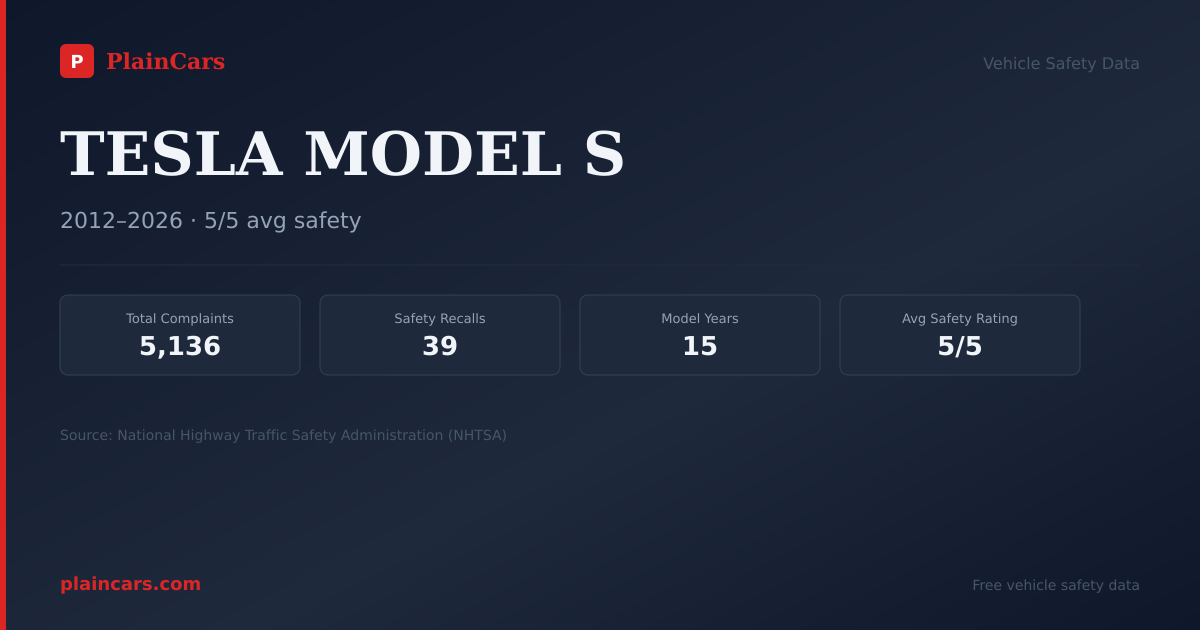
Total Complaints
7 filings
Tesla Model S · model year
7 NHTSA complaints, and 2 recall campaigns listed for this cohort. A VIN lookup is required to determine whether a specific vehicle has an unrepaired recall.
NHTSA overall rating
Not crash-tested
New Car Assessment Program
The verdict
The 2025 Tesla Model S posts top-10% complaint standing among its own model-year siblings.
The 2025TeslaModel S carries 7 consumer safety complaints in NHTSA's Office of Defects Investigation database for this specific model-year cohort. Within that volume, owners reported 0 crashes, 0 fires, 0 injuries, and 0 fatalities. No NCAP 5-star crash-test rating is available for this model year in the federal database.
The most frequently selected component label in reports for the 2025 Model S is suspension with 2 filings, followed by power train (2) and visibility/wiper (1). Complaint categories reflect owner reports and intake categorization; they do not establish a defect pattern or cause. This cohort has 2 NHTSA recall campaigns listed below. Enter a VIN in NHTSA's official recall lookup to determine whether a specific vehicle has an unrepaired recall.
NHTSA currently has 6 investigation files overlapping the 2025 Model S. Owners comparing this cohort against neighboring years should read the complaint-by-year trend as report volume, not a causal diagnosis. Use the related-complaint feed and the official recall lookup when researching a specific vehicle.
PlainCars' own composite of NHTSA NCAP crash-test ratings and rollover-risk assessment, each dimension normalized against the federal scale or the full national model-year corpus. Not an official NHTSA figure, and not a substitute for a specific vehicle's VIN-level recall check.
Total Complaints
7 filings
Crashes Reported
0 reports
Source
NHTSA ODI
Federal complaints database
At or below the fleet median complaint volume.
| Component | Count |
|---|---|
| SUSPENSION | 2 |
| POWER TRAIN | 2 |
| VISIBILITY/WIPER | 1 |
| WHEELS | 1 |
| STEERING | 1 |
AIR BAGS:FRONTAL:DRIVER SIDE:CUSHION
Tesla, Inc. (Tesla) is recalling certain 2021-2025 Model S and Model X vehicles. The driver's air bag could tear during deployment. As such, these vehicles fail to comply with the requirements of Federal Motor Vehicle Safety Standard (FMVSS) numbers 208, "Occupant Crash Protection" and 212, "Winds
BACK OVER PREVENTION:SOFTWARE
Tesla, Inc. (Tesla) is recalling certain 2024-2025 Model 3, Model S, 2023-2025 Model X, and Model Y vehicles. The computer circuit board may short, resulting in the loss of the rearview camera image. As such, these vehicles fail to comply with the requirements of Federal Motor Vehicle Safety Stand
The power train of my 2025 Tesla Model S failed. As a result, the car had several systems alert on my console that they were "unavailable" or "degraded", and in addition to the alerts I experienced their loss or degradation in real time. This included braking, steering, stability control, and traction control. Normally you don't have to hold the brake pedal down at a stop light on this electric vehicle, but when the failure occurred my car was rolling backwards at the stop light and so I had to hold down the brake. Also, steering was noticeably degraded and not stable. The car was also exhibiting behavior similar to a stuck accelerator whereby even with my foot off the accelerator the car would not slow up. Tesla had to tow my car to their nearest Tesla service center, and they replaced the front body controller and the battery controller which took three days. There were no warnings whatsoever or anything relating to the power train that were peculiar prior to this incident. I
The power train of my 2025 Model S failed similar to failure of 7-6-25 which I previously reported to NHTSA (complaint #11718413) and Tesla. Upon getting into my car on 2-7-26 and putting it in reverse, several alert messages displayed including "stability control disabled, traction control disabled, and emergency braking unavailable". I drove 1/4 mile to a safe area to call Tesla roadside assist, since my steering was noticeably degraded in real time and the car was not safe to drive. The car was towed to the nearest Tesla service center. Tesla made statements on their service report attached here, that this is a "known characteristic of the vehicle" and that if it happens again I should, "exit the car, let the car go to sleep and then once the vehicle is awakened the alert will not be present and it will operate normally". That is not a valid solution, and even though they told me they found nothing wrong when they looked at the car two days later on 2-9-26, I had walked away fr
The turning signal button on the steering wheel doesn't respond intermittently. It's a safety hazard to not engage a turning signal when making a turn.
I experienced excessive rear tire wear on both rear tires inner side The tire ended up blowing out on the rear passenger tire
I experienced excessive rear tire wear on both rear tires inner side The tire ended up blowing out on the rear passenger tire
TIRES WEAR EXCESSIVLY DUE TO INCORECT FACTORY AND NON-ADJUSTABLE CAMBER SETTINGS CAUSING EXTREME SAFTEY CONCERNS/BLOWOUTS, WHICH ARE NOT VISIBLE WITHOUT REMOVAL OF TIRE OR LIFTING OF VEHICLE BY AVERAGE MOTORIST. MY VEHICLE EXPERIENCED THIS WITHIN FIRST 10,000 MILES ON NEW CAR WITH NEW TIRES. FOURTUNEATLY A FLAT LED TO FURTHER INSPECTION AND REPLACEMENT BEFORE INCCURING TRAGIC OR ADVERSE CONSEQUENCES.
Tesla’s automatic wipers are unreliable. This vehicle lacks a dedicated rain sensor and instead uses the forward-facing camera and neural net to detect moisture. In light rain, the system often fails to activate. More critically, it frequently triggers false wipes during dry conditions—sometimes multiple times per day. Each dry swipe smears debris (e.g., bugs, sap), reducing visibility and risking permanent windshield scratches. This directly compromises driver safety and optics for the FSD/autopilot system. Tesla has acknowledged the issue but suggests turning off automatic wipers. However, this isn’t possible when FSD or Autopilot is active—they re-enable automatically. Proposed solution: If a wipe is triggered, the system should first activate the windshield washer. This would prevent dry swipes and maintain camera and driver visibility. The current logic is overly aggressive and lacks basic safeguards. Tesla must revise this behavior—both for user safety and hardware
Data vintage: August 2026. Sources: NHTSA Office of Defects Investigation (ODI) complaints database, NHTSA recall campaign API, NHTSA NCAP crash-test ratings, and NHTSA FARS for fatality cross-reference.
Every figure on PlainCars is rendered directly from NHTSA complaint and safety data, no number is typed in by an editor. This year-specific record is rendered from NHTSA ODI, recall, and NCAP rows for the 2025 Tesla Model S; no figure is typed in by an editor. See our editorial standards & corrections policy, the methodology behind these numbers, or report a data error. Data current as of August 2026.
Read our methodology - how this data is sourced, computed, and verified.