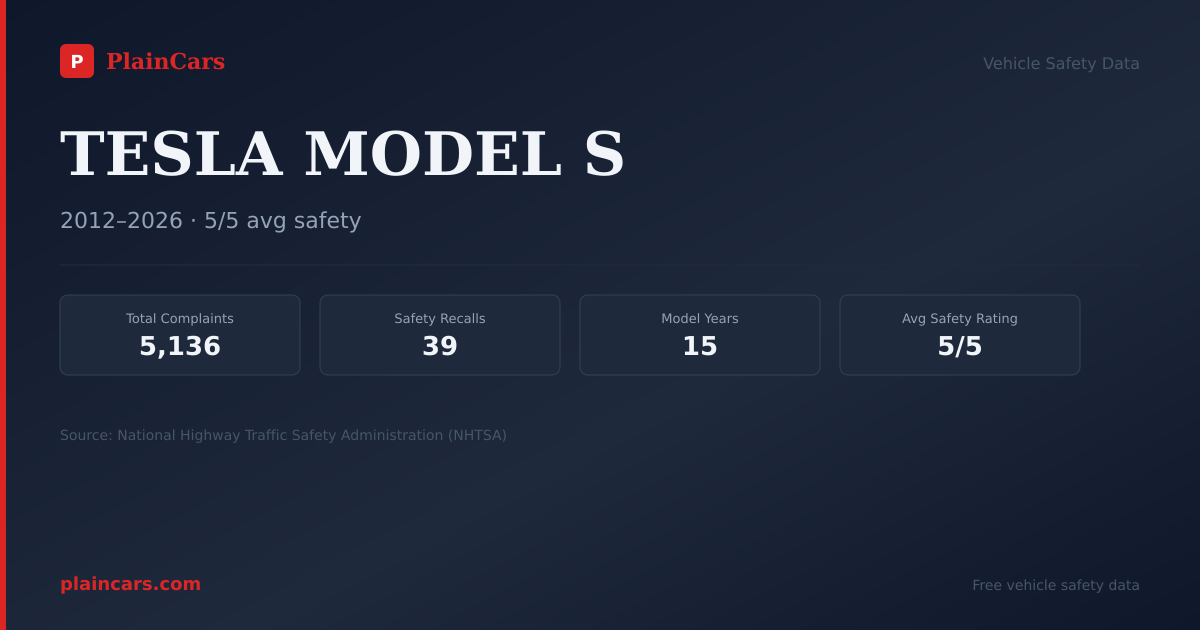
Total Complaints
269 filings
Tesla Model S · model year
269 NHTSA complaints, 28 crash reports, and 24 recall campaigns listed for this cohort. A VIN lookup is required to determine whether a specific vehicle has an unrepaired recall.
NHTSA overall rating
Not crash-tested
New Car Assessment Program
The verdict
The 2021 Tesla Model S posts above-average complaint volume among its own model-year siblings.
The 2021TeslaModel S carries 269 consumer safety complaints in NHTSA's Office of Defects Investigation database for this specific model-year cohort. Within that volume, owners reported 28 crashes, 2 fires, 3 injuries, and 2 fatalities. For crash performance, NHTSA's New Car Assessment Program gave this cohort an overall Not Rated/5 rating, with Not Rated/5 front crash, Not Rated/5 side crash, and 5/5 rollover scores derived from standardized barrier and dynamic tests.
The most frequently selected component label in reports for the 2021 Model S is unknown or other with 41 filings, followed by steering (29) and forward collision avoidance: automatic emergency braking (26). Complaint categories reflect owner reports and intake categorization; they do not establish a defect pattern or cause. This cohort has 24 NHTSA recall campaigns listed below. Enter a VIN in NHTSA's official recall lookup to determine whether a specific vehicle has an unrepaired recall.
NHTSA currently has 6 investigation files overlapping the 2021 Model S. Owners comparing this cohort against neighboring years should read the complaint-by-year trend as report volume, not a causal diagnosis. Use the related-complaint feed and the official recall lookup when researching a specific vehicle.
PlainCars' own composite of NHTSA NCAP crash-test ratings and rollover-risk assessment, each dimension normalized against the federal scale or the full national model-year corpus. Not an official NHTSA figure, and not a substitute for a specific vehicle's VIN-level recall check.
Total Complaints
269 filings
Crashes Reported
28 reports
Source
NHTSA ODI
Federal complaints database
Above median complaint volume, review patterns below.
| Component | Count |
|---|---|
| UNKNOWN OR OTHER | 41 |
| STEERING | 29 |
| FORWARD COLLISION AVOIDANCE: AUTOMATIC EMERGENCY BRAKING | 26 |
| FORWARD COLLISION AVOIDANCE: ADAPTIVE CRUISE CONTROL | 24 |
| ELECTRICAL SYSTEM | 21 |
| SUSPENSION | 16 |
| SERVICE BRAKES | 14 |
| VEHICLE SPEED CONTROL | 13 |
| WHEELS | 9 |
| STRUCTURE:BODY | 9 |
| FORWARD COLLISION AVOIDANCE: WARNINGS | 8 |
| TIRES | 8 |
| LANE DEPARTURE: ASSIST | 6 |
| SEAT BELTS | 6 |
| LANE DEPARTURE: WARNING | 5 |
ELECTRICAL SYSTEM: INSTRUMENT CLUSTER/PANEL
Tesla, Inc. (Tesla) is recalling certain 2012-2023 Model S, 2016-2024 Model X, 2017-2023 Model 3, 2019-2024 Model Y, and 2024 Cybertruck vehicles. An incorrect font size is displayed on the instrument panel for the Brake, Park, and Antilock Brake System (ABS) warning lights. As such, these vehicle
FORWARD COLLISION AVOIDANCE: SENSING SYSTEM: CAMERA
Tesla, Inc. (Tesla) is recalling certain 2017-2021 Model S, Model 3, Model X, and 2020-2021 Model Y vehicles operating software version 2021.36.5.2. A communication error may cause false forward-collision warning (FCW) or unexpected activation of the automatic emergency brake (AEB) system.
SEAT BELTS:FRONT:WARNING LIGHT/DEVICES
Tesla, Inc. (Tesla) is recalling certain 2012-2024 Model S, 2015-2024 Model X, 2017-2023 Model 3, and 2020-2023 Model Y vehicles. In the event of an unbelted driver, the seat belt warning light and audible chime may not activate as intended. As such, these vehicles fail to comply with the requirem
FORWARD COLLISION AVOIDANCE: WARNINGS:EXTERNAL/PEDESTRIAN ALERT
Tesla, Inc. (Tesla) is recalling certain 2013, 2018-2021 Model S, 2020-2021 Model X, 2018-2022 Model 3, and 2020-2022 Model Y vehicles. A factory reset muted the Pedestrian Warning System (PWS) sounds. As such, these vehicles fail to comply with the requirements of Federal Motor Vehicle Safety Sta
ELECTRICAL SYSTEM:ADAS:AUTONOMOUS/SELF DRIVING:SOFTWARE
Tesla, Inc. (Tesla) is recalling certain 2016-2022 Model S and Model X, 2017-2022 Model 3, and 2020-2022 Model Y vehicles. The "rolling stop" functionality available as part of the Full Self-Driving (Beta) software may allow the vehicle to travel through an all-way stop intersection without first c
AIR BAGS:FRONTAL:DRIVER SIDE:CUSHION
Tesla, Inc. (Tesla) is recalling certain 2021-2025 Model S and Model X vehicles. The driver's air bag could tear during deployment. As such, these vehicles fail to comply with the requirements of Federal Motor Vehicle Safety Standard (FMVSS) numbers 208, "Occupant Crash Protection" and 212, "Winds
LATCHES/LOCKS/LINKAGES:HOOD:LATCH
Tesla, Inc. (Tesla) is recalling certain 2021-2024 Model 3, Model S, Model X, and 2020-2024 Model Y vehicles. The hood latch assembly may fail to detect an unlatched hood condition after the hood has been opened.
AIR BAGS:SIDE/WINDOW:CURTAIN:INFLATOR
Tesla, Inc. (Tesla) is recalling certain 2021-2022 Model S vehicles. The right or left side curtain air bag inflators may have been assembled incorrectly.
LATCHES/LOCKS/LINKAGES:HOOD:LATCH
Tesla, Inc. (Tesla) is recalling certain 2014-2021 Model S vehicles. The front trunk latch assembly may be misaligned, preventing the secondary hood latch from engaging. As such, these vehicles fail to comply with the requirements of Federal Motor Vehicle Safety Standard number 113, "Hood Latch Sy
VISIBILITY:POWER WINDOW DEVICES AND CONTROLS
Tesla, Inc. (Tesla) is recalling certain 2017-2022 Model 3, 2020-2022 Model Y, and 2021-2022 Model S and Model X vehicles. The window automatic reversal system may not react correctly after detecting an obstruction. As such, these vehicles fail to comply with the requirements of Federal Motor Vehi
AIR BAGS
Tesla, Inc. (Tesla) is recalling certain 2021-2024 Model S and 2021-2025 Model X vehicles. An air bag with the incorrect horn pad may have been installed, preventing the horn from sounding.
STEERING:AUTOMATED/ADAPTIVE STEERING
Tesla, Inc. (Tesla) is recalling certain 2016-2023 Model S, Model X, 2017-2023 Model 3, and 2020-2023 Model Y vehicles equipped with Full Self-Driving Beta (FSD Beta) software or pending installation. The FSD Beta system may allow the vehicle to act unsafe around intersections, such as traveling st
SEAT BELTS:FRONT
Tesla, Inc. (Tesla) is recalling certain 2021-2023 Model S and Model X vehicles. The front-row seat belts may not be connected properly to the pretensioner anchors, which can cause the seat belts to detach.
ELECTRICAL SYSTEM:ADAS:AUTONOMOUS/SELF DRIVING:SOFTWARE
Tesla, Inc. (Tesla) is recalling 2012-2023 Model S, 2016-2023 Model X, 2017-2023 Model 3, and 2020-2023 Model Y vehicles equipped with all versions of Autosteer leading up to the version(s) that contains the recall remedy. In certain circumstances when Autosteer is engaged, the prominence and scope
ELECTRICAL SYSTEM:SOFTWARE
Tesla, Inc. (Tesla) is recalling certain 2020-2022 Model Y, Model X, Model S, and 2017-2022 Model 3 vehicles. The Boombox function allows sounds to be played through an external speaker while the vehicle is in motion, which may obscure the Pedestrian Warning System (PWS) sounds. As such, these veh
AIR BAGS
Tesla, Inc. (Tesla) is recalling certain 2021 Model X and Model S vehicles. The driver's air bag cushion may tear during deployment.
BACK OVER PREVENTION:SOFTWARE
Tesla, Inc. (Tesla) is recalling certain 2017, 2021-2023 Model 3, 2020-2023 Model Y, 2021-2023 Model S, and Model X vehicles operating software version 2026.8.6. The rearview camera image may be delayed when the vehicle is placed in reverse. As such, these vehicles fail to comply with the requiremen
ELECTRICAL SYSTEM:SOFTWARE
Tesla, Inc. (Tesla) is recalling certain 2020-2022 Model S, Model X, Model Y, and 2017-2022 Model 3 vehicles. The Boombox function allows sounds to be played through an external speaker while the vehicle is in motion, which may obscure the Pedestrian Warning System (PWS) sounds. As such, these veh
STEERING: STEERING WHEEL/HANDLE BAR
Tesla, Inc. (Tesla) is recalling certain 2021-2024 Model S and Model X vehicles. An incorrect air bag may have been installed when the steering yoke or round steering wheel was replaced with a different style of yoke or steering wheel.
BACK OVER PREVENTION:DISPLAY FUNCTION
Tesla, Inc. (Tesla) is recalling certain 2021-2022 Model S, Model X, and 2022 Model 3 and Model Y vehicles operating certain firmware releases. The infotainment central processing unit (CPU) may overheat during the preparation or process of fast-charging, causing the CPU to lag or restart.
ELECTRICAL SYSTEM:SOFTWARE
Tesla, Inc. (Tesla) is recalling certain 2021-2022 Model 3, Model S, Model X, and 2020-2022 Model Y vehicles. A software error may cause a valve in the heat pump to open unintentionally and trap the refrigerant inside the evaporator, resulting in decreased defrosting performance. As such, these ve
VISIBILITY:REARVIEW MIRRORS/DEVICES:EXTERIOR
Tesla, Inc. (Tesla) is recalling certain 2021 Model S exterior side rearview mirrors, part numbers: 1622232-00-B and 1622233-00-B. The driver side exterior rearview mirrors are convex (curved glass) and the passenger side mirrors do not include the "Objects in Mirror Are Closer Than They Appear" et
STEERING:ELECTRIC POWER ASSIST SYSTEM
Tesla, Inc. (Tesla) is recalling certain 2017-2021 Model S and Model X vehicles. The electronic power assist steering (EPAS) system may experience a loss of power steering assist when driving on rough roads or after hitting a pothole.
ELECTRICAL SYSTEM:SOFTWARE
Tesla, Inc. (Tesla) is recalling certain 2021-2022 Model S and Model X, 2017-2022 Model 3, and 2020-2022 Model Y vehicles. The audible chime may not activate when the vehicle starts and the driver has not buckled their seat belt. As such, these vehicles fail to comply with the requirements of Fede
I have started receiving airbag & seat safety issue alert but recieved appointment after a month even considering major safety concern. Some of 2021 vehicles are serviced under the recall Tesla sent. But told me mine doesn’t qualify for same issue for same year, same model cars. It seems like issue is with all Tesla Model S 2021 but Tesla charging big dollar amount to repair the safety concern. They have also mentioned there is on going concern with air suspension and all Tesla starts giving problem between 60,000 miles to 90,000 miles. It costs around $6000 to fix that issue and told me these are not safety concerns.
I have started receiving airbag & seat safety issue alert but recieved appointment after a month even considering major safety concern. Some of 2021 vehicles are serviced under the recall Tesla sent. But told me mine doesn’t qualify for same issue for same year, same model cars. It seems like issue is with all Tesla Model S 2021 but Tesla charging big dollar amount to repair the safety concern. They have also mentioned there is on going concern with air suspension and all Tesla starts giving problem between 60,000 miles to 90,000 miles. It costs around $6000 to fix that issue and told me these are not safety concerns.
I have started receiving airbag & seat safety issue alert but recieved appointment after a month even considering major safety concern. Some of 2021 vehicles are serviced under the recall Tesla sent. But told me mine doesn’t qualify for same issue for same year, same model cars. It seems like issue is with all Tesla Model S 2021 but Tesla charging big dollar amount to repair the safety concern. They have also mentioned there is on going concern with air suspension and all Tesla starts giving problem between 60,000 miles to 90,000 miles. It costs around $6000 to fix that issue and told me these are not safety concerns.
7/30/2025 The vehicle experienced a confirmed TOTAL loss of function to include steering, restraint, and braking functionality at approximately 60 to 65 miles per hour. This catastrophic failure placed myself and and others at severe risk. Although Tesla’s service notes confirm the event occurred, no corrective repair was performed. The vehicle was completely inoperative with a matter of seconds with no prior warning. At this point in time the car has continued to not operate the same steering and noises has been in the shop 5 times still no answer or repairs in regard to it shutting down or any other issues that continue to return. The last visit I was asked to purchase new tires because maybe that’s why, I did. I continue to be told nothing is wrong with the vehicle making me feel extremely defeated when I know the vehicle is not the same as it was.
7/30/2025 The vehicle experienced a confirmed TOTAL loss of function to include steering, restraint, and braking functionality at approximately 60 to 65 miles per hour. This catastrophic failure placed myself and and others at severe risk. Although Tesla’s service notes confirm the event occurred, no corrective repair was performed. The vehicle was completely inoperative with a matter of seconds with no prior warning. At this point in time the car has continued to not operate the same steering and noises has been in the shop 5 times still no answer or repairs in regard to it shutting down or any other issues that continue to return. The last visit I was asked to purchase new tires because maybe that’s why, I did. I continue to be told nothing is wrong with the vehicle making me feel extremely defeated when I know the vehicle is not the same as it was.
Vehicle: 2021 Tesla Model S Long Range VIN: [XXX] I am reporting multiple safety-related defects that existed at delivery or developed shortly thereafter, and Tesla has refused to diagnose or repair them under warranty. These defects create an unsafe driving condition and risk of loss of control or collision. Defect Summary: 1.Alignment Defect at Delivery: On the day I bought the car, the steering wheel pulled to the left and felt unstable. I reported this immediately to Tesla. They dismissed it as “normal.” 2.Premature Tire Wear: Within months, the left tire wore down to the steel belts on the left side while the right side had normal wear. An independent shop confirmed this was caused by suspension/bushing issues, not road damage. 3.Suspension/Bushing Failure: A third-party Tesla-certified shop confirmed that the suspension components are bent/tweaked and require replacement for safe driving. Tesla refused to inspect these components properly. 4.Unlatched Rear Seat at Delivery
Vehicle: 2021 Tesla Model S Long Range VIN: [XXX] I am reporting multiple safety-related defects that existed at delivery or developed shortly thereafter, and Tesla has refused to diagnose or repair them under warranty. These defects create an unsafe driving condition and risk of loss of control or collision. Defect Summary: 1.Alignment Defect at Delivery: On the day I bought the car, the steering wheel pulled to the left and felt unstable. I reported this immediately to Tesla. They dismissed it as “normal.” 2.Premature Tire Wear: Within months, the left tire wore down to the steel belts on the left side while the right side had normal wear. An independent shop confirmed this was caused by suspension/bushing issues, not road damage. 3.Suspension/Bushing Failure: A third-party Tesla-certified shop confirmed that the suspension components are bent/tweaked and require replacement for safe driving. Tesla refused to inspect these components properly. 4.Unlatched Rear Seat at Delivery
Vehicle: 2021 Tesla Model S Long Range VIN: [XXX] I am reporting multiple safety-related defects that existed at delivery or developed shortly thereafter, and Tesla has refused to diagnose or repair them under warranty. These defects create an unsafe driving condition and risk of loss of control or collision. Defect Summary: 1.Alignment Defect at Delivery: On the day I bought the car, the steering wheel pulled to the left and felt unstable. I reported this immediately to Tesla. They dismissed it as “normal.” 2.Premature Tire Wear: Within months, the left tire wore down to the steel belts on the left side while the right side had normal wear. An independent shop confirmed this was caused by suspension/bushing issues, not road damage. 3.Suspension/Bushing Failure: A third-party Tesla-certified shop confirmed that the suspension components are bent/tweaked and require replacement for safe driving. Tesla refused to inspect these components properly. 4.Unlatched Rear Seat at Delivery
Certified pre-owned 2021 Tesla Model S delivered on October 21, 2025 with worn Michelin Pilot Sport 4S summer tires (255/35ZR21 front, 295/30ZR21 rear). Tread depth measured approximately 2/32" on the outer tread shoulders of all four tires, below Tesla’s published 5/32" delivery standard. Within the first week of ownership, the vehicle hydroplaned multiple times in wet conditions at normal speeds. Tesla service declined to replace the tires, stating measurements were “taken in the wrong location” and that only the inner grooves count, despite Tesla’s public documentation and national tire safety standards defining tread depth across the full width of the tire. Vehicle was returned in same condition without correction, leaving a continued safety risk from inadequate tread and summer tires unsuited for Ohio’s cold and wet seasonal conditions.
On October 17, 2025, while using Full Self-Driving (FSD) mode on my 2021 Tesla Model S Plaid, the car failed to stop at two red lights within a three-hour period. In each case, the car attempted to drive through the intersection even though the signal was solid red. I intervened manually and applied the brakes to prevent a potential collision. There were no prior warnings or alerts, and I have not modified the vehicle. This behavior endangers my safety and the safety of others. I am willing to provide the vehicle and any available data logs for inspection if requested.
On October 17, 2025, while using Full Self-Driving (FSD) mode on my 2021 Tesla Model S Plaid, the car failed to stop at two red lights within a three-hour period. In each case, the car attempted to drive through the intersection even though the signal was solid red. I intervened manually and applied the brakes to prevent a potential collision. There were no prior warnings or alerts, and I have not modified the vehicle. This behavior endangers my safety and the safety of others. I am willing to provide the vehicle and any available data logs for inspection if requested.
On October 17, 2025, while using Full Self-Driving (FSD) mode on my 2021 Tesla Model S Plaid, the car failed to stop at two red lights within a three-hour period. In each case, the car attempted to drive through the intersection even though the signal was solid red. I intervened manually and applied the brakes to prevent a potential collision. There were no prior warnings or alerts, and I have not modified the vehicle. This behavior endangers my safety and the safety of others. I am willing to provide the vehicle and any available data logs for inspection if requested.
Tesla Model S 2021 Long Range: Upon closing the rear trunk close button from the app or close button on the hatch, the hatch goes down but won’t lock. It gives 3 beeps. Upon pressing open, it won’t go up and gives 3 beeps.
Tesla Model S 2021 Long Range: Upon closing the rear trunk close button from the app or close button on the hatch, the hatch goes down but won’t lock. It gives 3 beeps. Upon pressing open, it won’t go up and gives 3 beeps.
The reverse lights are incredibly insufficient and pose a safety risk when backing up. The lights are so dim, they are virtually ineffective to the point that they illuminate nothing that may be behind the car. This is not a bulb issue as they came from the factory, new, in this condition and the service center said there is nothing they can do. Other owners I have spoken with report the same issue.
The wrap on the steering yoke is peeling, already had a steering yoke replacement 18 months ago under warranty, and this replacement steering yoke exibiting same peeling issue. Could be a safety grip issue as the yoke portion is more slippery at the peeled section. Tesla refuses to replace this faulty yoke as a covered safety item.
The wrap on the steering yoke is peeling, already had a steering yoke replacement 18 months ago under warranty, and this replacement steering yoke exibiting same peeling issue. Could be a safety grip issue as the yoke portion is more slippery at the peeled section. Tesla refuses to replace this faulty yoke as a covered safety item.
Premature tire wear. Inside edges of rear tires wore out in 10k miles
Premature tire wear. Inside edges of rear tires wore out in 10k miles
The contact owns a 2021 Tesla Model S. The contact stated that while the vehicle was parked, the vehicle was connected to the charging port and independently went into Race mode. The contact stated that the charge increased from 0 to 60 instantly. The vehicle was taken to the dealer, where it was diagnosed with a software failure. The vehicle was repaired; however, the failure reoccurred. The contact stated that while the vehicle was charging, the charging stopped intermittently, and the vehicle completely stopped charging. The vehicle was taken back to the dealer, where it was diagnosed with battery corrosion and failure. The contact was informed that the battery contained water and was corroded. The contact questioned whether the vehicle had been in a flood. The contact was informed that the battery needed to be replaced. The vehicle was not repaired. The contact stated that the vehicle was taken to the dealer several times due to the persistent failure. Additionally, the contact rec
Mileage: 1,000
Data vintage: August 2026. Sources: NHTSA Office of Defects Investigation (ODI) complaints database, NHTSA recall campaign API, NHTSA NCAP crash-test ratings, and NHTSA FARS for fatality cross-reference.
Every figure on PlainCars is rendered directly from NHTSA complaint and safety data, no number is typed in by an editor. This year-specific record is rendered from NHTSA ODI, recall, and NCAP rows for the 2021 Tesla Model S; no figure is typed in by an editor. See our editorial standards & corrections policy, the methodology behind these numbers, or report a data error. Data current as of August 2026.
Read our methodology - how this data is sourced, computed, and verified.