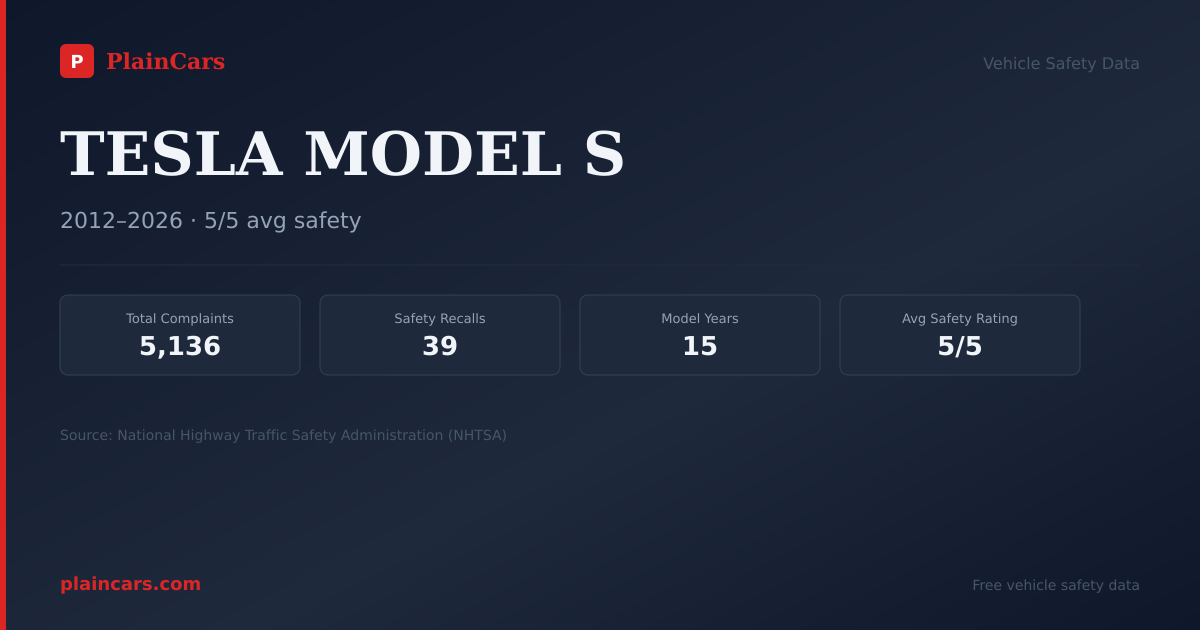
Total Complaints
993 filings
Tesla Model S · model year
993 NHTSA complaints, 154 crash reports, and 10 recall campaigns listed for this cohort. A VIN lookup is required to determine whether a specific vehicle has an unrepaired recall.
NHTSA overall rating
Not crash-tested
New Car Assessment Program
The verdict
The 2016 Tesla Model S posts above-average complaint volume among its own model-year siblings.
The 2016TeslaModel S carries 993 consumer safety complaints in NHTSA's Office of Defects Investigation database for this specific model-year cohort. Within that volume, owners reported 154 crashes, 23 fires, 115 injuries, and 12 fatalities. No NCAP 5-star crash-test rating is available for this model year in the federal database.
The most frequently selected component label in reports for the 2016 Model S is suspension with 206 filings, followed by unknown or other (148) and electrical system (140). Complaint categories reflect owner reports and intake categorization; they do not establish a defect pattern or cause. This cohort has 10 NHTSA recall campaigns listed below. Enter a VIN in NHTSA's official recall lookup to determine whether a specific vehicle has an unrepaired recall.
NHTSA currently has 6 investigation files overlapping the 2016 Model S. Owners comparing this cohort against neighboring years should read the complaint-by-year trend as report volume, not a causal diagnosis. Use the related-complaint feed and the official recall lookup when researching a specific vehicle.
PlainCars' own composite of NHTSA NCAP crash-test ratings and rollover-risk assessment, each dimension normalized against the federal scale or the full national model-year corpus. Not an official NHTSA figure, and not a substitute for a specific vehicle's VIN-level recall check.
Total Complaints
993 filings
Crashes Reported
154 reports
Source
NHTSA ODI
Federal complaints database
Above median complaint volume, review patterns below.
| Component | Count |
|---|---|
| SUSPENSION | 206 |
| UNKNOWN OR OTHER | 148 |
| ELECTRICAL SYSTEM | 140 |
| STEERING | 83 |
| VEHICLE SPEED CONTROL | 75 |
| SERVICE BRAKES | 53 |
| EXTERIOR LIGHTING | 49 |
| STRUCTURE:BODY | 27 |
| VISIBILITY/WIPER | 25 |
| FORWARD COLLISION AVOIDANCE: ADAPTIVE CRUISE CONTROL | 22 |
| WHEELS | 15 |
| BACK OVER PREVENTION | 15 |
| FORWARD COLLISION AVOIDANCE: AUTOMATIC EMERGENCY BRAKING | 14 |
| POWER TRAIN | 13 |
| FUEL/PROPULSION SYSTEM | 13 |
ELECTRICAL SYSTEM: INSTRUMENT CLUSTER/PANEL
Tesla, Inc. (Tesla) is recalling certain 2012-2023 Model S, 2016-2024 Model X, 2017-2023 Model 3, 2019-2024 Model Y, and 2024 Cybertruck vehicles. An incorrect font size is displayed on the instrument panel for the Brake, Park, and Antilock Brake System (ABS) warning lights. As such, these vehicle
STEERING:ELECTRIC POWER ASSIST SYSTEM
Tesla, Inc. (Tesla) is recalling certain 2012-2016 Tesla Model S vehicles equipped with Bosch steering racks. The aluminum bolts that attach the power steering gear assist motor to the gear housing may corrode and fracture causing a reduction or complete loss of power steering assist.
BACK OVER PREVENTION:SOFTWARE
Tesla, Inc. (Tesla) is recalling certain 2012-2018 Tesla Model S and 2016-2018 Model X vehicles with a center display equipped with a NVIDIA Tegra 3 processor and an 8GB eMMC NAND flash memory device. When the 8GB eMMC NAND flash memory device for the center display reaches lifetime wear, the eMMC
SEAT BELTS:FRONT:WARNING LIGHT/DEVICES
Tesla, Inc. (Tesla) is recalling certain 2012-2024 Model S, 2015-2024 Model X, 2017-2023 Model 3, and 2020-2023 Model Y vehicles. In the event of an unbelted driver, the seat belt warning light and audible chime may not activate as intended. As such, these vehicles fail to comply with the requirem
ELECTRICAL SYSTEM:ADAS:AUTONOMOUS/SELF DRIVING:SOFTWARE
Tesla, Inc. (Tesla) is recalling certain 2016-2022 Model S and Model X, 2017-2022 Model 3, and 2020-2022 Model Y vehicles. The "rolling stop" functionality available as part of the Full Self-Driving (Beta) software may allow the vehicle to travel through an all-way stop intersection without first c
LATCHES/LOCKS/LINKAGES:HOOD:LATCH
Tesla, Inc. (Tesla) is recalling certain 2014-2021 Model S vehicles. The front trunk latch assembly may be misaligned, preventing the secondary hood latch from engaging. As such, these vehicles fail to comply with the requirements of Federal Motor Vehicle Safety Standard number 113, "Hood Latch Sy
PARKING BRAKE
Tesla, Inc. (Tesla) is recalling certain 2016 Model S and Model X vehicles. The electric parking brake calipers have an internal gear that may be improperly manufactured, possibly resulting in the gear fracturing during parking brake application or release.
STEERING:AUTOMATED/ADAPTIVE STEERING
Tesla, Inc. (Tesla) is recalling certain 2016-2023 Model S, Model X, 2017-2023 Model 3, and 2020-2023 Model Y vehicles equipped with Full Self-Driving Beta (FSD Beta) software or pending installation. The FSD Beta system may allow the vehicle to act unsafe around intersections, such as traveling st
ELECTRICAL SYSTEM:ADAS:AUTONOMOUS/SELF DRIVING:SOFTWARE
Tesla, Inc. (Tesla) is recalling 2012-2023 Model S, 2016-2023 Model X, 2017-2023 Model 3, and 2020-2023 Model Y vehicles equipped with all versions of Autosteer leading up to the version(s) that contains the recall remedy. In certain circumstances when Autosteer is engaged, the prominence and scope
AIR BAGS:FRONTAL:PASSENGER SIDE:INFLATOR MODULE
Tesla, Inc. (Tesla) is recalling all 2014-2016 Model S vehicles equipped with certain air bag inflators assembled as part of the passenger frontal air bag modules used as original equipment or replacement equipment. In the event of a crash necessitating deployment of the passenger frontal air bag,
I am reporting a safety-related defect involving sudden loss of motive power on my 2016 Tesla Model S. During the drivetrain warranty period, the vehicle developed a persistent humming/buzzing noise from the rear drive unit. This noise was documented on video with a timestamp confirming it occurred while the vehicle was under warranty. At the time, there was no loss of performance or warning indicators. Due to the distance to the nearest Tesla service center (approximately 200 miles), the vehicle was not immediately inspected. When I later contacted Tesla Service, the vehicle was approximately three weeks outside the drivetrain warranty. Upon inspection, Tesla advised that the rear drive unit was failing and would require replacement at customer expense. Tesla declined warranty coverage despite evidence that the failure symptoms began during the warranty period. The rear drive unit later catastrophically failed while the vehicle was being driven uphill, resulting in a complete loss
I was parking the car and gently tapped on the accelerator to inch forward. The car accelerated suddenly, crashed into a concrete sign holder, and knocked down a sign, until I was able to stop it using the breaks. The accident caused $5000 worth of damage that I paid out of pocket to fix, since I assumed I must have made a mistake. However when I got the car back a month later, unintended acceleration happened AGAIN - under the same circumstances. I was parking and inching forward. I tapped the accelerator and the car accelerated suddenly. This time I was able to stop it before causing any damage. At this point, I KNEW that the first accident was not my error, since it had now happened again, and I was 100% sure that I did nothing wrong. I looked up "unintended acceleration - Tesla" and found examples of the exact same thing happening while parking. I looked for a fix, and it suggested changing the mode of the car to "creep." This so far has worked well.
My 2016 Tesla Model S (45,500 miles) is experiencing a complete failure of the Media Control Unit (MCU1), resulting in a total loss of the rearview camera display and defrost/defogging controls. This is a critical safety hazard. The unit was previously replaced by Tesla in 2021 under NHTSA Recall 21V-035. However, this replacement part has failed again after only a few years of low-mileage use. Tesla Service is refusing to provide a free repair or a goodwill discount for an MCU2 upgrade, claiming the 'recall repair' only had a 1-year warranty. It is unacceptable that a safety-critical component replaced under a federal recall fails twice in 45,000 miles. Tesla has failed to provide a permanent fix for the eMMC defect identified by NHTSA. By refusing to restore the camera functionality without charging full price, Tesla is knowingly allowing a safety defect to persist. I request an investigation into these premature failures of recall-replaced components
My 2016 Tesla Model S (45,500 miles) is experiencing a complete failure of the Media Control Unit (MCU1), resulting in a total loss of the rearview camera display and defrost/defogging controls. This is a critical safety hazard. The unit was previously replaced by Tesla in 2021 under NHTSA Recall 21V-035. However, this replacement part has failed again after only a few years of low-mileage use. Tesla Service is refusing to provide a free repair or a goodwill discount for an MCU2 upgrade, claiming the 'recall repair' only had a 1-year warranty. It is unacceptable that a safety-critical component replaced under a federal recall fails twice in 45,000 miles. Tesla has failed to provide a permanent fix for the eMMC defect identified by NHTSA. By refusing to restore the camera functionality without charging full price, Tesla is knowingly allowing a safety defect to persist. I request an investigation into these premature failures of recall-replaced components
My 2016 Tesla Model S (45,500 miles) is experiencing a complete failure of the Media Control Unit (MCU1), resulting in a total loss of the rearview camera display and defrost/defogging controls. This is a critical safety hazard. The unit was previously replaced by Tesla in 2021 under NHTSA Recall 21V-035. However, this replacement part has failed again after only a few years of low-mileage use. Tesla Service is refusing to provide a free repair or a goodwill discount for an MCU2 upgrade, claiming the 'recall repair' only had a 1-year warranty. It is unacceptable that a safety-critical component replaced under a federal recall fails twice in 45,000 miles. Tesla has failed to provide a permanent fix for the eMMC defect identified by NHTSA. By refusing to restore the camera functionality without charging full price, Tesla is knowingly allowing a safety defect to persist. I request an investigation into these premature failures of recall-replaced components
-Airbag warning light on -Horn not working -Steering wheel scroll buttons not working -Clicking noise when turning wheel This failure occurred during normal driving. Airbags will not deploy and horn is inoperable, creating a safety risk myself and my family. I have never been into any accidents and have only driven normal. These safety systems should not fail. This is a manufacturing issue.
-Airbag warning light on -Horn not working -Steering wheel scroll buttons not working -Clicking noise when turning wheel This failure occurred during normal driving. Airbags will not deploy and horn is inoperable, creating a safety risk myself and my family. I have never been into any accidents and have only driven normal. These safety systems should not fail. This is a manufacturing issue.
-Airbag warning light on -Horn not working -Steering wheel scroll buttons not working -Clicking noise when turning wheel This failure occurred during normal driving. Airbags will not deploy and horn is inoperable, creating a safety risk myself and my family. I have never been into any accidents and have only driven normal. These safety systems should not fail. This is a manufacturing issue.
The retracting door handle on my Tesla Model S failed, creating a dangerous situation where I could not enter the vehicle when needed. This defect poses a serious safety risk because if this failure occurred during a medical emergency, a crash, or a fire, neither I nor first responders would be able to access the vehicle quickly. In real‑world scenarios — such as needing to reach a child in the back seat, assisting an injured passenger, or evacuating the vehicle in traffic — a non‑functional door handle can cause delays that lead to injury. The failure also increases risk in cold‑weather regions, where being locked out of the vehicle can expose occupants to freezing temperatures. This is not a cosmetic issue; it is a critical safety hazard.
The contact owns a 2016 Tesla Model S. The contact stated that while driving approximately 10 MPH and making a right turn there was an abnormal sound coming from the front passenger’s side of the vehicle. The contact stated then started to smell a burning rubber odor. The contact was able to stop the vehicle. The contact stated that there was no warning light illuminated. The contact became aware that the front passenger’s side wheel had seized in a right turn position and was rubbing against the wheel well. The contact had the vehicle towed to the residence. The contact had not taken the vehicle to a local dealer or independent mechanic to be diagnosed or repaired. The manufacturer was not informed of the failure. The contact researched online and related the failure to NHTSA Action Number: PE20020 (Suspension). The failure mileage was 60,348.
Mileage: 60,348
While driving on the freeway in the fast lane at 75 MPH I80W, the car began a loud humming sound that came from the rear. My passenger and I noted that it was significant sound that we took a video to record the sound. I was the driver and I noticed that the sound increased as I accelerated. Then without any warning the car began to decelerate and no longer accelerated. The car slowed considerably to 35 MPH and it became a major safety issue because I had to cross all lanes of traffic at this slow speed. It was only after the car had completely shut down that the warning messages began to display. I reached the side of the road and we waited for the tow truck driver for about an hour. Subsequently, the car was towed to a Tesla dealer near my home. I was informed that the drive unit needed to be replaced with an explanation of internal failure, costing over $7000. However, the root cause of the internal failure was never explained or investigated even at my request stating that they do
While driving on the freeway in the fast lane at 75 MPH I80W, the car began a loud humming sound that came from the rear. My passenger and I noted that it was significant sound that we took a video to record the sound. I was the driver and I noticed that the sound increased as I accelerated. Then without any warning the car began to decelerate and no longer accelerated. The car slowed considerably to 35 MPH and it became a major safety issue because I had to cross all lanes of traffic at this slow speed. It was only after the car had completely shut down that the warning messages began to display. I reached the side of the road and we waited for the tow truck driver for about an hour. Subsequently, the car was towed to a Tesla dealer near my home. I was informed that the drive unit needed to be replaced with an explanation of internal failure, costing over $7000. However, the root cause of the internal failure was never explained or investigated even at my request stating that they do
While driving on the freeway in the fast lane at 75 MPH I80W, the car began a loud humming sound that came from the rear. My passenger and I noted that it was significant sound that we took a video to record the sound. I was the driver and I noticed that the sound increased as I accelerated. Then without any warning the car began to decelerate and no longer accelerated. The car slowed considerably to 35 MPH and it became a major safety issue because I had to cross all lanes of traffic at this slow speed. It was only after the car had completely shut down that the warning messages began to display. I reached the side of the road and we waited for the tow truck driver for about an hour. Subsequently, the car was towed to a Tesla dealer near my home. I was informed that the drive unit needed to be replaced with an explanation of internal failure, costing over $7000. However, the root cause of the internal failure was never explained or investigated even at my request stating that they do
I am writing to formally report a recall-related safety defect that occurred after the eMMC recall service on my vehicle’s Media Control Unit (MCU). Following the recall, the display adhesive began to leak and the screen started separating from its frame. The adhesive continues to drip onto the dashboard and the display shows signs of delamination. This is a safety issue that directly affects driver visibility and may result in electrical contamination inside the MCU. Under federal law, Tesla is required to correct any defect that is related to or arises from a recalled component. This obligation is clearly stated in 49 U.S. Code Section 30120 and 49 CFR Section 573.6. The adhesive leakage and display delamination meet the definition of a related safety defect under 49 CFR Section 573.5(c) because the problem is connected to the same system that was recalled and repaired. A manufacturer performing a recall repair must return the system to safe operating condition. Tesla is therefore
My car is equipped with Full Self Driving. When I use that mode the car drives over , on, or dangerously close to the middle yellow line. Basically it drives you into oncoming traffic every single time I use it. It also has erratic fluctuations in throttle control that would confuse other drivers and possibly cause an accident. It’s constantly increasing and decreasing the throttle and feels jerky going down the road. I took the car to the Tesla Service center yesterday and they confirmed the issue and checked the hardware associated with the system. They indicated that the hardware was all working and adjusted properly and that the issue is a software issue. They told me to not use it and that eventually maybe Tesla will put out an update that may fix the problem. Tesla has sold thousands of cars with FSD and continues to call the system in BETA. They have since moved on to 2 more versions of the software and not offered an upgrade to the thousands of early adopters with the origin
My car is equipped with Full Self Driving. When I use that mode the car drives over , on, or dangerously close to the middle yellow line. Basically it drives you into oncoming traffic every single time I use it. It also has erratic fluctuations in throttle control that would confuse other drivers and possibly cause an accident. It’s constantly increasing and decreasing the throttle and feels jerky going down the road. I took the car to the Tesla Service center yesterday and they confirmed the issue and checked the hardware associated with the system. They indicated that the hardware was all working and adjusted properly and that the issue is a software issue. They told me to not use it and that eventually maybe Tesla will put out an update that may fix the problem. Tesla has sold thousands of cars with FSD and continues to call the system in BETA. They have since moved on to 2 more versions of the software and not offered an upgrade to the thousands of early adopters with the origin
My car is equipped with Full Self Driving. When I use that mode the car drives over , on, or dangerously close to the middle yellow line. Basically it drives you into oncoming traffic every single time I use it. It also has erratic fluctuations in throttle control that would confuse other drivers and possibly cause an accident. It’s constantly increasing and decreasing the throttle and feels jerky going down the road. I took the car to the Tesla Service center yesterday and they confirmed the issue and checked the hardware associated with the system. They indicated that the hardware was all working and adjusted properly and that the issue is a software issue. They told me to not use it and that eventually maybe Tesla will put out an update that may fix the problem. Tesla has sold thousands of cars with FSD and continues to call the system in BETA. They have since moved on to 2 more versions of the software and not offered an upgrade to the thousands of early adopters with the origin
Car was making a rattling noise and no indication on the car indicating that it was a suspension issue. Drove for a few months without realizing that it was a suspension and hence a safety problem. Took it to the Tesla Service Center and they diagnosed as a suspension problem and said that it was unsafe to drive the car. The repair at Tesla to replace the links (aft, fore, sway bar) and spring/damper assembly was $5809.71;
The center touchscreen in my Tesla Model S developed a yellow discoloration and later began leaking a sticky fluid from the edges of the display. This fluid appears to be seeping from inside the screen and emits a noticeable odor. The touchscreen is the primary interface for controlling most of the vehicle’s safety-critical systems, including the backup camera, gear selection, climate control, lights, and driver assistance settings. The leak causes visible streaking and distortion on the display. This directly impacts the rearview camera feed — making it harder to see obstacles or pedestrians when reversing — which is a federally mandated safety feature under FMVSS 111. The problem worsens in hot weather and may result in fluid dripping onto electronics below, creating an electrical hazard or sudden display failure while driving. This appears to be a known design flaw in which the adhesive or seal inside the display fails over time. The issue can impair visibility of safety ale
The center touchscreen in my Tesla Model S developed a yellow discoloration and later began leaking a sticky fluid from the edges of the display. This fluid appears to be seeping from inside the screen and emits a noticeable odor. The touchscreen is the primary interface for controlling most of the vehicle’s safety-critical systems, including the backup camera, gear selection, climate control, lights, and driver assistance settings. The leak causes visible streaking and distortion on the display. This directly impacts the rearview camera feed — making it harder to see obstacles or pedestrians when reversing — which is a federally mandated safety feature under FMVSS 111. The problem worsens in hot weather and may result in fluid dripping onto electronics below, creating an electrical hazard or sudden display failure while driving. This appears to be a known design flaw in which the adhesive or seal inside the display fails over time. The issue can impair visibility of safety ale
Data vintage: August 2026. Sources: NHTSA Office of Defects Investigation (ODI) complaints database, NHTSA recall campaign API, NHTSA NCAP crash-test ratings, and NHTSA FARS for fatality cross-reference.
Every figure on PlainCars is rendered directly from NHTSA complaint and safety data, no number is typed in by an editor. This year-specific record is rendered from NHTSA ODI, recall, and NCAP rows for the 2016 Tesla Model S; no figure is typed in by an editor. See our editorial standards & corrections policy, the methodology behind these numbers, or report a data error. Data current as of August 2026.
Read our methodology - how this data is sourced, computed, and verified.