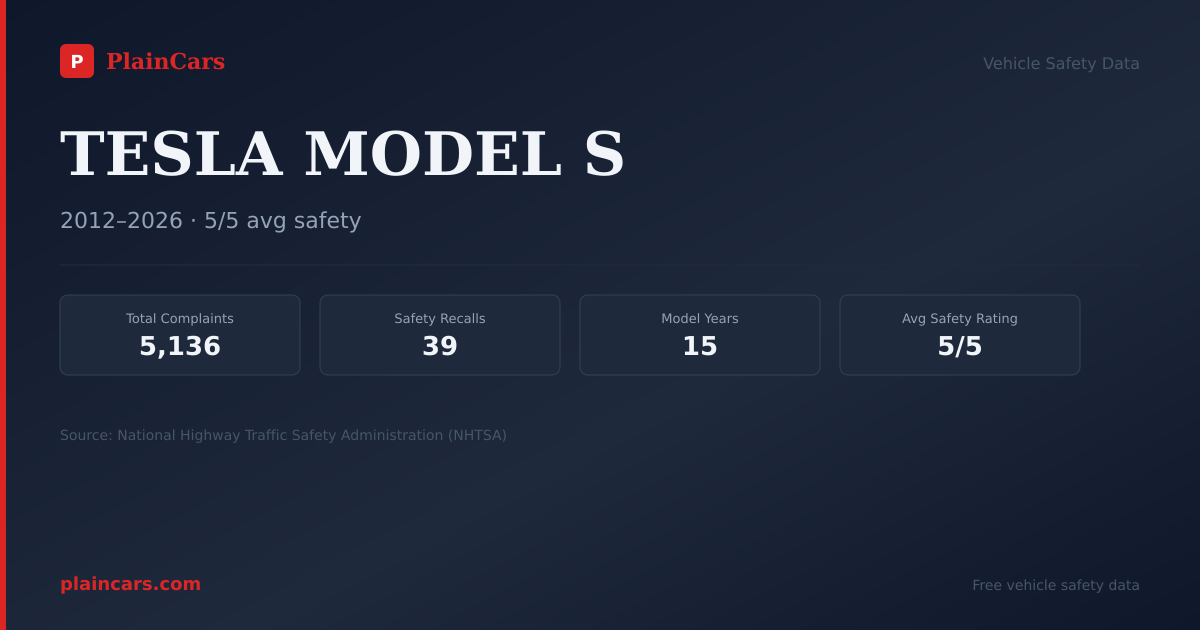
Total Complaints
1044 filings
Tesla Model S · model year
1044 NHTSA complaints, 114 crash reports, and 9 recall campaigns listed for this cohort. A VIN lookup is required to determine whether a specific vehicle has an unrepaired recall.
NHTSA overall rating
Not crash-tested
New Car Assessment Program
The verdict
The 2015 Tesla Model S posts above-average complaint volume among its own model-year siblings.
The 2015TeslaModel S carries 1044 consumer safety complaints in NHTSA's Office of Defects Investigation database for this specific model-year cohort. Within that volume, owners reported 114 crashes, 16 fires, 41 injuries, and 6 fatalities. No NCAP 5-star crash-test rating is available for this model year in the federal database.
The most frequently selected component label in reports for the 2015 Model S is electrical system with 258 filings, followed by unknown or other (189) and suspension (148). Complaint categories reflect owner reports and intake categorization; they do not establish a defect pattern or cause. This cohort has 9 NHTSA recall campaigns listed below. Enter a VIN in NHTSA's official recall lookup to determine whether a specific vehicle has an unrepaired recall.
NHTSA currently has 6 investigation files overlapping the 2015 Model S. Owners comparing this cohort against neighboring years should read the complaint-by-year trend as report volume, not a causal diagnosis. Use the related-complaint feed and the official recall lookup when researching a specific vehicle.
PlainCars' own composite of NHTSA NCAP crash-test ratings and rollover-risk assessment, each dimension normalized against the federal scale or the full national model-year corpus. Not an official NHTSA figure, and not a substitute for a specific vehicle's VIN-level recall check.
Total Complaints
1044 filings
Crashes Reported
114 reports
Source
NHTSA ODI
Federal complaints database
Above median complaint volume, review patterns below.
| Component | Count |
|---|---|
| ELECTRICAL SYSTEM | 258 |
| UNKNOWN OR OTHER | 189 |
| SUSPENSION | 148 |
| STEERING | 51 |
| EXTERIOR LIGHTING | 43 |
| VEHICLE SPEED CONTROL | 40 |
| FUEL/PROPULSION SYSTEM | 31 |
| VISIBILITY/WIPER | 29 |
| POWER TRAIN | 29 |
| STRUCTURE:BODY | 26 |
| AIR BAGS | 21 |
| ELECTRONIC STABILITY CONTROL (ESC) | 20 |
| FORWARD COLLISION AVOIDANCE: ADAPTIVE CRUISE CONTROL | 20 |
| SERVICE BRAKES | 19 |
| FORWARD COLLISION AVOIDANCE: AUTOMATIC EMERGENCY BRAKING | 18 |
ELECTRICAL SYSTEM: INSTRUMENT CLUSTER/PANEL
Tesla, Inc. (Tesla) is recalling certain 2012-2023 Model S, 2016-2024 Model X, 2017-2023 Model 3, 2019-2024 Model Y, and 2024 Cybertruck vehicles. An incorrect font size is displayed on the instrument panel for the Brake, Park, and Antilock Brake System (ABS) warning lights. As such, these vehicle
STEERING:ELECTRIC POWER ASSIST SYSTEM
Tesla, Inc. (Tesla) is recalling certain 2012-2016 Tesla Model S vehicles equipped with Bosch steering racks. The aluminum bolts that attach the power steering gear assist motor to the gear housing may corrode and fracture causing a reduction or complete loss of power steering assist.
BACK OVER PREVENTION:SOFTWARE
Tesla, Inc. (Tesla) is recalling certain 2012-2018 Tesla Model S and 2016-2018 Model X vehicles with a center display equipped with a NVIDIA Tegra 3 processor and an 8GB eMMC NAND flash memory device. When the 8GB eMMC NAND flash memory device for the center display reaches lifetime wear, the eMMC
SEAT BELTS:FRONT:WARNING LIGHT/DEVICES
Tesla, Inc. (Tesla) is recalling certain 2012-2024 Model S, 2015-2024 Model X, 2017-2023 Model 3, and 2020-2023 Model Y vehicles. In the event of an unbelted driver, the seat belt warning light and audible chime may not activate as intended. As such, these vehicles fail to comply with the requirem
SEAT BELTS:FRONT
Tesla Motors, Inc. (Tesla) is recalling certain model year 2012-2015 Model S vehicles manufactured May 31, 2012, to November 12, 2015. The affected vehicles are equipped with driver or front passenger seat belts that may be improperly connected to the outboard lap pretensioner.
LATCHES/LOCKS/LINKAGES:HOOD:LATCH
Tesla, Inc. (Tesla) is recalling certain 2014-2021 Model S vehicles. The front trunk latch assembly may be misaligned, preventing the secondary hood latch from engaging. As such, these vehicles fail to comply with the requirements of Federal Motor Vehicle Safety Standard number 113, "Hood Latch Sy
PARKING BRAKE
Tesla, Inc. (Tesla) is recalling certain 2016 Model S and Model X vehicles. The electric parking brake calipers have an internal gear that may be improperly manufactured, possibly resulting in the gear fracturing during parking brake application or release.
ELECTRICAL SYSTEM:ADAS:AUTONOMOUS/SELF DRIVING:SOFTWARE
Tesla, Inc. (Tesla) is recalling 2012-2023 Model S, 2016-2023 Model X, 2017-2023 Model 3, and 2020-2023 Model Y vehicles equipped with all versions of Autosteer leading up to the version(s) that contains the recall remedy. In certain circumstances when Autosteer is engaged, the prominence and scope
AIR BAGS:FRONTAL:PASSENGER SIDE:INFLATOR MODULE
Tesla, Inc. (Tesla) is recalling all 2014-2016 Model S vehicles equipped with certain air bag inflators assembled as part of the passenger frontal air bag modules used as original equipment or replacement equipment. In the event of a crash necessitating deployment of the passenger frontal air bag,
Parking brake has locked on and cannot be released
Tesla Model S has a notorious back hatch latching failure. It’s a flawed design that every replacement is a “when” and not “if for failure. As an owner its failed be about 4-5 times in 5+ years of ownership. The hatch back latching issue causes cruise control as well as their Autopilot steering navigation feature to be disabled when latch starts acting up or failing to fully close, which are helpful safety components to keep your car on the road going at proper speeds and staying in lane. Reporting this in hopes someone pushes Tesla to do something about this flaw that should be a manufacturers defect.
Tesla Model S has a notorious back hatch latching failure. It’s a flawed design that every replacement is a “when” and not “if for failure. As an owner its failed be about 4-5 times in 5+ years of ownership. The hatch back latching issue causes cruise control as well as their Autopilot steering navigation feature to be disabled when latch starts acting up or failing to fully close, which are helpful safety components to keep your car on the road going at proper speeds and staying in lane. Reporting this in hopes someone pushes Tesla to do something about this flaw that should be a manufacturers defect.
Tesla Model S has a notorious back hatch latching failure. It’s a flawed design that every replacement is a “when” and not “if for failure. As an owner its failed be about 4-5 times in 5+ years of ownership. The hatch back latching issue causes cruise control as well as their Autopilot steering navigation feature to be disabled when latch starts acting up or failing to fully close, which are helpful safety components to keep your car on the road going at proper speeds and staying in lane. Reporting this in hopes someone pushes Tesla to do something about this flaw that should be a manufacturers defect.
The contact owns a 2015 Tesla Model S. The contact stated while driving 40 MPH at night, one of the headlights became inoperable. The contact stated that both headlights had become intermittently inoperable, causing the contact to hesitate to drive the vehicle due to safety concerns. Upon investigating the issue online, the contact learned that several other vehicle owners were experiencing similar failures. The manufacturer was not notified of the failure. The vehicle was not diagnosed or repaired. The failure mileage was approximately 100,000.
Mileage: 100,000
My 2015 Tesla Model S has a serious safety issue where the vehicle suddenly reverts to Park while driving and will not stay in Drive. I had the car serviced at Tesla’s Austin Ridgepoint location, and they documented that the issue was “resolved” and “validated,” but the problem continues exactly the same. Tesla replaced the rear motor speed sensor, performed tests, and charged me $522 for the repair. However, the vehicle still cannot stay in Drive and remains unsafe to operate. After I reported that the repair did not fix the issue, Tesla deleted the entire service appointment and technician notes from my account, removing documentation of the failed repair. This is a critical safety defect involving unexpected shifting behavior and high-voltage component concerns. Tesla has not resolved the issue and has removed evidence of the repair attempt from my service history. I am requesting NHTSA assistance so Tesla properly addresses this safety hazard.
My 2015 Tesla Model S has a serious safety issue where the vehicle suddenly reverts to Park while driving and will not stay in Drive. I had the car serviced at Tesla’s Austin Ridgepoint location, and they documented that the issue was “resolved” and “validated,” but the problem continues exactly the same. Tesla replaced the rear motor speed sensor, performed tests, and charged me $522 for the repair. However, the vehicle still cannot stay in Drive and remains unsafe to operate. After I reported that the repair did not fix the issue, Tesla deleted the entire service appointment and technician notes from my account, removing documentation of the failed repair. This is a critical safety defect involving unexpected shifting behavior and high-voltage component concerns. Tesla has not resolved the issue and has removed evidence of the repair attempt from my service history. I am requesting NHTSA assistance so Tesla properly addresses this safety hazard.
I had been driving in the rain and the battery got wet. This was found to be due to corroded umbrella valves which allowed water to get in. The car had not been submerged or in deep water, simple driving on the interstate. The car gave me a warning "Service is required-car may not restart." I started out for the service center and the car failed after 65 miles. I thankfully was in a safe place when it happened. I had to be towed from Portland, Maine to Londonderry, NH for service. The umbrella valves were replaced at my cost $1,871.12). The umbrella valve problem is occurring on many models and Tesla is repairing them on the newer models, free of charge. They are not calling it a recall (it's a Service Notice) but I think I should be reimbursed for the repair since they should repair this potentially dangerous problem on all models, not just newer models.
My 2015 tesla model with less than 55000 mi had the front suspension broke on [XXX] when i pull out of the driveway. I heard a hard noise from passenger front tire that is scraping on the fender liner.The car was not drivable and had to be towed to a tesla dealership in cherry hill NJ > Quoted bill is $1800 to replace. With the low mileage , I never expected the suspension to brake unless there is a defect on the cars manufacturer front suspension fore link. I read on the NSHTSA that there was an investigation for the several complain for the 2015 - 2017 tesla model S . The service car representative took a picture of the broken suspension fore link that is holding the suspension front tires. I forgot to ask him to forward the picture to me.Maybe I can ask him when I pick up the car. INFORMATION REDACTED PURSUANT TO THE FREEDOM OF INFORMATION ACT (FOIA), 5 U.S.C. 552(B)(6)
was driving Tesla when warning light appeared “ charging declined “ . drove car home battery no longer charging . Tesla stopped working after only 68,000 miles . Tesla wanted $15000 to replace the battery more than the car is worth.
was driving Tesla when warning light appeared “ charging declined “ . drove car home battery no longer charging . Tesla stopped working after only 68,000 miles . Tesla wanted $15000 to replace the battery more than the car is worth.
An investigation has been conducted into a persistent and widespread defect affecting the 2015 Tesla Model S and other early models equipped with the first-generation Media Control Unit (MCU1). This defect manifests as the physical degradation and spontaneous leakage of a sticky adhesive substance from the edges of the vehicle's central infotainment screen and instrument cluster. The leaking substance is not merely a cosmetic issue but presents a credible safety risk to vehicle occupants and the vehicle itself. The substance is a source of Volatile Organic Compounds (VOCs), a class of chemicals with a low boiling point that are known to off-gas into the ambient air, a problem exacerbated by high temperatures. Exposure to these compounds can lead to both acute and long-term health consequences, including respiratory irritation, headaches, and in some cases, serious chronic illnesses. Furthermore, the presence of flammable solvents and components within the adhesive, combined with the h
An investigation has been conducted into a persistent and widespread defect affecting the 2015 Tesla Model S and other early models equipped with the first-generation Media Control Unit (MCU1). This defect manifests as the physical degradation and spontaneous leakage of a sticky adhesive substance from the edges of the vehicle's central infotainment screen and instrument cluster. The leaking substance is not merely a cosmetic issue but presents a credible safety risk to vehicle occupants and the vehicle itself. The substance is a source of Volatile Organic Compounds (VOCs), a class of chemicals with a low boiling point that are known to off-gas into the ambient air, a problem exacerbated by high temperatures. Exposure to these compounds can lead to both acute and long-term health consequences, including respiratory irritation, headaches, and in some cases, serious chronic illnesses. Furthermore, the presence of flammable solvents and components within the adhesive, combined with the h
What happened? While driving my 2015 Tesla Model S, the main touchscreen (MCU) began intermittently going black, disabling access to essential vehicle controls, navigation, climate settings, and rear-view camera display. At times when the MCU was functioning, the rear-view camera feed would still display a black screen upon shifting into Reverse, leaving me without any rear visibility. Component or system that failed: Media Control Unit (MCU1) / eMMC memory failure Rear-view camera and/or associated wiring harness Safety risk: The intermittent blackouts of the MCU and loss of rear camera feed created significant safety hazards, especially when reversing or attempting to adjust driving settings while in motion. The loss of rear visibility increased the risk of collision with pedestrians, cyclists, or obstacles. The MCU failure also limited access to defrost/defog controls and turn signal audio feedback. Problem reproduction and confirmation: Tesla Service has confirmed both the MCU
What happened? While driving my 2015 Tesla Model S, the main touchscreen (MCU) began intermittently going black, disabling access to essential vehicle controls, navigation, climate settings, and rear-view camera display. At times when the MCU was functioning, the rear-view camera feed would still display a black screen upon shifting into Reverse, leaving me without any rear visibility. Component or system that failed: Media Control Unit (MCU1) / eMMC memory failure Rear-view camera and/or associated wiring harness Safety risk: The intermittent blackouts of the MCU and loss of rear camera feed created significant safety hazards, especially when reversing or attempting to adjust driving settings while in motion. The loss of rear visibility increased the risk of collision with pedestrians, cyclists, or obstacles. The MCU failure also limited access to defrost/defog controls and turn signal audio feedback. Problem reproduction and confirmation: Tesla Service has confirmed both the MCU
What happened? While driving my 2015 Tesla Model S, the main touchscreen (MCU) began intermittently going black, disabling access to essential vehicle controls, navigation, climate settings, and rear-view camera display. At times when the MCU was functioning, the rear-view camera feed would still display a black screen upon shifting into Reverse, leaving me without any rear visibility. Component or system that failed: Media Control Unit (MCU1) / eMMC memory failure Rear-view camera and/or associated wiring harness Safety risk: The intermittent blackouts of the MCU and loss of rear camera feed created significant safety hazards, especially when reversing or attempting to adjust driving settings while in motion. The loss of rear visibility increased the risk of collision with pedestrians, cyclists, or obstacles. The MCU failure also limited access to defrost/defog controls and turn signal audio feedback. Problem reproduction and confirmation: Tesla Service has confirmed both the MCU
A few times the steering control has shut off while I am driving. Steering failure lasts a few seconds and then returns to normal function. The car makes a VERY loud alarm sound when the steering is inoperable. I have not seen any failure messages on the screen or in the Service menu. I took the car to Tesla for service yesterday. They did some sort of remote scan of the fault codes and told me that there is nothing wrong. They told me to continue to drive the car and record when the steering stops working again. This sounds like ridiculously bad advice to me. While the steering control has always returned in just a few seconds, that does not mean that it will in any future failure. I am concerned about driving this car. Tesla wants $275 an hour to investigate the problem, which also seems ridiculous to me. I have seen that there has been a recall for similar problems in newer Tesla Model S vehicles. It seems logical to me that these problems may be related and deserve additional
Many air bubbles are appearing towards the bottom of the instrument panel on our 2015 Tesla Model S. This started a couple of weeks ago and the bubbles are increasing in size and number and they are moving upwards. The bubbles don’t presently obscure important driver information such as the transmission mode (drive, park, reverse, neutral), remaining battery range (e.g. 80%), car speed (mph), parking sensor distance, brake light status, car door open, frunk open, tailgate open, time, outdoor temperature, car lights on/off, warning lights, etc. However, the bubbles likely will do so in the future. Much of this information is vital for safe driving (e.g. transmission mode, speed (mph), remaining battery range, brake light status, and warning lights). As such this display should be replaced by Tesla at nominal or no charge to the owner. According to the internet, the cause of these air bubbles is a failed seal around the instrument cluster that allows a lamination fluid betwee
Large drive unit that has previously been replaced by Tesla failed due to coolant ingress leaking through rotor seal. Known issue per 3rd party technicians.
Hi, my trunk won't open when I press the button. This is the second occurrence that jas happend. When inside the trunk compartment the emergency cable to open the trunk is also not responsive and can not open the trunk. I think this is a big safety concern as the safety cord is there for a reason and in both cases id did not worked.
Data vintage: August 2026. Sources: NHTSA Office of Defects Investigation (ODI) complaints database, NHTSA recall campaign API, NHTSA NCAP crash-test ratings, and NHTSA FARS for fatality cross-reference.
Every figure on PlainCars is rendered directly from NHTSA complaint and safety data, no number is typed in by an editor. This year-specific record is rendered from NHTSA ODI, recall, and NCAP rows for the 2015 Tesla Model S; no figure is typed in by an editor. See our editorial standards & corrections policy, the methodology behind these numbers, or report a data error. Data current as of August 2026.
Read our methodology - how this data is sourced, computed, and verified.