Total Complaints
146 filings
Tesla Cybertruck · model year
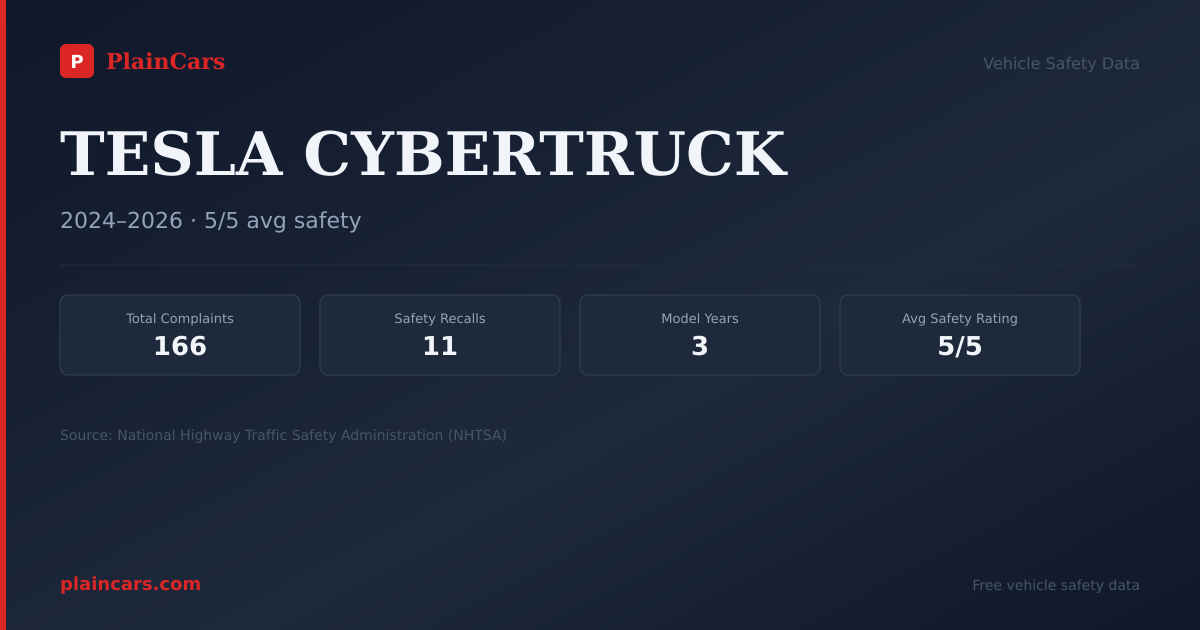
146 NHTSA complaints, 32 crash reports, and 11 recall campaigns listed for this cohort. A VIN lookup is required to determine whether a specific vehicle has an unrepaired recall.
NHTSA overall rating
5 / 5 ★
New Car Assessment Program
The verdict
The 2024 Tesla Cybertruck carries a top NHTSA safety rating.
The 2024TeslaCybertruck carries 146 consumer safety complaints in NHTSA's Office of Defects Investigation database for this specific model-year cohort. Within that volume, owners reported 32 crashes, 3 fires, 26 injuries, and 9 fatalities. For crash performance, NHTSA's New Car Assessment Program gave this cohort an overall 5/5 rating, with 5/5 front crash, 5/5 side crash, and 4/5 rollover scores derived from standardized barrier and dynamic tests.
The most frequently selected component label in reports for the 2024 Cybertruck is structure:body with 18 filings, followed by unknown or other (17) and visibility/wiper (14). Complaint categories reflect owner reports and intake categorization; they do not establish a defect pattern or cause. This cohort has 11 NHTSA recall campaigns listed below. Enter a VIN in NHTSA's official recall lookup to determine whether a specific vehicle has an unrepaired recall.
NHTSA currently has 19 investigation files overlapping the 2024 Cybertruck, and 4 remain open. Owners comparing this cohort against neighboring years should read the complaint-by-year trend as report volume, not a causal diagnosis. Use the related-complaint feed and the official recall lookup when researching a specific vehicle.
PlainCars' own composite of NHTSA NCAP crash-test ratings and rollover-risk assessment, each dimension normalized against the federal scale or the full national model-year corpus. Not an official NHTSA figure, and not a substitute for a specific vehicle's VIN-level recall check.
Total Complaints
146 filings
Crashes Reported
32 reports
Source
NHTSA ODI
Federal complaints database
At or below the fleet median complaint volume.
| Component | Count |
|---|---|
| STRUCTURE:BODY | 18 |
| UNKNOWN OR OTHER | 17 |
| VISIBILITY/WIPER | 14 |
| ELECTRICAL SYSTEM | 12 |
| STEERING | 10 |
| STRUCTURE | 10 |
| EXTERIOR LIGHTING | 7 |
| FORWARD COLLISION AVOIDANCE: ADAPTIVE CRUISE CONTROL | 6 |
| SERVICE BRAKES | 6 |
| FORWARD COLLISION AVOIDANCE: AUTOMATIC EMERGENCY BRAKING | 6 |
| VEHICLE SPEED CONTROL | 5 |
| LANE DEPARTURE: ASSIST | 5 |
| FORWARD COLLISION AVOIDANCE: WARNINGS | 4 |
| WHEELS | 4 |
| SUSPENSION | 3 |
ELECTRICAL SYSTEM: INSTRUMENT CLUSTER/PANEL
Tesla, Inc. (Tesla) is recalling certain 2012-2023 Model S, 2016-2024 Model X, 2017-2023 Model 3, 2019-2024 Model Y, and 2024 Cybertruck vehicles. An incorrect font size is displayed on the instrument panel for the Brake, Park, and Antilock Brake System (ABS) warning lights. As such, these vehicle
EXTERIOR LIGHTING
Tesla, Inc. (Tesla) is recalling certain 2024 Cybertruck vehicles equipped with a service-installed off-road light bar accessory. An incorrect surface primer may have been used to attach the lightbar to the windshield, causing the light bar to loosen and detach.
BACK OVER PREVENTION:SOFTWARE
Tesla, Inc. (Tesla) is recalling certain 2024 Cybertruck vehicles. The rearview camera image may be delayed after shifting into reverse. As such, these vehicles fail to comply with the requirements of Federal Motor Vehicle Safety Standard (FMVSS) number 111, "Rear Visibility."
WHEELS:LUGS/NUTS/BOLTS/STUDS
Tesla, Inc. (Tesla) is recalling certain 2024-2026 Cybertruck vehicles equipped with 18-inch steel wheels. The brake rotor stud holes may crack and allow the stud to separate from the wheel hub.
STRUCTURE:BODY
Tesla, Inc. (Tesla) is recalling certain 2024 Cybertruck vehicles. The trunk bed trim sail applique could have been improperly adhered and can loosen.
VISIBILITY:WINDSHIELD WIPER/WASHER:MOTOR
Tesla, Inc. (Tesla) is recalling certain 2024 Cybertruck vehicles. Excessive electrical current can cause the front windshield wiper motor controller to fail.
STRUCTURE:BODY
Tesla, Inc. (Tesla) is recalling certain 2024-2025 Cybertruck vehicles. The light bar can delaminate and detach from the vehicle.
TIRES:PRESSURE MONITORING AND REGULATING SYSTEMS
Tesla, Inc. (Tesla) is recalling certain 2024 Cybertruck, 2017-2025 Model 3, and 2020-2025 Model Y vehicles. The tire pressure monitoring system (TPMS) warning light may not remain illuminated between drive cycles, failing to warn the driver of low tire pressure. As such, these vehicles fail to co
VEHICLE SPEED CONTROL:ACCELERATOR PEDAL
Tesla, Inc. (Tesla) is recalling certain 2024 Cybertruck vehicles. The accelerator pedal pad may dislodge and cause the pedal to become trapped by the interior trim.
EXTERIOR LIGHTING
Tesla, Inc. (Tesla) is recalling certain 2024-2026 Cybertruck vehicles operating software prior to 2025.38.3. The vehicle controller software may cause the front parking lights to be too bright and exceed the maximum light output, adversely affecting the vision of other drivers. As such, these vehic
ELECTRICAL SYSTEM:PROPULSION SYSTEM:INVERTER
Tesla, Inc. (Tesla) is recalling certain 2024 Cybertruck vehicles. A fault in the drive inverter may cause a loss of drive power to the wheels.
Since the release of V14, the Full Self-Driving (FSD) system automatically defaults to operating approximately 7 MPH above the posted speed limit. This occurs on all road types, including city streets and highways. When FSD is engaged, the vehicle sets the cruising speed above the detected speed limit without driver input. There is no setting that allows the driver to enforce strict compliance with the posted limit. Available speed settings only permit equal or greater deviation above the speed limit. The driver cannot manually lock or command the system to remain at or below the posted limit while FSD is active. The only way to prevent speeding is to fully disengage FSD. This is not a malfunction. The vehicle is operating as designed under V14. This creates a safety concern because: 1.The system is programmed to exceed legal speed limits by default. 2.The driver does not retain meaningful authority to ensure lawful operation while automation is engaged. 3.Automatic speeding increas
Since the release of V14, the Full Self-Driving (FSD) system automatically defaults to operating approximately 7 MPH above the posted speed limit. This occurs on all road types, including city streets and highways. When FSD is engaged, the vehicle sets the cruising speed above the detected speed limit without driver input. There is no setting that allows the driver to enforce strict compliance with the posted limit. Available speed settings only permit equal or greater deviation above the speed limit. The driver cannot manually lock or command the system to remain at or below the posted limit while FSD is active. The only way to prevent speeding is to fully disengage FSD. This is not a malfunction. The vehicle is operating as designed under V14. This creates a safety concern because: 1.The system is programmed to exceed legal speed limits by default. 2.The driver does not retain meaningful authority to ensure lawful operation while automation is engaged. 3.Automatic speeding increas
Since the release of V14, the Full Self-Driving (FSD) system automatically defaults to operating approximately 7 MPH above the posted speed limit. This occurs on all road types, including city streets and highways. When FSD is engaged, the vehicle sets the cruising speed above the detected speed limit without driver input. There is no setting that allows the driver to enforce strict compliance with the posted limit. Available speed settings only permit equal or greater deviation above the speed limit. The driver cannot manually lock or command the system to remain at or below the posted limit while FSD is active. The only way to prevent speeding is to fully disengage FSD. This is not a malfunction. The vehicle is operating as designed under V14. This creates a safety concern because: 1.The system is programmed to exceed legal speed limits by default. 2.The driver does not retain meaningful authority to ensure lawful operation while automation is engaged. 3.Automatic speeding increas
One day my car would not charge. At all. Luckily, I was at home when this happened, but had it happened to me or worse, my wife it could've been a very scary or dangerous situation. Either one of us could've been stuck with no way of charging. It's like a gas car with no way of putting gas in. The car would not charge from home or other chargers, including Tesla superchargers. When I described the problem to the Tesla dealer, they were very aware of the problem and said that it was the Power Conversion System. There was no prior warning before this happened. Though they are aware of the problem, they are only fixing/replacing them on a warranty basis. Even though they know about the faulty part that they made, and acknowledge, they are not doing a recall or fixing the problem unless you pay for the parts and labor. I asked if this is normal for a car that is under 2yrs old and he said this part can go bad at anytime. The best thing that can happen is for it to happen early wh
One day my car would not charge. At all. Luckily, I was at home when this happened, but had it happened to me or worse, my wife it could've been a very scary or dangerous situation. Either one of us could've been stuck with no way of charging. It's like a gas car with no way of putting gas in. The car would not charge from home or other chargers, including Tesla superchargers. When I described the problem to the Tesla dealer, they were very aware of the problem and said that it was the Power Conversion System. There was no prior warning before this happened. Though they are aware of the problem, they are only fixing/replacing them on a warranty basis. Even though they know about the faulty part that they made, and acknowledge, they are not doing a recall or fixing the problem unless you pay for the parts and labor. I asked if this is normal for a car that is under 2yrs old and he said this part can go bad at anytime. The best thing that can happen is for it to happen early wh
The rear passenger-side seat belt retractor is malfunctioning. The seat belt does not properly retract or maintain tension during normal use. The belt remains loose and does not snugly secure the passenger unless manually adjusted multiple times, reducing the effectiveness of the restraint system. This seat is regularly used by a child passenger. Because the seat belt does not function as designed, the safety of a child occupant is compromised, particularly in the event of sudden braking or a collision. This involves a primary safety restraint system. The issue was discovered during normal driving conditions and is repeatable and consistent. The seat belt assembly is available for inspection upon request. No warning lights, alerts, or messages appeared prior to or during the malfunction. The issue was not caused by an accident, impact, or misuse. The vehicle is otherwise operable. The manufacturer was contacted for service. Initially, a service charge of approximately $55 was propo
All the road safety features stopped working all of a sudden. Auto lights. Defaulted to high beams. Lane departure stopped, cruise control stopped, forward emergency braking stopped, rear cross traffic stopped, blind stopped stopped, and other safety’s I am not sure of.
All the road safety features stopped working all of a sudden. Auto lights. Defaulted to high beams. Lane departure stopped, cruise control stopped, forward emergency braking stopped, rear cross traffic stopped, blind stopped stopped, and other safety’s I am not sure of.
All the road safety features stopped working all of a sudden. Auto lights. Defaulted to high beams. Lane departure stopped, cruise control stopped, forward emergency braking stopped, rear cross traffic stopped, blind stopped stopped, and other safety’s I am not sure of.
While operating on a public roadway with Tesla Full Self-Driving (Supervised) engaged, the vehicle unexpectedly departed its intended roadway trajectory. Upon recognizing unsafe vehicle behavior, I attempted to manually override and disengage the system using normal driver control inputs. Despite these attempts, the system did not disengage or yield control in a timely or effective manner. The vehicle continued on an unsafe path, left the roadway, and collided with a fence and a tree before meaningful driver control could be restored. This incident raises concerns regarding the reliability of driver override authority and the system’s ability to relinquish control during supervised operation.
While operating on a public roadway with Tesla Full Self-Driving (Supervised) engaged, the vehicle unexpectedly departed its intended roadway trajectory. Upon recognizing unsafe vehicle behavior, I attempted to manually override and disengage the system using normal driver control inputs. Despite these attempts, the system did not disengage or yield control in a timely or effective manner. The vehicle continued on an unsafe path, left the roadway, and collided with a fence and a tree before meaningful driver control could be restored. This incident raises concerns regarding the reliability of driver override authority and the system’s ability to relinquish control during supervised operation.
While operating on a public roadway with Tesla Full Self-Driving (Supervised) engaged, the vehicle unexpectedly departed its intended roadway trajectory. Upon recognizing unsafe vehicle behavior, I attempted to manually override and disengage the system using normal driver control inputs. Despite these attempts, the system did not disengage or yield control in a timely or effective manner. The vehicle continued on an unsafe path, left the roadway, and collided with a fence and a tree before meaningful driver control could be restored. This incident raises concerns regarding the reliability of driver override authority and the system’s ability to relinquish control during supervised operation.
On December 23, 2025, my 2024 Tesla Cybertruck (Foundation Series) was operating with Full Self-Driving (FSD – Supervised) engaged. While FSD was active, the vehicle executed an unsafe driving trajectory. I attempted to intervene and regain control; however, the system did not disengage as expected and did not yield control appropriately to driver input. Despite driver intervention attempts, the vehicle continued along the unsafe trajectory, resulting in a loss of control and collision with roadside objects. There were no mechanical warnings or alerts prior to the incident. The issue appears related to system behavior, disengagement logic, and driver override response while FSD was active. The vehicle is currently preserved under a formal litigation hold. No inspection, teardown, or data access has occurred. Tesla has confirmed in writing that it does not modify, delete, or alter vehicle data it has received. I am submitting this complaint due to concerns regarding the safety be
At approximately 6:30 PM on January 4, I experienced an incident where the passenger front door unlatched, completely by itself without pressing the unlatched button or pulling the manual release. It has since opened itself again in my driveway. And this can be a very serious issue if it worked to unlatch while driving and the door swings open and causes an accident or hits an object or person which can in terms caused serious injury, or property damage, and even in some cases if a passenger is in the seat in the door and latches without their seatbelt on, it can cause serious injury, and or death. In the event of a passenger falling out.
The contact owns a 2024 Tesla Cybertruck. The contact stated that while driving at a moderate speed on a windy day, a metal piece, approximately 2-3 ft. long and located on the side of the sunroof, detached from the vehicle. The contact managed to recover the piece that detached from the vehicle. The vehicle was taken to a Tesla service center, where the failure was acknowledged the failure, and the contact was provided an estimate for the repair. The contact stated that the failure was a manufacturer's defect and that the repair should be free of charge. The vehicle had yet to be repaired. The failure mileage was approximately 11,000.
Mileage: 11,000
I believe there was an issue with the ABS system that kept me from stopping the vehicle, as speed was increasing while going downhill with the brake pedal pushed hard. I was forced to make the choice to steer the vehicle into a mountainside to stop it before I ended up over the side of the mountain road. The vehicle then tipped over, coming to a stop.
While driving on a local road and thank fully at speed of 20mph vehicle lost all power, in few seconds of alerts steering failed as well as brake failed. Car slowly coasted to stop and died completely. Steering and brakes were completely unresponsive all of a sudden while driving. Was only able to get out of car via emergency exit. If this was on a highway at highway speed am very positive it would have been a disaster.
While driving on a local road and thank fully at speed of 20mph vehicle lost all power, in few seconds of alerts steering failed as well as brake failed. Car slowly coasted to stop and died completely. Steering and brakes were completely unresponsive all of a sudden while driving. Was only able to get out of car via emergency exit. If this was on a highway at highway speed am very positive it would have been a disaster.
While driving on a local road and thank fully at speed of 20mph vehicle lost all power, in few seconds of alerts steering failed as well as brake failed. Car slowly coasted to stop and died completely. Steering and brakes were completely unresponsive all of a sudden while driving. Was only able to get out of car via emergency exit. If this was on a highway at highway speed am very positive it would have been a disaster.
Vehicle aggressively shakes in highway speeds I had 3 repeated issues w my cybertruck already documented
Emergency egress controls are not readily accessible and clearly identifiable.
Traffic safety violations while Full Self Driving ("FSD") is engaged
Electronic door handles become inoperative
Compliance with Standing General Order 2021-01 Reporting Requirements
Recall 23V838 Remedy Effectiveness
Data vintage: August 2026. Sources: NHTSA Office of Defects Investigation (ODI) complaints database, NHTSA recall campaign API, NHTSA NCAP crash-test ratings, and NHTSA FARS for fatality cross-reference.
Every figure on PlainCars is rendered directly from NHTSA complaint and safety data, no number is typed in by an editor. This year-specific record is rendered from NHTSA ODI, recall, and NCAP rows for the 2024 Tesla Cybertruck; no figure is typed in by an editor. See our editorial standards & corrections policy, the methodology behind these numbers, or report a data error. Data current as of August 2026.
Read our methodology - how this data is sourced, computed, and verified.