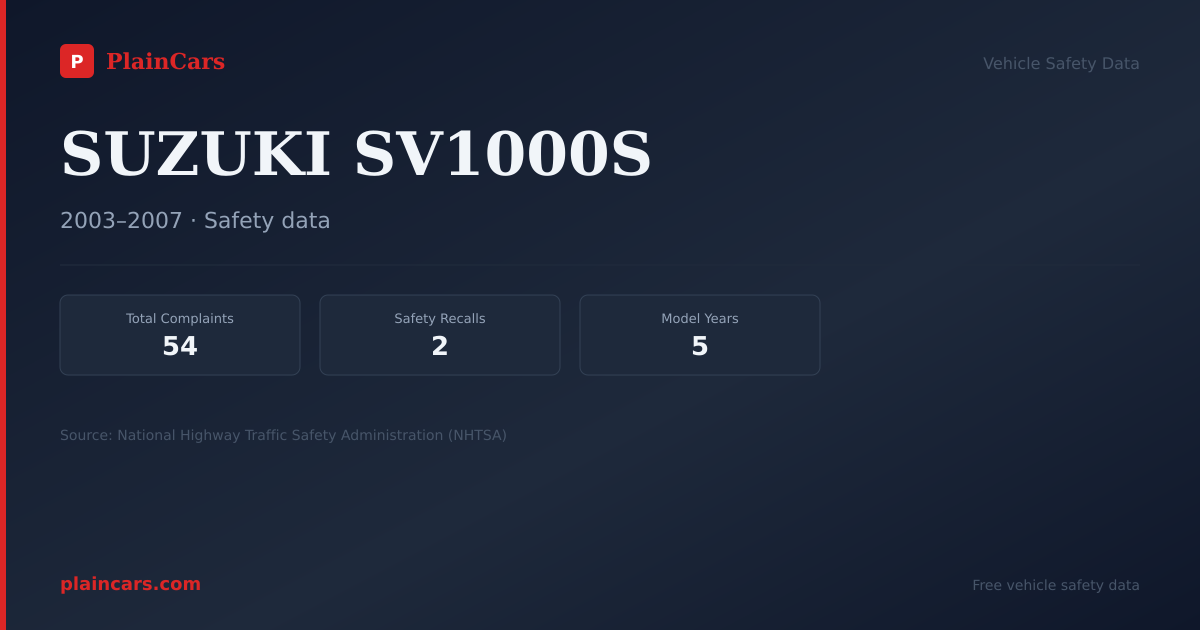
Total Complaints
7 filings
Suzuki Sv1000s · model year
7 NHTSA complaints, and 2 recall campaigns listed for this cohort. A VIN lookup is required to determine whether a specific vehicle has an unrepaired recall.
NHTSA overall rating
Not crash-tested
New Car Assessment Program
The verdict
The 2004 Suzuki Sv1000s posts above-average complaint volume among its own model-year siblings.
The 2004SuzukiSv1000s carries 7 consumer safety complaints in NHTSA's Office of Defects Investigation database for this specific model-year cohort. Within that volume, owners reported 0 crashes, 0 fires, 0 injuries, and 0 fatalities. No NCAP 5-star crash-test rating is available for this model year in the federal database.
The most frequently selected component label in reports for the 2004 Sv1000s is electrical system with 4 filings, followed by engine (3). Complaint categories reflect owner reports and intake categorization; they do not establish a defect pattern or cause. This cohort has 2 NHTSA recall campaigns listed below. Enter a VIN in NHTSA's official recall lookup to determine whether a specific vehicle has an unrepaired recall.
NHTSA currently has 14 investigation files overlapping the 2004 Sv1000s. Owners comparing this cohort against neighboring years should read the complaint-by-year trend as report volume, not a causal diagnosis. Use the related-complaint feed and the official recall lookup when researching a specific vehicle.
PlainCars' own composite of NHTSA NCAP crash-test ratings and rollover-risk assessment, each dimension normalized against the federal scale or the full national model-year corpus. Not an official NHTSA figure, and not a substitute for a specific vehicle's VIN-level recall check.
Total Complaints
7 filings
Crashes Reported
0 reports
Source
NHTSA ODI
Federal complaints database
At or below the fleet median complaint volume.
| Component | Count |
|---|---|
| ELECTRICAL SYSTEM | 4 |
| ENGINE | 3 |
FUEL SYSTEM, GASOLINE:STORAGE:TANK ASSEMBLY
ON CERTAIN CALIFORNIA-SPECIFICATION MODEL MOTORCYCLES, REPEATED STRESS FROM VIBRATION CAN CAUSE A CRACK TO FORM IN THE AREA WHERE THE LIQUID/VAPOR SEPARATOR BRACKET IS WELDED INSIDE THE FUEL TANK. THIS CAN ALLOW FUEL LEAKAGE TO OCCUR.
EQUIPMENT
MOTION PRO IS RECALLING 10,000 AFTERMARKET BRAKE LEVERS, MODEL NO. 14-0415, SOLD FOR USE ON CERTAIN MY 1999 THROUGH 2008 SUZUKI AND MY 1998 THROUGH 2003 YAMAHA MOTORCYCLES. THE LOBE HEIGHT ON SOME OF THESE LEVERS ARE SMALLER AND DO NOT PROPERLY ENGAGE THE STOMP LAMP SWITCH WHICH WILL NOT DEACTIVATE
MAGNETS GLUED INTO MAGNETO FAILED, CAUSING CHARGING SYSTEM TO FAIL. THIS IS A CONSTANT PROBLEM WITH THIS AND SIMILAR MODELS
Mileage: 14,000
MOTORCYCLE STARTED TO VIBRATE MORE AT HANDLE BARS AND BECAME UNCOMFORTABLE TO RIDE. ELECTRICAL OUTPUT FROM THE MAGNETO WAS ALSO STARTING TO DROP IN DC OUTPUT. SELF INVESTIGATION INTO ISSUE REVEALED THAT THE INTERNAL MAGNETO ROTOR THAT NORMALLY HAS 6 MAGNETS EPOXIED TO IT, NOW ONLY HAD 1 EPOXIED IN THE CORRECT PLACE. THE OTHER 5 HAD BROKEN THE BOND AND WERE SLIDING AROUND CAUSING DAMAGE AND WERE ALL BUNCHED UP CAUSING THE VIBRATION ISSUE ALONG WITH THE LOW VOLTAGE OUTPUT TO THE ELECTRICAL SYSTEM. ENGINE WAS CLEANED OUT, AND PART REPLACED WITH NEW SUZUKI OEM PART. *TR
Mileage: 38,000
MOTORCYCLE STARTED TO VIBRATE MORE AT HANDLE BARS AND BECAME UNCOMFORTABLE TO RIDE. ELECTRICAL OUTPUT FROM THE MAGNETO WAS ALSO STARTING TO DROP IN DC OUTPUT. SELF INVESTIGATION INTO ISSUE REVEALED THAT THE INTERNAL MAGNETO ROTOR THAT NORMALLY HAS 6 MAGNETS EPOXIED TO IT, NOW ONLY HAD 1 EPOXIED IN THE CORRECT PLACE. THE OTHER 5 HAD BROKEN THE BOND AND WERE SLIDING AROUND CAUSING DAMAGE AND WERE ALL BUNCHED UP CAUSING THE VIBRATION ISSUE ALONG WITH THE LOW VOLTAGE OUTPUT TO THE ELECTRICAL SYSTEM. ENGINE WAS CLEANED OUT, AND PART REPLACED WITH NEW SUZUKI OEM PART. *TR
Mileage: 38,000
THIS IS A SECOND FAILURE. MOTORCYCLE STARTED TO VIBRATE MORE AT HANDLE BARS AND BECAME UNCOMFORTABLE TO RIDE. ELECTRICAL OUTPUT FROM THE MAGNETO WAS ALSO STARTING TO DROP IN DC OUTPUT. SELF INVESTIGATION INTO ISSUE REVEALED THAT THE INTERNAL MAGNETO ROTOR THAT NORMALLY HAS 6 MAGNETS EPOXIED TO IT, NOW ONLY HAD 3 EPOXIED IN THE CORRECT PLACE. THE OTHER 3 HAD BROKEN THE BOND AND WERE SLIDING AROUND CAUSING DAMAGE AND WERE ALL BUNCHED UP CAUSING THE VIBRATION ISSUE ALONG WITH THE LOW VOLTAGE OUTPUT TO THE ELECTRICAL SYSTEM. ENGINE WAS CLEANED OUT, AND PART REPLACED WITH NEW SUZUKI OEM PART. THIS IS THE SECOND FAILURE IN THE SAME BIKE OF AN OEM SUZUKI PART. FIRST FAILURE ODI 10594978. *TR
Mileage: 68,200
THIS IS A SECOND FAILURE. MOTORCYCLE STARTED TO VIBRATE MORE AT HANDLE BARS AND BECAME UNCOMFORTABLE TO RIDE. ELECTRICAL OUTPUT FROM THE MAGNETO WAS ALSO STARTING TO DROP IN DC OUTPUT. SELF INVESTIGATION INTO ISSUE REVEALED THAT THE INTERNAL MAGNETO ROTOR THAT NORMALLY HAS 6 MAGNETS EPOXIED TO IT, NOW ONLY HAD 3 EPOXIED IN THE CORRECT PLACE. THE OTHER 3 HAD BROKEN THE BOND AND WERE SLIDING AROUND CAUSING DAMAGE AND WERE ALL BUNCHED UP CAUSING THE VIBRATION ISSUE ALONG WITH THE LOW VOLTAGE OUTPUT TO THE ELECTRICAL SYSTEM. ENGINE WAS CLEANED OUT, AND PART REPLACED WITH NEW SUZUKI OEM PART. THIS IS THE SECOND FAILURE IN THE SAME BIKE OF AN OEM SUZUKI PART. FIRST FAILURE ODI 10594978. *TR
Mileage: 68,200
MOTORCYCLE STARTED TO VIBRATE MORE AT HANDLE BARS AND BECAME UNCOMFORTABLE TO RIDE. ELECTRICAL OUTPUT FROM THE MAGNETO WAS ALSO STARTING TO DROP IN DC OUTPUT. SELF INVESTIGATION INTO ISSUE REVEALED THAT THE INTERNAL MAGNETO ROTOR THAT NORMALLY HAS 6 MAGNETS EPOXIED TO IT, NOW ONLY HAD 4 EPOXIED IN THE CORRECT PLACE. THE OTHER 2 HAD BROKEN THE BOND AND WERE SLIDING AROUND CAUSING DAMAGE AND WERE ALL BUNCHED UP CAUSING THE VIBRATION ISSUE ALONG WITH THE LOW VOLTAGE OUTPUT TO THE ELECTRICAL SYSTEM. ENGINE WAS CLEANED OUT, AND PART REPLACED WITH NEW SUZUKI OEM PART. *TR
Mileage: 6,800
MOTORCYCLE STARTED TO VIBRATE MORE AT HANDLE BARS AND BECAME UNCOMFORTABLE TO RIDE. ELECTRICAL OUTPUT FROM THE MAGNETO WAS ALSO STARTING TO DROP IN DC OUTPUT. SELF INVESTIGATION INTO ISSUE REVEALED THAT THE INTERNAL MAGNETO ROTOR THAT NORMALLY HAS 6 MAGNETS EPOXIED TO IT, NOW ONLY HAD 4 EPOXIED IN THE CORRECT PLACE. THE OTHER 2 HAD BROKEN THE BOND AND WERE SLIDING AROUND CAUSING DAMAGE AND WERE ALL BUNCHED UP CAUSING THE VIBRATION ISSUE ALONG WITH THE LOW VOLTAGE OUTPUT TO THE ELECTRICAL SYSTEM. ENGINE WAS CLEANED OUT, AND PART REPLACED WITH NEW SUZUKI OEM PART. *TR
Mileage: 6,800
Data vintage: August 2026. Sources: NHTSA Office of Defects Investigation (ODI) complaints database, NHTSA recall campaign API, NHTSA NCAP crash-test ratings, and NHTSA FARS for fatality cross-reference.
Every figure on PlainCars is rendered directly from NHTSA complaint and safety data, no number is typed in by an editor. This year-specific record is rendered from NHTSA ODI, recall, and NCAP rows for the 2004 Suzuki Sv1000s; no figure is typed in by an editor. See our editorial standards & corrections policy, the methodology behind these numbers, or report a data error. Data current as of August 2026.
Read our methodology - how this data is sourced, computed, and verified.