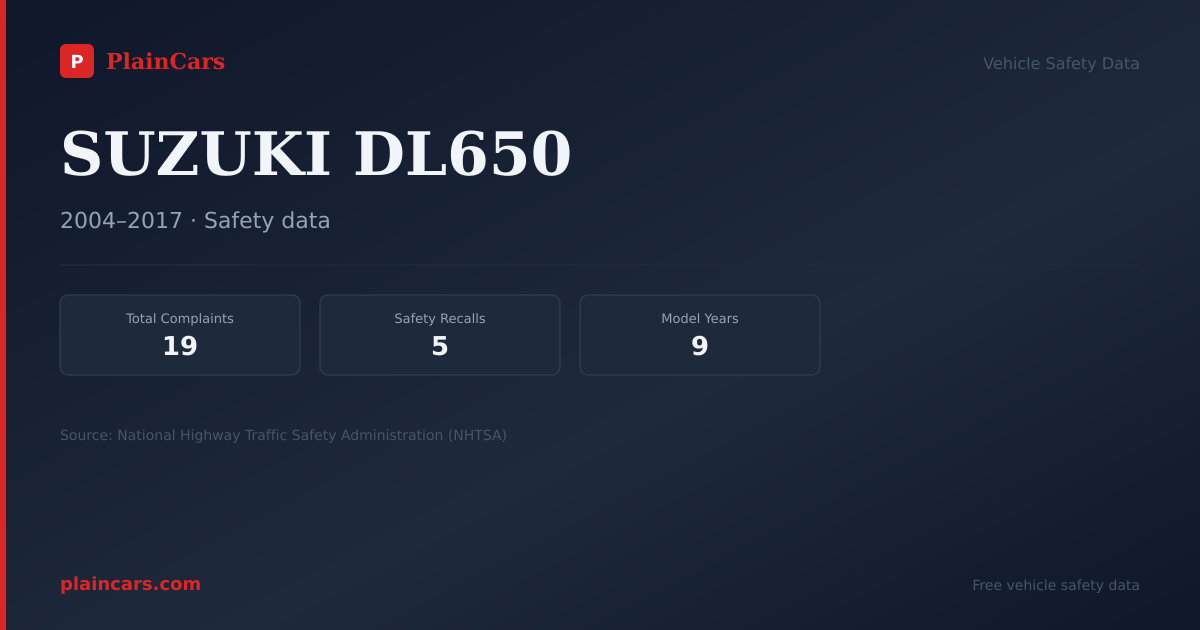
Total Complaints
3 filings
Suzuki Dl650 · model year
3 NHTSA complaints. A VIN lookup is required to determine whether a specific vehicle has an unrepaired recall.
NHTSA overall rating
Not crash-tested
New Car Assessment Program
The verdict
The 2011 Suzuki Dl650 posts above-average complaint volume among its own model-year siblings.
The 2011SuzukiDl650 carries 3 consumer safety complaints in NHTSA's Office of Defects Investigation database for this specific model-year cohort. Within that volume, owners reported 0 crashes, 0 fires, 0 injuries, and 0 fatalities. No NCAP 5-star crash-test rating is available for this model year in the federal database.
The most frequently selected component label in reports for the 2011 Dl650 is electrical system with 2 filings, followed by fuel system, gasoline (1). Complaint categories reflect owner reports and intake categorization; they do not establish a defect pattern or cause.
NHTSA currently has 14 investigation files overlapping the 2011 Dl650. Owners comparing this cohort against neighboring years should read the complaint-by-year trend as report volume, not a causal diagnosis. Use the related-complaint feed and the official recall lookup when researching a specific vehicle.
PlainCars' own composite of NHTSA NCAP crash-test ratings and rollover-risk assessment, each dimension normalized against the federal scale or the full national model-year corpus. Not an official NHTSA figure, and not a substitute for a specific vehicle's VIN-level recall check.
Total Complaints
3 filings
Crashes Reported
0 reports
Source
NHTSA ODI
Federal complaints database
At or below the fleet median complaint volume.
| Component | Count |
|---|---|
| ELECTRICAL SYSTEM | 2 |
| FUEL SYSTEM, GASOLINE | 1 |
FAILED COMPONENT: SPEEDOMETER. THE SPEEDOMETER ON THIS VEHICLE IS HIGHLY IN ACCURATE. AT MAY ROADWAYS (40 TO 55MPH) AND HIGHWAY SPEEDS (UP TO 85 IN SOME STATES). AT THESE SPEEDS, THE SPEEDOMETER IS OVER BY AS MUCH AS 10 TO 12 MPH OR AS MUCH AS 15%. MEASURED AGAINST GPS, OTHER VEHICLES, AND POINT-TO-POINT TIMING. THIS HAS SEVERAL EFFECTS: - WHEN TRAVELING ON ROADS WITH MINIMUM SPEED LIMITS, ONE COULD BE TRAVELING SLOWER THAN PASTED - TRAVELING IN HIGHWAYS AT POSTED SPEEDS, ONE IS TRAVELING LESS THAN WHAT THE SPEEDOMETER SAYS AND COULD BE OVERTAKEN BY ANOTHER VEHICLE. - ODOMETER IS OVERSTATED OVER THOUSANDS OF MILES. VEHICLES SHOWS MORE MILEAGE THAN ACTUAL, THEREFORE DEVALUATION. I.E. AT 25K MILES, THE VEHICLE WOULD BE STATING AS 2K TO 2.5K MORE/EXTRA MILES THAN ACTUAL. - THE EXTRA MILES COULD EXPIRE WARRANTY EARLIER THAN WHAT IS EXPECTED. THIS ISSUE NEEDS TO BE ADDRESSED. MANUFACTURERS HAVE TO PROVIDE CALIBRATION TO A MORE ACCEPTABLE RANGE - ~2% TO 3%. MOST VEHICLES ARE WITHIN T
Mileage: 100
FAILED COMPONENT; FUEL INDICATOR THE DIGITAL FUEL INDICATOR IS NOT READING ACCURATELY. FUEL INDICATOR SHOWS MORE FUEL THAN WHAT IS ACTUALLY AVAILABLE IN THE TANK. - AT ONLY 1/4 FULL TANK, TEH INDICATOR STILL SHOWS AS 3/4 FULL. - WHEN FILLING THE TANK (5.4 GAL CAPACITY) AT APPX 1/4 FULL (OR APPX 1.3 GAL), THE TANK ACCEPTS APPX 4 GAL OF FUEL. - THIS REFLECT AN ERROR OF APPX 60% LESS MORE FUEL THAN ACTUALLY AVAILABLE. - THIS INACCURACY CAN CAUSE ENGINE STALLING AND A POSSIBLE ACCIDENT. - MANUFACTURER SHOULD PROVIDE A CORRECTION/FIX TO HAVE THIS READING BE ACCURATE TO ~10% OR SOME ACCEPTABLE STANDARD, NOT A 60% ERROR. *TR
Mileage: 1,100
FAILED COMPONENT; FUEL INDICATOR THE DIGITAL FUEL INDICATOR IS NOT READING ACCURATELY. FUEL INDICATOR SHOWS MORE FUEL THAN WHAT IS ACTUALLY AVAILABLE IN THE TANK. - AT ONLY 1/4 FULL TANK, TEH INDICATOR STILL SHOWS AS 3/4 FULL. - WHEN FILLING THE TANK (5.4 GAL CAPACITY) AT APPX 1/4 FULL (OR APPX 1.3 GAL), THE TANK ACCEPTS APPX 4 GAL OF FUEL. - THIS REFLECT AN ERROR OF APPX 60% LESS MORE FUEL THAN ACTUALLY AVAILABLE. - THIS INACCURACY CAN CAUSE ENGINE STALLING AND A POSSIBLE ACCIDENT. - MANUFACTURER SHOULD PROVIDE A CORRECTION/FIX TO HAVE THIS READING BE ACCURATE TO ~10% OR SOME ACCEPTABLE STANDARD, NOT A 60% ERROR. *TR
Mileage: 1,100
Data vintage: August 2026. Sources: NHTSA Office of Defects Investigation (ODI) complaints database, NHTSA recall campaign API, NHTSA NCAP crash-test ratings, and NHTSA FARS for fatality cross-reference.
Every figure on PlainCars is rendered directly from NHTSA complaint and safety data, no number is typed in by an editor. This year-specific record is rendered from NHTSA ODI, recall, and NCAP rows for the 2011 Suzuki Dl650; no figure is typed in by an editor. See our editorial standards & corrections policy, the methodology behind these numbers, or report a data error. Data current as of August 2026.
Read our methodology - how this data is sourced, computed, and verified.