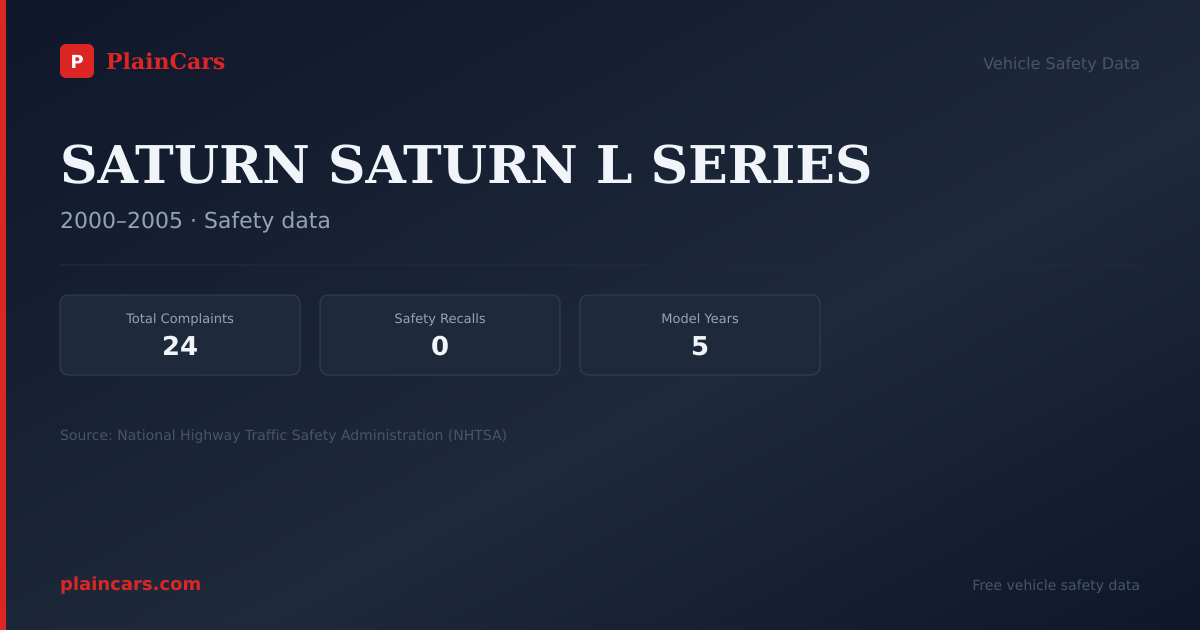
Total Complaints
3 filings
Saturn Saturn L Series · model year
3 NHTSA complaints. A VIN lookup is required to determine whether a specific vehicle has an unrepaired recall.
NHTSA overall rating
Not crash-tested
New Car Assessment Program
The verdict
The 2002 Saturn Saturn L Series posts below-average complaint volume among its own model-year siblings.
The 2002SaturnSaturn L Series carries 3 consumer safety complaints in NHTSA's Office of Defects Investigation database for this specific model-year cohort. Within that volume, owners reported 0 crashes, 0 fires, 0 injuries, and 0 fatalities. No NCAP 5-star crash-test rating is available for this model year in the federal database.
The most frequently selected component label in reports for the 2002 Saturn L Series is engine and engine cooling:engine with 1 filings, followed by exterior lighting:tail lights (1) and electrical system:ignition:module (1). Complaint categories reflect owner reports and intake categorization; they do not establish a defect pattern or cause.
NHTSA currently has 14 investigation files overlapping the 2002 Saturn L Series. Owners comparing this cohort against neighboring years should read the complaint-by-year trend as report volume, not a causal diagnosis. Use the related-complaint feed and the official recall lookup when researching a specific vehicle.
PlainCars' own composite of NHTSA NCAP crash-test ratings and rollover-risk assessment, each dimension normalized against the federal scale or the full national model-year corpus. Not an official NHTSA figure, and not a substitute for a specific vehicle's VIN-level recall check.
Total Complaints
3 filings
Crashes Reported
0 reports
Source
NHTSA ODI
Federal complaints database
At or below the fleet median complaint volume.
| Component | Count |
|---|---|
| ENGINE AND ENGINE COOLING:ENGINE | 1 |
| EXTERIOR LIGHTING:TAIL LIGHTS | 1 |
| ELECTRICAL SYSTEM:IGNITION:MODULE | 1 |
VEHICLE ENGINE STALLED WHILE TRAVELING IN A HIGH TRAFFIC INTERSECTION A LOW IDLE SPEED. PRIVATE MECHANIC DIAGNOSED PROBLEM AS IGNITION CONTROL MODULE FAILURE. THERE WAS ALREADY A RECALL ISSUED (03V2310000)A.K.A.03-C-06, HOWEVER IT DOES NOT COVER THIS VEHICLE. THIS IS 2002 SATURN L100 WITH 23,000 MILES. THE MFG HAS TO BE AWARE THAT THIS PROBLEM EXISTS. THE COST OF THIS REPAIR WAS $497.00. THERE WAS NO ACCIDENT OR INJURIES IN THIS INCIDENT FORTUNATELY. I HAVE RETAINED THE DEFECTIVE PART FOR INSPECTION IF NEEDED. *TR
Mileage: 23,000
SINCE DATE OF PURCHASE I HAVE HAD PROBLEMS W/THE TAIL LAMP BRACKET HOUSING ASSEMBLY. THIS PROBLEM WAS CORRECTED, I THOUGHT WHEN I BROUGHT BACK THE VEHICLE ON DATE OF PURCHASE, SUCH WAS NOT THE CASE, THE TAIL LAMP BRACKET HOUSING CONTINUED TO BURN OUT. I STRESSED TO THE REPAIR FACILITY AT SATURN THAT THERE IS A PROBLEM. FINALLY I RECEIVED A RECALL LETTER IN 2005 FOR THIS DEFECT (TAIL LIGHT HOUSING BRACKET). I HAVE ALREADY HAD THE VESICLE FOR 2 YEARS PRIOR TO THE RECALL, IN 2005, IT STILL BURNS OUT 3 BULBS AT A TIME USUALLY A WEEK OR MONTH AFTER REPAIR. IT IS NOW 2006 AND I STILL HAVE THE SAME PROBLEM. THE VEHICLE WAS REPAIRED AT NO COST TO ME ONLY BECAUSE I HAVE ADDRESSED THE PROBLEM WITH THE MANAGER OF THE DEALERSHIP (REPAIR DEPARTMENT), BUT THEY HAVE ONLY NOTED THE REPAIR TWICE; SO EVERY TIME THE ASSEMBLY UNIT GOES OUT THEY TRY AND CHARGE ME FOR THE REPAIR!...NOW THE CAR IS NEARLY PAID OFF AND I STILL HAVE THIS PROBLEM. OBVIOUSLY THIS IS A DEFECT THAT CAN'T BE REPAIRED. MY R
MY 2002 SATURN L200 WITH 66,000 STARTED AND RAN FINE UNTIL I TURNED A CORNER WAS GOING ABOUT 10 TO 20 MPH AND THE CAR JUST STOPPED RUNNING APPOX 100 YARDS FROM A BUSY INTERSECTION. CAR WAS TOWED TO LOCAL DEALERSHIP THEY WOULD BE UNABLE TO LOOK AT IT TILL THE NEXT DAY. THEY FOUND THAT THE TIMING CHAIN AND CYLINDER HEAD WOULD COST $2200 TO FIX BECAUSE OF THIS FAILURE. NO INJURIES OR CRASHES OCCURRED ASK DEALER IF THIS WAS COMMON HE SAID NO THAT THIS OCCURS EVERY COUPLE OF MONTHS. *NM
Mileage: 66,400
Electric Power Steering Failure
Electric Power Steering Failure
OUTSIDE DOOR HANDLES STICK UNLATCHED
TIMING CHAIN BREAKS, ENGINE STALL
TIMING CHAIN FAILURE-STALL
Data vintage: August 2026. Sources: NHTSA Office of Defects Investigation (ODI) complaints database, NHTSA recall campaign API, NHTSA NCAP crash-test ratings, and NHTSA FARS for fatality cross-reference.
Every figure on PlainCars is rendered directly from NHTSA complaint and safety data, no number is typed in by an editor. This year-specific record is rendered from NHTSA ODI, recall, and NCAP rows for the 2002 Saturn Saturn L Series; no figure is typed in by an editor. See our editorial standards & corrections policy, the methodology behind these numbers, or report a data error. Data current as of August 2026.
Read our methodology - how this data is sourced, computed, and verified.