Total Complaints
1 filings
Porsche Macan GTS · model year
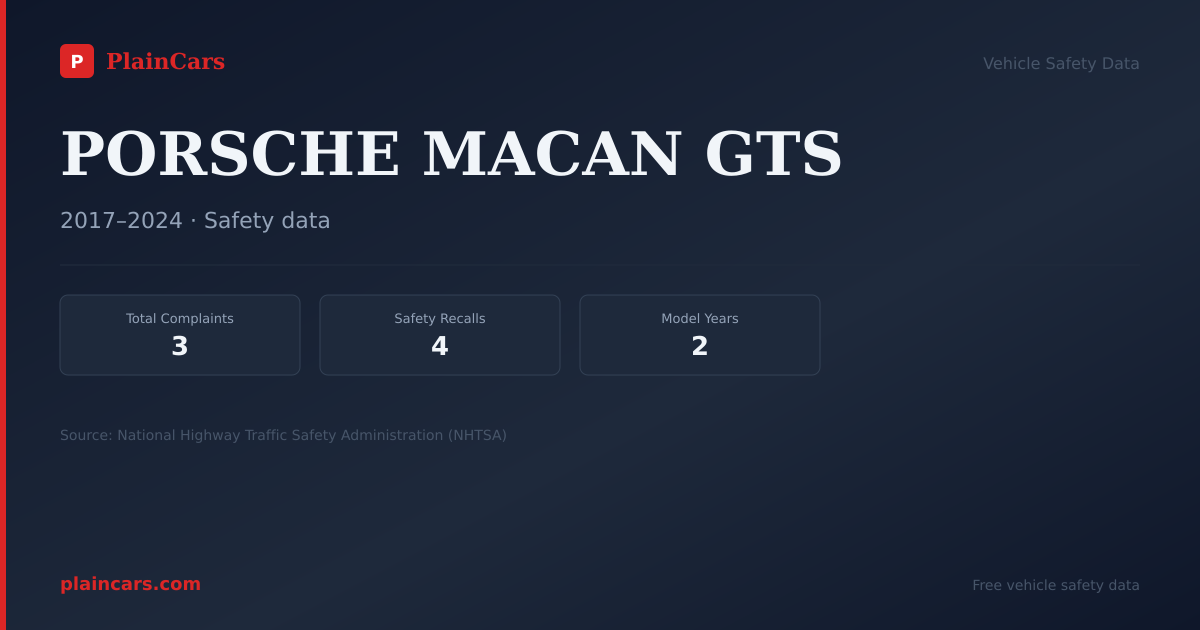
1 NHTSA complaints, and 4 recall campaigns listed for this cohort. A VIN lookup is required to determine whether a specific vehicle has an unrepaired recall.
NHTSA overall rating
Not crash-tested
New Car Assessment Program
The 2017PorscheMacan GTS carries 1 consumer safety complaint in NHTSA's Office of Defects Investigation database for this specific model-year cohort. Within that volume, owners reported 0 crashes, 0 fires, 0 injuries, and 0 fatalities. For crash performance, NHTSA's New Car Assessment Program gave this cohort an overall Not Rated/5 rating, with Not Rated/5 front crash, Not Rated/5 side crash, and Not Rated/5 rollover scores derived from standardized barrier and dynamic tests.
The most frequently selected component label in reports for the 2017 Macan GTS is fuel system, gasoline with 1 filings. Complaint categories reflect owner reports and intake categorization; they do not establish a defect pattern or cause. This cohort has 4 NHTSA recall campaigns listed below. Enter a VIN in NHTSA's official recall lookup to determine whether a specific vehicle has an unrepaired recall.
NHTSA currently has 5 investigation files overlapping the 2017 Macan GTS. Owners comparing this cohort against neighboring years should read the complaint-by-year trend as report volume, not a causal diagnosis. Use the related-complaint feed and the official recall lookup when researching a specific vehicle.
PlainCars' own composite of NHTSA NCAP crash-test ratings and rollover-risk assessment, each dimension normalized against the federal scale or the full national model-year corpus. Not an official NHTSA figure, and not a substitute for a specific vehicle's VIN-level recall check.
Total Complaints
1 filings
Crashes Reported
0 reports
Source
NHTSA ODI
Federal complaints database
At or below the fleet median complaint volume.
| Component | Count |
|---|---|
| FUEL SYSTEM, GASOLINE | 1 |
EQUIPMENT
Porsche Cars North America, Inc. (Porsche) is recalling certain 2017 Porsche Cayenne Turbo S, Cayenne Turbo, Cayenne Plug-in Hybrid, Cayenne GTS, Cayenne Plug-in Hybrid Platinum Edition, Macan Turbo and Macan GTS vehicles, 2017-2018 Cayenne S, Macan, Cayenne Platinum Edition and Macan S vehicles and
FUEL SYSTEM, GASOLINE:DELIVERY:FUEL PUMP
Porsche Cars North America, Inc. (Porsche) is recalling certain 2015-2017 Macan S and Macan Turbo vehicles, and 2017 Macan, Macan Turbo with the Performance Package, and Macan GTS vehicles. The fuel pump flange on the affected vehicles may crack, allowing fuel to leak.
AIR BAGS:SENSOR:OCCUPANT CLASSIFICATION:FRONT PASSENGER
Porsche Cars North America, Inc. (Porsche) is recalling certain 2017-2018 Macan, Macan Turbo Kits, Macan GTS, 2015-2018 Macan S, and Macan Turbo vehicles. The front passenger seat occupancy sensor mat may degrade and fail to detect a passenger in the front seat.
AIR BAGS:SENSOR:OCCUPANT CLASSIFICATION
Porsche Cars North America, Inc. (Porsche) is recalling certain 2015-2016 Macan S and Macan Turbo and 2017 Macan GTS vehicles. The passenger occupant detection sensor mat may fail in the front passenger seat, deactivating the front passenger air bag. As such, these vehicles fail to comply with the
The contact owns a 2017 Porsche Macan GTS. The contact stated that upon attempting to start the vehicle, the vehicle failed to start. After a visual inspection of the fuel system, the contact became aware that the fuel pump flange was cracked, causing a fuel leak. No warning lights were illuminated. The vehicle was taken to an independent mechanic, who diagnosed a failure with the fuel pump flange. The vehicle was repaired. After investigating the failure, the contact related the failure to NHTSA Campaign Number: 20V077000 (Fuel System, Gasoline) and 17V289000 (Fuel System, Gasoline) but the VIN was not included. The manufacturer was not notified of the failure. The failure mileage was 50,000.
Data vintage: August 2026. Sources: NHTSA Office of Defects Investigation (ODI) complaints database, NHTSA recall campaign API, NHTSA NCAP crash-test ratings, and NHTSA FARS for fatality cross-reference.
Every figure on PlainCars is rendered directly from NHTSA complaint and safety data, no number is typed in by an editor. This year-specific record is rendered from NHTSA ODI, recall, and NCAP rows for the 2017 Porsche Macan GTS; no figure is typed in by an editor. See our editorial standards & corrections policy, the methodology behind these numbers, or report a data error. Data current as of August 2026.
Read our methodology - how this data is sourced, computed, and verified.