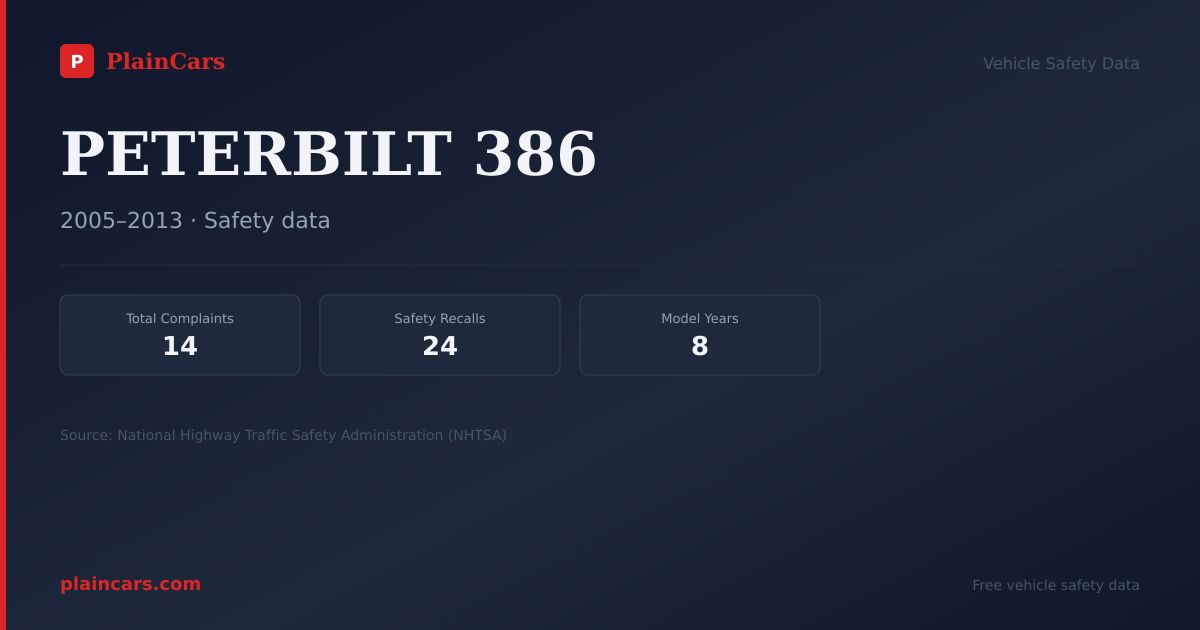
Total Complaints
1 filings
Peterbilt 386 · model year
1 NHTSA complaints, and 5 recall campaigns listed for this cohort. A VIN lookup is required to determine whether a specific vehicle has an unrepaired recall.
NHTSA overall rating
Not crash-tested
New Car Assessment Program
The verdict
The 2010 Peterbilt 386 posts top-quartile complaint standing among its own model-year siblings.
The 2010Peterbilt386 carries 1 consumer safety complaint in NHTSA's Office of Defects Investigation database for this specific model-year cohort. Within that volume, owners reported 0 crashes, 0 fires, 0 injuries, and 0 fatalities. No NCAP 5-star crash-test rating is available for this model year in the federal database.
The most frequently selected component label in reports for the 2010 386 is visibility with 1 filings. Complaint categories reflect owner reports and intake categorization; they do not establish a defect pattern or cause. This cohort has 5 NHTSA recall campaigns listed below. Enter a VIN in NHTSA's official recall lookup to determine whether a specific vehicle has an unrepaired recall.
NHTSA currently has 3 investigation files overlapping the 2010 386. Owners comparing this cohort against neighboring years should read the complaint-by-year trend as report volume, not a causal diagnosis. Use the related-complaint feed and the official recall lookup when researching a specific vehicle.
PlainCars' own composite of NHTSA NCAP crash-test ratings and rollover-risk assessment, each dimension normalized against the federal scale or the full national model-year corpus. Not an official NHTSA figure, and not a substitute for a specific vehicle's VIN-level recall check.
Total Complaints
1 filings
Crashes Reported
0 reports
Source
NHTSA ODI
Federal complaints database
At or below the fleet median complaint volume.
| Component | Count |
|---|---|
| VISIBILITY | 1 |
EQUIPMENT:OTHER:LABELS
Paccar Incorporated (Paccar) is recalling certain 2004-2013 Peterbilt 379, 357, 378, 367, 388, 365, 389, 385 and 386 trucks manufactured from April 3, 2003, through October 25, 2013 and equipped with tri-drive rear axles and a tag or pusher axle. The affected vehicles may be missing required inform
FUEL SYSTEM, OTHER:STORAGE:TANK ASSEMBLY
PACCAR IS RECALLING CERTAIN MODEL YEAR 2008-2012 KENWORTH T2000, T660, T700, T800, AND W900, AS WELL AS MODEL YEAR 2009-2012 PETERBILT 365, 367, 384, 386, 387, 388, 389, AND 587 TRUCKS EQUIPPED WITH PACCAR MX ENGINES. THE OIL MODULE CENTRIFUGAL SPINNER FILTER CAP IN THE PACCAR MX ENGINE MAY BECOME
ELECTRICAL SYSTEM:SOFTWARE
PACCAR IS RECALLING CERTAIN MODEL YEAR 2011-2012 KENWORTH T660, T700, AND T800 VEHICLES MANUFACTURED FROM APRIL 19, 2010, THROUGH MAY 13, 2011, AND MODEL YEAR 2008, 2010, AND 2011 PETERBILT 365, 367, 384, 386, 387, 388 AND 587 VEHICLES MANUFACTURED FROM APRIL 20, 2010, THROUGH JUNE 11, 2011, AND EQU
ELECTRONIC STABILITY CONTROL (ESC)
PACCAR Incorporated (PACCAR) is recalling certain 2008-2019 Peterbilt 330, 335, 337, 340, 348, 365, 367, 384, 386, 387, 388, 389, 567, 579 and 587 vehicles and 2008-2020 Kenworth T170, T270, T370, T660, T680, T800, T880, and W900 vehicles equipped with NAMUX Software. In the event that the Anti-lo
STEERING:COLUMN
PACCAR IS RECALLING CERTAIN MODEL YEAR 2008-2010 TRUCKS EQUIPPED WITH TRW STEERING SHAFTS. THE CIRCUMFERENTIAL WELD AROUND THE STEERING SHAFT TUBE THAT WELDS THE SPLINED TUBE TO THE NON-SPLINED TUBE MAY BE MISLOCATED. MISLOCATION OF THE CIRCUMFERENTIAL WELD MAY ALLOW THE SPLINED TUBE AND NON-SPLIN
2010 PETERBILT 386, RAIN WATER BEADS ON THE SIDE WINDOWS AND DOES NOT GET BLOWN OFF. AS THIS BEADING BUILDS UP ON THE WINDOWS AND THE MIRROR, IT BECOMES VERY DIFFICULT TO SEE ANYTHING IN THE MIRRORS. WHEN THIS OCCURS AT NIGHT IT IS IMPOSSIBLE TO SEE ANYTHING IN THE MIRRORS. CHANGING LANES IN THESE CONDITIONS IS EXTREMELY DANGEROUS. *TR
Data vintage: August 2026. Sources: NHTSA Office of Defects Investigation (ODI) complaints database, NHTSA recall campaign API, NHTSA NCAP crash-test ratings, and NHTSA FARS for fatality cross-reference.
Every figure on PlainCars is rendered directly from NHTSA complaint and safety data, no number is typed in by an editor. This year-specific record is rendered from NHTSA ODI, recall, and NCAP rows for the 2010 Peterbilt 386; no figure is typed in by an editor. See our editorial standards & corrections policy, the methodology behind these numbers, or report a data error. Data current as of August 2026.
Read our methodology - how this data is sourced, computed, and verified.