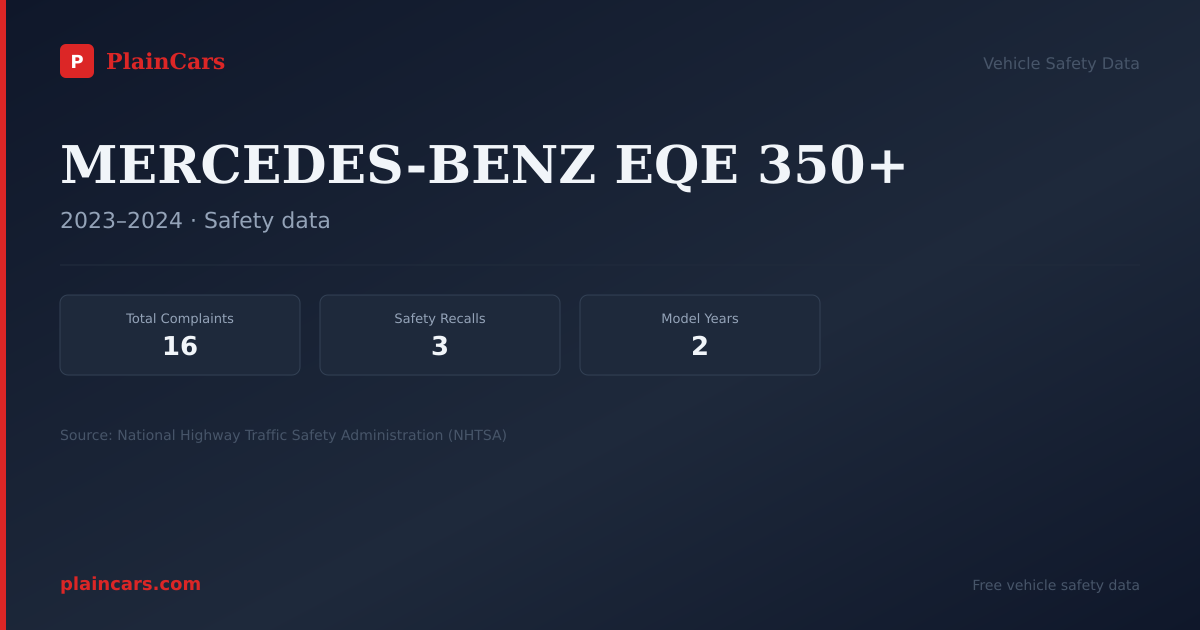
Total Complaints
10 filings
Mercedes-Benz EQE 350+ · model year
10 NHTSA complaints, 4 crash reports, and 2 recall campaigns listed for this cohort. A VIN lookup is required to determine whether a specific vehicle has an unrepaired recall.
NHTSA overall rating
Not crash-tested
New Car Assessment Program
The 2024Mercedes-BenzEQE 350+ carries 10 consumer safety complaints in NHTSA's Office of Defects Investigation database for this specific model-year cohort. Within that volume, owners reported 4 crashes, 0 fires, 3 injuries, and 0 fatalities. No NCAP 5-star crash-test rating is available for this model year in the federal database.
The most frequently selected component label in reports for the 2024 EQE 350+ is service brakes with 3 filings, followed by electrical system (2) and forward collision avoidance: automatic emergency braking (2). Complaint categories reflect owner reports and intake categorization; they do not establish a defect pattern or cause. This cohort has 2 NHTSA recall campaigns listed below. Enter a VIN in NHTSA's official recall lookup to determine whether a specific vehicle has an unrepaired recall.
NHTSA currently has 15 investigation files overlapping the 2024 EQE 350+. Owners comparing this cohort against neighboring years should read the complaint-by-year trend as report volume, not a causal diagnosis. Use the related-complaint feed and the official recall lookup when researching a specific vehicle.
PlainCars' own composite of NHTSA NCAP crash-test ratings and rollover-risk assessment, each dimension normalized against the federal scale or the full national model-year corpus. Not an official NHTSA figure, and not a substitute for a specific vehicle's VIN-level recall check.
Total Complaints
10 filings
Crashes Reported
4 reports
Source
NHTSA ODI
Federal complaints database
At or below the fleet median complaint volume.
| Component | Count |
|---|---|
| SERVICE BRAKES | 3 |
| ELECTRICAL SYSTEM | 2 |
| FORWARD COLLISION AVOIDANCE: AUTOMATIC EMERGENCY BRAKING | 2 |
| TIRES | 1 |
| UNKNOWN OR OTHER | 1 |
| EXTERIOR LIGHTING | 1 |
ELECTRICAL SYSTEM:PROPULSION SYSTEM:TRACTION BATTERY:MANAGEMENT SYSTEM/ENERGY CONTROL MODULE (BMS/BECM):SOFTWARE
Mercedes-Benz USA, LLC (MBUSA) is recalling certain 2024 EQE 350 4MATIC, EQE 350+, EQE 500 4MATIC, EQS 450 4MATIC, EQS 450+, EQS 580 4MATIC, AMG EQE 53 4MATIC, AMG EQS 53 4MATIC, 2023-2025 EQE SUV 350 4MATIC, EQE SUV 350+, EQE SUV 500 4MATIC, EQS SUV 450 4MATIC, EQS SUV 450+, EQS SUV 580 4MATIC, 202
BACK OVER PREVENTION:WARNINGS:EXTERNAL/PEDESTRIAN ALERT
Mercedes-Benz USA, LLC (MBUSA) is recalling certain 2022-2025 S-Class, EQE SUV, EQE, EQS SUV and EQS vehicles. Please see the recall report for a complete list of models. Software in the Acoustic Vehicle Alerting System (AVAS) may cause an incorrect external pedestrian warning sound while reversing.
The vehicle experienced repeated electrical wiring harness damage in the lighting, tire and connector areas due to exposed and insufficiently protected wiring near socket terminations. On two separate service visits, authorized dealership technicians confirmed that rodents chewed through multiple exposed wires. The affected wiring involves critical electrical systems. The connectors lack adequate shielding, loom, or protective insulation at exposed termination points. The insulation ends before the connector, leaving conductors vulnerable to environmental exposure and rodent access. Warning indicators illuminated on the dashboard, and the vehicle required dealer repair on both occasions. The damaged wiring was inspected and confirmed by certified technicians and is available for inspection upon request. This condition presents a significant safety risk. If a rodent partially damages a wire connected to braking systems, steering systems, high-voltage components, sensors, or engine co
The vehicle experienced repeated electrical wiring harness damage in the lighting, tire and connector areas due to exposed and insufficiently protected wiring near socket terminations. On two separate service visits, authorized dealership technicians confirmed that rodents chewed through multiple exposed wires. The affected wiring involves critical electrical systems. The connectors lack adequate shielding, loom, or protective insulation at exposed termination points. The insulation ends before the connector, leaving conductors vulnerable to environmental exposure and rodent access. Warning indicators illuminated on the dashboard, and the vehicle required dealer repair on both occasions. The damaged wiring was inspected and confirmed by certified technicians and is available for inspection upon request. This condition presents a significant safety risk. If a rodent partially damages a wire connected to braking systems, steering systems, high-voltage components, sensors, or engine co
The vehicle experienced repeated electrical wiring harness damage in the lighting, tire and connector areas due to exposed and insufficiently protected wiring near socket terminations. On two separate service visits, authorized dealership technicians confirmed that rodents chewed through multiple exposed wires. The affected wiring involves critical electrical systems. The connectors lack adequate shielding, loom, or protective insulation at exposed termination points. The insulation ends before the connector, leaving conductors vulnerable to environmental exposure and rodent access. Warning indicators illuminated on the dashboard, and the vehicle required dealer repair on both occasions. The damaged wiring was inspected and confirmed by certified technicians and is available for inspection upon request. This condition presents a significant safety risk. If a rodent partially damages a wire connected to braking systems, steering systems, high-voltage components, sensors, or engine co
The car made a sudden and very hard brake in the middle of the street at around 40 - 50 miles per hour, on a empty road.
The car made a sudden and very hard brake in the middle of the street at around 40 - 50 miles per hour, on a empty road.
Twice, the car has autonomously braked when there was no threat to the car. The first time we were subsequently rear ended, though fortunately at low speed. There was cosmetic damage to the bumpers of both cars and the occupants were shaken up, but not injured. The second time the were driving at about 35mph when the car slammed on the brakes. Fortunately the following vehicle was not close and there was no collision. The occupants were again shaken up, but not injured. The "braking assistance" can be disabled, but only for the current trip. It is automatically reenabled the next time the car is started.
I was driving from Fresno to Lake Tahoe stopped in Manteca to charge my car at the Tesla SC as I was reversing into the charge spot the car suddenly stopped a message appeared “speed severely restricted “ I tapped the gas pedal and no response within a millisecond the car accelerated in reverse at a high speed hitting the pole in front of the Supercharger resulting in damage to the backend of the eqe
I was driving from Fresno to Lake Tahoe stopped in Manteca to charge my car at the Tesla SC as I was reversing into the charge spot the car suddenly stopped a message appeared “speed severely restricted “ I tapped the gas pedal and no response within a millisecond the car accelerated in reverse at a high speed hitting the pole in front of the Supercharger resulting in damage to the backend of the eqe
I was driving from Fresno to Lake Tahoe stopped in Manteca to charge my car at the Tesla SC as I was reversing into the charge spot the car suddenly stopped a message appeared “speed severely restricted “ I tapped the gas pedal and no response within a millisecond the car accelerated in reverse at a high speed hitting the pole in front of the Supercharger resulting in damage to the backend of the eqe
On [XXX] around [XXX] while driving my 2024 Mercedes-Benz EQE350 [XXX] near Santa Clarita, CA, I experienced a flat tire due to a 4 mm puncture in the center tread of the rear driver's side tire. I immediately contacted Mercedes Me customer support , and the representative advised me that my vehicle's run-flat tire system would allow me to continue driving up to 50 miles, as long as I stayed under 50 mph. I followed this guidance very cautiously, driving under 30 mph. Despite this, the tire completely blew out in less than10 miles. The road conditions were normal, the tire was in good condition prior to the incident, and weather was mild. This incident endangered my safety and that of my wife and our toddler, who were in the vehicle with me at the time and was extremely frightened by the sudden blowout. I believe the run-flat system failed to perform as expected and/or the advice I received from Mercedes Me was unsafe and caused more damage to my vehicle and put my family in more dan
Data vintage: August 2026. Sources: NHTSA Office of Defects Investigation (ODI) complaints database, NHTSA recall campaign API, NHTSA NCAP crash-test ratings, and NHTSA FARS for fatality cross-reference.
Every figure on PlainCars is rendered directly from NHTSA complaint and safety data, no number is typed in by an editor. This year-specific record is rendered from NHTSA ODI, recall, and NCAP rows for the 2024 Mercedes-Benz EQE 350+; no figure is typed in by an editor. See our editorial standards & corrections policy, the methodology behind these numbers, or report a data error. Data current as of August 2026.
Read our methodology - how this data is sourced, computed, and verified.