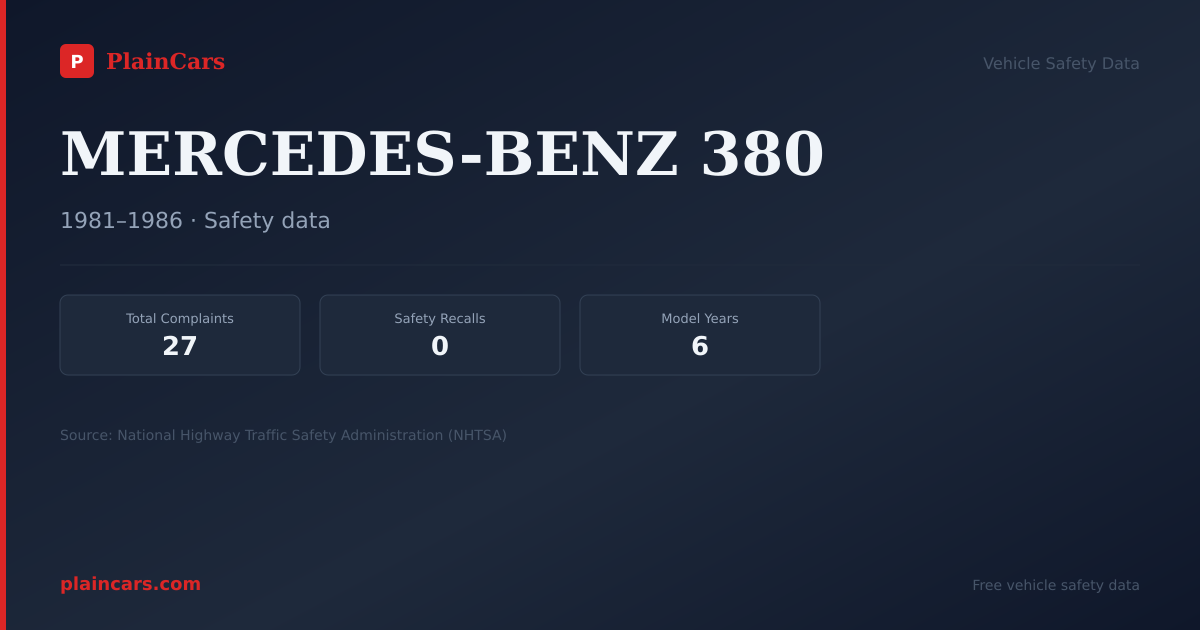
Total Complaints
6 filings
Mercedes-Benz 380 · model year
6 NHTSA complaints. A VIN lookup is required to determine whether a specific vehicle has an unrepaired recall.
NHTSA overall rating
Not crash-tested
New Car Assessment Program
The verdict
The 1981 Mercedes-Benz 380 posts below-average complaint volume among its own model-year siblings.
The 1981Mercedes-Benz380 carries 6 consumer safety complaints in NHTSA's Office of Defects Investigation database for this specific model-year cohort. Within that volume, owners reported 0 crashes, 2 fires, 0 injuries, and 0 fatalities. No NCAP 5-star crash-test rating is available for this model year in the federal database.
The most frequently selected component label in reports for the 1981 380 is engine and engine cooling:engine:gasoline with 1 filings, followed by engine and engine cooling:exhaust system:manifold/header/muffler/tail pipe (1) and engine and engine cooling:engine (1). Complaint categories reflect owner reports and intake categorization; they do not establish a defect pattern or cause.
NHTSA currently has 15 investigation files overlapping the 1981 380. Owners comparing this cohort against neighboring years should read the complaint-by-year trend as report volume, not a causal diagnosis. Use the related-complaint feed and the official recall lookup when researching a specific vehicle.
PlainCars' own composite of NHTSA NCAP crash-test ratings and rollover-risk assessment, each dimension normalized against the federal scale or the full national model-year corpus. Not an official NHTSA figure, and not a substitute for a specific vehicle's VIN-level recall check.
Total Complaints
6 filings
Crashes Reported
0 reports
Source
NHTSA ODI
Federal complaints database
At or below the fleet median complaint volume.
| Component | Count |
|---|---|
| ENGINE AND ENGINE COOLING:ENGINE:GASOLINE | 1 |
| ENGINE AND ENGINE COOLING:EXHAUST SYSTEM:MANIFOLD/HEADER/MUFFLER/TAIL PIPE | 1 |
| ENGINE AND ENGINE COOLING:ENGINE | 1 |
| SUSPENSION | 1 |
| WHEELS | 1 |
| STEERING | 1 |
Mercedes has acknowledged and agreed to repair at their cost the defect in the subframe connections to the wheel control arms. This structural weakness, once snapped, results in the loss of control, wheels falling off and suspension components dropping to the ground. MBZ agreed to fix this issue on all R107 and C107 cars (US Models 450SL/SLC) from 1973 thru 1980- Mercedes Recall#191185120001, SIL 33/001 Subframe Modification Dated 11/1/85 - but did not include the R107 and C107 between 1981-1985 (US Model 380SL/SLC) that developed the same potential life threatening catastrophic defect. Mercedes did, however, update the the 1986-1989 models with strengthened subframes, a de facto admission of their bad unsafe design. My recently purchased 1981 380SLC was just inspected for this issue and cracks are clearly present, requiring immediate strengthening.
Mercedes has acknowledged and agreed to repair at their cost the defect in the subframe connections to the wheel control arms. This structural weakness, once snapped, results in the loss of control, wheels falling off and suspension components dropping to the ground. MBZ agreed to fix this issue on all R107 and C107 cars (US Models 450SL/SLC) from 1973 thru 1980- Mercedes Recall#191185120001, SIL 33/001 Subframe Modification Dated 11/1/85 - but did not include the R107 and C107 between 1981-1985 (US Model 380SL/SLC) that developed the same potential life threatening catastrophic defect. Mercedes did, however, update the the 1986-1989 models with strengthened subframes, a de facto admission of their bad unsafe design. My recently purchased 1981 380SLC was just inspected for this issue and cracks are clearly present, requiring immediate strengthening.
Mercedes has acknowledged and agreed to repair at their cost the defect in the subframe connections to the wheel control arms. This structural weakness, once snapped, results in the loss of control, wheels falling off and suspension components dropping to the ground. MBZ agreed to fix this issue on all R107 and C107 cars (US Models 450SL/SLC) from 1973 thru 1980- Mercedes Recall#191185120001, SIL 33/001 Subframe Modification Dated 11/1/85 - but did not include the R107 and C107 between 1981-1985 (US Model 380SL/SLC) that developed the same potential life threatening catastrophic defect. Mercedes did, however, update the the 1986-1989 models with strengthened subframes, a de facto admission of their bad unsafe design. My recently purchased 1981 380SLC was just inspected for this issue and cracks are clearly present, requiring immediate strengthening.
THE TIMING CHAIN FAILED, AND THE WHOLE ENGINE HAD TO BE REPLACED. AT THE TIME, IN 1987, I BELIEVED MERCEDES THAT THE PROBLEM WAS A ONE TIME ISSUE, AND THAT THE PROBLEM WAS DUE TO A POOR DRIVER WHO HAD OWNED THE CAR PREVIOUSLY. LAST WEEK, A FRIED OF MINE, HAD A 1986, 380 SL FAIL WITH THE SAME PROBLEM. AFTER MORE INVESTIGATION, I FOUND OUT THAT MERCEDES CHANGED THE DESIGN OF THE TIMING COMPONENT TO USE A DOUBLE INSTEAD OF A SINGLE CHAIN. THE CHANGE WAS MADE LATE IN THE 1980'S. AFTER INVESTIGATING THIS WEB SITE, I SEE THAT THERE IS A HIGH FREQUENCY OF TIMING CHAIN FAILURES ON THE 380 SL MODELS IN THE 1980'S. I WOULD LIKE TO SEE A SUMMARY OF ALL THE FAILURES OVER THOSE YEARS, AND I THINK THAT MERCEDES OWES SOMETHING TO ALL OF US WHO HAVE HAD TO REPLACE ENGINES. THANK YOU FOR YOUR ATTENTION.*AK
ENGINE FIRE, CONSUMER STATED THAT HE HAD JUST GOT THE MUFFLER REPLACED THAT DAY. (OHIO TRAFFIC CRASH REPORT). MJS
ENGINE FIRE, CONSUMER STATED THAT HE HAD JUST GOT THE MUFFLER REPLACED THAT DAY. (OHIO TRAFFIC CRASH REPORT). MJS
Data vintage: August 2026. Sources: NHTSA Office of Defects Investigation (ODI) complaints database, NHTSA recall campaign API, NHTSA NCAP crash-test ratings, and NHTSA FARS for fatality cross-reference.
Every figure on PlainCars is rendered directly from NHTSA complaint and safety data, no number is typed in by an editor. This year-specific record is rendered from NHTSA ODI, recall, and NCAP rows for the 1981 Mercedes-Benz 380; no figure is typed in by an editor. See our editorial standards & corrections policy, the methodology behind these numbers, or report a data error. Data current as of August 2026.
Read our methodology - how this data is sourced, computed, and verified.