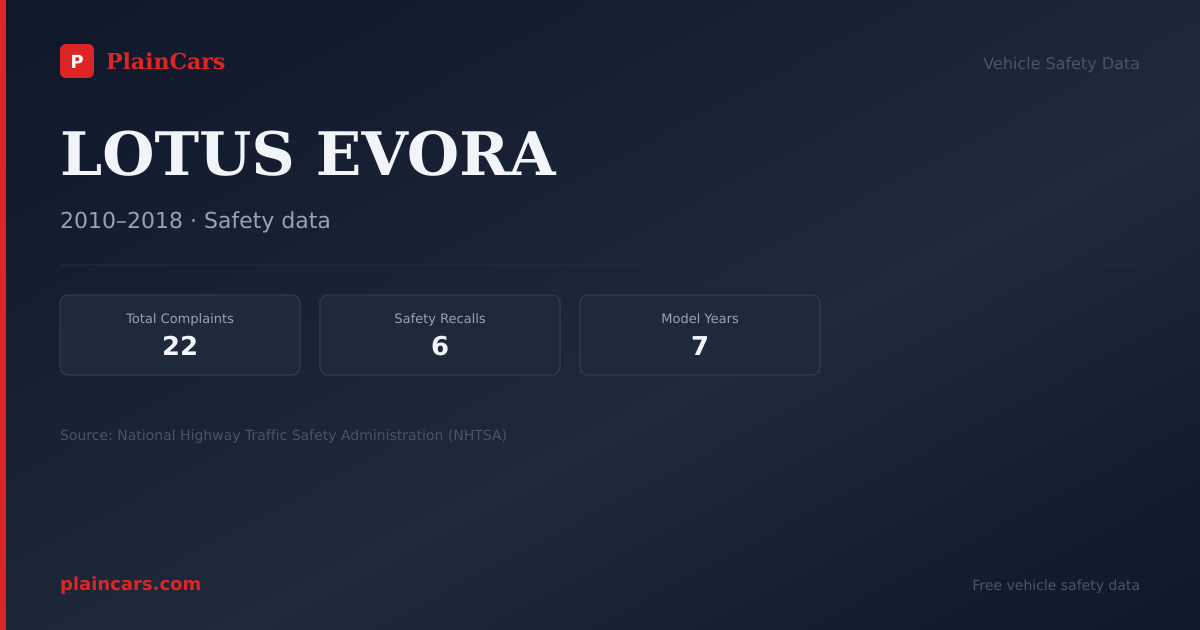
Total Complaints
4 filings
Lotus Evora · model year
4 NHTSA complaints, and 1 recall campaign listed for this cohort. A VIN lookup is required to determine whether a specific vehicle has an unrepaired recall.
NHTSA overall rating
Not crash-tested
New Car Assessment Program
The verdict
The 2017 Lotus Evora posts above-average complaint volume among its own model-year siblings.
The 2017LotusEvora carries 4 consumer safety complaints in NHTSA's Office of Defects Investigation database for this specific model-year cohort. Within that volume, owners reported 0 crashes, 0 fires, 0 injuries, and 0 fatalities. No NCAP 5-star crash-test rating is available for this model year in the federal database.
The most frequently selected component label in reports for the 2017 Evora is engine with 2 filings, followed by electrical system (1) and suspension:rear (1). Complaint categories reflect owner reports and intake categorization; they do not establish a defect pattern or cause. This cohort has 1 NHTSA recall campaign listed below. Enter a VIN in NHTSA's official recall lookup to determine whether a specific vehicle has an unrepaired recall.
NHTSA currently has 1 investigation file overlapping the 2017 Evora. Owners comparing this cohort against neighboring years should read the complaint-by-year trend as report volume, not a causal diagnosis. Use the related-complaint feed and the official recall lookup when researching a specific vehicle.
PlainCars' own composite of NHTSA NCAP crash-test ratings and rollover-risk assessment, each dimension normalized against the federal scale or the full national model-year corpus. Not an official NHTSA figure, and not a substitute for a specific vehicle's VIN-level recall check.
Total Complaints
4 filings
Crashes Reported
0 reports
Source
NHTSA ODI
Federal complaints database
At or below the fleet median complaint volume.
| Component | Count |
|---|---|
| ENGINE | 2 |
| ELECTRICAL SYSTEM | 1 |
| SUSPENSION:REAR | 1 |
STRUCTURE
Lotus Cars USA, Inc. (Lotus) is recalling certain 2017-2018 Evora vehicles. The toe board in the passenger footwell lacks stiffness, allowing the knee of an unbelted occupant to contact the rigid structure of the vehicle, in the event of a crash. As such, these vehicles fail to comply with the req
The contact owns a 2017 Lotus Evora. The contact stated that there was a clunking sound coming from the rear suspension. The vehicle was taken to a certified mechanic who was certified to work on Lotus vehicles, but not associated with the dealer, and the rear suspension arm was inspected and diagnosed with a fracture in the casting of the suspension. The suspension arm and bushing were replaced. The manufacturer was informed of the failure. The failure mileage was approximately 69,000.
Mileage: 69,000
For the second time, a Throttle Actuator code forced an engine shutdown while on a busy freeway with only very narrow breakdown lane stranding the car. Attempts to reset the code(s) failed for about 30 minutes whereupon codes reset and have not recurred indicating the code was only transient but very dangerous.
Driving on an interstate highway a MIL (Malfunction Indicator Light) illuminated and within less than 5 seconds, the engine went into shutdown mode. I was able to safely clear the highway but on a central lane and heavy traffic it would have been impossible to safely clear the highway and the car would be stranded in the middle of the road. Checking malfunction codes indicated a throttle body malfunction or at least a sensed malfunction as the car showed no problem ahead of shutdown. Second code indicated a “LIMP HOME” mode which quickly progressed to a “SHUT DOWN” mode as indicated by a third code. I believe that I would rather damage equipment rather than shutdown in the middle of the highway and the shutdown mode should be programmed out. Car was towed to Lotus of Dallas dealer for troubleshooting and as of now there is no resolution.
Driving on an interstate highway a MIL (Malfunction Indicator Light) illuminated and within less than 5 seconds, the engine went into shutdown mode. I was able to safely clear the highway but on a central lane and heavy traffic it would have been impossible to safely clear the highway and the car would be stranded in the middle of the road. Checking malfunction codes indicated a throttle body malfunction or at least a sensed malfunction as the car showed no problem ahead of shutdown. Second code indicated a “LIMP HOME” mode which quickly progressed to a “SHUT DOWN” mode as indicated by a third code. I believe that I would rather damage equipment rather than shutdown in the middle of the highway and the shutdown mode should be programmed out. Car was towed to Lotus of Dallas dealer for troubleshooting and as of now there is no resolution.
Data vintage: August 2026. Sources: NHTSA Office of Defects Investigation (ODI) complaints database, NHTSA recall campaign API, NHTSA NCAP crash-test ratings, and NHTSA FARS for fatality cross-reference.
Every figure on PlainCars is rendered directly from NHTSA complaint and safety data, no number is typed in by an editor. This year-specific record is rendered from NHTSA ODI, recall, and NCAP rows for the 2017 Lotus Evora; no figure is typed in by an editor. See our editorial standards & corrections policy, the methodology behind these numbers, or report a data error. Data current as of August 2026.
Read our methodology - how this data is sourced, computed, and verified.