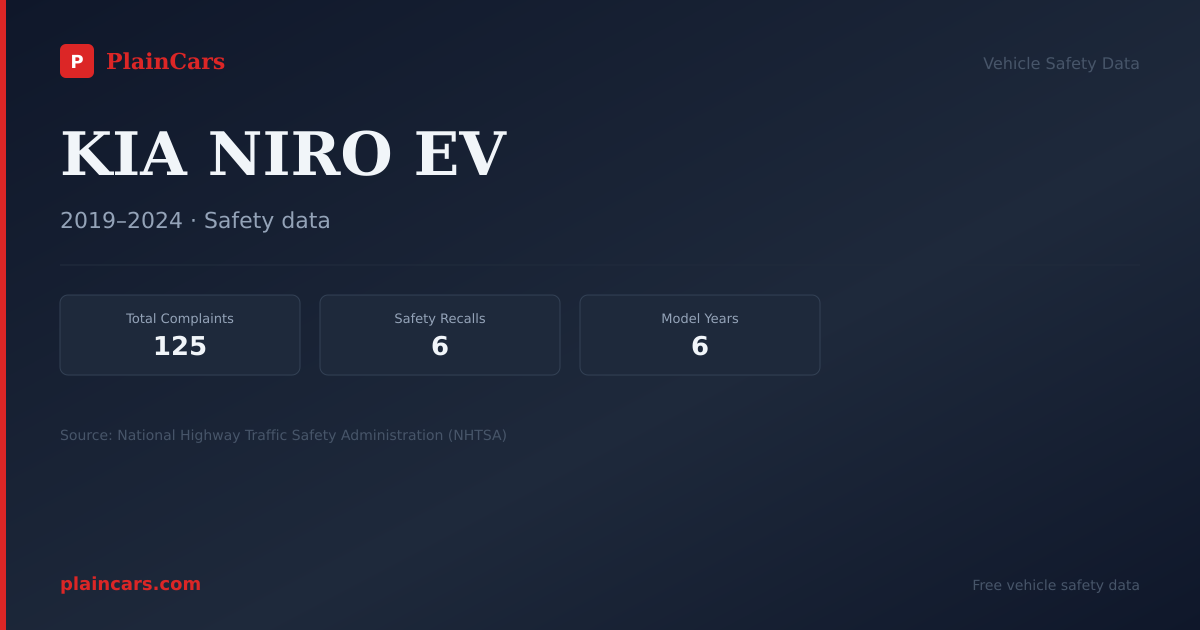
Total Complaints
2 filings
KIA Niro EV · model year
2 NHTSA complaints, and 1 recall campaign listed for this cohort. A VIN lookup is required to determine whether a specific vehicle has an unrepaired recall.
NHTSA overall rating
Not crash-tested
New Car Assessment Program
The verdict
The 2021 KIA Niro EV posts top-1% complaint standing (fewest filings) among its own model-year siblings.
The 2021KIANiro EV carries 2 consumer safety complaints in NHTSA's Office of Defects Investigation database for this specific model-year cohort. Within that volume, owners reported 0 crashes, 0 fires, 0 injuries, and 0 fatalities. No NCAP 5-star crash-test rating is available for this model year in the federal database.
The most frequently selected component label in reports for the 2021 Niro EV is back over prevention: back-up alarm with 1 filings, followed by service brakes (1). Complaint categories reflect owner reports and intake categorization; they do not establish a defect pattern or cause. This cohort has 1 NHTSA recall campaign listed below. Enter a VIN in NHTSA's official recall lookup to determine whether a specific vehicle has an unrepaired recall.
NHTSA currently has 38 investigation files overlapping the 2021 Niro EV. Owners comparing this cohort against neighboring years should read the complaint-by-year trend as report volume, not a causal diagnosis. Use the related-complaint feed and the official recall lookup when researching a specific vehicle.
PlainCars' own composite of NHTSA NCAP crash-test ratings and rollover-risk assessment, each dimension normalized against the federal scale or the full national model-year corpus. Not an official NHTSA figure, and not a substitute for a specific vehicle's VIN-level recall check.
Total Complaints
2 filings
Crashes Reported
0 reports
Source
NHTSA ODI
Federal complaints database
At or below the fleet median complaint volume.
| Component | Count |
|---|---|
| BACK OVER PREVENTION: BACK-UP ALARM | 1 |
| SERVICE BRAKES | 1 |
BACK OVER PREVENTION: SENSING SYSTEM: CAMERA
Kia America, Inc. (Kia) is recalling certain 2020-2022 Niro EV vehicles. The circuit board for the rearview camera may become damaged and cause the rearview camera image not to display. As such, these vehicles fail to comply with the requirements of Federal Motor Vehicle Safety Standard (FMVSS) numb
The rear brake rotors on the vehicle are pitted, as confirmed by a local repair shop. The "incident" is ongoing. Kia refuses to repair or replace them under warranty (25,500 miles on the car), claiming they are wear item. However, pitting is not wear, in fact quite the opposite. My analysis (30+ yrs in the auto business): As an EV, regenerative braking means the actual brake systems are rarely used. Noise at low speeds prompted the inspection at a local shop. Braking under high speeds does not result in noise, telling me the system relies too heavily on the front brakes. The result is the rear rotors are too often unused leaving them to rust and then pit. Tesla recognizes that regen braking can actually harm brake rotors, suggesting burnishing the brakes at times using the following procedure: 1) Drive the vehicle at approximately 50 mph - 55 mph (80 km/h - 90 km/h) on a straight road. 2) Apply moderate, consistent pressure to the brake pedal to slowly decelerate the vehicle, relea
I'm a new Niro Ev driver. The VESS noise when reversing the vehicle is very loud. It is too loud, I live in close proximity to neighbors and have to get up early for work and the sound is a major nuisance, I would not want a neighbor that has this car . I understand VESS in place for safety but the reverse backup beeping is just a step down from a garbage truck backing up, especially in the silence of a residential neighborhood in the early AM hours. Furthermore, I and others as seen on web forums will reverse faster than we normally would do to be able to take the car out of reverse as quickly as possible to stop the blaring beeping. This creates its own risk, as if there is less time to react if there is a pedestrian behind the vehicle. The volume of the noise should be greatly reduced. It is also unnecessary noise pollution. Kia, please fix this.
Data vintage: August 2026. Sources: NHTSA Office of Defects Investigation (ODI) complaints database, NHTSA recall campaign API, NHTSA NCAP crash-test ratings, and NHTSA FARS for fatality cross-reference.
Every figure on PlainCars is rendered directly from NHTSA complaint and safety data, no number is typed in by an editor. This year-specific record is rendered from NHTSA ODI, recall, and NCAP rows for the 2021 KIA Niro EV; no figure is typed in by an editor. See our editorial standards & corrections policy, the methodology behind these numbers, or report a data error. Data current as of August 2026.
Read our methodology - how this data is sourced, computed, and verified.