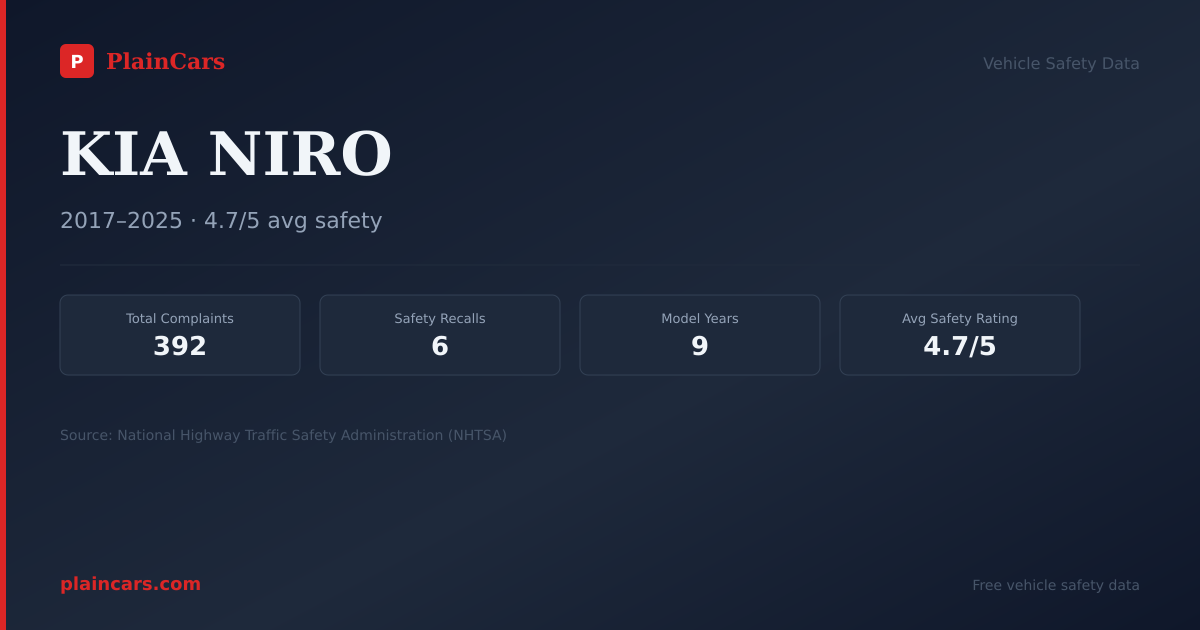
Total Complaints
91 filings
KIA Niro · model year
91 NHTSA complaints, 4 crash reports, and 4 recall campaigns listed for this cohort. A VIN lookup is required to determine whether a specific vehicle has an unrepaired recall.
NHTSA overall rating
Not crash-tested
New Car Assessment Program
The verdict
The 2017 KIA Niro posts above-average complaint volume among its own model-year siblings.
The 2017KIANiro carries 91 consumer safety complaints in NHTSA's Office of Defects Investigation database for this specific model-year cohort. Within that volume, owners reported 4 crashes, 7 fires, 4 injuries, and 0 fatalities. No NCAP 5-star crash-test rating is available for this model year in the federal database.
The most frequently selected component label in reports for the 2017 Niro is engine with 22 filings, followed by electrical system (13) and power train (12). Complaint categories reflect owner reports and intake categorization; they do not establish a defect pattern or cause. This cohort has 4 NHTSA recall campaigns listed below. Enter a VIN in NHTSA's official recall lookup to determine whether a specific vehicle has an unrepaired recall.
NHTSA currently has 38 investigation files overlapping the 2017 Niro. Owners comparing this cohort against neighboring years should read the complaint-by-year trend as report volume, not a causal diagnosis. Use the related-complaint feed and the official recall lookup when researching a specific vehicle.
PlainCars' own composite of NHTSA NCAP crash-test ratings and rollover-risk assessment, each dimension normalized against the federal scale or the full national model-year corpus. Not an official NHTSA figure, and not a substitute for a specific vehicle's VIN-level recall check.
Total Complaints
91 filings
Crashes Reported
4 reports
Source
NHTSA ODI
Federal complaints database
At or below the fleet median complaint volume.
| Component | Count |
|---|---|
| ENGINE | 22 |
| ELECTRICAL SYSTEM | 13 |
| POWER TRAIN | 12 |
| UNKNOWN OR OTHER | 11 |
| FUEL/PROPULSION SYSTEM | 8 |
| STEERING | 6 |
| STRUCTURE:BODY | 3 |
| AIR BAGS | 2 |
| ENGINE AND ENGINE COOLING | 2 |
| ELECTRICAL SYSTEM:12V/24V/48V BATTERY | 1 |
| ELECTRONIC STABILITY CONTROL (ESC) | 1 |
| TIRES | 1 |
| ENGINE AND ENGINE COOLING:EXHAUST SYSTEM | 1 |
| LATCHES/LOCKS/LINKAGES | 1 |
| STRUCTURE:BODY:DOOR:HANDLE:EXTERIOR | 1 |
POWER TRAIN:AUTOMATIC TRANSMISSION:INTERNAL:CLUTCHES/BANDS:ACTUATORS/SOLENOIDS
Kia America, Inc. (Kia) is recalling certain 2017-2022 Niro and 2018-2022 Niro Plug-in Hybrid vehicles. Fluid may leak into the printed circuit board inside the hydraulic clutch actuator, which can result in an engine compartment fire.
HYBRID PROPULSION SYSTEM
Kia Motors America (Kia) is recalling certain 2017-2018 Kia Niro hybrid electric vehicles. The Main Relay within the Power Relay Assembly (PRA) may have inadequate connections between its contacts, causing increased electrical resistance.
HYBRID PROPULSION SYSTEM
Kia Motors America (Kia) is recalling certain 2017 Kia Niro vehicles. The Hydraulic Clutch Actuator (HCA) inner oil seal may leak, allowing oil to accumulate in the cap area, possibly resulting in an electrical short.
HYBRID PROPULSION SYSTEM
Kia Motors America (Kia) is recalling certain 2017-2018 Kia Niro hybrid electric vehicles previously recalled under recall 18V-666. The Main Relay within the Power Relay Assembly (PRA) may have inadequate connections between its contacts, causing increased electrical resistance, which can overheat
Power sterring went out - MDPS. Car has less than 50,000 miles. This is apparently happening to many of this model & a recall was done on a very small number of vehicles for the same issue. The recall should be expanded. This is very unsafe.
When I was driving, a propulsion system warning went off. Then a malfunction in the vehicle’s powertrain/propulsion system lit up on the GPS screen. Shortly afterward, the engine began smoking, and a loud popping sound occurred simultaneously. The vehicle then experienced a sudden loss of propulsion, requiring me to pull over immediately to avoid a hazardous situation. An authorized Kia dealer subsequently diagnosed a blown head gasket with internal coolant intrusion, confirming an internal powertrain failure consistent with propulsion system malfunction, and the vehicle became inoperable. The vehicle was inspected in October and the loss-of-propulsion failure occurred in December.
When I was driving, a propulsion system warning went off. Then a malfunction in the vehicle’s powertrain/propulsion system lit up on the GPS screen. Shortly afterward, the engine began smoking, and a loud popping sound occurred simultaneously. The vehicle then experienced a sudden loss of propulsion, requiring me to pull over immediately to avoid a hazardous situation. An authorized Kia dealer subsequently diagnosed a blown head gasket with internal coolant intrusion, confirming an internal powertrain failure consistent with propulsion system malfunction, and the vehicle became inoperable. The vehicle was inspected in October and the loss-of-propulsion failure occurred in December.
When I was driving, a propulsion system warning went off. Then a malfunction in the vehicle’s powertrain/propulsion system lit up on the GPS screen. Shortly afterward, the engine began smoking, and a loud popping sound occurred simultaneously. The vehicle then experienced a sudden loss of propulsion, requiring me to pull over immediately to avoid a hazardous situation. An authorized Kia dealer subsequently diagnosed a blown head gasket with internal coolant intrusion, confirming an internal powertrain failure consistent with propulsion system malfunction, and the vehicle became inoperable. The vehicle was inspected in October and the loss-of-propulsion failure occurred in December.
The contact owns a 2017 Kia Niro. The contact stated that while driving at an undisclosed speed, the check engine warning light illuminated. The contact used a personal code reader and retrieved a fault code related to the evaporative emissions. The contact replaced the gas cap. The contact stated that the failure persisted. The vehicle was then taken to an independent mechanic, who diagnosed the vehicle with internal failure. The independent mechanic provided the contact with the Manufacturer's Service Action Number: SA395. The contact was informed that the failure might be related to the evaporative emissions system. The vehicle was not repaired. The contact stated that the failure persisted. The manufacturer was made aware of the failure and referred the contact to the NHSTA Hotline for assistance. The approximate failure mileage was 135,000.
Mileage: 135,000
Failed/leaking coolant heat exchanger which is integrated into the rear catalytic converter assembly. This seems to be a well-known issue with 2017-2020 Kia Niros. Leaks cause overheating of the engine or no heat in the vehicle and potential blown head gaskets. This issue has been confirmed by an independent service center. Car itself gave no messages or warnings regarding the leak.
The contact owns a 2017 Kia Niro. The contact stated that while operating the vehicle, the message "Engine Overheated - Turn Engine Off" was displayed with white smoke coming from the exhaust system. Upon inspection, it was discovered that the coolant level was extremely low. The contact stated that coolant was added to the reservoir; however, hours later the coolant level was low again. The vehicle was towed to the local mechanic, who diagnosed the vehicle and determined that the head gasket was blown and that the engine needed to be replaced. The vehicle was not repaired. The manufacturer and local dealer were not notified of the failure. The failure mileage was 112,000.
Mileage: 112,000
The heat exchanger (exhaust heat recovery system) on my 2017 Kia Niro has been diagnosed by an authorized Kia dealership as leaking coolant. The failed component can be available for inspection upon request. This failure poses a serious safety risk. The heat exchanger is part of the vehicle’s cooling system, and when it leaks, the engine can rapidly lose coolant while driving. This can lead to sudden overheating, reduced power, or potential engine shutdown in traffic. A driver may not receive immediate warning, and if the vehicle overheats unexpectedly at highway speeds, it can put both the occupants and surrounding drivers at risk of a collision. Coolant leaking into the exhaust system can also create steam and white smoke that may impair visibility for the driver or other vehicles. The problem has been confirmed by a Kia dealership, which inspected the vehicle and provided a repair estimate of over $3,500 for heat exchanger replacement. The vehicle has not been inspected by the p
The push buttons that lock/unlock the car in the outer front door handles fell out within two weeks of each other (passenger door and driver door). There was no sign of them being loose before falling out. There was no event that would cause them to fall out. Without the buttons, the lock circuitry is exposed. Kia dealership has seen the broken handles but unable to reinsert the buttons.
I am experiencing engine issues with my 2017 Kia Niro Touring Launch Edition at approximately 111,000 miles, including engine hesitation and lack of acceleration, along with engine code P0011. These symptoms started suddenly and have made highway driving difficult and potentially unsafe, as I was recently in the mountains unable to exceed 35 mph. This appears to be a widespread issue among 2017 Kia Niro owners, with many reporting CVVT (Continuously Variable Valve Timing) or solenoid failures around 100,000 miles shortly after the powertrain warranty expires suggesting a pattern of premature failure. My car was purchased certified preowned and is still within the 10 year timeframe. No official recall currently exists for this issue, but it should be investigated. Despite submitting service requests and making multiple attempts to contact the dealership to have these recalls addressed, I have received little to no follow up. I have not yet had the engine issue officially diagnosed by a
I am experiencing engine issues with my 2017 Kia Niro Touring Launch Edition at approximately 111,000 miles, including engine hesitation and lack of acceleration, along with engine code P0011. These symptoms started suddenly and have made highway driving difficult and potentially unsafe, as I was recently in the mountains unable to exceed 35 mph. This appears to be a widespread issue among 2017 Kia Niro owners, with many reporting CVVT (Continuously Variable Valve Timing) or solenoid failures around 100,000 miles shortly after the powertrain warranty expires suggesting a pattern of premature failure. My car was purchased certified preowned and is still within the 10 year timeframe. No official recall currently exists for this issue, but it should be investigated. Despite submitting service requests and making multiple attempts to contact the dealership to have these recalls addressed, I have received little to no follow up. I have not yet had the engine issue officially diagnosed by a
Cooling system broke down at 140k miles. Water pump, EHRS failure EGR Cooler. Engine head gasket blown needs engine replacement 144k miles $9000 repair. Problems confirmed by dealership. Engine light never came on for cooling system, water pump coupling repair. Engine light did come on for head gasket and vehicle stopped working.
Cooling system broke down at 140k miles. Water pump, EHRS failure EGR Cooler. Engine head gasket blown needs engine replacement 144k miles $9000 repair. Problems confirmed by dealership. Engine light never came on for cooling system, water pump coupling repair. Engine light did come on for head gasket and vehicle stopped working.
I was driving my car as usual and it began overheating. I took it to the mechanic and they could not find a coolant leak, even though the coolant was all gone. We added more coolant and I was on my way. A few weeks later, the same thing happened. The mechanic said to take it to the dealer because they would need to run a diagnostic. I took it to the dealer and they said there were some new recalls that needed to be repaired that could fix the issue. They did the recalls, I topped off my coolant, and I was on my way. One week later, while picking up my son from school, the engine had a catastrophic failure. This was not only dangerous to me and my kids, but to those around me. The car stopped and refused to start up again mid-driving. I had it towed to the Dealer (Kia of Carson) and they rand diagnostics. A few days later they send me a quote for $10K to replace the engine as well as the muffler system - more than the current market value of the car. The car has just over 70K miles on i
The contact owns a 2017 Kia Niro. The contact stated while driving at an undisclosed speed, the check hybrid system warning light illuminated, and the hybrid system seized. The vehicle was towed to the dealer where it was diagnosed with power relay assembly failure. The contact was informed that the power relay assembly needed to be replaced. The vehicle was taken to the dealer to be repaired. The contact referenced Technical Service Bulletin: SC256 as a possible fix for the failure. The manufacturer was not made aware of the failure. The failure mileage was approximately 87,000.
Mileage: 87,000
My Kia Niro 2017 began losing antifreeze back in January of 2024. Upon inspection by Folsom Lake KIA they determined that the EGR needed to be replaced. The dealership made the repair under my third-party warranty that I purchased when I bought the car preowned in 2020 (22,000 miles). In August 2024 the engine began to overheat triggering and engine light. The car had approximately 90,000 miles on it at the time. The antifreeze was gone, and I filled it up and took it to the dealership a few weeks later when they had an available appointment. They were not able to diagnose the issue during that visit. They said that I had to schedule a multiday appointment to get a diagnostic done. In the meantime, I was adding antifreeze every few days to keep the reservoir full. I took the car back to Folsom Lake KIA on October 14th and received a diagnostic on the 17th that the vehicle's heat exchange recover system was leaking the antifreeze into the exhaust which burns off as a white smok
I had some lurching when trying to accelerate for a month before the check engine and HEV warning beeping came on. Kia Niro EGR (Gas Recirculated Cooler) failed at 105K miles. It leaked on to the engine causing it to overheat. My children and I got smoked out and my child had an asthma attack from this issue. We were also stressed, thinking the engine would catch fire. Kia says there are no recalls for my 2017, yet the 2023 has a recall on this exact item. I would like this complaint to be filed due to a part failing 5K miles after a warrenty. The problem was diagnosed by the Kia Dealer. Quote is $1875.
I had some lurching when trying to accelerate for a month before the check engine and HEV warning beeping came on. Kia Niro EGR (Gas Recirculated Cooler) failed at 105K miles. It leaked on to the engine causing it to overheat. My children and I got smoked out and my child had an asthma attack from this issue. We were also stressed, thinking the engine would catch fire. Kia says there are no recalls for my 2017, yet the 2023 has a recall on this exact item. I would like this complaint to be filed due to a part failing 5K miles after a warrenty. The problem was diagnosed by the Kia Dealer. Quote is $1875.
I received a warning indication that the engine temperature is too hot while driving the vehicle to work. I opened the hood of my vehicle and discovered the vehicle’s coolant reservoir was empty which led me to believe there was a coolant leak. I took the vehicle to be inspected and diagnosed by an independent repair shop (non-dealership) and it was explained that there was in fact a coolant leak and it’s because the exhaust heater exchanger is failing. This is a serious safety concern because if there is a coolant leak the vehicle’s engine can overheat causing further and extensive damage to the engine which could result in a fire. Based on research, there have been other cases where this particular year/model vehicle has had or is experiencing issues with the exhaust heater exchange failing. This faulty system is causing customers who own the same year/model vehicle that I drive to either bypass the exhaust heater exchange all together—which I don’t believe is safe to do—
I received a warning indication that the engine temperature is too hot while driving the vehicle to work. I opened the hood of my vehicle and discovered the vehicle’s coolant reservoir was empty which led me to believe there was a coolant leak. I took the vehicle to be inspected and diagnosed by an independent repair shop (non-dealership) and it was explained that there was in fact a coolant leak and it’s because the exhaust heater exchanger is failing. This is a serious safety concern because if there is a coolant leak the vehicle’s engine can overheat causing further and extensive damage to the engine which could result in a fire. Based on research, there have been other cases where this particular year/model vehicle has had or is experiencing issues with the exhaust heater exchange failing. This faulty system is causing customers who own the same year/model vehicle that I drive to either bypass the exhaust heater exchange all together—which I don’t believe is safe to do—
Data vintage: August 2026. Sources: NHTSA Office of Defects Investigation (ODI) complaints database, NHTSA recall campaign API, NHTSA NCAP crash-test ratings, and NHTSA FARS for fatality cross-reference.
Every figure on PlainCars is rendered directly from NHTSA complaint and safety data, no number is typed in by an editor. This year-specific record is rendered from NHTSA ODI, recall, and NCAP rows for the 2017 KIA Niro; no figure is typed in by an editor. See our editorial standards & corrections policy, the methodology behind these numbers, or report a data error. Data current as of August 2026.
Read our methodology - how this data is sourced, computed, and verified.