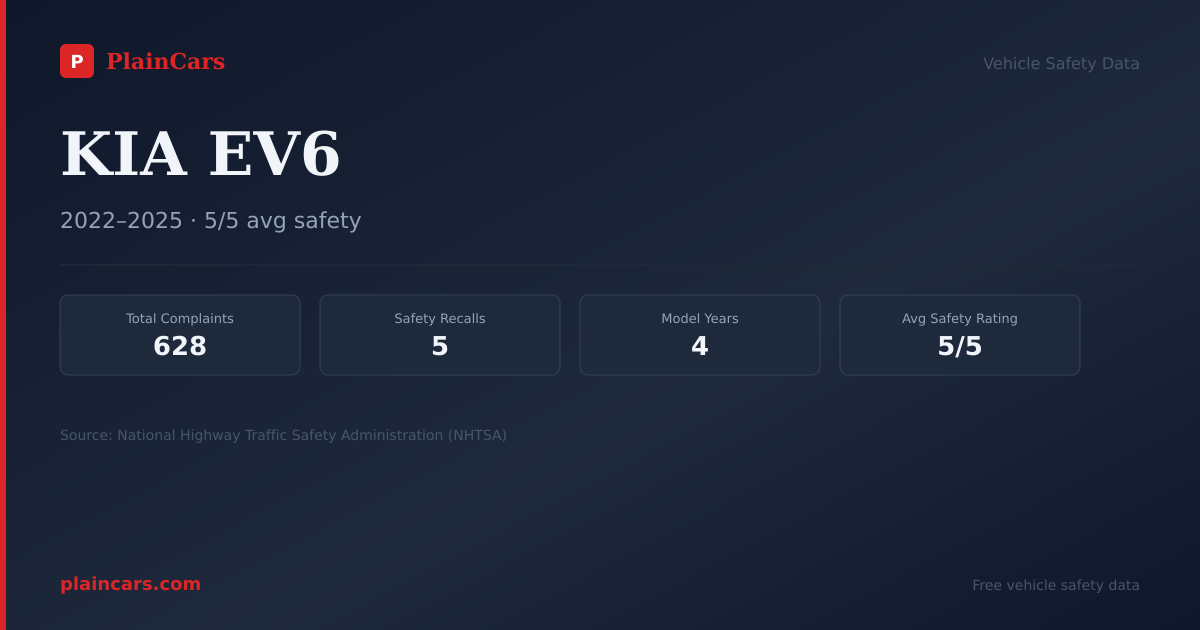
Total Complaints
360 filings
KIA EV6 · model year
360 NHTSA complaints, 25 crash reports, and 4 recall campaigns listed for this cohort. A VIN lookup is required to determine whether a specific vehicle has an unrepaired recall.
NHTSA overall rating
Not crash-tested
New Car Assessment Program
The verdict
The 2022 KIA EV6 posts above-average complaint volume among its own model-year siblings.
The 2022KIAEV6 carries 360 consumer safety complaints in NHTSA's Office of Defects Investigation database for this specific model-year cohort. Within that volume, owners reported 25 crashes, 0 fires, 10 injuries, and 3 fatalities. For crash performance, NHTSA's New Car Assessment Program gave this cohort an overall Not Rated/5 rating, with 5/5 front crash, 5/5 side crash, and Not Rated/5 rollover scores derived from standardized barrier and dynamic tests.
The most frequently selected component label in reports for the 2022 EV6 is electrical system with 171 filings, followed by fuel/propulsion system (36) and power train (33). Complaint categories reflect owner reports and intake categorization; they do not establish a defect pattern or cause. This cohort has 4 NHTSA recall campaigns listed below. Enter a VIN in NHTSA's official recall lookup to determine whether a specific vehicle has an unrepaired recall.
NHTSA currently has 38 investigation files overlapping the 2022 EV6. Owners comparing this cohort against neighboring years should read the complaint-by-year trend as report volume, not a causal diagnosis. Use the related-complaint feed and the official recall lookup when researching a specific vehicle.
PlainCars' own composite of NHTSA NCAP crash-test ratings and rollover-risk assessment, each dimension normalized against the federal scale or the full national model-year corpus. Not an official NHTSA figure, and not a substitute for a specific vehicle's VIN-level recall check.
Total Complaints
360 filings
Crashes Reported
25 reports
Source
NHTSA ODI
Federal complaints database
Above median complaint volume, review patterns below.
| Component | Count |
|---|---|
| ELECTRICAL SYSTEM | 171 |
| FUEL/PROPULSION SYSTEM | 36 |
| POWER TRAIN | 33 |
| UNKNOWN OR OTHER | 26 |
| SERVICE BRAKES | 12 |
| ENGINE | 10 |
| STRUCTURE:BODY | 9 |
| FORWARD COLLISION AVOIDANCE: WARNINGS | 8 |
| EXTERIOR LIGHTING | 8 |
| VEHICLE SPEED CONTROL | 8 |
| FORWARD COLLISION AVOIDANCE: AUTOMATIC EMERGENCY BRAKING | 6 |
| VISIBILITY/WIPER | 4 |
| LANE DEPARTURE: ASSIST | 4 |
| LANE DEPARTURE: BLIND SPOT DETECTION | 4 |
| FORWARD COLLISION AVOIDANCE: ADAPTIVE CRUISE CONTROL | 3 |
ELECTRICAL SYSTEM:12V/24V/48V BATTERY
Kia America, Inc. (Kia) is recalling certain 2022-2024 EV6 vehicles. The Integrated Charging Control Unit (ICCU) may become damaged and stop charging the 12-volt battery, which can result in a loss of drive power.
ELECTRICAL SYSTEM:12V/24V/48V BATTERY
Kia America, Inc. (Kia) is recalling certain 2022-2024 EV6 vehicles. The Integrated Charging Control Unit (ICCU) may become damaged and stop charging the 12-Volt battery, which can result in a loss of drive power.
PARKING BRAKE:ELECTRICAL:CONTROL MODULE:SOFTWARE
Kia Motor America (Kia) is recalling certain 2022 EV6 vehicles. A software error in the Shifter Control Unit (SCU) may disengage the parking mechanism, which can allow the vehicle to rollaway.
ELECTRICAL SYSTEM:PROPULSION SYSTEM:TRACTION BATTERY
Kia America, Inc. (Kia) is recalling certain 2022-2024 EV6 and 2024 EV9 vehicles. The high voltage battery cells may contain misaligned electrodes, which can lead to a fire while parked or driving.
Incident occured october 17, 2024. Was driving approximately 30mph on a local road when lights flashed to "check electric vehicle system". Was speed restricted to 25mph (on 45mph road) and was able to make it back home approximately 1 mile away. Car completely shut down in my street prior to making it to my driveway. It needed to be towed to the nearest dealership. No lights in dash working and flickering. Prior to this failure over the preceding several months there were errors where I would plug the car into Level 2 charging at home (9.6kWh) and the car would stop charging with a hot charging port approximately every 1 hour. I would unplug and replug in again. Charging would work. Level 3 was working just fine without problem. After going to the dealership it was deemed that the ICCU component needed to be replaced. After replacing car worked well and no charging issues occured.
Incident occured october 17, 2024. Was driving approximately 30mph on a local road when lights flashed to "check electric vehicle system". Was speed restricted to 25mph (on 45mph road) and was able to make it back home approximately 1 mile away. Car completely shut down in my street prior to making it to my driveway. It needed to be towed to the nearest dealership. No lights in dash working and flickering. Prior to this failure over the preceding several months there were errors where I would plug the car into Level 2 charging at home (9.6kWh) and the car would stop charging with a hot charging port approximately every 1 hour. I would unplug and replug in again. Charging would work. Level 3 was working just fine without problem. After going to the dealership it was deemed that the ICCU component needed to be replaced. After replacing car worked well and no charging issues occured.
Incident occured october 17, 2024. Was driving approximately 30mph on a local road when lights flashed to "check electric vehicle system". Was speed restricted to 25mph (on 45mph road) and was able to make it back home approximately 1 mile away. Car completely shut down in my street prior to making it to my driveway. It needed to be towed to the nearest dealership. No lights in dash working and flickering. Prior to this failure over the preceding several months there were errors where I would plug the car into Level 2 charging at home (9.6kWh) and the car would stop charging with a hot charging port approximately every 1 hour. I would unplug and replug in again. Charging would work. Level 3 was working just fine without problem. After going to the dealership it was deemed that the ICCU component needed to be replaced. After replacing car worked well and no charging issues occured.
While driving in traffic I heard a pop, then the "Check Electric Vehicle System" warning came on the dashboard. After a minute or so the dash warning changed to "Stop Vehicle" and the car limped home but at a lower speed. This matched the description I had seen of ICCU failures on Kia and Hyundai EVs. Dealer confirmed this was in fact the issue, and I had it replaced under warranty. This was a safety issue for me and my family because when it failed I was driving in traffic on a four-lane road at night, in <40-degree weather, and it requires a tow to the dealership for repair. Although I now have a new ICCU, I am also now concerned that it might happen again. The vehicle has not been inspected by police, insurance or manufacturer that I'm aware of.
While driving in traffic I heard a pop, then the "Check Electric Vehicle System" warning came on the dashboard. After a minute or so the dash warning changed to "Stop Vehicle" and the car limped home but at a lower speed. This matched the description I had seen of ICCU failures on Kia and Hyundai EVs. Dealer confirmed this was in fact the issue, and I had it replaced under warranty. This was a safety issue for me and my family because when it failed I was driving in traffic on a four-lane road at night, in <40-degree weather, and it requires a tow to the dealership for repair. Although I now have a new ICCU, I am also now concerned that it might happen again. The vehicle has not been inspected by police, insurance or manufacturer that I'm aware of.
While driving at speed, I heard a pop noise from the car. A few seconds later, I received notification to check vehicle electric system. The vehicle slowed down despite my increasing throttle input. I was able to limp to a parking lot where it was flat bed towed. This experience matches a previous issue I had when it was diagnosed with an ICCU failure with the same vehicle.
While driving at speed, I heard a pop noise from the car. A few seconds later, I received notification to check vehicle electric system. The vehicle slowed down despite my increasing throttle input. I was able to limp to a parking lot where it was flat bed towed. This experience matches a previous issue I had when it was diagnosed with an ICCU failure with the same vehicle.
While driving at speed, I heard a pop noise from the car. A few seconds later, I received notification to check vehicle electric system. The vehicle slowed down despite my increasing throttle input. I was able to limp to a parking lot where it was flat bed towed. This experience matches a previous issue I had when it was diagnosed with an ICCU failure with the same vehicle.
Integrated charging control unit (ICCU) failed. While my failure prevents ac charging, the unit is could also fail causing the 12v battery not to charge and the car to power down while driving on the highway. There were no indication of part failure.
Kia 2022 EV6 41,238 miles. The ICCU failed and was towed to KIA dealership. It was covered only because we got the extended warranty. Was at 88% charge, dashboard lit up with the warning “Check electric vehicle system”. Loss of drive power increases the risk of a crash.
ICCu failed. All the symptoms others have reported and discussed. (Reddit Kia subreddit + Kia Fotum). Sent home unable to charge. Kia claimed they could charge and wouldn’t do anything. After the second trip to the dealership they said “ it kick d out a ICCU code so we can replace it now”. They knew it was bad and the warranty protocol stinks. Software update did not prevent this. A fix and extended warranty should be required.
ICCU failed needed replacement, 2 weeks after 12v battery died.
I am reporting a recurring safety defect. While driving the vehicle the Integrated Charging Control unit (ICCU) failed and caused the vehicle to lose power and stop in the road. I feel strongly that this ICCU issue and subsequent failure should be made into a safety recall. Kia / Hyundai / Genesis all share the same e-gmp platform and utilize an ICCU that fails and leaves motorists in unsafe situations. The ICCU should be recalled and replaced with a unit that works. The current recall remedies are only software updates, and are insufficient to prevent this safety issue and hardware defect, posing ongoing safety risk to drivers and other motorists. The ICCU should be a permanent fix, rather than just software patches that do not fix the issue. My vehicle had all software patches and was up to date, yet those were not sufficient to prevent this hardware defect and safety situation.
I am reporting a recurring safety defect. While driving the vehicle the Integrated Charging Control unit (ICCU) failed and caused the vehicle to lose power and stop in the road. I feel strongly that this ICCU issue and subsequent failure should be made into a safety recall. Kia / Hyundai / Genesis all share the same e-gmp platform and utilize an ICCU that fails and leaves motorists in unsafe situations. The ICCU should be recalled and replaced with a unit that works. The current recall remedies are only software updates, and are insufficient to prevent this safety issue and hardware defect, posing ongoing safety risk to drivers and other motorists. The ICCU should be a permanent fix, rather than just software patches that do not fix the issue. My vehicle had all software patches and was up to date, yet those were not sufficient to prevent this hardware defect and safety situation.
This electric vehicle would not charge from a 120VAC or 240VAC source. It would charge using HVDC. It has been repaired by a KIA dealership and therefore the part is not available for inspection. I don't know that anyone's highway safety was at risk because the vehicle continued to operate normally and could be recharged, although not at home. That said, the failure presented as a dead-short to the EVSE, causing the circuit breaker to activate. If the home were improperly wired, I suppose an electrical fire could have occurred. The component that failed and was replaced is the "ICCU," the same component which was subject to a NHTSA recall for failing to maintain 12V power for charging the auxiliary battery and powering the 12V auxiliary equipment. The vehicle was inspected by a KIA dealer and the defective part was replaced. There was no advance warning. One day the vehicle charged normally. The next day, it did not. I am providing this information because NHTSA should have a co
I completed recall in March of 2025 for the ICCU, it failed driving down a busy road in January 2026. Kia did complete the repairs, but only warranties for 12k miles. It seems from forums I am in that this is a common problem. It also caused me to be without transportation for several weeks
I completed recall in March of 2025 for the ICCU, it failed driving down a busy road in January 2026. Kia did complete the repairs, but only warranties for 12k miles. It seems from forums I am in that this is a common problem. It also caused me to be without transportation for several weeks
The ICCU stopped working as we were driving on a backroom. The Check Electric Vehicle System" warning light came on, 12V battery discharge, and sudden loss of motor power. If this happened on the highway or while crossing an intersection, there is a high risk of getting hit by another vehicle by the car's sudden deacceleration. The same issue was replicated at the dealership and they are working on a repair or replacing the ICCU.
The car suddenly went into low power mode. It had to be towed to the dealer. The dealer learned the next day that the ICCU failed per the recall. However, while parts arrived a week ago, they do not have sufficient personnel to complete the work. They said it would likely be several more days. I was not offered a loaner. Were I not calling every few days I would not have any information. The dealer has never initiated a call to me for status.
Car lost all power and came to a stop while backing out of a driveway on a residential street. It would not respond to any attempts to start it. None of assessories worked. It had to be towed to the dealership. The dealer said the 12v battery was at fault and had to be ordered from Kia. I was told the ICCU unit had failed and drained the 12v battery. It waited for the part from Kia. Then the ICCU needed to be replaced. This was in 2024. The part was not examined. There were no warning signs or symptoms. Had I been in highway traffic my life would have been in danger
Data vintage: August 2026. Sources: NHTSA Office of Defects Investigation (ODI) complaints database, NHTSA recall campaign API, NHTSA NCAP crash-test ratings, and NHTSA FARS for fatality cross-reference.
Every figure on PlainCars is rendered directly from NHTSA complaint and safety data, no number is typed in by an editor. This year-specific record is rendered from NHTSA ODI, recall, and NCAP rows for the 2022 KIA EV6; no figure is typed in by an editor. See our editorial standards & corrections policy, the methodology behind these numbers, or report a data error. Data current as of August 2026.
Read our methodology - how this data is sourced, computed, and verified.