Total Complaints
7 filings
KIA Carnival Hybrid · model year
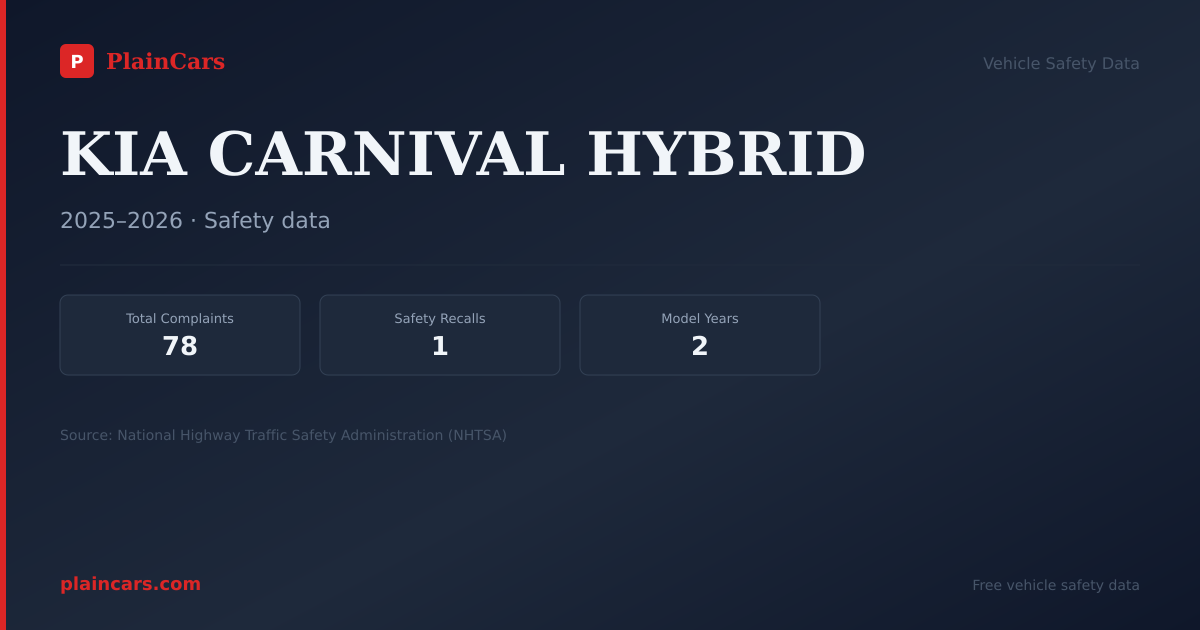
7 NHTSA complaints, and 1 recall campaign listed for this cohort. A VIN lookup is required to determine whether a specific vehicle has an unrepaired recall.
NHTSA overall rating
Not crash-tested
New Car Assessment Program
The 2026KIACarnival Hybrid carries 7 consumer safety complaints in NHTSA's Office of Defects Investigation database for this specific model-year cohort. Within that volume, owners reported 0 crashes, 0 fires, 0 injuries, and 0 fatalities. No NCAP 5-star crash-test rating is available for this model year in the federal database.
The most frequently selected component label in reports for the 2026 Carnival Hybrid is power train with 3 filings, followed by electrical system (1) and engine (1). Complaint categories reflect owner reports and intake categorization; they do not establish a defect pattern or cause. This cohort has 1 NHTSA recall campaign listed below. Enter a VIN in NHTSA's official recall lookup to determine whether a specific vehicle has an unrepaired recall.
NHTSA currently has 38 investigation files overlapping the 2026 Carnival Hybrid. Owners comparing this cohort against neighboring years should read the complaint-by-year trend as report volume, not a causal diagnosis. Use the related-complaint feed and the official recall lookup when researching a specific vehicle.
PlainCars' own composite of NHTSA NCAP crash-test ratings and rollover-risk assessment, each dimension normalized against the federal scale or the full national model-year corpus. Not an official NHTSA figure, and not a substitute for a specific vehicle's VIN-level recall check.
Total Complaints
7 filings
Crashes Reported
0 reports
Source
NHTSA ODI
Federal complaints database
At or below the fleet median complaint volume.
| Component | Count |
|---|---|
| POWER TRAIN | 3 |
| ELECTRICAL SYSTEM | 1 |
| ENGINE | 1 |
| FORWARD COLLISION AVOIDANCE: ADAPTIVE CRUISE CONTROL | 1 |
| VEHICLE SPEED CONTROL | 1 |
ELECTRICAL SYSTEM: INSTRUMENT CLUSTER/PANEL
Kia America, Inc. (Kia) is recalling certain 2025 Kia K4, 2025-2026 Sorento, Sorento Hybrid, Sorento Plug-In Hybrid Electric (PHEV), 2026 Sportage, Sportage Hybrid, Sportage PHEV, K5, EV9, Carnival, and Carnival Hybrid vehicles. Due to a software error, the instrument panel display may fail. As suc
Driving on freeway with the heater on, Cold weather, car had multiple issue messages (transmission control unit and adaptive cruise control) as well as a check engine light come on as the car went limp and would not accelerate. Has to pull off of the freeway after nearly getting in multiple accidents due to losing speed from 65 mph to 30. Had the gas pedal all the way to the ground and the car would barely accelerate.
Driving on freeway with the heater on, Cold weather, car had multiple issue messages (transmission control unit and adaptive cruise control) as well as a check engine light come on as the car went limp and would not accelerate. Has to pull off of the freeway after nearly getting in multiple accidents due to losing speed from 65 mph to 30. Had the gas pedal all the way to the ground and the car would barely accelerate.
Driving on freeway with the heater on, Cold weather, car had multiple issue messages (transmission control unit and adaptive cruise control) as well as a check engine light come on as the car went limp and would not accelerate. Has to pull off of the freeway after nearly getting in multiple accidents due to losing speed from 65 mph to 30. Had the gas pedal all the way to the ground and the car would barely accelerate.
Without presenting any errors, the vehicle appears to enter some sort of limp home mode which limits speed to 31mph until the vehicle is turned off and re-started. 31mph is well below the speed limit on most public roads and being limited to this speed with no ability to pull over to stop/start the car creates a significant safety hazard to the driver of the vehicle and other motorists.
On the highway, the vehicle would not accelerate and was losing speed even though the gas pedal was fully depressed. Initially, the vehicle was in ECO drive mode, traveling approximately 65 mph and the steering wheel paddle to toggle the regenerative breaking between levels 1-3 prior to getting onto the highway. The vehicle speed dropped from ~75mph into the low 50mph range on the highway and was able to maintain speed then slowly regain speed when then phenomenon would happen again. The engine light was not initially on but did come on eventually. The engine light flashed at first but then stayed solid. Eventually a safe space was found on the side of the highway to pull over and restart the car. After restarting, the vehicle was able to regain highway speed (using caution, slow acceleration to merge back onto the highway), however when attempting to accelerate faster to see if the problem persisted, it did and the car again would not accelerate even when fully depressing the gas
On the highway, the vehicle would not accelerate and was losing speed even though the gas pedal was fully depressed. Initially, the vehicle was in ECO drive mode, traveling approximately 65 mph and the steering wheel paddle to toggle the regenerative breaking between levels 1-3 prior to getting onto the highway. The vehicle speed dropped from ~75mph into the low 50mph range on the highway and was able to maintain speed then slowly regain speed when then phenomenon would happen again. The engine light was not initially on but did come on eventually. The engine light flashed at first but then stayed solid. Eventually a safe space was found on the side of the highway to pull over and restart the car. After restarting, the vehicle was able to regain highway speed (using caution, slow acceleration to merge back onto the highway), however when attempting to accelerate faster to see if the problem persisted, it did and the car again would not accelerate even when fully depressing the gas
On the highway, the vehicle would not accelerate and was losing speed even though the gas pedal was fully depressed. Initially, the vehicle was in ECO drive mode, traveling approximately 65 mph and the steering wheel paddle to toggle the regenerative breaking between levels 1-3 prior to getting onto the highway. The vehicle speed dropped from ~75mph into the low 50mph range on the highway and was able to maintain speed then slowly regain speed when then phenomenon would happen again. The engine light was not initially on but did come on eventually. The engine light flashed at first but then stayed solid. Eventually a safe space was found on the side of the highway to pull over and restart the car. After restarting, the vehicle was able to regain highway speed (using caution, slow acceleration to merge back onto the highway), however when attempting to accelerate faster to see if the problem persisted, it did and the car again would not accelerate even when fully depressing the gas
Data vintage: August 2026. Sources: NHTSA Office of Defects Investigation (ODI) complaints database, NHTSA recall campaign API, NHTSA NCAP crash-test ratings, and NHTSA FARS for fatality cross-reference.
Every figure on PlainCars is rendered directly from NHTSA complaint and safety data, no number is typed in by an editor. This year-specific record is rendered from NHTSA ODI, recall, and NCAP rows for the 2026 KIA Carnival Hybrid; no figure is typed in by an editor. See our editorial standards & corrections policy, the methodology behind these numbers, or report a data error. Data current as of August 2026.
Read our methodology - how this data is sourced, computed, and verified.