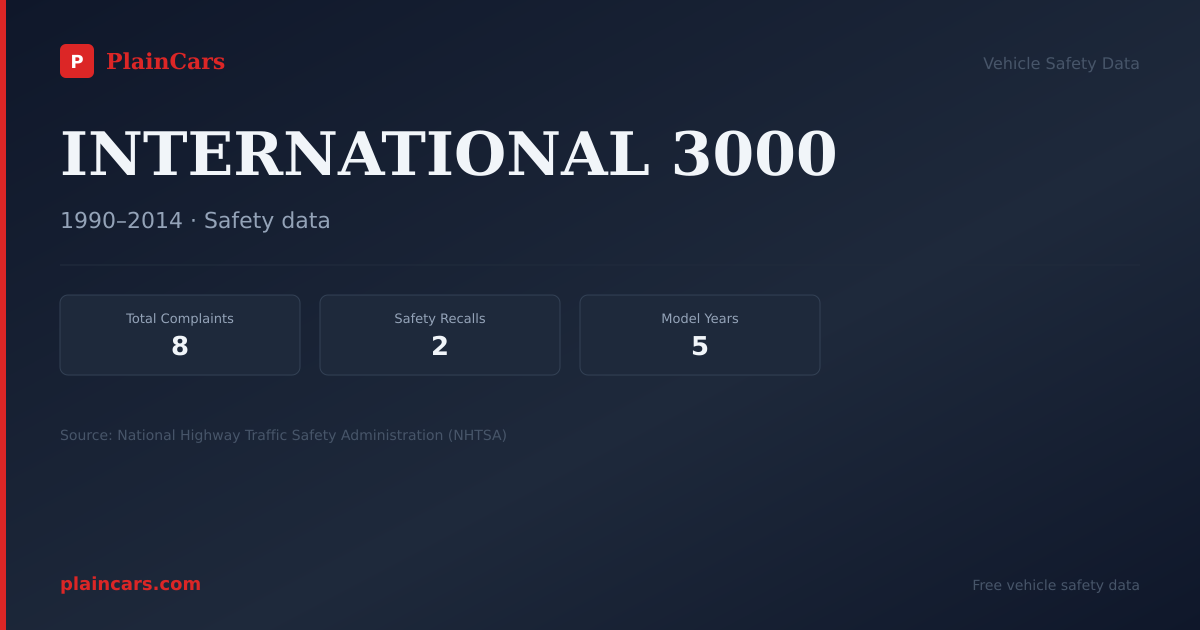
Total Complaints
1 filings
International 3000 · model year
1 NHTSA complaints, and 1 recall campaign listed for this cohort. A VIN lookup is required to determine whether a specific vehicle has an unrepaired recall.
NHTSA overall rating
Not crash-tested
New Car Assessment Program
The verdict
The 2009 International 3000 posts top-1% complaint standing (fewest filings) among its own model-year siblings.
The 2009International3000 carries 1 consumer safety complaint in NHTSA's Office of Defects Investigation database for this specific model-year cohort. Within that volume, owners reported 0 crashes, 0 fires, 0 injuries, and 0 fatalities. No NCAP 5-star crash-test rating is available for this model year in the federal database.
The most frequently selected component label in reports for the 2009 3000 is engine with 1 filings. Complaint categories reflect owner reports and intake categorization; they do not establish a defect pattern or cause. This cohort has 1 NHTSA recall campaign listed below. Enter a VIN in NHTSA's official recall lookup to determine whether a specific vehicle has an unrepaired recall.
NHTSA currently has 22 investigation files overlapping the 2009 3000. Owners comparing this cohort against neighboring years should read the complaint-by-year trend as report volume, not a causal diagnosis. Use the related-complaint feed and the official recall lookup when researching a specific vehicle.
PlainCars' own composite of NHTSA NCAP crash-test ratings and rollover-risk assessment, each dimension normalized against the federal scale or the full national model-year corpus. Not an official NHTSA figure, and not a substitute for a specific vehicle's VIN-level recall check.
Total Complaints
1 filings
Crashes Reported
0 reports
Source
NHTSA ODI
Federal complaints database
At or below the fleet median complaint volume.
| Component | Count |
|---|---|
| ENGINE | 1 |
ELECTRICAL SYSTEM
NAVISTAR IS RECALLING 51,588 HEAVY TRUCKS, COMMERCIAL BUSES AND SCHOOL BUSES MANUFACTURED BETWEEN NOVEMBER 21, 2000 AND MAY 21, 2008, EQUIPPED WITH ONE OR MORE REMOTE POWER MODULES. THE POTTING MATERIAL THAT ENCAPSULATES THE CIRCUIT BOARD OF THE VEHICLE'S REMOTE POWER MODULE MAY NOT SUFFICIENTLY SE
OUR SCHOOL BUS FLEET HAD 88 ENGINES AFFECTED BY SAFETY RECALL G-12523, "REPLACEMENT OF HIGH PRESSURE OIL LINE" DESPITE NEVER HAVING A PROBLEM WITH THE HIGH PRESSURE OIL HOSES BEFORE. THE DEALER RESPONDED QUICKLY, BUT AFTER COMPLETING APPROXIMATELY 20 HOSE CHANGES, SEVERAL OF THE ONES COMPLETED EXPERIENCED OIL LEAKS AT THE CONNECTION BY THE HEAD. THEY PAUSED A FEW WEEKS TO EVALUATE THE PROBLEM BEFORE COMPLETING THE REMAINDER OF THE FLEET BY ABOUT MAY 2013. WE HAVE EXPERIENCED NINE DIFFERENT BUS ENGINES THAT LEAKED AFTER COMPLETING THE RECALL. TWO OF THESE NINE HOSES LEAKED A SECOND TIME AFTER REPAIR. ONE OF THESE INCIDENTS WAS MAJOR RESULTING WITH AN ENGINE SHUTDOWN THAT REQUIRED SUBSTANTIAL OIL CLEAN UP ON A PUBLIC ROAD. THESE OIL LEAKS HAVE RESULTED IN SUBSTANTIAL DIRECT COSTS REPLACING OIL, ROUTE SCHEDULING AND VEHICLE DOWNTIME. *TR
Mileage: 69,891
Data vintage: August 2026. Sources: NHTSA Office of Defects Investigation (ODI) complaints database, NHTSA recall campaign API, NHTSA NCAP crash-test ratings, and NHTSA FARS for fatality cross-reference.
Every figure on PlainCars is rendered directly from NHTSA complaint and safety data, no number is typed in by an editor. This year-specific record is rendered from NHTSA ODI, recall, and NCAP rows for the 2009 International 3000; no figure is typed in by an editor. See our editorial standards & corrections policy, the methodology behind these numbers, or report a data error. Data current as of August 2026.
Read our methodology - how this data is sourced, computed, and verified.