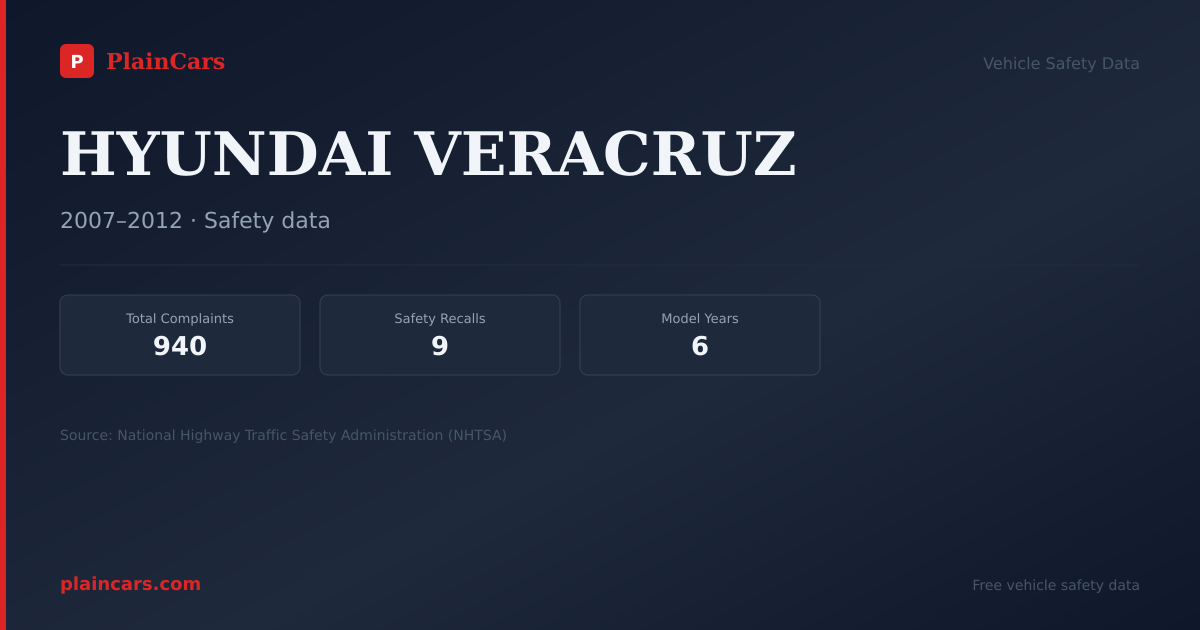
Total Complaints
358 filings
Hyundai Veracruz · model year
358 NHTSA complaints, 15 crash reports, and 7 recall campaigns listed for this cohort. A VIN lookup is required to determine whether a specific vehicle has an unrepaired recall.
NHTSA overall rating
Not crash-tested
New Car Assessment Program
The verdict
The 2008 Hyundai Veracruz posts above-average complaint volume among its own model-year siblings.
The 2008HyundaiVeracruz carries 358 consumer safety complaints in NHTSA's Office of Defects Investigation database for this specific model-year cohort. Within that volume, owners reported 15 crashes, 3 fires, 37 injuries, and 0 fatalities. No NCAP 5-star crash-test rating is available for this model year in the federal database.
The most frequently selected component label in reports for the 2008 Veracruz is electrical system with 57 filings, followed by engine (51) and service brakes (45). Complaint categories reflect owner reports and intake categorization; they do not establish a defect pattern or cause. This cohort has 7 NHTSA recall campaigns listed below. Enter a VIN in NHTSA's official recall lookup to determine whether a specific vehicle has an unrepaired recall.
NHTSA currently has 37 investigation files overlapping the 2008 Veracruz, and 1 remain open. Owners comparing this cohort against neighboring years should read the complaint-by-year trend as report volume, not a causal diagnosis. Use the related-complaint feed and the official recall lookup when researching a specific vehicle.
PlainCars' own composite of NHTSA NCAP crash-test ratings and rollover-risk assessment, each dimension normalized against the federal scale or the full national model-year corpus. Not an official NHTSA figure, and not a substitute for a specific vehicle's VIN-level recall check.
Total Complaints
358 filings
Crashes Reported
15 reports
Source
NHTSA ODI
Federal complaints database
Above median complaint volume, review patterns below.
| Component | Count |
|---|---|
| ELECTRICAL SYSTEM | 57 |
| ENGINE | 51 |
| SERVICE BRAKES | 45 |
| ENGINE AND ENGINE COOLING | 40 |
| ELECTRONIC STABILITY CONTROL (ESC) | 36 |
| AIR BAGS | 19 |
| STEERING | 15 |
| POWER TRAIN | 14 |
| VEHICLE SPEED CONTROL | 12 |
| EXTERIOR LIGHTING | 11 |
| UNKNOWN OR OTHER | 10 |
| SERVICE BRAKES, HYDRAULIC | 4 |
| SEAT BELTS | 4 |
| FUEL/PROPULSION SYSTEM | 4 |
| ELECTRICAL SYSTEM:ALTERNATOR/GENERATOR/REGULATOR | 4 |
EXTERIOR LIGHTING:BRAKE LIGHTS:SWITCH
HYUNDAI IS RECALLING 532,633 MY 2006-2007 ACCENT, ENTOURAGE, SONATA, MY 2007 AZERA, ELANTRA AND SANTA FE, MY 2005-2007 TUCSON AND MY 2007-2008 VERACRUZ VEHICLES. THE STOP LAMP SWITCH IN THE AFFECTED VEHICLES MAY MALFUNCTION. A MALFUNCTIONING STOP LAMP SWITCH MAY CAUSE THE BRAKE LIGHTS TO NOT ILLUM
ENGINE AND ENGINE COOLING:ENGINE:OIL/LUBRICATION:SEALS/GASKETS
Hyundai Motor America (Hyundai) is recalling certain 2007-2012 Veracruz vehicles that were previously recalled under recall number 14V-415. Oil may leak from the front cylinder bank cover gasket, potentially dripping onto the alternator and causing the charging system to become inoperative.
AIR BAGS:FRONTAL
HYUNDAI IS RECALLING CERTAIN MODEL YEAR 2007-2008 HYUNDAI VERACRUZ VEHICLES MANUFACTURED FROM DECEMBER 26, 2006, THROUGH MARCH 21, 2008, AND MODEL YEAR 2007-2008 HYUNDAI SANTA FE VEHICLES MANUFACTURED FROM APRIL 19, 2006 THROUGH MARCH 20, 2008. THE CLOCK SPRING CONTACT ASSEMBLY FOR THE DRIVER'S AIR
ENGINE AND ENGINE COOLING:ENGINE
Hyundai Motor Company (Hyundai) is recalling certain model year 2007-2012 Veracruz vehicles manufactured from December 26, 2006, through July 24, 2012. The affected vehicles may experience an oil leak from the front cylinder bank valve cover gasket. If there is a sufficient amount of oil dropped o
TRAILER HITCHES
THIS RECALL HAS BEEN SUPERCEDED BY RECALL 08E-055. HYUNDAI IS RECALLING 3,387 TRAILER HITCH WIRING HARNESSES EITHER INCLUDED WITH A TRAILER HITCH OR SOLD AS A SERVICE PART MANUFACTURED BY THULE TOWING SYSTEMS AND DISTRIBUTED BY HYUNDAI FOR INSTALLATION ON MY 2007-2008 SANTA FE AND VERACRUZ VEHICLES
TRAILER HITCHES
HYUNDAI IS RECALLING 3,387 TRAILER HITCH WIRING HARNESSES EITHER INCLUDED WITH A TRAILER HITCH OR SOLD AS A SERVICE PART MANUFACTURED BY THULE TOWING SYSTEMS AND DISTRIBUTED BY HYUNDAI FOR INSTALLATION ON MY 2007-2008 SANTA FE AND VERACRUZ VEHICLES. THE ACCESSORY TRAILER HITCH WIRING HARNESS CONVER
EXTERIOR LIGHTING:BRAKE LIGHTS:SWITCH
Hyundai Motor Company (Hyundai) is recalling certain model year 2006-2009 Accent, model year 2007-2011 Azera, Sonata and Sante Fe,2006-2011 Tucson, 2009-2011 Elantra Touring, 2007-2010 Elantra, 2008-2011 Veracruz, 2009-2011 Genesis, 2010-2011 Genesis Coupe, 2007-2008 Entourage, and 2006-2008 Tiburo
Radiator needs fluid and the liquid would go to the engine. The head gasket is blown. Repaired multiple times still giving the same issue. Oil is leaking.
Radiator needs fluid and the liquid would go to the engine. The head gasket is blown. Repaired multiple times still giving the same issue. Oil is leaking.
The contact owns a 2008 Hyundai Veracruz. The contact stated that while driving at an undisclosed speed, there was smoke coming from underneath the hood. The check engine warning light was illuminated. The vehicle was taken to an independent mechanic, who discovered there was oil leaking from the valve cover gasket. The mechanic performed an unknown repair, but the failure persisted. The vehicle was not repaired. The contact became aware of NHTSA Campaign Number: 20V705000 (Engine and Engine Cooling); associated with the VIN after the vehicle failed the State Inspection due to the unrepaired recall. The manufacturer was not made aware of the failure. The failure mileage was approximately 120,000.
Mileage: 120,000
This is referring to NHTSA recall 20V705000 a/k/a Hyundai TSB: 21-01047H-2 whereas my 2008 Hyundai Veracruz was brought into a Hyundai dealership regarding the above mentioned safety recall. Dealer refused to remedy the recall without first purchasing an otherwise irrelevant part to the remedy. The TSB clearly states all parts and labor necessary to honoring the safety recall would be granted to the consumer. This refusal to honor a recall poses a safety hazard as this vehicle is my sole form of transportation.
This is referring to NHTSA recall 20V705000 a/k/a Hyundai TSB: 21-01047H-2 whereas my 2008 Hyundai Veracruz was brought into a Hyundai dealership regarding the above mentioned safety recall. Dealer refused to remedy the recall without first purchasing an otherwise irrelevant part to the remedy. The TSB clearly states all parts and labor necessary to honoring the safety recall would be granted to the consumer. This refusal to honor a recall poses a safety hazard as this vehicle is my sole form of transportation.
Bought my Veracruz in 2018. After not even a year I started experiencing problems with the charging system. Car would die overnight. Replaced a battery with the new one 3 weeks later same thing happened. Changed many sensors checked the fuses looked for parasitic draw... battery cables. Removed the alternator had it checked at advance auto it was surprisingly good. It was covered with oil leaking out of valve cover.. replaced the valve cover seal but the problem still remains. That leakage messed up my charging system. I cannot even drive the car safely anymore because the voltage keeps dropping rapidly. Even tho alternator is good it's not charging the battery while car is running. P0346 is the code I'm getting when I scan the vehicle. Check engine and TPMS are on. I won't even be able to pass emissions test next month due to this mess.
Bought my Veracruz in 2018. After not even a year I started experiencing problems with the charging system. Car would die overnight. Replaced a battery with the new one 3 weeks later same thing happened. Changed many sensors checked the fuses looked for parasitic draw... battery cables. Removed the alternator had it checked at advance auto it was surprisingly good. It was covered with oil leaking out of valve cover.. replaced the valve cover seal but the problem still remains. That leakage messed up my charging system. I cannot even drive the car safely anymore because the voltage keeps dropping rapidly. Even tho alternator is good it's not charging the battery while car is running. P0346 is the code I'm getting when I scan the vehicle. Check engine and TPMS are on. I won't even be able to pass emissions test next month due to this mess.
The contact owns a 2008 Hyundai Veracruz. The contact stated that while his wife was driving at an undisclosed speed, the brakes seized in the middle of the highway. The contact stated that several unknown warning lights were illuminated. The contact's wife and a nearby driver were able to guide the vehicle to the shoulder of the roadway. The contact's wife raised the hood, and the contact became aware that smoke was coming from the ABS module accompanied by electrical sparks. The contact’s wife turned the vehicle off. The contact noticed that the aluminum ABS module casing was burned. The contact disconnected the battery and the ABS fuse, which stopped the smoke and the electrical sparks. The vehicle was then driven to the residence. The vehicle was not diagnosed or repaired by an independent mechanic or the dealer. The manufacturer was made aware of the failure but provided no assistance. The failure mileage was approximately 170,000.
Mileage: 170,000
The contact owns a 2008 Hyundai Veracruz. The contact stated that while his wife was driving at an undisclosed speed, the brakes seized in the middle of the highway. The contact stated that several unknown warning lights were illuminated. The contact's wife and a nearby driver were able to guide the vehicle to the shoulder of the roadway. The contact's wife raised the hood, and the contact became aware that smoke was coming from the ABS module accompanied by electrical sparks. The contact’s wife turned the vehicle off. The contact noticed that the aluminum ABS module casing was burned. The contact disconnected the battery and the ABS fuse, which stopped the smoke and the electrical sparks. The vehicle was then driven to the residence. The vehicle was not diagnosed or repaired by an independent mechanic or the dealer. The manufacturer was made aware of the failure but provided no assistance. The failure mileage was approximately 170,000.
Mileage: 170,000
ABS Anti-Lock Brake System Failure (ABS Control Unit) As seen in NHTSA CAMPAIGN [XXX], for newer year models, The Anti-Lock Brake System (ABS) module may leak brake fluid internally and cause an electrical short, which can result in an engine compartment fire while parked or driving. This recall should also include 2008-2010 Hyundai Veracruz's as the ABS Module is the same part number and can leak brake fluid. This can lead to serious injury or death as the car may not function as intended or catch on fire. I noticed a strong burning smell similar to burning toast when the car was dropped off at the shop. My Mechanics noticed my ABS Control Unit had liquid coming out of the poorly sealed module, and told me to report this to the NTSHA. The unit had to be replaced for about $3800. The first symptom is the ESC Light flashing while driving. Others include the AWD Light, Brake Light, ABS Light, and, Traction Control Lights. On many forums like the link shown below other people have
ABS Anti-Lock Brake System Failure (ABS Control Unit) As seen in NHTSA CAMPAIGN [XXX], for newer year models, The Anti-Lock Brake System (ABS) module may leak brake fluid internally and cause an electrical short, which can result in an engine compartment fire while parked or driving. This recall should also include 2008-2010 Hyundai Veracruz's as the ABS Module is the same part number and can leak brake fluid. This can lead to serious injury or death as the car may not function as intended or catch on fire. I noticed a strong burning smell similar to burning toast when the car was dropped off at the shop. My Mechanics noticed my ABS Control Unit had liquid coming out of the poorly sealed module, and told me to report this to the NTSHA. The unit had to be replaced for about $3800. The first symptom is the ESC Light flashing while driving. Others include the AWD Light, Brake Light, ABS Light, and, Traction Control Lights. On many forums like the link shown below other people have
ABS Anti-Lock Brake System Failure (ABS Control Unit) As seen in NHTSA CAMPAIGN [XXX], for newer year models, The Anti-Lock Brake System (ABS) module may leak brake fluid internally and cause an electrical short, which can result in an engine compartment fire while parked or driving. This recall should also include 2008-2010 Hyundai Veracruz's as the ABS Module is the same part number and can leak brake fluid. This can lead to serious injury or death as the car may not function as intended or catch on fire. I noticed a strong burning smell similar to burning toast when the car was dropped off at the shop. My Mechanics noticed my ABS Control Unit had liquid coming out of the poorly sealed module, and told me to report this to the NTSHA. The unit had to be replaced for about $3800. The first symptom is the ESC Light flashing while driving. Others include the AWD Light, Brake Light, ABS Light, and, Traction Control Lights. On many forums like the link shown below other people have
Component or System Failed or Malfunctioned: The ABS harness connecting to the ABS module is the primary culprit. Specifically, the top part of the harness is not adequately sealed, which has led to water ingress and subsequent wire shorting. Availability for Inspection: No, the ABS harness is available for inspection upon request. Safety Risk: The malfunctioning ABS harness poses a significant safety risk. When the ABS system fails, it affects braking performance, stability control, and traction control. This jeopardizes the safety of both the driver and other road users. Confirmation by Service Centers: While the issue was previously identified by the Hyundai Dealer it was attributed to a short in the Tow Hitch Wire. Unfortunately, the problem was not adequately resolved at that time. The recent appearance of the ESC Light, ABS Light, and Traction Control Light confirms that the issue persists. Inspections: The vehicle has not been inspected by the manufacturer, police, or insur
Component or System Failed or Malfunctioned: The ABS harness connecting to the ABS module is the primary culprit. Specifically, the top part of the harness is not adequately sealed, which has led to water ingress and subsequent wire shorting. Availability for Inspection: No, the ABS harness is available for inspection upon request. Safety Risk: The malfunctioning ABS harness poses a significant safety risk. When the ABS system fails, it affects braking performance, stability control, and traction control. This jeopardizes the safety of both the driver and other road users. Confirmation by Service Centers: While the issue was previously identified by the Hyundai Dealer it was attributed to a short in the Tow Hitch Wire. Unfortunately, the problem was not adequately resolved at that time. The recent appearance of the ESC Light, ABS Light, and Traction Control Light confirms that the issue persists. Inspections: The vehicle has not been inspected by the manufacturer, police, or insur
Component or System Failed or Malfunctioned: The ABS harness connecting to the ABS module is the primary culprit. Specifically, the top part of the harness is not adequately sealed, which has led to water ingress and subsequent wire shorting. Availability for Inspection: No, the ABS harness is available for inspection upon request. Safety Risk: The malfunctioning ABS harness poses a significant safety risk. When the ABS system fails, it affects braking performance, stability control, and traction control. This jeopardizes the safety of both the driver and other road users. Confirmation by Service Centers: While the issue was previously identified by the Hyundai Dealer it was attributed to a short in the Tow Hitch Wire. Unfortunately, the problem was not adequately resolved at that time. The recent appearance of the ESC Light, ABS Light, and Traction Control Light confirms that the issue persists. Inspections: The vehicle has not been inspected by the manufacturer, police, or insur
The contact owns a 2008 Hyundai Veracruz. The contact stated while driving at approximately 45 MPH and slowing to exit a highway while turning to the right on the exit ramp the vehicle stalled. The contact stated that the power steering failed, and extra force was needed to turn the steering wheel. The contact did not notice any warning lights being illuminated. The contact stopped and turned off and restarted the vehicle and the steering regained normal functionality. The vehicle was towed to an independent mechanic to be diagnosed. The mechanic determined that the alternator and battery needed to be replaced. The vehicle was repaired. The contact stated that the failure returned and additionally, the vehicle was leaking engine oil. The contact had taken the vehicle to a dealer who diagnosed the vehicle and determined that the alternator needed to be replaced and that the seal on the oil drain plug was replaced. The vehicle was repaired but was still leaking oil and experiencing inter
Mileage: 82,000
The contact owns a 2008 Hyundai Veracruz. The contact stated while driving at approximately 45 MPH and slowing to exit a highway while turning to the right on the exit ramp the vehicle stalled. The contact stated that the power steering failed, and extra force was needed to turn the steering wheel. The contact did not notice any warning lights being illuminated. The contact stopped and turned off and restarted the vehicle and the steering regained normal functionality. The vehicle was towed to an independent mechanic to be diagnosed. The mechanic determined that the alternator and battery needed to be replaced. The vehicle was repaired. The contact stated that the failure returned and additionally, the vehicle was leaking engine oil. The contact had taken the vehicle to a dealer who diagnosed the vehicle and determined that the alternator needed to be replaced and that the seal on the oil drain plug was replaced. The vehicle was repaired but was still leaking oil and experiencing inter
Mileage: 82,000
The contact owns a 2008 Hyundai Veracruz. The contact stated that the valve cover gasket was leaking and had been replaced several times, in addition to the manifold; however, the failure persisted. The contact received notification of NHTSA Campaign Number: 20V705000 (Engine and Engine Cooling); however, the part to do the recall repair was not yet available. The vehicle was taken to the dealer, where he was informed that the valve cover gasket was leaking. The vehicle was not repaired. The contact stated that the manufacturer had exceeded a reasonable amount of time for the recall repair. The manufacturer was made aware of the failure, and a case was opened; however, no further assistance was provided. The failure mileage was approximately 75,000. Parts distribution disconnect.
Mileage: 75,000
We received a recall notice during the pandemic for an issue that previously was a recall. It was repaired but was not a permanent fix. There was oil leaking on the alternator but we were told that they couldn't make the repair for three months due to being so backed up. We understood and put off the repair until they were more caught up. We took our Veracruz in for the repair, which was supposed to be at no cost to us, only to have the dealership want over $2000 to repair it or they said they couldn't guarantee that oil wouldn't continue to drip onto the alternator. We declined the extra cost because the recall was to replace the alternator and install an oil protector. They told us that our vehicle would be ready at a certain time and it wasn't. When we finally got it back they left out parts and didn't let us know they had them but easily located them when we went back to get them. The next morning after we picked up our vehicle it was dead and there was oil all over the inside unde
The contact owns a 2008 Hyundai Veracruz. The contact stated that while driving approximately 35 MPH, the vehicle started shaking violently and lost motive power and stalled. The contact was able to restart the vehicle and drive to his residence. The contact became aware that the alternator had shattered and was filled with oil. The contact called and notified the local dealer about the failure however, the vehicle was not diagnosed or repaired. The manufacturer was not contacted. The failure mileage was approximately 150,000.
Mileage: 150,000
Data vintage: August 2026. Sources: NHTSA Office of Defects Investigation (ODI) complaints database, NHTSA recall campaign API, NHTSA NCAP crash-test ratings, and NHTSA FARS for fatality cross-reference.
Every figure on PlainCars is rendered directly from NHTSA complaint and safety data, no number is typed in by an editor. This year-specific record is rendered from NHTSA ODI, recall, and NCAP rows for the 2008 Hyundai Veracruz; no figure is typed in by an editor. See our editorial standards & corrections policy, the methodology behind these numbers, or report a data error. Data current as of August 2026.
Read our methodology - how this data is sourced, computed, and verified.