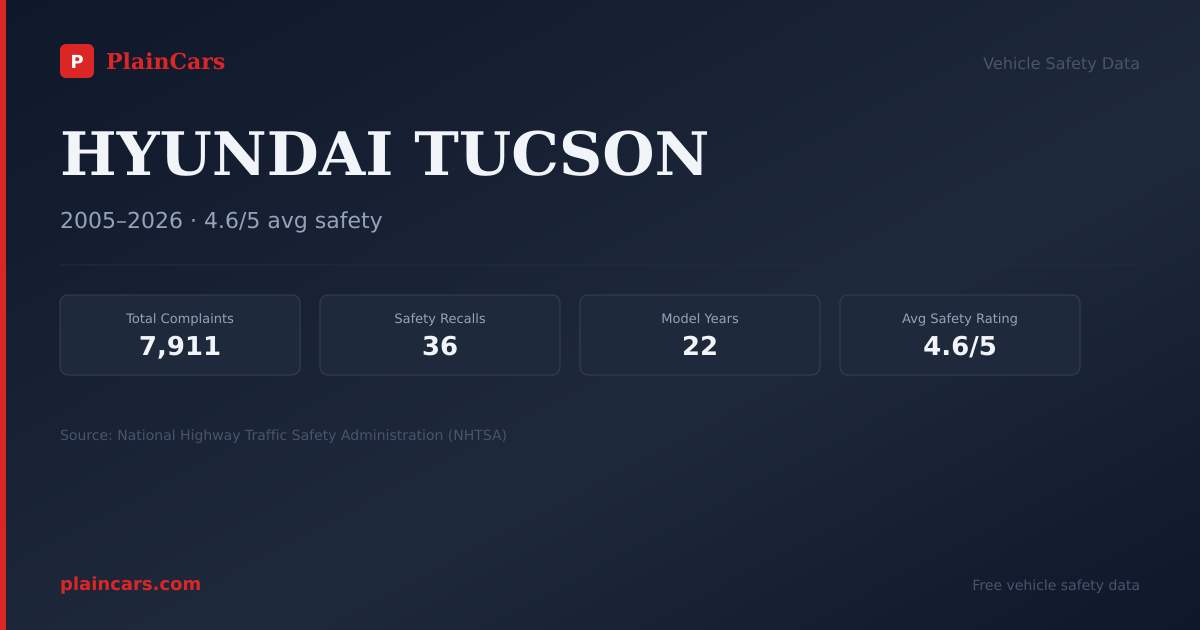
Total Complaints
2112 filings
Hyundai Tucson · model year
2112 NHTSA complaints, 23 crash reports, and 5 recall campaigns listed for this cohort. A VIN lookup is required to determine whether a specific vehicle has an unrepaired recall.
NHTSA overall rating
5 / 5 ★
New Car Assessment Program
The verdict
The 2016 Hyundai Tucson pairs above-average complaint volume with a top NHTSA safety rating.
The 2016HyundaiTucson carries 2112 consumer safety complaints in NHTSA's Office of Defects Investigation database for this specific model-year cohort. Within that volume, owners reported 23 crashes, 38 fires, 12 injuries, and 0 fatalities. For crash performance, NHTSA's New Car Assessment Program gave this cohort an overall 5/5 rating, with 5/5 front crash, 5/5 side crash, and 4/5 rollover scores derived from standardized barrier and dynamic tests.
The most frequently selected component label in reports for the 2016 Tucson is power train with 503 filings, followed by engine (406) and unknown or other (252). Complaint categories reflect owner reports and intake categorization; they do not establish a defect pattern or cause. This cohort has 5 NHTSA recall campaigns listed below. Enter a VIN in NHTSA's official recall lookup to determine whether a specific vehicle has an unrepaired recall.
NHTSA currently has 37 investigation files overlapping the 2016 Tucson, and 1 remain open. Owners comparing this cohort against neighboring years should read the complaint-by-year trend as report volume, not a causal diagnosis. Use the related-complaint feed and the official recall lookup when researching a specific vehicle.
PlainCars' own composite of NHTSA NCAP crash-test ratings and rollover-risk assessment, each dimension normalized against the federal scale or the full national model-year corpus. Not an official NHTSA figure, and not a substitute for a specific vehicle's VIN-level recall check.
Total Complaints
2112 filings
Crashes Reported
23 reports
Source
NHTSA ODI
Federal complaints database
Above median complaint volume, review patterns below.
| Component | Count |
|---|---|
| POWER TRAIN | 503 |
| ENGINE | 406 |
| UNKNOWN OR OTHER | 252 |
| STRUCTURE:BODY | 216 |
| ELECTRICAL SYSTEM | 205 |
| LATCHES/LOCKS/LINKAGES:DOORS:LATCH | 126 |
| VEHICLE SPEED CONTROL | 108 |
| FUEL/PROPULSION SYSTEM | 55 |
| SERVICE BRAKES | 33 |
| EXTERIOR LIGHTING | 26 |
| STEERING | 21 |
| VISIBILITY:POWER WINDOW DEVICES AND CONTROLS | 21 |
| AIR BAGS | 15 |
| LATCHES/LOCKS/LINKAGES | 15 |
| SERVICE BRAKES, HYDRAULIC | 14 |
POWER TRAIN:AUTOMATIC TRANSMISSION:CONTROL MODULE (TCM/PCM/TECM)
Hyundai Motor Company (Hyundai) is recalling certain model year 2016 Tucson vehicles manufactured May 20, 2015 through May 31, 2016 and equipped with a 7-speed EcoShift Dual Clutch Transmission. Certain driving conditions and high temperatures may cause the vehicle to not move if the accelerator pe
LATCHES/LOCKS/LINKAGES:HOOD:LATCH
Hyundai Motor Company (Hyundai) is recalling certain model year 2016 Tucson vehicles manufactured May 19, 2015 to March 14, 2016. In the affected vehicles, if the primary hood latch has been released, and the vehicle is driven, the secondary hood latch may not hold adequately secure the hood to pre
ELECTRICAL SYSTEM:WIRING
Hyundai Motor America (Hyundai) is recalling certain model year 2016-2017 Tucson vehicles manufactured May 19, 2015, to November 14, 2016, and 2017 Santa Fe vehicles manufactured November 28, 2015, to November 14, 2016. The affected vehicles may be equipped with an accessory trailer hitch wiring ha
EXTERIOR LIGHTING:TAIL LIGHTS
Hyundai Motor America (Hyundai) is recalling certain model year 2016 Hyundai Tucson vehicles manufactured May 26, 2015 to January 15, 2016 and equipped with an accessory trailer hitch harness either included with the accessory trailer hitch or sold as a service part. In the affected vehicles, when
SERVICE BRAKES, HYDRAULIC:ANTILOCK/TRACTION CONTROL/ELECTRONIC LIMITED SLIP:CONTROL UNIT/MODULE
Hyundai Motor America (Hyundai) recalled certain 2019-2021 Tucson vehicles on September 4, 2020. On December 30, 2020, Hyundai expanded the recall population, and added certain 2016-2018 Tucson vehicles. The Anti-lock Brake Hydraulic Electronic Control Unit (HECU) could corrode internally and caus
Excessive oil consumption caused engine failure on December 17, 2025. My truck stopped and I was stranded on Highway I55 South for 4 hours. Hyundai and the Extended warranty has denied fixing my truck. It is still at [XXX] Hyundai as of today. Hyundai’s failure to properly diagnose or repair this issue when it was first reported under warranty has caused financial burden, diminished vehicle value, loss of use and inconvenience, and emotional distress and stress. This is a legitimate safety concern. I am demanding resolution of an ongoing excessive oil consumption defect in my 2016 Hyundai vehicle. This defect began while the vehicle was under warranty and has continued despite proper maintenance and compliance with Hyundai’s service requirements. I expect Hyundai to honor its legal and contractual obligations without further delay. Please contact [XXX] [XXX] Hyundai) @ [XXX] for details regarding repairs, oil consumption tests, etc. INFORMATION REDACTED PURSUANT TO THE F
The engine, specifically cylinder # 3, has had a catastrophic failure at 114,000 miles. Engine repair shops and engine experts have determined the only fix is a complete engine replacement. Cost estimates are $8500 for a new engine + labor estimated at $2000. Scrap value is estimated at $1000 - $1500 The dealer from whom we bought the car in late 2015 said it is out of warranty. This is unacceptable. Please, please issue a recall on the engine of this vehicle. The vehicle is available for inspection if requested. Failure was catastrophic Problem has been confirmed by engine experts The car is not drivable to a manufacturing facility The engine has not been inspected by police nor our insurance company There we no warning lamps or messages Symptoms include shuddering at initial acceleration beginning at 75,000 miles Dealer said there was no problem and recommended and performed a transmission fluid change
Window regulator and motor have failed due to plastic gears stripping out. I have replaced my two front windows in 2024 at $1063 a window. This week I had both rear windows fail allowing the windows to drop down unexpectedly. I was able to manually pull the windows up and tape them. I was supposed to receive a call from Hyundai twice this week about getting these covered under a recall since all four has failed, but they have failed to contact me.
The contact owns a 2016 Hyundai Tucson. The contact stated that the check engine warning light was illuminated, and there was a ticking sound coming from the front of the vehicle. The vehicle was taken to Auto Zone, where a mechanic diagnosed the vehicle with a knock sensor failure. The knock sensor was replaced. The mechanic informed the contact that the vehicle was included in Manufacturer Campaign: CS966 for the transmission control module (TCM). The vehicle was taken to the dealer, who confirmed that the vehicle was included and the software update was performed. After the vehicle was repaired, the check engine warning light was no longer illuminated; however, approximately 30 minutes later, the vehicle failed to exceed 35 MPH, and the check engine warning light started flashing. The vehicle was returned to the dealer, and the contact was informed that the software update caused the vehicle to enter LIMP Mode to protect the engine. The dealer informed the contact to drive the vehic
Mileage: 125,000
The contact owns a 2016 Hyundai Tucson. The contact stated that the check engine warning light was illuminated, and there was a ticking sound coming from the front of the vehicle. The vehicle was taken to Auto Zone, where a mechanic diagnosed the vehicle with a knock sensor failure. The knock sensor was replaced. The mechanic informed the contact that the vehicle was included in Manufacturer Campaign: CS966 for the transmission control module (TCM). The vehicle was taken to the dealer, who confirmed that the vehicle was included and the software update was performed. After the vehicle was repaired, the check engine warning light was no longer illuminated; however, approximately 30 minutes later, the vehicle failed to exceed 35 MPH, and the check engine warning light started flashing. The vehicle was returned to the dealer, and the contact was informed that the software update caused the vehicle to enter LIMP Mode to protect the engine. The dealer informed the contact to drive the vehic
Mileage: 125,000
I have diligently maintained the vehicle with all scheduled services performed at the Rick Case Hyundai dealership. My maintenance records show a documented history of proper oil changes and other essential services. These records confirm that the vehicle was regularly serviced according to the manufacturer's recommendations. The diagnostic report from the dealership indicates bad piston and heat marks, but there is no evidence to suggest this was caused by a lack of proper maintenance.
I am filing this complaint regarding my 2016 Hyundai Tucson due to excessive oil consumption. The vehicle burns oil at an abnormal rate, requiring me to add approximately one quart of engine oil every one to two weeks, even though the vehicle is driven very infrequently. This condition poses a serious safety risk because the engine could run low or completely out of oil while the vehicle is in operation, potentially causing sudden engine failure. This vehicle is used to transport my family, including children, which puts their safety at risk. I have taken the vehicle to Hyundai dealerships multiple times for full ispection , but no defect, warning, or solution was ever identified or communicated to me. There have been no warning lights or messages on the dashboard to alert me of low oil levels or engine problems, increasing the risk of failure without warning. The problem is ongoing and repeatable, and the vehicle and engine are available for inspection upon request.
I am filing this complaint regarding my 2016 Hyundai Tucson due to excessive oil consumption. The vehicle burns oil at an abnormal rate, requiring me to add approximately one quart of engine oil every one to two weeks, even though the vehicle is driven very infrequently. This condition poses a serious safety risk because the engine could run low or completely out of oil while the vehicle is in operation, potentially causing sudden engine failure. This vehicle is used to transport my family, including children, which puts their safety at risk. I have taken the vehicle to Hyundai dealerships multiple times for full ispection , but no defect, warning, or solution was ever identified or communicated to me. There have been no warning lights or messages on the dashboard to alert me of low oil levels or engine problems, increasing the risk of failure without warning. The problem is ongoing and repeatable, and the vehicle and engine are available for inspection upon request.
The car has been diagnosed with internal engine failure by both an independent service center and a dealership service center. The issue was described as a rod timing issue causing knocking, leading to failure of the engine. A light was not on for a majority of the issue but did start flashing before car became completely undrivable. The car was sold to me with this issue and has been driven for nearly 3 years with a power loss issue that was dismissed as turbo lag or other issues. Driving a car with this issue that does not alert with a check engine light is a major threat to driver and passenger safety as it can result in engine seizure and vehicle fires. The engine issues began at the least before 58,000 miles, with total failure occuring at roughly 96,000 miles. Hyundai is known for this issue, particularly in turbo model engines. Only once during ownership of the car did the check engine light come on prior to engine failure. When checked, it was described as a catalytic converter
There is a major problem with certain year Hyundai vehicles from 2016-2021 with the engine burning oil and clogging up the exhaust. My moms vehicle has been at dealership for evaluation and combustion cleaning multiple times and the problem still continues. There has been times where she is driving car and it starts to bog down and loose power which is a safety issue especially if on highway. The vehicle is burning oil, occasionally have to add oil. The engine light does come on at times. The car has been at dealership for recommended oil consumption test at every 1000 miles and has not passed. Combustion cleaning done each time and sent on way. Called and made complaint with Hyundai corporate and and got no where. The tech department at Hyundai factory gave dealership recommendations to do which were completed and still having same issue. The factory was only willing to cover 70% off the cost of new catalytic convertor and my mom to be responsible for remaining balance. Hyundai claim
On my husband's way home from work he explained to me that the car had a "hiccup" and then an engine light blinked on, then it died at an intersection. He was pretty close to home so he got it started again and drove it home. He replaced spark plugs and coil packs and it still had a misfire. We took it to an auto repair shop where they did a scan and told us it had a dead hole in cylinder 2 and that it needs a full engine replacement. The car also had an oil change just before Thanksgiving. My husband checks oil regularly and added a quart a month before the oil change and it seems to consume more oil then it should.
Numerous issues with this vehicle. Now, when having oil change, told by the hyundai service center that it is using excessive oil and may need a new engine. In researching this problem, have discovered hyundai has had several problems with excessive oil consumption in their many of their hyundai vehicles, including the 2016 Tuscan
My 2016 Hyundai Tucson experienced engine failure consistent with known Hyundai engine defects. After reporting multiple battery outages, rapid oil consumption, and limited acceleration ability, outstanding warranties were checked and updated. However, the issues persisted, and the engine failed suddenly while I was driving. Hyundai denied warranty coverage without proof of the issues being unrelated to the warranty. This presents a serious safety hazard due to unexpected engine failure.
My 2016 Hyundai Tucson experienced engine failure consistent with known Hyundai engine defects. After reporting multiple battery outages, rapid oil consumption, and limited acceleration ability, outstanding warranties were checked and updated. However, the issues persisted, and the engine failed suddenly while I was driving. Hyundai denied warranty coverage without proof of the issues being unrelated to the warranty. This presents a serious safety hazard due to unexpected engine failure.
The contact owns a 2016 Hyundai Tucson. The contact stated that after coming to a complete stop, the vehicle failed to accelerate as intended while depressing the accelerator pedal. The vehicle went into LIMP Mode. In addition, the vehicle failed to accelerate above 30 MPH. No warning light was illuminated. The vehicle was taken to several dealers. The contact was informed that the unknown hoses and the dipstick melted inside due to the engine overheating. The contact stated that the catalytic converter was replaced; however, the failure persisted. The contact stated that the catalytic converter had been replaced three times since the first failure. The contact stated that on a separate occasion, the engine was consuming an excessive amount of engine oil. The contact was adding engine oil every two weeks. The vehicle was not diagnosed or repaired by an independent mechanic or dealer. The failure was a recurring failure, and the contact drove the vehicle intermittently due to the safety
Mileage: 90,000
The contact owns a 2016 Hyundai Tucson. The contact stated that after coming to a complete stop, the vehicle failed to accelerate as intended while depressing the accelerator pedal. The vehicle went into LIMP Mode. In addition, the vehicle failed to accelerate above 30 MPH. No warning light was illuminated. The vehicle was taken to several dealers. The contact was informed that the unknown hoses and the dipstick melted inside due to the engine overheating. The contact stated that the catalytic converter was replaced; however, the failure persisted. The contact stated that the catalytic converter had been replaced three times since the first failure. The contact stated that on a separate occasion, the engine was consuming an excessive amount of engine oil. The contact was adding engine oil every two weeks. The vehicle was not diagnosed or repaired by an independent mechanic or dealer. The failure was a recurring failure, and the contact drove the vehicle intermittently due to the safety
Mileage: 90,000
While driving under normal conditions, my engine experienced a sudden and catastrophic failure. The check-engine light illuminated, the vehicle began shaking violently, and I was forced to pull over immediately due to safety concerns. There was no prior warning and no oil pressure or oil warning light activated at any time before or during the failure. After stopping safely, I checked the oil level and found it lower than expected. I added oil as a precaution, but the condition did not improve and the vehicle became inoperable and required towing. The engine assembly remains intact and available for inspection upon request. This failure posed a serious safety risk, as the loss of engine function occurred without warning while the vehicle was in motion, creating the risk of stalling or loss of control. The vehicle was inspected by an authorized Hyundai dealership. Hyundai Motor America denied warranty and goodwill assistance, citing mileage and alleged insufficient maintenance docume
Car died/lost power while driving in traffic 11/28/25. Good Samaritan was kind enough to push me off the road out of traffic. Car was towed to Hyundai dealer that day, then 12/1 told engine failure, required engine replacement. Class action lawsuit settlement for engine replacement, but denied by Hyundai because of "neglect", since I am not able to locate all of the service records that they request. Known faulty rotating assembly, and Hyundai has implemented concerted practice of denying warranty coverage for failed engine. Now having to pay almost $8K to replace with new engine, but concern that new engine will have same issue. (multiple posts about this). There was high potential for significant traffic collision, injury due to sudden, catastrophic engine failure. Traumatic experience.
Car died/lost power while driving in traffic 11/28/25. Good Samaritan was kind enough to push me off the road out of traffic. Car was towed to Hyundai dealer that day, then 12/1 told engine failure, required engine replacement. Class action lawsuit settlement for engine replacement, but denied by Hyundai because of "neglect", since I am not able to locate all of the service records that they request. Known faulty rotating assembly, and Hyundai has implemented concerted practice of denying warranty coverage for failed engine. Now having to pay almost $8K to replace with new engine, but concern that new engine will have same issue. (multiple posts about this). There was high potential for significant traffic collision, injury due to sudden, catastrophic engine failure. Traumatic experience.
While driving on the highway at normal speed, the vehicle suddenly lost power and shut off without warning. There were no warning lights or messages prior to the loss of power. I was able to safely pull over, but the engine would not restart at that time and the vehicle required towing. The sudden engine shutdown occurred in active traffic and created a safety risk due to loss of propulsion. The vehicle later restarted, but I brought it to an authorized Hyundai dealership for inspection. The dealership diagnosed internal engine damage, including piston ring failure and cylinder wall scoring, and advised that the engine would need to be replaced. Since the incident, the vehicle has shown intermittent oil pressure warning lights and reduced performance. The issue has been confirmed by a dealer inspection. The vehicle is currently not considered reliable or safe for regular driving.
Data vintage: August 2026. Sources: NHTSA Office of Defects Investigation (ODI) complaints database, NHTSA recall campaign API, NHTSA NCAP crash-test ratings, and NHTSA FARS for fatality cross-reference.
Every figure on PlainCars is rendered directly from NHTSA complaint and safety data, no number is typed in by an editor. This year-specific record is rendered from NHTSA ODI, recall, and NCAP rows for the 2016 Hyundai Tucson; no figure is typed in by an editor. See our editorial standards & corrections policy, the methodology behind these numbers, or report a data error. Data current as of August 2026.
Read our methodology - how this data is sourced, computed, and verified.