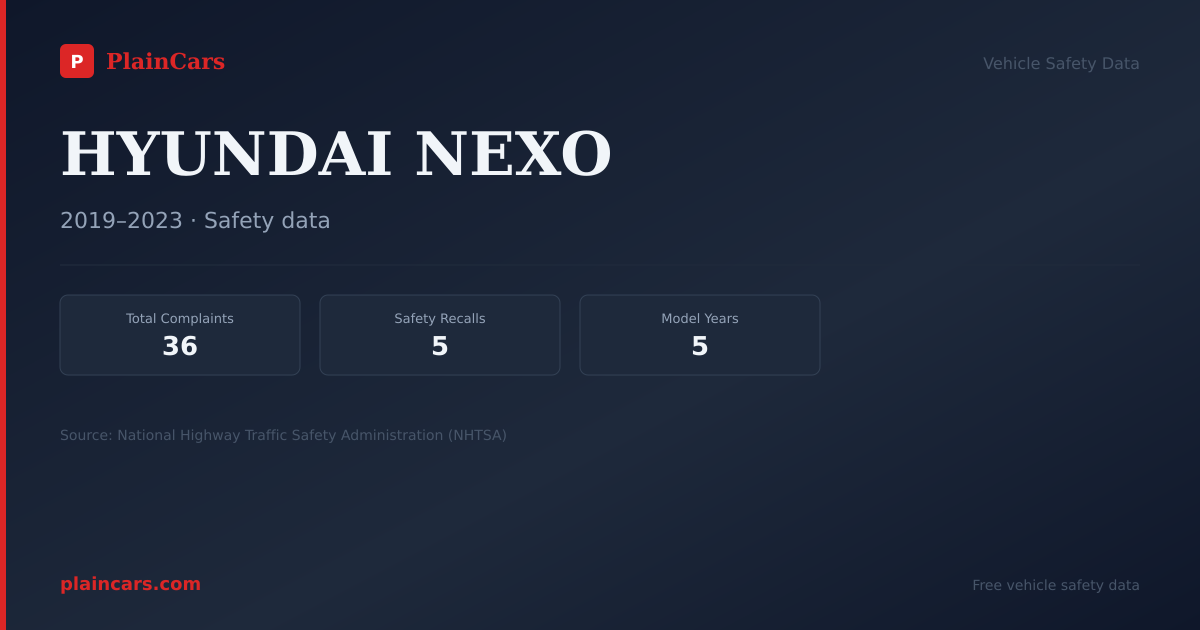
Total Complaints
9 filings
Hyundai Nexo · model year
9 NHTSA complaints, and 1 recall campaign listed for this cohort. A VIN lookup is required to determine whether a specific vehicle has an unrepaired recall.
NHTSA overall rating
Not crash-tested
New Car Assessment Program
The verdict
The 2023 Hyundai Nexo posts below-average complaint volume among its own model-year siblings.
The 2023HyundaiNexo carries 9 consumer safety complaints in NHTSA's Office of Defects Investigation database for this specific model-year cohort. Within that volume, owners reported 0 crashes, 0 fires, 0 injuries, and 0 fatalities. For crash performance, NHTSA's New Car Assessment Program gave this cohort an overall Not Rated/5 rating, with Not Rated/5 front crash, Not Rated/5 side crash, and Not Rated/5 rollover scores derived from standardized barrier and dynamic tests.
The most frequently selected component label in reports for the 2023 Nexo is fuel/propulsion system with 3 filings, followed by unknown or other (2) and service brakes (1). Complaint categories reflect owner reports and intake categorization; they do not establish a defect pattern or cause. This cohort has 1 NHTSA recall campaign listed below. Enter a VIN in NHTSA's official recall lookup to determine whether a specific vehicle has an unrepaired recall.
NHTSA currently has 37 investigation files overlapping the 2023 Nexo, and 1 remain open. Owners comparing this cohort against neighboring years should read the complaint-by-year trend as report volume, not a causal diagnosis. Use the related-complaint feed and the official recall lookup when researching a specific vehicle.
PlainCars' own composite of NHTSA NCAP crash-test ratings and rollover-risk assessment, each dimension normalized against the federal scale or the full national model-year corpus. Not an official NHTSA figure, and not a substitute for a specific vehicle's VIN-level recall check.
Total Complaints
9 filings
Crashes Reported
0 reports
Source
NHTSA ODI
Federal complaints database
At or below the fleet median complaint volume.
| Component | Count |
|---|---|
| FUEL/PROPULSION SYSTEM | 3 |
| UNKNOWN OR OTHER | 2 |
| SERVICE BRAKES | 1 |
| LANE DEPARTURE: ASSIST | 1 |
| FORWARD COLLISION AVOIDANCE: AUTOMATIC EMERGENCY BRAKING | 1 |
| ENGINE | 1 |
FUEL SYSTEM, OTHER:STORAGE:TANK ASSEMBLY:PRESSURE RELIEF DEVICES
Hyundai Motor America (Hyundai) is recalling certain 2019-2024 Nexo vehicles. The thermally activated pressure relief device (TPRD) may break and cause a hydrogen gas leak, which can result in a fire while parked.
The vehicle has a material operability limitation related to its fuel/propulsion system that was not disclosed at the time of sale. After purchase, the vehicle’s real-world operation is materially restricted due to fuel availability and system limitations that prevent reliable use as represented. The limitation affects the ability to operate the vehicle predictably and as intended. This issue is not cosmetic or preference-based. It affects normal vehicle operation and reliability. The condition is ongoing and reproducible. The dealer and manufacturer have been contacted. The condition has not been corrected.
The vehicle has a material operability limitation related to its fuel/propulsion system that was not disclosed at the time of sale. After purchase, the vehicle’s real-world operation is materially restricted due to fuel availability and system limitations that prevent reliable use as represented. The limitation affects the ability to operate the vehicle predictably and as intended. This issue is not cosmetic or preference-based. It affects normal vehicle operation and reliability. The condition is ongoing and reproducible. The dealer and manufacturer have been contacted. The condition has not been corrected.
The vehicle has a material operability limitation related to its fuel/propulsion system that was not disclosed at the time of sale. After purchase, the vehicle’s real-world operation is materially restricted due to fuel availability and system limitations that prevent reliable use as represented. The limitation affects the ability to operate the vehicle predictably and as intended. This issue is not cosmetic or preference-based. It affects normal vehicle operation and reliability. The condition is ongoing and reproducible. The dealer and manufacturer have been contacted. The condition has not been corrected.
Vehicle: 2023 Hyundai Nexo Limited VIN: [XXX] Mileage at failure: ~12,077 Location: California What is the problem? After Hyundai performed Safety Recall 269 (thermally-activated pressure relief device) on my vehicle, the vehicle developed a hydrogen leak and was declared unsafe. Hyundai advised that no repair remedy is available. When did this happen? January 13, 2026, during attempted pickup from the dealership following recall service. What happened? My vehicle was taken to an authorized Hyundai dealer for Safety Recall 269. On the evening of January 12, 2026, the service advisor called and said the vehicle was ready for pickup. When I arrived the next day, the dealer attempted to bring the vehicle out. A malfunction appeared, and after over an hour, I was told the vehicle was leaking hydrogen and was unsafe to release. The dealer retained the vehicle and provided a loaner. The following day I was informed that the vehicle would be bought back and that no repair remedy or parts are
The vehicle uses hydrogen fuel which is stored in three high pressure cylinders. Any fires or damage to the vehicle that affects the fuel system can result in an explosion. During a recent recall, customers were recommended not to park near structures because the car can explode and cause property damage. This is applicable to all hydrogen fuel cell vehicles available in the US.
The vehicle uses hydrogen fuel which is stored in three high pressure cylinders. Any fires or damage to the vehicle that affects the fuel system can result in an explosion. During a recent recall, customers were recommended not to park near structures because the car can explode and cause property damage. This is applicable to all hydrogen fuel cell vehicles available in the US.
The vehicle uses hydrogen fuel which is stored in three high pressure cylinders. Any fires or damage to the vehicle that affects the fuel system can result in an explosion. During a recent recall, customers were recommended not to park near structures because the car can explode and cause property damage. This is applicable to all hydrogen fuel cell vehicles available in the US.
A THERMALLY-ACTIVATED PRESSURE RELIEF DEVICE (TPRD) THAT VENTS HYDROGEN GAS TO THE ATMOSPHERE TO PREVENT OVER-PRESSURIZATION OF THE HYDROGEN FUEL TANK IN THE EVENT OF OVERHEATING IN THE LOCAL AREA AROUND THE HYDROGEN FUEL TANKS. THE TPRD IS DESIGNED TO VENTTHROUGH A GLASS BULB-TYPE RELEASE MECHANISM THAT FRACTURES WHEN A SPECIFICOPERTAING TEMPERATURE IS REACHED. THE GLASS BULB-TYPE MECHANISM IN THE SUBJECT VEHICLES COULD PREMATURELY FRACTURE DUE TO MICROCRACKS IN THE GLASS, WHICH COULD LEAD TO INADVERTENT DISCHARGE OF HYDROGEN GAS DURING NORMAL VEHICLE OPERATION. HYDROGEN GAS LEAKING IN CONFINED AREAS WITH THE PRESENCE OF AN IGNITION SURCE MAY INCREASE THE RISK OF A VEHICLE FIRE WHIEL PARKED. THE DEALER WILL NOT BE ABLE TO REPAIR UNTIL MAY 12, 2025
I WAS DRIVEN ABOUT 65 MILES WHEN SUDDENLY SHOW ON THE CLUSTER EMERGENCY BRAKE APPLY IT HAPPEN TODAY AND ABOUT 2 WEEKS BEFORE . I HAPPEN LIKE 5 SECONDS AND DISAPPEAR AND BOTH CASES.
Data vintage: August 2026. Sources: NHTSA Office of Defects Investigation (ODI) complaints database, NHTSA recall campaign API, NHTSA NCAP crash-test ratings, and NHTSA FARS for fatality cross-reference.
Every figure on PlainCars is rendered directly from NHTSA complaint and safety data, no number is typed in by an editor. This year-specific record is rendered from NHTSA ODI, recall, and NCAP rows for the 2023 Hyundai Nexo; no figure is typed in by an editor. See our editorial standards & corrections policy, the methodology behind these numbers, or report a data error. Data current as of August 2026.
Read our methodology - how this data is sourced, computed, and verified.