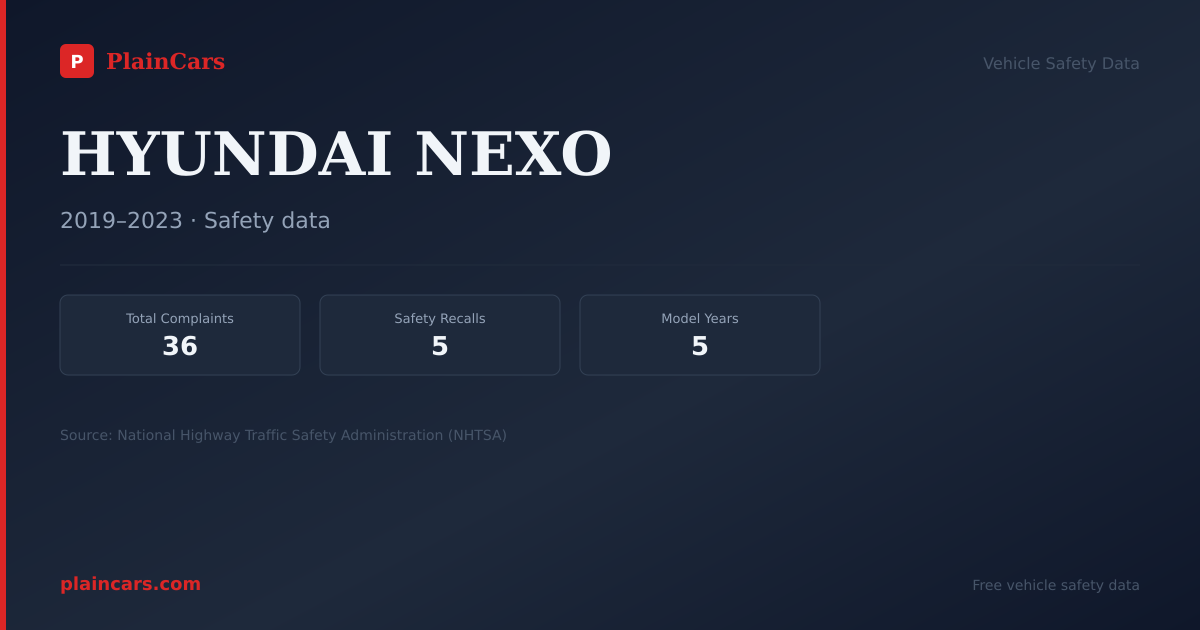
Total Complaints
10 filings
Hyundai Nexo · model year
10 NHTSA complaints, and 2 recall campaigns listed for this cohort. A VIN lookup is required to determine whether a specific vehicle has an unrepaired recall.
NHTSA overall rating
Not crash-tested
New Car Assessment Program
The verdict
The 2021 Hyundai Nexo posts above-average complaint volume among its own model-year siblings.
The 2021HyundaiNexo carries 10 consumer safety complaints in NHTSA's Office of Defects Investigation database for this specific model-year cohort. Within that volume, owners reported 0 crashes, 0 fires, 0 injuries, and 0 fatalities. For crash performance, NHTSA's New Car Assessment Program gave this cohort an overall Not Rated/5 rating, with Not Rated/5 front crash, Not Rated/5 side crash, and Not Rated/5 rollover scores derived from standardized barrier and dynamic tests.
The most frequently selected component label in reports for the 2021 Nexo is fuel/propulsion system with 3 filings, followed by electrical system (2) and engine (2). Complaint categories reflect owner reports and intake categorization; they do not establish a defect pattern or cause. This cohort has 2 NHTSA recall campaigns listed below. Enter a VIN in NHTSA's official recall lookup to determine whether a specific vehicle has an unrepaired recall.
NHTSA currently has 37 investigation files overlapping the 2021 Nexo, and 1 remain open. Owners comparing this cohort against neighboring years should read the complaint-by-year trend as report volume, not a causal diagnosis. Use the related-complaint feed and the official recall lookup when researching a specific vehicle.
PlainCars' own composite of NHTSA NCAP crash-test ratings and rollover-risk assessment, each dimension normalized against the federal scale or the full national model-year corpus. Not an official NHTSA figure, and not a substitute for a specific vehicle's VIN-level recall check.
Total Complaints
10 filings
Crashes Reported
0 reports
Source
NHTSA ODI
Federal complaints database
At or below the fleet median complaint volume.
| Component | Count |
|---|---|
| FUEL/PROPULSION SYSTEM | 3 |
| ELECTRICAL SYSTEM | 2 |
| ENGINE | 2 |
| FORWARD COLLISION AVOIDANCE: AUTOMATIC EMERGENCY BRAKING | 1 |
| FUEL SYSTEM, OTHER | 1 |
| POWER TRAIN | 1 |
FUEL SYSTEM, OTHER:DELIVERY
Hyundai Motor America (Hyundai) is recalling certain 2019-2021 Nexo vehicles. The hydrogen gas detection sensors may fail to detect leaks in the hydrogen gas delivery system.
FUEL SYSTEM, OTHER:STORAGE:TANK ASSEMBLY:PRESSURE RELIEF DEVICES
Hyundai Motor America (Hyundai) is recalling certain 2019-2024 Nexo vehicles. The thermally activated pressure relief device (TPRD) may break and cause a hydrogen gas leak, which can result in a fire while parked.
Hydrogen fuel cell system is unstable/unreliable. Vehicle fueling infrastructure is completely unreliable and cannot be depended on for safe, ongoing operation of vehicle.
It has become more frequent for there to be a delay in acceleration of about 3 to 4 seconds when traveling uphill. My car lost acceleration while going uphill. As I was gradually accelerating from a red traffic light to climb a hill, my car became stuck at a certain speed, around 50 mph on April 3rd. Even when pressing the acceleration pedal to the maximum, it wouldn't accelerate. On March 2nd, while entering the freeway on an uphill section, my car suddently lost acceleration and slowed down for about 4 seconds before finally accelerating again. At the moment, a car was traveling fast in the right lane, and I narrowly avoided being hit by it. I quickly moved onto the shoulder and then returned to the right lane when it was safe. Posing serious safety concerns for both myself as the driver and any passengers in the car. My car has been towed in and is currently being investigated by technicians at the Hyundai dealer (Tustin) since 4/05/2024.
It has become more frequent for there to be a delay in acceleration of about 3 to 4 seconds when traveling uphill. My car lost acceleration while going uphill. As I was gradually accelerating from a red traffic light to climb a hill, my car became stuck at a certain speed, around 50 mph on April 3rd. Even when pressing the acceleration pedal to the maximum, it wouldn't accelerate. On March 2nd, while entering the freeway on an uphill section, my car suddently lost acceleration and slowed down for about 4 seconds before finally accelerating again. At the moment, a car was traveling fast in the right lane, and I narrowly avoided being hit by it. I quickly moved onto the shoulder and then returned to the right lane when it was safe. Posing serious safety concerns for both myself as the driver and any passengers in the car. My car has been towed in and is currently being investigated by technicians at the Hyundai dealer (Tustin) since 4/05/2024.
It has become more frequent for there to be a delay in acceleration of about 3 to 4 seconds when traveling uphill. My car lost acceleration while going uphill. As I was gradually accelerating from a red traffic light to climb a hill, my car became stuck at a certain speed, around 50 mph on April 3rd. Even when pressing the acceleration pedal to the maximum, it wouldn't accelerate. On March 2nd, while entering the freeway on an uphill section, my car suddently lost acceleration and slowed down for about 4 seconds before finally accelerating again. At the moment, a car was traveling fast in the right lane, and I narrowly avoided being hit by it. I quickly moved onto the shoulder and then returned to the right lane when it was safe. Posing serious safety concerns for both myself as the driver and any passengers in the car. My car has been towed in and is currently being investigated by technicians at the Hyundai dealer (Tustin) since 4/05/2024.
Catastrophic issue awaiting to happen. I am fearful the car can blow up. Hydrogen gas leak has been detected since March 2022. After and during the pumping, often there would be a loud hissing sound coming from the vehicle no from the pump itself. After fueling with hydrogen gas, it takes a minute for the car to read and update the tank. Then it throws loud flashing warnings on the dashboard stating the car needs to be pull over immediately. It reads “Hydrogen leak detected. Stop safely immediately. Check fuel cell system. Range limited to 2 mi. Stop safely immediately”. The use of this car is to drive my family around including to and from school. My kids are scare to be in the car. I am terrified that the car could be a bomb. People in line with the Toyota Mirai were frighten. They said I shouldn’t be driving this car. This has been happening since March 2021. Hyundai acknowledges the issue and issues recall 225. I went into service the vehicle on Sep 29 an
The contact owns a 2021 Hyundai Nexo. The contact received notification of NHTSA Campaign Number: 22V258000 (Fuel System, Other, Electrical System) however, the part to do the recall repair was not yet available. The contact stated that the manufacturer had exceeded a reasonable amount of time for the recall repair. The dealer was made aware of the issue and confirmed that parts were not yet available. The manufacturer was made aware of the issue and confirmed that parts were not yet available. The contact had not experienced a failure. VIN tool confirms parts not available.
The contact owns a 2021 Hyundai Nexo. The contact received notification of NHTSA Campaign Number: 22V258000 (Fuel System, Other, Electrical System) however, the part to do the recall repair was not yet available. The contact stated that the manufacturer had exceeded a reasonable amount of time for the recall repair. The dealer was made aware of the issue and confirmed that parts were not yet available. The manufacturer was made aware of the issue and confirmed that parts were not yet available. The contact had not experienced a failure. VIN tool confirms parts not available.
The car does not automatically brake to avoid collision. I have tested the car by going straight into a large object either another car or person in front of my car and it will not brake. In addition the hydrogen sensor is not working properly as I have already been informed of from their recall number 225 NHTSA Recall 22V-258 which I just received a few days ago. I am dissappointed that it took 3 months for Hyundai to notify me of this very serious safety issue and I am now calling the NHTSA to see what options I have to return this vehicle as I do not feel safe driving, operating, or even parking my car at my home with a hydrogen sensor that is faulty as that is a very serious fire hazard.
The car does not automatically brake to avoid collision. I have tested the car by going straight into a large object either another car or person in front of my car and it will not brake. In addition the hydrogen sensor is not working properly as I have already been informed of from their recall number 225 NHTSA Recall 22V-258 which I just received a few days ago. I am dissappointed that it took 3 months for Hyundai to notify me of this very serious safety issue and I am now calling the NHTSA to see what options I have to return this vehicle as I do not feel safe driving, operating, or even parking my car at my home with a hydrogen sensor that is faulty as that is a very serious fire hazard.
The car does not automatically brake to avoid collision. I have tested the car by going straight into a large object either another car or person in front of my car and it will not brake. In addition the hydrogen sensor is not working properly as I have already been informed of from their recall number 225 NHTSA Recall 22V-258 which I just received a few days ago. I am dissappointed that it took 3 months for Hyundai to notify me of this very serious safety issue and I am now calling the NHTSA to see what options I have to return this vehicle as I do not feel safe driving, operating, or even parking my car at my home with a hydrogen sensor that is faulty as that is a very serious fire hazard.
Data vintage: August 2026. Sources: NHTSA Office of Defects Investigation (ODI) complaints database, NHTSA recall campaign API, NHTSA NCAP crash-test ratings, and NHTSA FARS for fatality cross-reference.
Every figure on PlainCars is rendered directly from NHTSA complaint and safety data, no number is typed in by an editor. This year-specific record is rendered from NHTSA ODI, recall, and NCAP rows for the 2021 Hyundai Nexo; no figure is typed in by an editor. See our editorial standards & corrections policy, the methodology behind these numbers, or report a data error. Data current as of August 2026.
Read our methodology - how this data is sourced, computed, and verified.