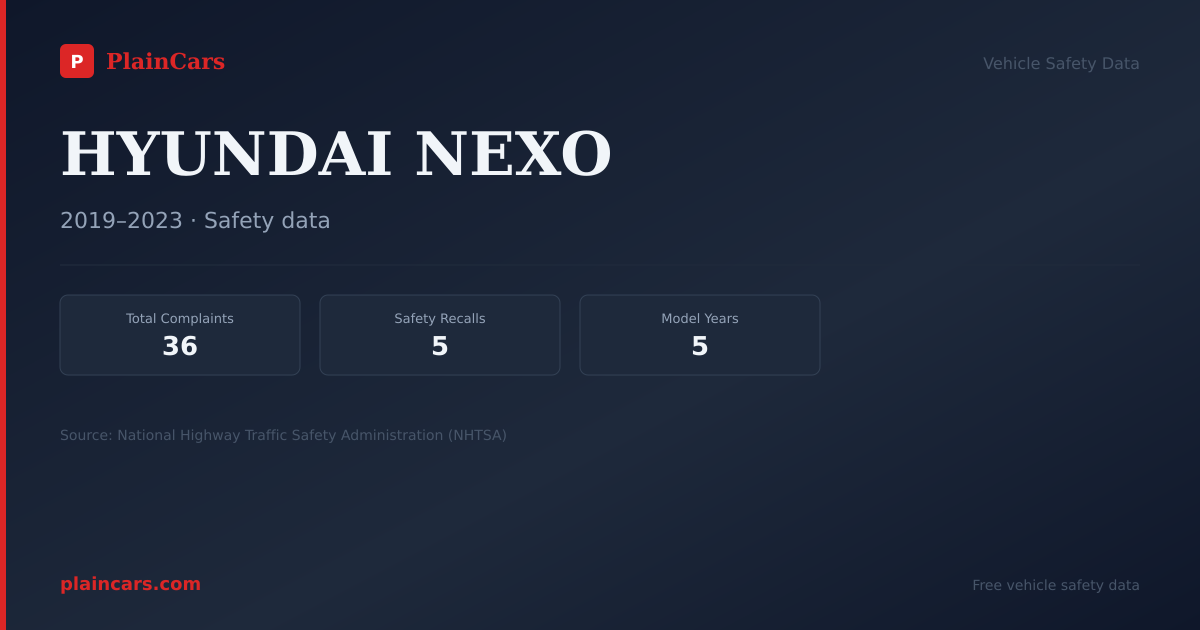
Total Complaints
13 filings
Hyundai Nexo · model year
13 NHTSA complaints, and 4 recall campaigns listed for this cohort. A VIN lookup is required to determine whether a specific vehicle has an unrepaired recall.
NHTSA overall rating
Not crash-tested
New Car Assessment Program
The verdict
The 2020 Hyundai Nexo posts above-average complaint volume among its own model-year siblings.
The 2020HyundaiNexo carries 13 consumer safety complaints in NHTSA's Office of Defects Investigation database for this specific model-year cohort. Within that volume, owners reported 0 crashes, 0 fires, 0 injuries, and 0 fatalities. For crash performance, NHTSA's New Car Assessment Program gave this cohort an overall Not Rated/5 rating, with Not Rated/5 front crash, Not Rated/5 side crash, and Not Rated/5 rollover scores derived from standardized barrier and dynamic tests.
The most frequently selected component label in reports for the 2020 Nexo is fuel/propulsion system with 5 filings, followed by engine (2) and power train (2). Complaint categories reflect owner reports and intake categorization; they do not establish a defect pattern or cause. This cohort has 4 NHTSA recall campaigns listed below. Enter a VIN in NHTSA's official recall lookup to determine whether a specific vehicle has an unrepaired recall.
NHTSA currently has 37 investigation files overlapping the 2020 Nexo, and 1 remain open. Owners comparing this cohort against neighboring years should read the complaint-by-year trend as report volume, not a causal diagnosis. Use the related-complaint feed and the official recall lookup when researching a specific vehicle.
PlainCars' own composite of NHTSA NCAP crash-test ratings and rollover-risk assessment, each dimension normalized against the federal scale or the full national model-year corpus. Not an official NHTSA figure, and not a substitute for a specific vehicle's VIN-level recall check.
Total Complaints
13 filings
Crashes Reported
0 reports
Source
NHTSA ODI
Federal complaints database
At or below the fleet median complaint volume.
| Component | Count |
|---|---|
| FUEL/PROPULSION SYSTEM | 5 |
| ENGINE | 2 |
| POWER TRAIN | 2 |
| ELECTRICAL SYSTEM:PROPULSION SYSTEM:FUEL CELL | 1 |
| UNKNOWN OR OTHER | 1 |
| VEHICLE SPEED CONTROL | 1 |
| FUEL SYSTEM, OTHER | 1 |
FUEL SYSTEM, OTHER:DELIVERY
Hyundai Motor America (Hyundai) is recalling certain 2019-2021 Nexo vehicles. The hydrogen gas detection sensors may fail to detect leaks in the hydrogen gas delivery system.
FUEL SYSTEM, OTHER:STORAGE:TANK ASSEMBLY:PRESSURE RELIEF DEVICES
Hyundai Motor America (Hyundai) is recalling certain 2019-2024 Nexo vehicles. The thermally activated pressure relief device (TPRD) may break and cause a hydrogen gas leak, which can result in a fire while parked.
ELECTRICAL SYSTEM:SOFTWARE
Hyundai Motor America (Hyundai) is recalling certain 2020 Nexo and Sonata vehicles. The Remote Smart Parking Assist (RSPA) software may fail to prevent vehicle movement upon detection of an RSPA system malfunction.
SERVICE BRAKES, HYDRAULIC:POWER ASSIST:ELECTRIC:CONTROL MODULE:SOFTWARE
Hyundai Motor America (Hyundai) is recalling certain 2019-2020 Nexo Fuel Cell and 2019-2021 Kona Electric vehicles. The Integrated Electronic Brake (IEB) system may detect an abnormal sensor signal and as a result, may significantly reduce braking performance.
Hyundai sells Nexo Hydrogen Fuel Cell vehicles with known Fuel Cell stack issues, leading to severe safety issues from sudden power loss when driving, especially when overtaking and driving on highways and/or uphill. The power loss issue was diagnosed to originate from a fuel-cell stack failure, one of the Nexo’s main power-train components. This is a known power-train issue to Hyundai, debated online since 2021 by consumers experiencing the same power loss, across various Hyundai web-logs. Other affected consumers filed a class action lawsuit this year against Hyundai Motor America Inc, for the same and other reasons. The lawsuit accuses Hyundai of selling Nexo vehicles equipped with defective systems that fail to perform as promised. Plaintiffs argue that these defects compromise the vehicle’s performance, including the core hydrogen fuel cell stack, leading to reduced reliability and substantial safety concerns. There is no warning light indicating this issue when driving the Ne
Hyundai sells Nexo Hydrogen Fuel Cell vehicles with known Fuel Cell stack issues, leading to severe safety issues from sudden power loss when driving, especially when overtaking and driving on highways and/or uphill. The power loss issue was diagnosed to originate from a fuel-cell stack failure, one of the Nexo’s main power-train components. This is a known power-train issue to Hyundai, debated online since 2021 by consumers experiencing the same power loss, across various Hyundai web-logs. Other affected consumers filed a class action lawsuit this year against Hyundai Motor America Inc, for the same and other reasons. The lawsuit accuses Hyundai of selling Nexo vehicles equipped with defective systems that fail to perform as promised. Plaintiffs argue that these defects compromise the vehicle’s performance, including the core hydrogen fuel cell stack, leading to reduced reliability and substantial safety concerns. There is no warning light indicating this issue when driving the Ne
Hyundai sells Nexo Hydrogen Fuel Cell vehicles with known Fuel Cell stack issues, leading to severe safety issues from sudden power loss when driving, especially when overtaking and driving on highways and/or uphill. The power loss issue was diagnosed to originate from a fuel-cell stack failure, one of the Nexo’s main power-train components. This is a known power-train issue to Hyundai, debated online since 2021 by consumers experiencing the same power loss, across various Hyundai web-logs. Other affected consumers filed a class action lawsuit this year against Hyundai Motor America Inc, for the same and other reasons. The lawsuit accuses Hyundai of selling Nexo vehicles equipped with defective systems that fail to perform as promised. Plaintiffs argue that these defects compromise the vehicle’s performance, including the core hydrogen fuel cell stack, leading to reduced reliability and substantial safety concerns. There is no warning light indicating this issue when driving the Ne
The contact owns a 2020 Hyundai Nexo. The contact received notification of NHTSA Campaign Number: 24V761000000 (Fuel system, Other, Fuel/Propulsion System); however, the part to do the recall repair was unavailable. The contact stated that the manufacturer had exceeded a reasonable amount of time for the recall repair. The manufacturer was made aware of the issue and a case was filed. The contact was informed that the only dealer capable of performing the recall repair on the vehicle was in California. The contact was advised to contact the NHTSA Hotline to report the issue. The contact had not experienced an issue. Parts distribution disconnect.
The contact owns a 2020 Hyundai Nexo. The contact received notification of NHTSA Campaign Number: 24V761000000 (Fuel system, Other, Fuel/Propulsion System); however, the part to do the recall repair was unavailable. The contact stated that the manufacturer had exceeded a reasonable amount of time for the recall repair. The manufacturer was made aware of the issue and a case was filed. The contact was informed that the only dealer capable of performing the recall repair on the vehicle was in California. The contact was advised to contact the NHTSA Hotline to report the issue. The contact had not experienced an issue. Parts distribution disconnect.
PLEASE SEE ATTACH FOR DETAILS 1. Component or System Involved The Fuel Cell System and Accelerator Pedal Control System are suspected to have malfunctioned. The issue is characterized by the vehicle's failure to respond to input from the accelerator pedal, particularly at speeds between 45-65 mph, which may be linked to increased power demand from the fuel cell system. The system is available for inspection upon request, as the issue is ongoing. 2. Safety Risks The malfunction poses a serious safety risk to the driver, passengers, and other road users. Sudden and unexpected loss of acceleration while driving, overtaking, or climbing inclines creates a high risk of collisions, especially on highways where traffic moves at high speeds. Other drivers may not have sufficient time to react, leading to rear-end collisions or side-impact crashes. 3. Problem Reproduction and Confirmation The problem occurs consistently after driving for a short period (less than five minutes) and has not be
PLEASE SEE ATTACH FOR DETAILS 1. Component or System Involved The Fuel Cell System and Accelerator Pedal Control System are suspected to have malfunctioned. The issue is characterized by the vehicle's failure to respond to input from the accelerator pedal, particularly at speeds between 45-65 mph, which may be linked to increased power demand from the fuel cell system. The system is available for inspection upon request, as the issue is ongoing. 2. Safety Risks The malfunction poses a serious safety risk to the driver, passengers, and other road users. Sudden and unexpected loss of acceleration while driving, overtaking, or climbing inclines creates a high risk of collisions, especially on highways where traffic moves at high speeds. Other drivers may not have sufficient time to react, leading to rear-end collisions or side-impact crashes. 3. Problem Reproduction and Confirmation The problem occurs consistently after driving for a short period (less than five minutes) and has not be
PLEASE SEE ATTACH FOR DETAILS 1. Component or System Involved The Fuel Cell System and Accelerator Pedal Control System are suspected to have malfunctioned. The issue is characterized by the vehicle's failure to respond to input from the accelerator pedal, particularly at speeds between 45-65 mph, which may be linked to increased power demand from the fuel cell system. The system is available for inspection upon request, as the issue is ongoing. 2. Safety Risks The malfunction poses a serious safety risk to the driver, passengers, and other road users. Sudden and unexpected loss of acceleration while driving, overtaking, or climbing inclines creates a high risk of collisions, especially on highways where traffic moves at high speeds. Other drivers may not have sufficient time to react, leading to rear-end collisions or side-impact crashes. 3. Problem Reproduction and Confirmation The problem occurs consistently after driving for a short period (less than five minutes) and has not be
I received a safety recall on this car via mail. I brought it to the dealership service center in van nuys, ca, to which they said no recall currently exists on this car. A month later, I’m now experiencing a sensor of the fuel cell system failure. In addition, the CarPlay function on my car has not been working for 2 years and both Tustin and van nuys Hyundai dealership fail to fix it
I received a safety recall on this car via mail. I brought it to the dealership service center in van nuys, ca, to which they said no recall currently exists on this car. A month later, I’m now experiencing a sensor of the fuel cell system failure. In addition, the CarPlay function on my car has not been working for 2 years and both Tustin and van nuys Hyundai dealership fail to fix it
The city I live is located on top of a hill/low mountain. When I drive uphill by following speed limits to my home the car often can't keep recommended speed (45 mph). The speed drops significantly(can go even 25 mph) and unpredictable. At the beginning I believe the car was able to keep the speed but it slowly started losing the power. The risk is that a vehicle behind might not expect such behavior from my car and also changing lanes is tricky because it can't accelerate and it moves slower than other cars on the road. I've contacted dealership's service two times but they didn't find any issue. I also contacted Hyundai's customer support but they wasn't able to help me as well. The person from the service said that Hyundai is aware of the situation but they don't have any solution. My guess is that the problem is with battery. Battery performs as buffer to power electric engine in hydrogen fueled vehicles. When I drive uphill the battery probably drains fast and the energy from hy
The contact owns a 2020 Hyundai Nexo. The contact stated while driving at various speeds going uphill, the vehicle would lose power and lose speed. The vehicle was taken to a local dealer where it was diagnosed with needing the fuel cells replaced however, the vehicle was not repaired. The manufacturer was informed of the failure and offered to buy back the vehicle. The failure mileage was 7,438.
Mileage: 7,438
Starting March 29, 2021 fuel cell failure when pressing the accelerator, started out as an intermittent failure. Over the period of two weeks while waiting for an appointment to get the vehicle in for repair the problem increased in infrequency. When the vehicle was delivered to the dealership for repair any attempt to accelerate would cause the vehicles fuel cell to shut down and fail. As of May 23, 2021 I have requested and dealership has not released any service documents. The dealership still has possession of the vehicle.
Data vintage: August 2026. Sources: NHTSA Office of Defects Investigation (ODI) complaints database, NHTSA recall campaign API, NHTSA NCAP crash-test ratings, and NHTSA FARS for fatality cross-reference.
Every figure on PlainCars is rendered directly from NHTSA complaint and safety data, no number is typed in by an editor. This year-specific record is rendered from NHTSA ODI, recall, and NCAP rows for the 2020 Hyundai Nexo; no figure is typed in by an editor. See our editorial standards & corrections policy, the methodology behind these numbers, or report a data error. Data current as of August 2026.
Read our methodology - how this data is sourced, computed, and verified.